Last updated: October 2026
Key takeaways
- Egocentric data collection India programs give one team access to very different kitchens, workshops, farms, shops and warehouses across regions.
- Plan coverage as a grid of region x work setting x narration language, not as one national quota.
- Spoken task narration can be captured in the participant’s own language; set language quotas before recruitment starts.
- India’s DPDP Act and DPDP Rules 2025 shape consent on site, including people who appear in the background of homes and shops.
- Seasons, festivals, heat and power supply affect capture schedules, so build them into the plan.
Robotics and embodied AI teams add India to their capture plans for diversity: of settings, of task styles and of languages. This guide covers what is specific to egocentric data collection in India: which regions and work settings to cover, how to plan narration languages, which metadata to record, how to work with site owners, how the DPDP Act applies to head-mounted capture, and the field realities that shape schedules. If you are comparing vendors, rigs or pricing models, read our guide to choosing an egocentric data collection vendor first; this post does not repeat it.
Want to see India footage first? Request a sample clip set.
Why do robotics teams collect egocentric data in India?
Robotics teams collect egocentric data in India because one country program can cover a wide range of real work settings, from home kitchens and small workshops to farms, shops and warehouses, along with many regional languages for spoken narration. That variety helps models see different tools, layouts, lighting and task styles without running separate programs in many countries.
Research groups have drawn on Indian settings before. The Ego4D consortium, whose project site describes thousands of hours of daily-life video recorded in multiple countries, included a university partner in India. Commercial programs need more control than a research benchmark offers: chosen tasks, chosen settings, consent written for AI training and an agreed spec. Our Ego4D guide explains where public data stops fitting.
Which regions and work settings can an India program cover?
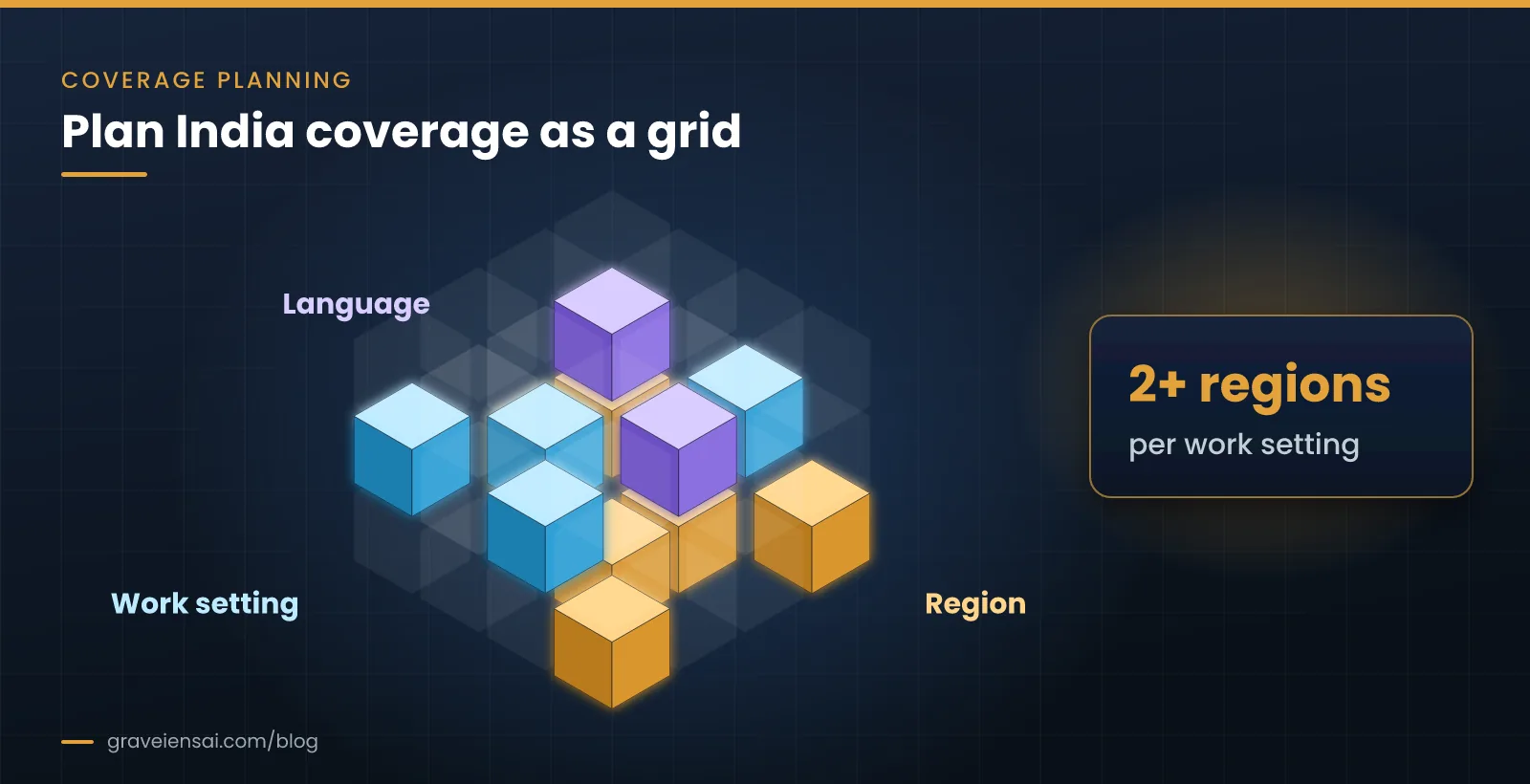
An India program can cover home kitchens, small workshops and manufacturing units, farms, neighborhood shops and warehouses, and each region adds its own layouts, tools and languages. Plan coverage as a grid: pick the settings your model needs, then spread them across two or more regions so the model does not learn one city’s look.
| Region (examples) | Work settings to consider | Narration languages to plan |
|---|---|---|
| North (Delhi NCR, Punjab, Uttar Pradesh) | Home kitchens, small workshops, warehouses near logistics hubs, farms | Hindi, Punjabi, Indian English |
| West (Maharashtra, Gujarat) | Manufacturing units, retail shops, home kitchens | Marathi, Gujarati, Hindi |
| South (Karnataka, Tamil Nadu, Kerala, Telangana, Andhra Pradesh) | Electronics and component workshops, kitchens, farms | Kannada, Tamil, Malayalam, Telugu, Indian English |
| East (West Bengal, Odisha) | Farms, markets, small workshops, home kitchens | Bengali, Odia, Hindi |
Treat the table as a planning starting point, not a census. A good program confirms access site by site, records region and setting in the metadata of every file, and checks coverage weekly against the grid.
Sample coverage plans for three program types
In egocentric data collection India programs, the right grid depends on what the model must learn. The examples below show how three common programs spread the same India capacity in different ways. They are planning patterns, not fixed quotas.
| Program goal | Settings to weight | Region spread | Narration plan |
|---|---|---|---|
| General manipulation pretraining | Home kitchens, cleaning and laundry, small repairs | Three or four regions, many households per region | Free narration in the participant’s language, with step names in English |
| Warehouse and logistics tasks | Picking, packing, sorting and shelf restocking | Two or three logistics hubs, several sites each | Short scripted step names to align with action segments |
| Agriculture and outdoor work | Harvesting, sorting produce, tool handling | Regions chosen by crop calendar, not by city | Regional language narration with a shared glossary of tool names |
Two rules hold across all three. Keep at least two regions per setting, so the model does not learn one city’s appliances or one factory’s layout. And fix the share of each cell before capture starts, so recruitment does not drift toward whichever sites are easiest to book.
How should you plan narration languages?
Plan narration languages by deciding what the model will use speech for: action labels, instructions or multilingual grounding. Then set a quota per language and region, agree the script and transcription rules, and recruit participants who are comfortable narrating in that language. Many participants mix English terms into their speech, so agree how code-switching is transcribed.
- Narration style. Free narration sounds natural; scripted step names are easier to align with action segments.
- Script. Decide native script vs romanized text for transcripts before capture.
- Code-switching. Mixed Hindi-English (Hinglish) and similar speech is normal; tag language spans if your model needs them.
- Audio quality. Busy kitchens and workshops are loud; set a minimum audio standard for narration.
For transcription conventions and dialect quotas, see our Indic speech data collection guide.
Which metadata fields matter most for India programs?
For India programs, the metadata that matters most records where and how each clip was captured: region and city, setting type, site type (home, owner-run shop or factory), narration language and script, session time and lighting, and the consent and site-agreement IDs. These fields let you prove coverage against the grid and rebalance it later.
- Location: state and city or district, never a street address.
- Setting and site type: for example home kitchen, owner-run shop, factory floor or farm.
- Task: task ID from your protocol, plus any deviations the coordinator noted.
- Language: narration language, script used for the transcript and a code-switching flag.
- Conditions: time of day, indoor or outdoor, and a simple lighting rating.
- Consent: participant consent ID, site agreement ID and the bystander steps applied.
Collect only what the model or the audit needs. Data minimisation is a DPDP principle, so leave out personal attributes that do not serve the program, and keep identity data separate from the footage.
Working with site owners in India
Most capture in India happens on someone else’s premises, so site agreements matter as much as participant consent. Each site type needs a slightly different approach.
- Homes. The participant may not be the decision-maker for the household. Agree capture times with the household, and agree which rooms are in scope.
- Owner-run shops and workshops. Get the owner’s written agreement, even when the participant is a family member. Agree what happens when customers walk in.
- Factories and warehouses. Expect safety inductions, protective equipment rules and camera-free zones, such as areas with confidential designs or screens.
- Farms. The land owner and the worker may be different people; both need to agree. Plan around harvest windows and travel time between plots.
Record every site agreement with an ID and link it to the files captured there. Buyers increasingly ask for that link during audits.
What does the DPDP Act mean for egocentric capture in India?
India’s Digital Personal Data Protection Act, 2023, applies when footage can identify people, which head-mounted video often does. The DPDP Rules, 2025, notified in November 2025, phase in over 18 months and require clear, stand-alone notices for consent. For egocentric capture, that means written consent for AI training from participants, permission from site owners and a plan for people in the background.
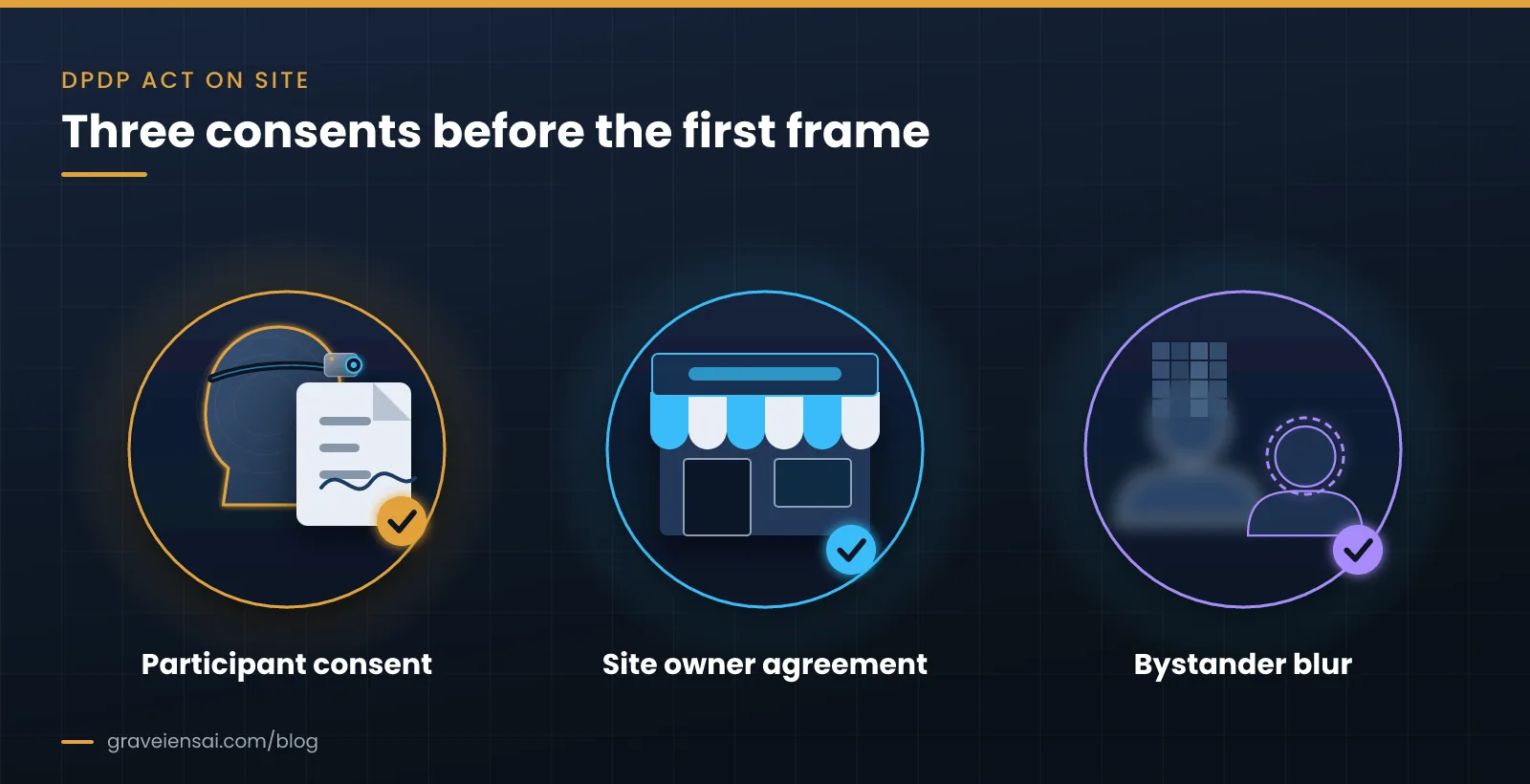
On site in India, the people in the background are usually family members at home, co-workers in a workshop or customers in a shop. A practical bystander plan includes signage or verbal notice at the start of a session, a way for anyone to ask to be left out, capture windows that avoid busy hours, and blurring of faces that did not consent. Our DPDP Act guide for AI training data covers roles, the rules timeline and buyer obligations in detail. This section is general information, not legal advice.
Planning coverage? Ask us for the India coverage planner (regions x settings x languages).
Field realities that shape an India capture schedule
- Heat. Summer heat shortens comfortable session length and makes phones and cameras throttle; plan breaks and spare devices.
- Monsoon. Rain affects outdoor work, farm tasks and travel between sites; schedule outdoor tasks around it.
- Festivals and harvests. Work patterns change around major festivals and harvest periods, which can help or hurt depending on the task.
- Power supply. Short outages still happen in some areas; keep charged batteries and offline storage on site.
- Household norms. Some households prefer a coordinator of the same gender, or capture only at certain times of day. Ask, and plan recruitment around it.
- Small-site permissions. Many workshops and shops are owner-run; get the owner’s written agreement, not just the worker’s.
- Upload bandwidth. Mobile data in smaller towns can be slow for large video files. Plan local backups and scheduled uploads from a hub, rather than live uploads from each site.
- Device travel. Rigs move between cities by courier or with coordinators. Track serial numbers and calibration files per device, so every clip still maps to the right camera.
None of these is a reason to avoid India. They are reasons to write the schedule with local coordinators, who know which weeks and hours work in their region.
The BHARAT fit check for an India program
Score each item from 1 to 5 before you commit budget. Low scores point to planning work, not necessarily to a different country.
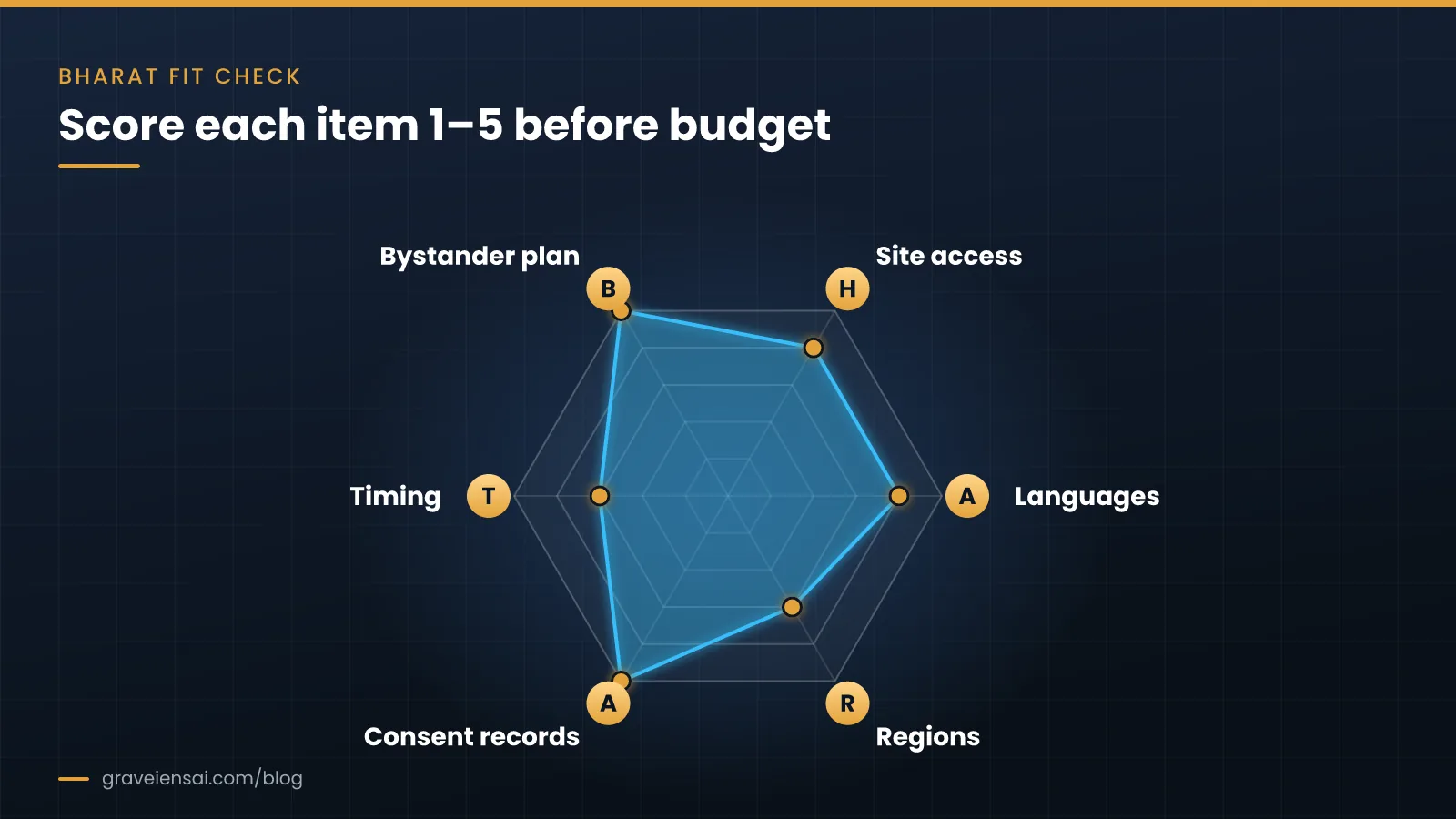
- B: Bystander plan. Notice, opt-out and blurring rules for people in the background are written down.
- H: Home and site access. You know which settings need owner agreements and how they will be recorded.
- A: Accents and languages. Narration languages, scripts and code-switching rules are agreed.
- R: Regions. Coverage spans at least two regions per setting, with metadata to prove it.
- A: Accountable consent records. Every file links to a participant consent record and a site agreement.
- T: Timing. The schedule accounts for heat, monsoon and festival periods.
Once India is in the plan, use the CAPTURES checklist in our vendor guide to compare providers, and the humanoid robot training data guide to place egocentric video alongside teleoperation and simulation.
How Graveiens AI runs egocentric capture in India
Graveiens AI runs egocentric video data collection through an explicit-consent workflow: participant onboarding, recording and capture management, metadata tagging and QA. Participants and site owners consent to AI-training use before any recording, and coordinators brief them on the task protocol and bystander rules in their own language.
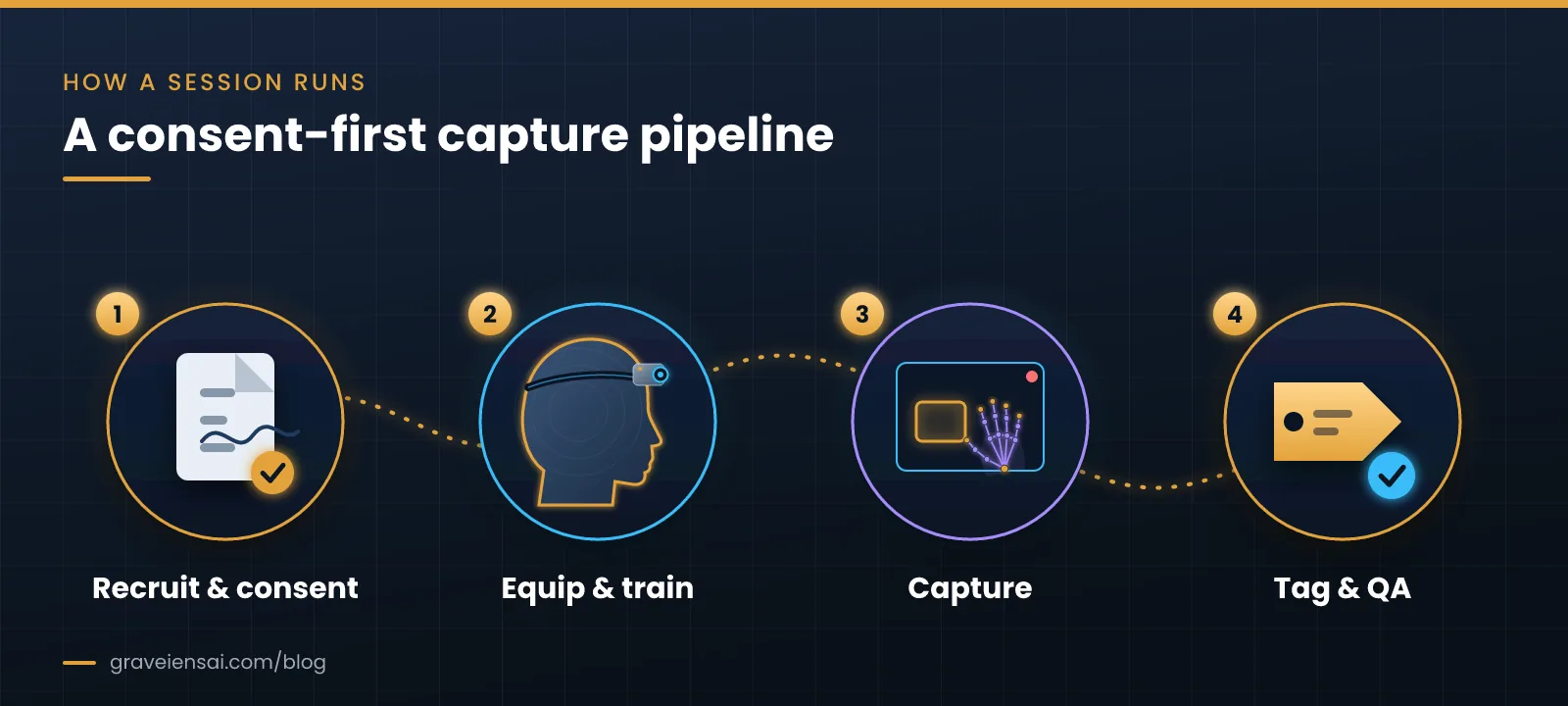
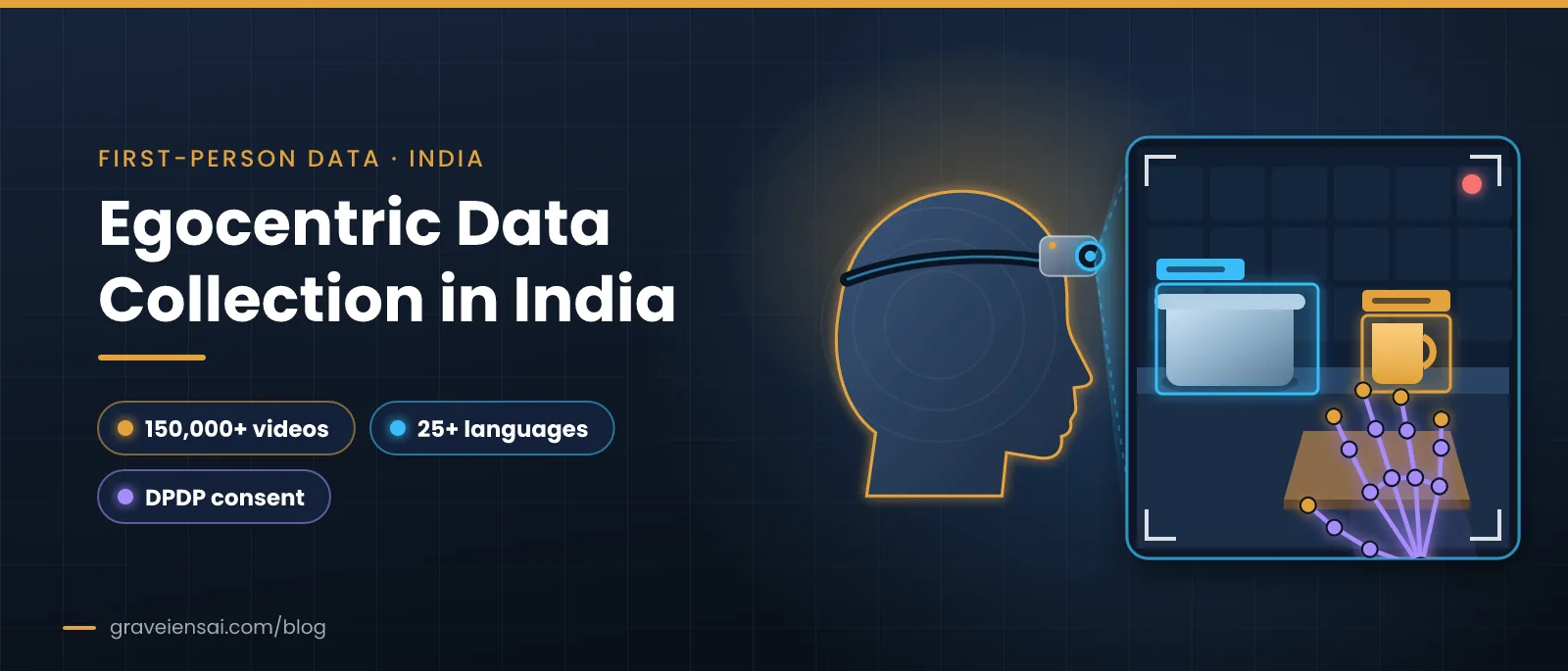
Our network has already captured 150,000+ consent-backed egocentric videos across India’s kitchens, workshops, warehouses, farms and stores, drawing on 500+ industries and businesses. Narration and metadata can be delivered in 25+ languages, with deep Indic coverage. Clients are invoiced only for approved deliverables, and Graveiens AI is ISO 9001 certified.
Frequently asked questions
Why collect egocentric video in India rather than only in the US or EU?
India adds variety that is hard to get elsewhere in one program: different kitchen layouts, tools, workshop setups, farm tasks and many regional languages for narration. Teams often keep some capture in their home market and add India for diversity, then compare acceptance rates and model results across both.
Is egocentric data collection legal in India?
Yes, when it follows the DPDP Act, 2023, and the DPDP Rules, 2025. That means informed, specific consent for AI-training use, clear notice, a way to withdraw, and care for people who appear in the background. Rules phase in over 18 months from November 2025, so build to them now. This is not legal advice.
Which Indian languages can task narration be recorded in?
Narration can be planned in the participant’s own language, such as Hindi, Bengali, Marathi, Tamil, Telugu, Kannada, Malayalam, Gujarati, Punjabi or Odia, plus Indian English. Set a quota per language and region, and agree script and code-switching rules before recruitment.
How do you handle family members or customers who appear in footage?
Use notice at the start of each session, give anyone the option to stay out of frame, schedule capture around busy periods and blur faces of people who did not consent. Record these steps in the session log so the buyer can audit them later.
Which work settings are easiest to start with in India?
Home kitchens and small workshops are often the quickest to set up, because one owner can agree to access. Warehouses, factories and farms need more permissions and scheduling, so many programs prove the spec in simpler settings first and then add harder sites.
What metadata should each India clip carry?
At minimum: state and city, setting and site type, task ID, narration language and script, time of day and lighting, plus the participant consent ID and site agreement ID. Keep identity data separate from footage and collect only the fields the model or the audit needs.
Where can I compare egocentric vendors and pricing?
This guide covers India-specific planning only. For rigs, the CAPTURES vendor checklist, cost drivers and pilot design, see our guide to choosing an egocentric data collection vendor.
Scope an India egocentric pilot
For egocentric data collection India pilots, tell us your tasks, settings, regions and narration languages, and we will come back with a coverage plan. Explore egocentric video data collection or scope a pilot billed only on approved files.
Sources
- Ministry of Electronics and Information Technology, Government of India. The Digital Personal Data Protection Act, 2023. meity.gov.in
- Press Information Bureau, Government of India. “Government notifies DPDP Rules to empower citizens and protect privacy,” 14 November 2025. pib.gov.in
- Ego4D consortium. Egocentric 4D Perception (Ego4D) project site. ego4d-data.org
About the author
Graveiens AI Editorial Team. The team writes from day-to-day work running consent-backed data programs for AI and robotics teams, including first-person video capture, annotation and multilingual voice data.

Jitendra Choubay is the CEO & Founder of Graveiens AI, leading a human-in-the-loop data services team that helps AI builders with data collection, annotation, consent-backed voice data, transcription and LLM fine-tuning. He writes on building better, ethically sourced AI training data.
Get the next Graveiens AI article
Expert notes on AI data, annotation, LLMs and eLearning — no spam, unsubscribe anytime.
Need AI Development? Data Annotation? eLearning?
Talk to Graveiens AI about data collection, annotation, voice data, RLHF/SFT, LLM evaluation and AI training data — invoiced only on approved work.
Contact Graveiens AI