| The Ego4D dataset is a large, openly released egocentric video benchmark: more than 3,670 hours of unscripted, first-person daily-life footage recorded by 931 camera wearers across 74 locations in 9 countries. It was built by an 88-researcher international consortium of 13 universities and Facebook AI Research (now Meta) and released in February 2022. For teams building computer vision, augmented reality, or robotics models, it is the reference point for what first-person perception data looks like at scale, and a useful starting line before you decide whether public data is enough or you need your own. |
This guide explains what is actually inside Ego4D, how its five benchmark tasks are organized, how licensing and access work, and where a research benchmark stops being sufficient for a shipping product. It closes with a simple scoring tool to help you decide between public data and custom collection.
At a glance
| Question | Short answer |
|---|---|
| What is the Ego4D dataset? | An open, large-scale egocentric (first-person) video dataset with 3,670+ hours of daily-life activity and a suite of benchmark tasks. |
| Who built it and when? | An 88-researcher consortium of 13 universities plus Facebook AI Research (Meta), released February 2022. |
| How big is it? | 931 camera wearers, 74 locations, 9 countries; the full-scale download is roughly 7.1 TB. |
| What tasks does it support? | Five benchmarks: Episodic Memory, Hands and Objects, Audio-Visual Diarization, Social Interaction, and Forecasting. |
| Is it free to use? | Free to download after you register, accept the Ego4D License Agreement, and are approved; review the current license for your intended use. |
| Can I train a commercial robot on it directly? | Rarely as-is. It is a research benchmark, not turnkey robot training data, and often needs task-specific custom data collection to close the gap. |
What is the Ego4D dataset?
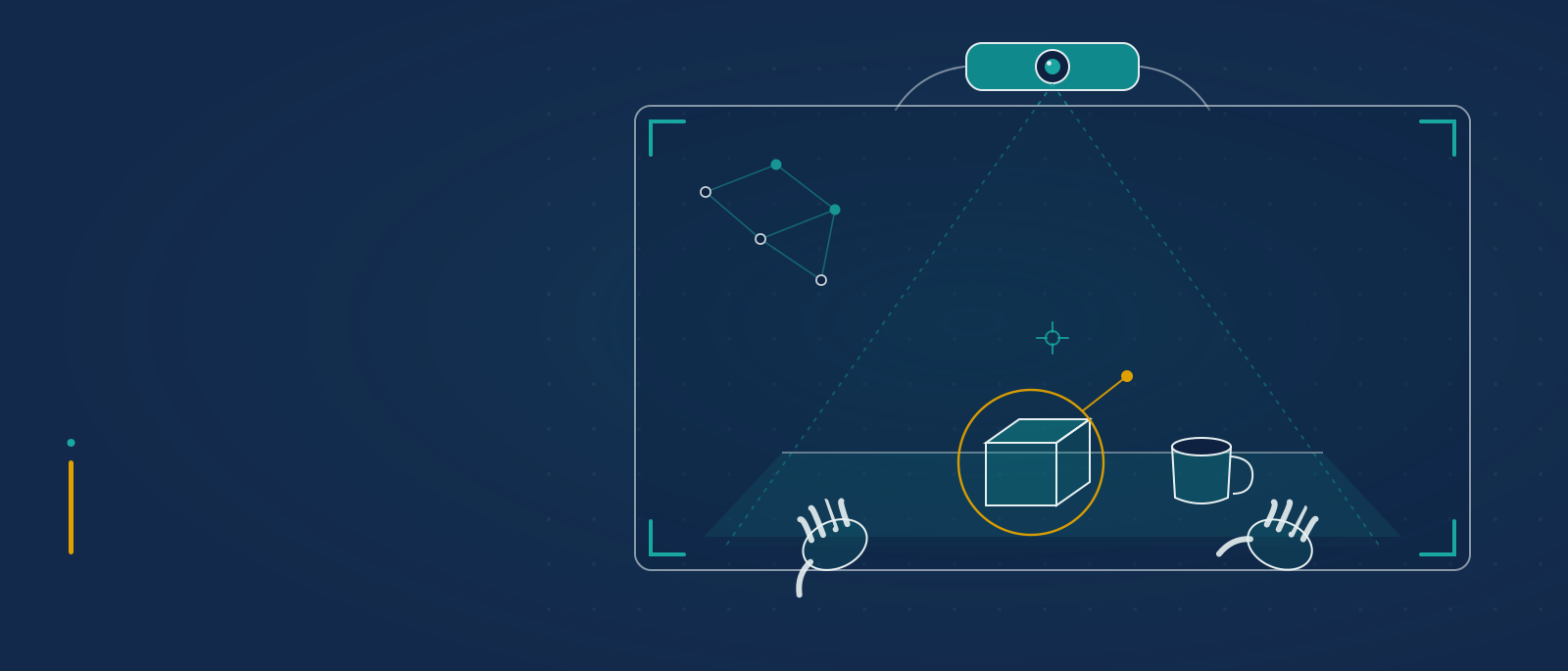
The Ego4D dataset is a collection of first-person video captured by people wearing head-mounted cameras while going about ordinary activities: cooking, cleaning, shopping, working, playing sports, and socializing. “Ego” refers to the egocentric point of view, and “4D” reflects the goal of understanding activity through both space and time. Unlike a third-person or “exocentric” clip filmed by a bystander, egocentric footage shows the world as the wearer sees it, including their hands, the objects they touch, and where their attention moves.
Before Ego4D, most action-recognition research relied on curated web video or small, single-setting collections. Ego4D changed the scale. According to the project, it is more than 20 times larger than any prior egocentric collection in hours of footage, and it was recorded in real homes, workplaces, and streets rather than a lab. That combination of scale and messiness is why it became a standard egocentric video dataset for the field.
What is inside Ego4D
Ego4D is more than raw video. Portions of it carry rich sensor and annotation layers, and the annotations are grouped into five benchmark tasks that map to how humans understand experience across time.
The five Ego4D benchmarks are:
- Episodic Memory: answering questions about the past, such as “where did I leave my keys,” using visual, textual, and moment-based queries.
- Hands and Objects: recognizing how the wearer changes the state of objects, including object detection and state-change moments.
- Audio-Visual Diarization: identifying who spoke, when, and what was said in a scene.
- Social Interaction: understanding attention and conversation, such as who is looking at or talking to the wearer.
- Forecasting: predicting future movement and the next likely action.
Beyond video, parts of the dataset include audio, 3D meshes of the environment, eye gaze, stereo, and synchronized footage from multiple egocentric cameras recording the same event. That multimodal layer is what makes Ego4D valuable for research on perception, memory, and physical AI rather than simple clip classification.
Why Ego4D matters for embodied and physical AI
First-person data is the closest widely available proxy for what a robot or a pair of smart glasses actually sees. A household robot learning to load a dishwasher needs to reason about hands, objects, and sequence from roughly the same viewpoint a person has while doing the task. Egocentric video captures that viewpoint directly, which is why the Ego4D dataset is frequently used to pretrain and benchmark models for imitation learning, activity recognition, and vision-language-action systems. As a source of robot training data, though, it has limits we return to below.
It also lowered the barrier to entry. Any qualified team can study first-person perception without funding a global capture program, which accelerated academic progress and gave companies a shared yardstick. If you are new to the space, our primer on what egocentric video is covers the fundamentals and the wider dataset landscape.
Ego4D vs Ego-Exo4D vs EPIC-KITCHENS vs custom collection
Ego4D is not the only option, and it is not always the right one. The table below compares the main public egocentric benchmarks against purpose-built custom data collection. No single choice wins everywhere; the right pick depends on your task, your hardware, and whether the output is a paper or a product.
| Option | Best for | Scale and scope | Viewpoint | Commercial readiness |
|---|---|---|---|---|
| Ego4D dataset | Broad first-person perception research and pretraining | 3,670+ hrs, 9 countries, many activities | Egocentric only | Research benchmark; verify license for product use |
| Ego-Exo4D | Skilled-task learning needing paired first and third-person views | 1,400+ hrs, 800+ participants, Aria capture | Egocentric plus synchronized exocentric | Research benchmark; released 2023 to 2024 |
| EPIC-KITCHENS-100 | Fine-grained kitchen actions and object interaction | Roughly 100 hrs of unscripted kitchen activity | Egocentric only | Research benchmark; narrow domain |
| Custom data collection | A specific robot, environment, or product task | Sized to your task, hardware, and consent terms | Matched to your device and mounting | Model-ready, consent-backed, license-clear |
The pattern is consistent. Public datasets are excellent for learning general priors and comparing models. When you need footage that matches your exact robot, your exact warehouse, and a license you can ship on, robot training data usually has to be collected for the job.
How to access and license the Ego4D dataset
Access to the dataset is free but gated. You first review and accept the Ego4D License Agreement (hosted at ego4d.dev), either as an individual or on behalf of your institution. After you register, approval typically takes around 48 hours, after which you receive time-limited AWS credentials by email.
Downloading uses the official command-line tool, installed with pip install ego4d, or the code in the facebookresearch/Ego4d GitHub repository. The full-scale dataset is roughly 7.1 TB, so most teams pull only the subsets and annotations they need. Because terms and permitted uses can change, and because the difference between research use and commercial deployment is material, always read the current Ego4D License Agreement for your specific use case rather than assuming a public dataset is free to embed in a product. Data licensing is where many well-meaning projects create legal risk for themselves later, so treat data licensing as a launch-blocking requirement, not an afterthought.
The gap between a research benchmark and production training data
This is the point most guides skip. The Ego4D dataset was designed to advance research, not to train one company’s specific robot. That design goal creates a predictable gap when you move from a benchmark leaderboard to a deployed product.
Three gaps show up again and again. First, task mismatch: Ego4D captures everyday life broadly, so it may contain almost none of the exact manipulation your robot must perform. Second, embodiment mismatch: the camera height, lens, field of view, and mounting in the dataset rarely match your hardware, and a model trained on one viewpoint degrades on another. Third, license and consent mismatch: a research license and the consent basis behind public data may not cover a commercial product, and retrofitting consent is often impossible.
None of this makes Ego4D less valuable. It makes it a starting layer. The mature pattern is to pretrain on public egocentric data, then fine-tune on a smaller, precise, consent-backed dataset that mirrors your deployment. Deciding how much custom data you need is the real question, which the framework below is built to answer.
The Graveiens Ego Data Fit Score
Use this five-factor scoring tool to judge whether the Ego4D dataset (or any public egocentric dataset) is enough on its own, or whether you need custom collection. Score each factor from 1 (poor fit) to 5 (strong fit), then add them up.
| Factor | What to evaluate | Score |
|---|---|---|
| Task fit | Does the dataset contain the exact actions and objects your model must handle? | 1 to 5 |
| Environment fit | Do the scenes match your real deployment settings and lighting? | 1 to 5 |
| Embodiment fit | Do camera height, lens, field of view, and mounting match your hardware? | 1 to 5 |
| Annotation fit | Are the labels you need present, accurate, and at the right granularity? | 1 to 5 |
| License and consent fit | Does the license and consent basis cover your commercial use? | 1 to 5 |
How to read your Ego Data Fit Score:
- 20 to 25: The public dataset likely covers most of your needs. Validate on a held-out sample before committing.
- 13 to 19: Use the public data to pretrain, then commission a targeted custom dataset to close the gaps.
- 5 to 12: Public data is a weak fit. Prioritize custom data collection built to your task, hardware, and license from the start.
The score is deliberately simple so a cross-functional team can agree on it in one meeting. The lowest-scoring factor is usually where your model will fail in the field, so treat it as the priority.
How to build a custom egocentric dataset
When the fit score points to custom data, a disciplined process keeps quality high and cost predictable.
- Define the target task and the exact objects, actions, and outcomes the model must learn.
- Match the capture hardware and mounting to your production device so the viewpoint transfers.
- Recruit representative participants and environments, with documented, informed consent.
- Write a labeling schema with clear action boundaries before a single clip is annotated.
- Run a small pilot, review it, and correct the protocol before scaling.
- Annotate with subject-matter reviewers, then validate against a gold-standard set.
- Deliver model-ready files, measure model performance, and iterate on the weakest slice.
This is the workflow behind Graveiens AI egocentric video data collection, which has already gathered 150,000-plus consent-backed egocentric videos across real Indian work environments for robotics and physical AI teams.
Common mistakes teams make with Ego4D
| Common mistake | Why it happens | Why it matters | How to prevent it |
|---|---|---|---|
| Treating a benchmark score as product readiness | Leaderboards are concrete and motivating | A model that tops an Ego4D task can still fail on your hardware | Test on data captured from your actual device before you trust the number |
| Ignoring the license until launch | The data downloads easily, so terms feel like a formality | A research license discovered late can block a release | Confirm data licensing fits your use case before you build on the data |
| Skipping the annotation schema | Labeling feels like the easy part | Inconsistent action boundaries quietly cap model accuracy | Lock the schema and run a labeled pilot before scaling |
Illustrative examples
Illustrative example one: A warehouse robotics team pretrains a grasping model on Ego4D and Ego-Exo4D, scores well on public benchmarks, then sees accuracy drop on its own low-mounted gripper camera. An Ego Data Fit Score flags a weak embodiment fit. The fix is a focused custom dataset filmed from the robot’s own viewpoint, used to fine-tune the pretrained model.
Illustrative example two: An AR glasses startup wants reliable hand and object recognition in home kitchens. Ego4D and EPIC-KITCHENS give strong general priors, but the product needs a specific set of appliances and gestures. A small, consent-backed collection targeting those exact interactions closes the gap without the cost of collecting everything from scratch. These examples are illustrative and do not represent specific customer results.
Frequently asked questions
What is the Ego4D dataset used for?
It is used to train and benchmark models that understand first-person video, including episodic memory, hand-object interaction, audio-visual diarization, social interaction, and activity forecasting. It is widely used in computer vision, augmented reality, and robotics research as a shared egocentric video dataset.
Is the Ego4D dataset free?
Downloading is free, but access is gated. You must register, accept the Ego4D License Agreement, and be approved, which usually takes about 48 hours, before you receive credentials to download the data.
Can I use Ego4D for commercial products?
Not automatically. The license and the consent basis behind the data govern permitted uses, and the difference between research and commercial deployment is significant. Review the current Ego4D License Agreement for your specific case before shipping anything built on it.
Ego4D vs Ego-Exo4D: what is the difference?
Ego4D captures first-person video only. Ego-Exo4D, released later, adds synchronized third-person (exocentric) views of the same skilled activities, along with richer sensors, which helps models learn tasks from both perspectives.
How large is the Ego4D dataset?
It contains more than 3,670 hours of video from 931 camera wearers across 74 locations in 9 countries. The full-scale download is roughly 7.1 TB, so most teams download only the subsets and annotations they need.
Is the Ego4D dataset enough to train a robot?
Usually not on its own. It is a research benchmark and general pretraining source. Production robots typically need custom robot training data collected from the robot’s own viewpoint and environment to perform reliably.
How do I decide between public data and custom collection?
Score your task, environment, embodiment, annotation, and license fit from 1 to 5 each using the Graveiens Ego Data Fit Score. A high total favors public data; a low total favors custom data collection.
Who created the Ego4D dataset?
It was created by an international consortium of 88 researchers across 13 universities and Facebook AI Research (now Meta), and presented at CVPR 2022.
About the authors
This article was written by the Graveiens AI content team Graveiens AI is a human-in-the-loop data services company that collects, annotates, and reviews training data for AI teams, with subject-matter reviewers rather than raw labelers. Graveiens AI holds [ISO certification: insert exact certification and number, e.g. ISO 9001:2017, once verified]. Learn more on our egocentric video data collection page, or explore our broader data collection services and expert data annotation and labeling.
Conclusion
The Ego4D dataset is the field’s most important open egocentric video benchmark: 3,670-plus hours of real first-person life, five well-defined tasks, and a multimodal foundation that moved research forward. For learning general priors and comparing models, it is hard to beat. For shipping a product, it is a starting layer, not the finish line. The recurring lesson is that a benchmark measures research progress, while a deployed model needs data that matches its exact task, hardware, and license.
If your Ego Data Fit Score points to custom collection, that is where a consent-first partner earns its place. Graveiens AI runs managed egocentric video data collection with documented consent, subject-matter review, and pay-on-approval pricing, so you only pay for accepted hours. To pressure-test whether public data is enough or you need your own, book a pilot and start with a low-risk program.
Sources
- Grauman et al., “Ego4D: Around the World in 3,000 Hours of Egocentric Video,” CVPR 2022. https://arxiv.org/abs/2110.07058
- Ego4D official project site, statistics and benchmarks. https://ego4d-data.org/
- Ego4D documentation, “Start Here” (license and access). https://ego4d-data.org/docs/start-here/
- facebookresearch/Ego4d command-line tool. https://github.com/facebookresearch/Ego4d
- Meta AI, “Introducing Ego-Exo4D.” https://ai.meta.com/blog/ego-exo4d-video-learning-perception/

Jitendra Choubay is the CEO & Founder of Graveiens AI, leading a human-in-the-loop data services team that helps AI builders with data collection, annotation, consent-backed voice data, transcription and LLM fine-tuning. He writes on building better, ethically sourced AI training data.
Get the next Graveiens AI article
Expert notes on AI data, annotation, LLMs and eLearning — no spam, unsubscribe anytime.
Need AI Development? Data Annotation? eLearning?
Talk to Graveiens AI about data collection, annotation, voice data, RLHF/SFT, LLM evaluation and AI training data — invoiced only on approved work.
Contact Graveiens AI