Last updated: October 2026
Key takeaways
- Judge an egocentric data collection vendor on evidence, not decks: an unedited raw sample, calibration files, a sync spec and real consent forms should arrive before you sign a purchase order.
- Match the rig to the robot: a head-mounted phone covers most RGB volume, while stereo, depth or a custom rig matched to your robot’s camera field of view is worth paying for only when your model needs it.
- Buy accepted hours, not recorded hours: pricing per accepted hour moves the cost of rejected footage to the vendor and makes your real cost predictable.
- Write acceptance criteria before capture starts: most disputes in egocentric programs come from criteria that were agreed after footage was already recorded.
- Start with a 25 to 100 hour pilot billed on approved hours, then scale with daily uploads and rolling QA.
Choosing an egocentric data collection vendor is now a core sourcing decision for robotics and embodied AI teams. First-person video is cheap to record and expensive to get right. The wrong rig, a missing calibration file or a consent gap can make hundreds of hours unusable for training.
This buyer’s guide is for robotics, physical AI and computer vision leads who need humanoid robot training data or other first-person video at scale. You will get a capture rig comparison, the eight-point CAPTURES vendor checklist, a cost-driver table that explains what moves egocentric video cost per hour, a pilot plan, RFQ questions and the red flags we see most often.
Want to see what good looks like first? Request a sample clip set straight off our rigs, with the calibration files attached.
What does an egocentric data collection vendor do?
An egocentric data collection vendor recruits and consents participants, equips them with head-mounted or wearable cameras, captures first-person video of real tasks in real environments, and delivers QA-checked, metadata-tagged footage to your spec. Good vendors also handle facility permissions, bystander privacy, sensor calibration, synchronization and optional annotation.
In short: the vendor turns your capture spec into accepted hours of training data. Recording is the easy part. The work sits in the operations around it.
A full-service vendor typically owns six jobs:
- Recruitment and consent. Finding participants and the businesses or households where they work, then collecting written consent from both.
- Device logistics. Shipping, charging, tracking, replacing and retrieving rigs across many sites.
- Calibration and sync. Logging camera intrinsics and lens distortion per device, and keeping video, audio and IMU streams on one clock.
- Capture management. Training participants on your task protocol and supervising sessions on site or remotely.
- Metadata and QA. Tagging each file with task, environment and device data, then checking it against acceptance criteria.
- Delivery and annotation. Packaging files in your format, with optional hand pose, action segments or object tags.
If you are new to the format, our primer on what egocentric video is and how it is used covers the basics. Research datasets show what this looks like at scale. Ego4D, for example, holds 3,670 hours of daily-life video from 923 participants in 74 locations across 9 countries, according to the Ego4D project site. Public data like this is a starting layer. Our guide to the Ego4D dataset and when you need custom data explains where it stops fitting a commercial robot.
Which capture rig should your vendor use?
Pick the cheapest rig that still records the signal your model needs. Head-mounted smartphones suit high-volume RGB capture. Action cameras suit harsh or low-light sites. Stereo and depth rigs suit 3D tasks. VR headsets add rough hand tracking. Custom rigs match a robot’s own camera field of view.
For head-mounted camera data collection, the rig decides more of your budget and your data quality than almost any other choice. It sets resolution, field of view, distortion, sensor streams and how long a participant can comfortably record. Ask every egocentric data collection vendor which device families they run in production today, not which ones they could source.
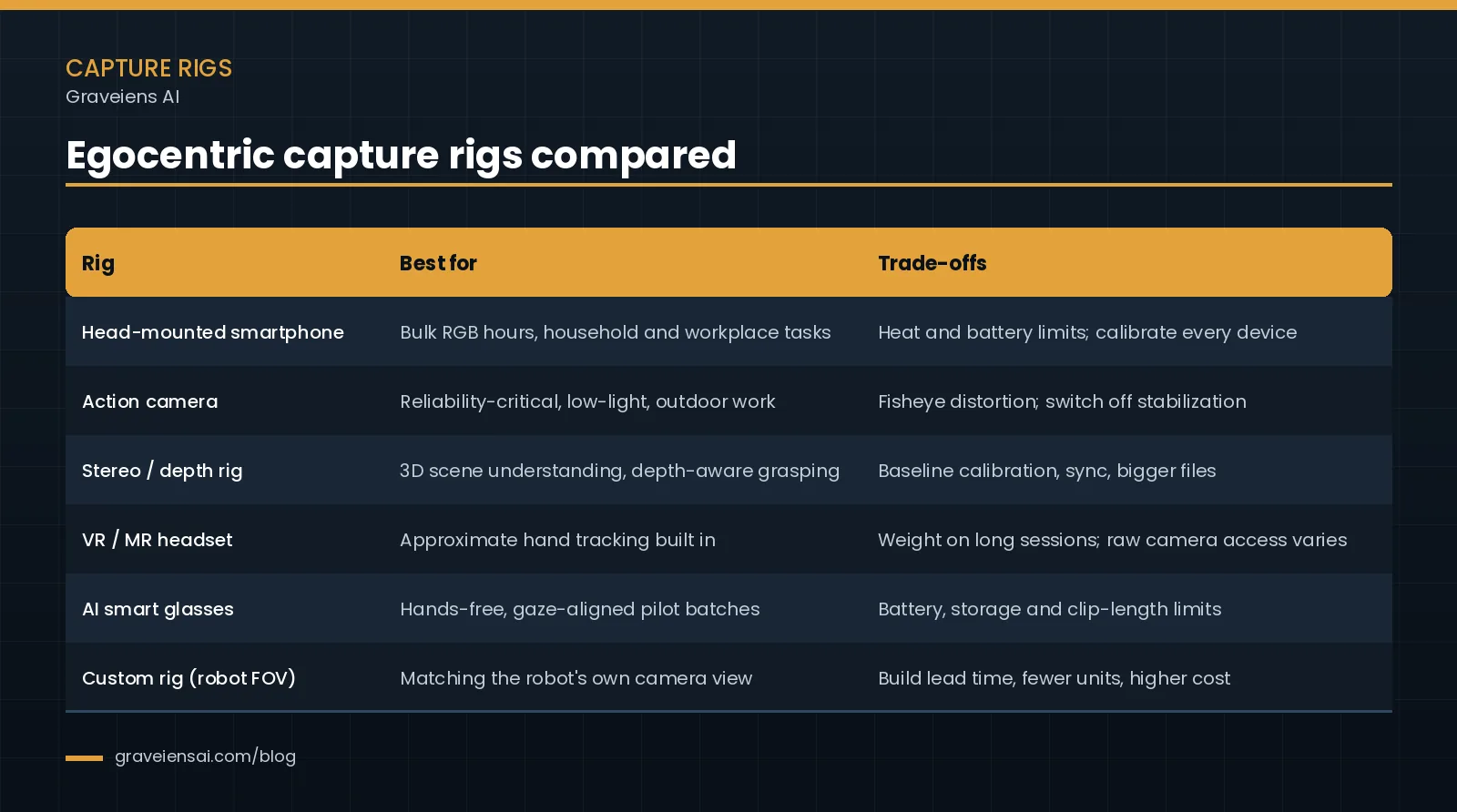
| Rig | Best for | Trade-offs |
|---|---|---|
| Head-mounted smartphone | Bulk RGB hours for household and workplace tasks; usually the lowest cost per hour | Heat and battery limits on long sessions; each phone needs its own calibration file |
| Action camera | Reliability-critical, outdoor or low-light work where footage quality drives review | Wide fisheye lenses need distortion calibration; electronic stabilization must be switched off for geometry-sensitive use |
| Stereo or depth rig | 3D scene understanding, depth-aware grasping, stereo egocentric video | Baseline calibration, tight frame sync, heavier rigs and much larger files |
| VR or mixed-reality headset | Approximate hand tracking without separate pose annotation | Weight and comfort limit session length; raw camera access varies by device |
| AI smart glasses | Hands-free, gaze-aligned capture for pilot batches | Battery, storage and clip-length limits; smaller fleets |
| Custom rig matched to robot FOV | Embodiment matching, when your robot’s camera height, lens and mounting must be mirrored | Build lead time, fewer units and a higher cost per hour |
Device diversity versus device consistency
There is a real tension here. Ego4D deliberately used seven different off-the-shelf head-mounted cameras so that models would not overfit to a single capture device, per the project’s own FAQ. A robotics team fine-tuning one policy for one robot often wants the opposite: one rig, one lens and one mounting height. Decide which you need before you request quotes, because it changes the fleet, the calibration workload and the price.
Sensor streams beyond RGB
An egocentric dataset for robotics now often carries more than video. Ego-Exo4D pairs its 1,286 hours of video with multichannel audio, eye gaze, 3D point clouds, camera poses and IMU data, according to the Ego-Exo4D paper. Each extra stream is useful only if it is synchronized and calibrated. An IMU on its own clock is noise, not signal.
How to evaluate an egocentric data collection vendor: the CAPTURES checklist
Evaluate an egocentric data collection vendor with eight checks: consent records, acceptance criteria, a paid pilot, a time-sync spec, an unedited raw sample, rig calibration files, enforceable legal compliance and privacy screening. A vendor that cannot show all eight before the purchase order is asking you to carry the risk.
We built CAPTURES from the questions buyers’ legal, ML and procurement teams ask us most often. Use it as a scorecard in vendor calls.
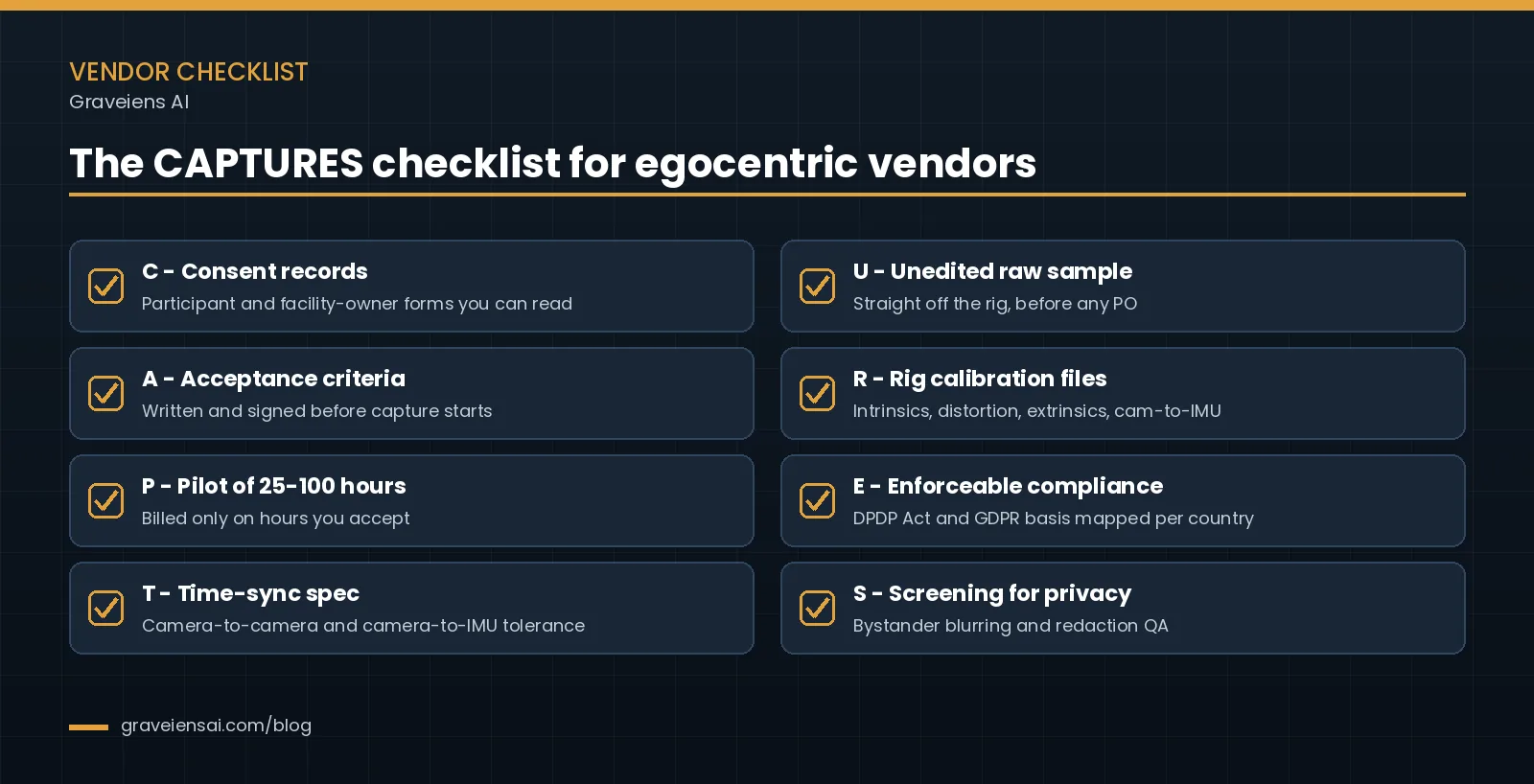
- C: Consent records. Ask for the actual participant consent form and the facility-owner agreement. Both should name AI training as the purpose, explain withdrawal and cover bystander protocols on site.
- A: Acceptance criteria before capture. Agree in writing what makes a clip acceptable: minimum duration, hands in frame, lighting, blur limits, task completion and metadata fields. Criteria written after recording invite disputes.
- P: Pilot of 25 to 100 hours. Large enough to expose real failure modes, small enough to walk away from. It should be billed on accepted hours only.
- T: Time-sync spec. Get the stated tolerance for camera-to-camera and camera-to-IMU sync, and how it is achieved: hardware trigger, shared clock or post-hoc alignment.
- U: Unedited raw sample. Request clips straight off the rig, not a highlight reel. Raw files show dropped frames, exposure swings and real hand visibility.
- R: Rig calibration files. Expect intrinsics and distortion for every device, plus extrinsics and baseline for stereo and camera-to-IMU transforms where an IMU is used.
- E: Enforceable compliance. The vendor should map its consent and storage to the laws that apply in each capture country, such as India’s DPDP Act and the EU GDPR.
- S: Screening for privacy. Ask how faces of bystanders, screens and documents are blurred, who reviews the redaction and what the rework rule is.
What the law expects from consent
India’s Digital Personal Data Protection Act was enacted on 11 August 2023. The DPDP Rules, 2025 were notified in November 2025 with an 18-month phased compliance timeline. They require standalone consent notices that explain the specific purpose of collection, per the Government of India release of 14 November 2025. As of October 2026 that window is still running, so build to the Rules now rather than later.
For capture involving people in the EU, the General Data Protection Regulation (EU) 2016/679 requires a lawful basis for processing. Where that basis is consent, the controller must be able to demonstrate it (Article 7(1)) and the person can withdraw it at any time (Article 7(3)). In practice, that means per-file consent records and a way to pull a participant’s footage on request.
Want the checklist as a working document? Ask us for the CAPTURES checklist and RFQ template, and we will send the version our team uses on scoping calls.
What drives egocentric video cost per hour?
Egocentric video cost per hour is driven mainly by rig type, sensor sync and calibration needs, environment access, the number of countries and participant quotas, the annotation layer and the QA acceptance rate. Resolution, task scripting, consent work and delivery format add smaller amounts. Volume spreads fixed setup costs.
No reputable egocentric data collection vendor can give a firm price before seeing the full spec, and we do not publish rates for that reason. What you can do is understand which levers move the number, then decide which ones your model truly needs.
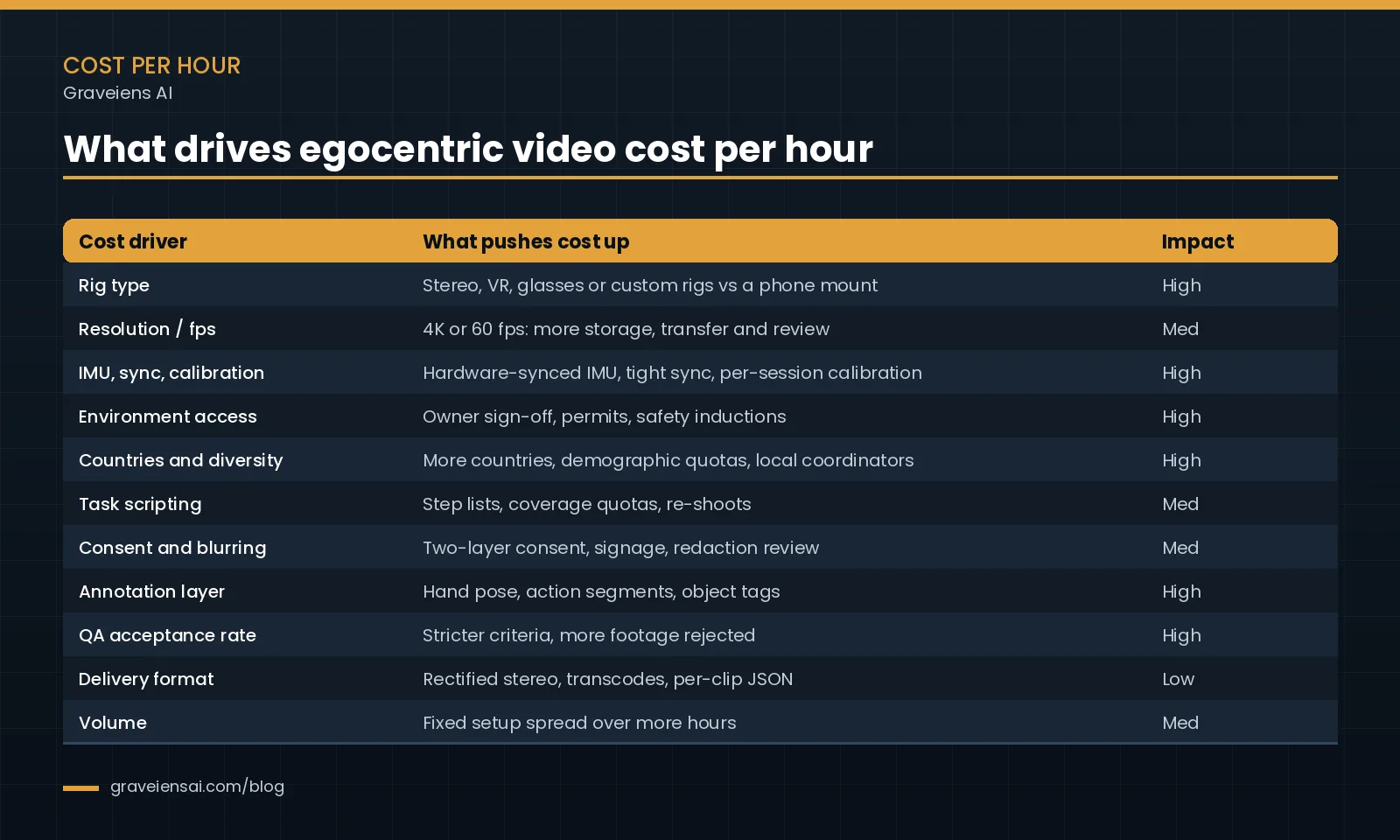
| Cost driver | What pushes cost up | Impact |
|---|---|---|
| Rig type | Stereo or depth rigs, VR headsets, smart glasses or a custom rig matched to the robot camera FOV, compared with a smartphone head-mount or action cam | High |
| Resolution and fps | 4K or 60 fps capture increases storage, upload time and review effort | Med |
| IMU, sync and calibration | Hardware-synced IMU, tight multi-camera sync and per-session calibration checks | High |
| Environment access and permits | Factories, farms, kitchens and retail floors need owner sign-off, site visits and safety inductions | High |
| Countries and participant diversity | Each added country brings local coordinators, legal review and demographic quotas | High |
| Task scripting | Step-by-step scripts, coverage quotas per task and re-shoots for missed steps | Med |
| Consent and bystander blurring | Participant plus facility consent, signage and face or screen redaction review | Med |
| Annotation layer | Hand pose, action segments with start and end times, object tags or narration | High |
| QA acceptance rate | Stricter criteria mean more footage is rejected and absorbed in the price | High |
| Delivery format | Rectified stereo, custom containers, transcodes and per-clip JSON metadata | Low |
| Volume | Small batches carry the full setup cost; larger programs spread it across more hours | Med |
Per accepted hour versus per recorded hour
A recorded hour is any hour of footage that came off a rig. A delivered hour is what remains after trimming and packaging. An accepted hour is footage that passed your written acceptance criteria. Only the last one trains your model.
When a vendor prices per recorded hour, you pay for blurred clips, missed steps and sessions where the hands left the frame. Your effective cost is the recorded-hour rate divided by the share of footage you accept. As a simple illustration, if you accept 70 of every 100 recorded hours, each usable hour costs about 1.4 times the quoted rate.
Pricing per accepted hour reverses that. The vendor absorbs rejected footage, so the unit price may look higher at first, but your budget stops moving with quality swings. It also aligns incentives: the vendor earns more only by capturing clean footage the first time.
Where buyers overspend
- Stereo by default. If your policy trains on monocular RGB, stereo egocentric video adds cost and file size without adding signal.
- Dense annotation too early. Collect and accept the footage first, then annotate a sample to see which labels change model behavior.
- Too many countries in the pilot. Prove the spec in one or two locations, then add diversity once acceptance rates are stable.
How should an egocentric pilot run?
A good egocentric pilot runs in five steps: lock the spec, review an unedited raw sample with calibration files, capture 25 to 100 hours billed only on accepted hours, review rejects and tighten the spec, then scale with daily uploads and rolling QA. Each step has a clear exit decision.
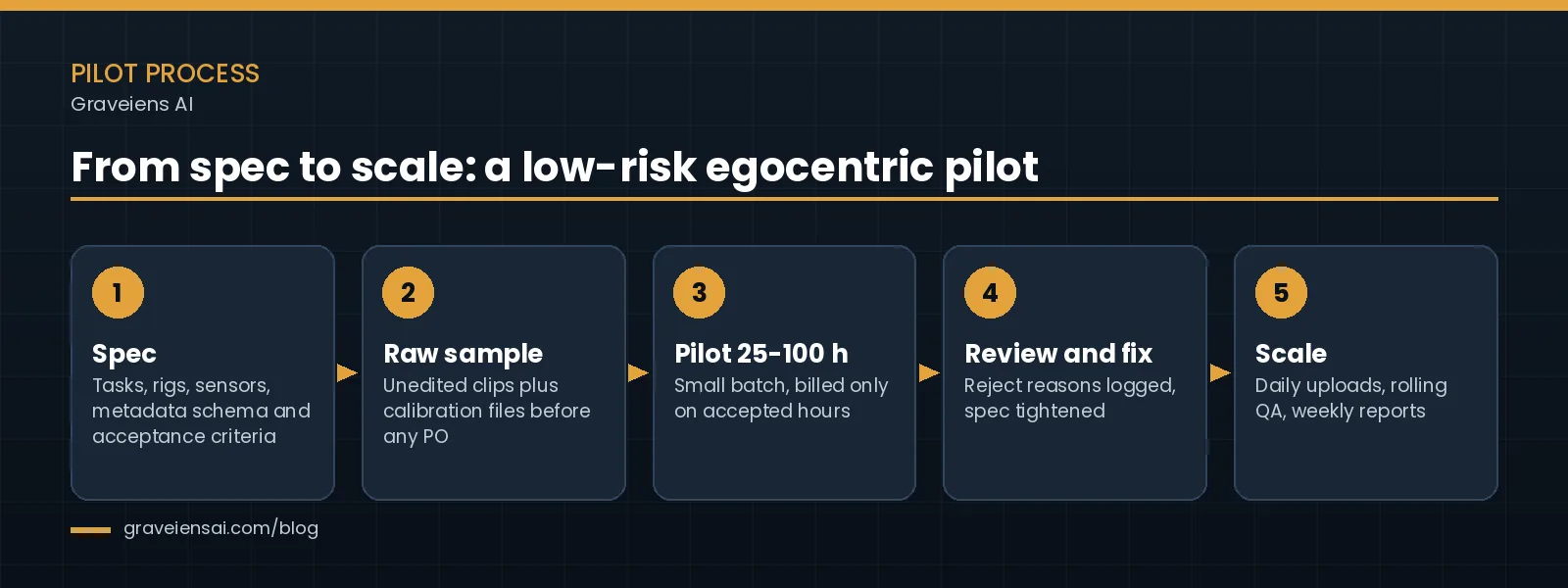
- Spec. Define tasks, environments, rig, resolution and frame rate, sensor streams, metadata schema and acceptance criteria. Include narration language if you need spoken task descriptions.
- Raw sample. Review unedited clips from the exact rig you will use, with its calibration file. Check hand visibility, blur and exposure on your own tooling.
- Pilot of 25 to 100 hours. Run a small batch across a few sites. Ask for per-file QA status and reasons for every rejected clip.
- Review and fix. Sort rejects by cause. Most issues trace back to mounting height, lighting or vague task steps, and each one becomes a spec change.
- Scale. Move to daily uploads with rolling QA and a weekly report on accepted hours, rejects and coverage by task and environment.
Daily uploads matter more than they sound. They let your ML team spot drift within days, not after a month of footage has piled up. Any egocentric data collection vendor that is confident in its operations should accept these terms.
What questions should you ask in an RFQ?
A strong RFQ asks each egocentric data collection vendor to prove capability in writing: device families in production, calibration and sync methods, consent templates, acceptance criteria, QA process, legal basis per country, capacity per week and pricing unit. Ask for a raw sample with every response so you compare footage, not promises.
- Which device families do you run in production today, and how many units of each?
- Can you share an unedited raw clip and its calibration file from the rig you propose?
- How do you synchronize video, audio and IMU, and what tolerance do you guarantee?
- Do you disable electronic stabilization and other in-camera processing on request?
- Can we see your participant consent form and your facility-owner agreement?
- How do you handle bystanders, screens and documents in frame?
- Which laws apply in each proposed capture country, and how does your consent map to them?
- Do you price per recorded, delivered or accepted hour? How are acceptance criteria agreed?
- What weekly capacity can you commit to, and what happens if you miss it?
- What metadata ships with each file, and in what format?
- Can you add annotation layers such as hand pose, action segments or object tags?
- Who owns the footage and what license do we receive for model training?
Red flags when choosing an egocentric data collection vendor
Walk away, or at least slow down, if you see any of these:
- Edited sizzle reels only. Polished clips hide dropped frames, blur and exposure swings.
- No calibration files. Without intrinsics and distortion, geometry-dependent models cannot use the footage properly.
- Vague sync answers. “We align it later” with no stated tolerance usually means misaligned IMU and video.
- Consent forms “available after signing”. Your legal team should review them before any contract.
- Pricing per recorded hour with no written acceptance criteria. You carry all the quality risk.
- No bystander protocol. Workplaces and public spaces always contain people who did not sign up.
- Unlimited capacity claims. Real capacity is bounded by rigs, coordinators and sites. Ask for numbers per week.
- Unclear data rights. If the license for model training is not written down, assume it does not exist.
How Graveiens AI runs egocentric programs
As an egocentric data collection vendor, Graveiens AI runs managed egocentric video data collection built around explicit consent and pay-for-approved-deliverables billing. The workflow has four stages, and each one maps to a CAPTURES check.
- Participant onboarding. Participants and facility owners sign explicit consent for AI training use. Coordinators brief them on the task protocol and on-site bystander rules in their own language.
- Capture management. We match the device to the spec from multiple device families, including head-mounted smartphone rigs, action cameras, stereo and depth rigs, VR headsets, AI smart glasses and custom rigs built to a robot’s camera field of view. Calibration is logged per device and session.
- Metadata tagging. Every file carries task, environment, device and session metadata to your schema, with narration in 25+ languages where needed.
- QA. Footage is checked against acceptance criteria agreed before capture. You are invoiced only for the hours you approve.
Our capture network covers industrial sites, agricultural work, households, retail floors and kitchens. When a program needs labels, our data annotation team adds hand pose, action segments or object tags under the same QA process. Teams that also need robot-side demonstrations can read how teleoperated demonstrations complement first-person video.
Graveiens AI is ISO 9001 certified. We do not quote prices before we see a full spec, because rig, sensors, sites and acceptance criteria change the number. Send the spec and we will scope it honestly, including what we would leave out.
How much does egocentric video data cost per hour?
There is no single market rate. Cost per accepted hour depends on rig type, sensor sync and calibration, environment access, countries, annotation and the acceptance rate. A smartphone head-mount capturing plain RGB in one country sits at the low end. Stereo, multi-country or annotated programs cost more. Ask vendors to quote per accepted hour against a written spec.
What is the difference between per recorded hour and per accepted hour?
Per recorded hour means you pay for all footage captured, including clips that fail quality checks. Per accepted hour means you pay only for footage that passes acceptance criteria agreed before capture. Accepted-hour pricing moves the cost of rejected footage to the vendor and makes your real cost per usable hour predictable.
How many hours should an egocentric data pilot be?
Most teams start with 25 to 100 hours. That is enough to surface real failure modes such as mounting height, lighting, hand visibility and task coverage, while keeping spend small. Run it across a few sites, require reasons for every rejected clip and bill only on accepted hours. Scale once acceptance rates hold steady.
Which camera is best for humanoid robot training data?
It depends on the policy you are training. For broad manipulation pretraining, head-mounted smartphone or action-camera RGB at scale is usually enough. For embodiment matching, a custom rig that mirrors the robot’s own camera height, lens and field of view is better. Add depth or stereo only if your model uses 3D input.
Do I need stereo egocentric video?
Only if your model consumes depth or stereo input, or you need 3D scene reconstruction. Stereo rigs need baseline calibration and tight frame sync, and they produce much larger files, so they cost more per accepted hour. Many teams pilot in monocular RGB first, then add a stereo slice for tasks where depth clearly matters.
What consent is needed for head-mounted camera data collection?
You need written consent from each participant for AI training use, plus agreement from the owner of any workplace or premises used. Sites should follow bystander protocols such as signage and exclusion zones, with blurring of non-consenting faces. Map consent to local law, such as India’s DPDP Act and the EU GDPR, in each capture country.
Can an egocentric data collection vendor also annotate the footage?
Many can, and keeping both under one QA process reduces handoffs. Common layers are action segments with start and end times, hand pose, object tags and narration. Collect and accept footage first, then annotate a sample to confirm which labels actually help your model before committing to dense annotation across the full dataset.
Scope your egocentric pilot
See the footage before you commit. Request a sample clip set with calibration files, or scope a 25 to 100 hour pilot billed only on approved hours. Share your tasks, environments and rig needs, and our team will come back with a scoped plan for your first-person video dataset.
Sources
- Ego4D consortium, “Egocentric 4D Perception (Ego4D)” project site and FAQ (accessed October 2026). https://ego4d-data.org/
- Grauman et al., “Ego-Exo4D: Understanding Skilled Human Activity from First- and Third-Person Perspectives,” arXiv:2311.18259 (v4, September 2024). https://arxiv.org/abs/2311.18259
- Press Information Bureau, Government of India, “Government notifies DPDP Rules to empower citizens and protect privacy,” 14 November 2025. https://www.pib.gov.in/PressReleasePage.aspx?PRID=2190014
- Regulation (EU) 2016/679 (General Data Protection Regulation), EUR-Lex. https://eur-lex.europa.eu/eli/reg/2016/679/oj
About the author
Graveiens AI Editorial Team. The Graveiens AI Editorial Team writes from day-to-day work running consent-backed data programs for AI and robotics teams, including first-person video capture, annotation and multilingual voice data. Our guides focus on the operational detail buyers need: rigs, consent, QA gates, file formats and how pricing is built.

Jitendra Choubay is the CEO & Founder of Graveiens AI, leading a human-in-the-loop data services team that helps AI builders with data collection, annotation, consent-backed voice data, transcription and LLM fine-tuning. He writes on building better, ethically sourced AI training data.
Get the next Graveiens AI article
Expert notes on AI data, annotation, LLMs and eLearning — no spam, unsubscribe anytime.
Need AI Development? Data Annotation? eLearning?
Talk to Graveiens AI about data collection, annotation, voice data, RLHF/SFT, LLM evaluation and AI training data — invoiced only on approved work.
Contact Graveiens AI