Teleoperation is the real-time operation of a machine or robot by a human from a distance, using controls, sensors, and feedback to act as if the operator were physically present. In one sentence: a person moves, the robot moves, and the work gets done somewhere the person is not. This guide explains what it means, the main types, how the leading approaches compare, how to choose one, and why teleoperated demonstrations have quietly become one of the most valuable fuels for training modern robots.
You will get a plain-English definition, a comparison table you can cite, an original decision framework, a practical selection checklist, worked examples, and clear answers to the questions people actually ask.
At a glance
| Question | Direct answer |
|---|---|
| What is teleoperation? | Real-time human control of a robot or machine from a distance, with sensory feedback to guide the operator. |
| What is the teleoperation robotics meaning? | In robotics, it is a control mode where a human, not an onboard policy, decides the robot’s actions moment to moment. |
| Who invented it? | Raymond Goertz built the first master-slave manipulator at Argonne National Laboratory around 1948 to 1949. |
| Why does it matter now? | Human-guided demonstrations are a leading way to collect the training data that teaches robots new manipulation skills. |
| Key modern example | Stanford’s Mobile ALOHA, a roughly $32,000 whole-body teleoperation rig, showed co-training gains of up to 95% on some tasks. |
| How do I choose an approach? | Match the control mode to your latency, feedback needs, task complexity, and data goals (see the selection checklist below). |
Table of contents
1. What is teleoperation?
2. Teleoperation, telerobotics, and remote robot control
3. A short history of teleoperated systems
4. Types of teleoperation
5. Comparison table: the main teleoperation approaches
6. When each approach wins
7. How to choose a robot teleoperation setup: a checklist
8. The 5C Teleoperation Data Framework
9. Worked examples
10. The data behind good teleoperation
11. FAQ
12. About the authors
13. Conclusion
14. Sources
What is teleoperation?
Teleoperation is the direct, real-time control of a robot or machine by a human operator located somewhere else, linked by a communication channel that carries commands one way and feedback the other. The word joins the Greek “tele” (distant) with “operation,” so it literally means operating at a distance. Put simply, a teleoperated robot extends human skill across distance, which is why robot teleoperation appears anywhere the work is too far, too small, or too dangerous for hands-on control.
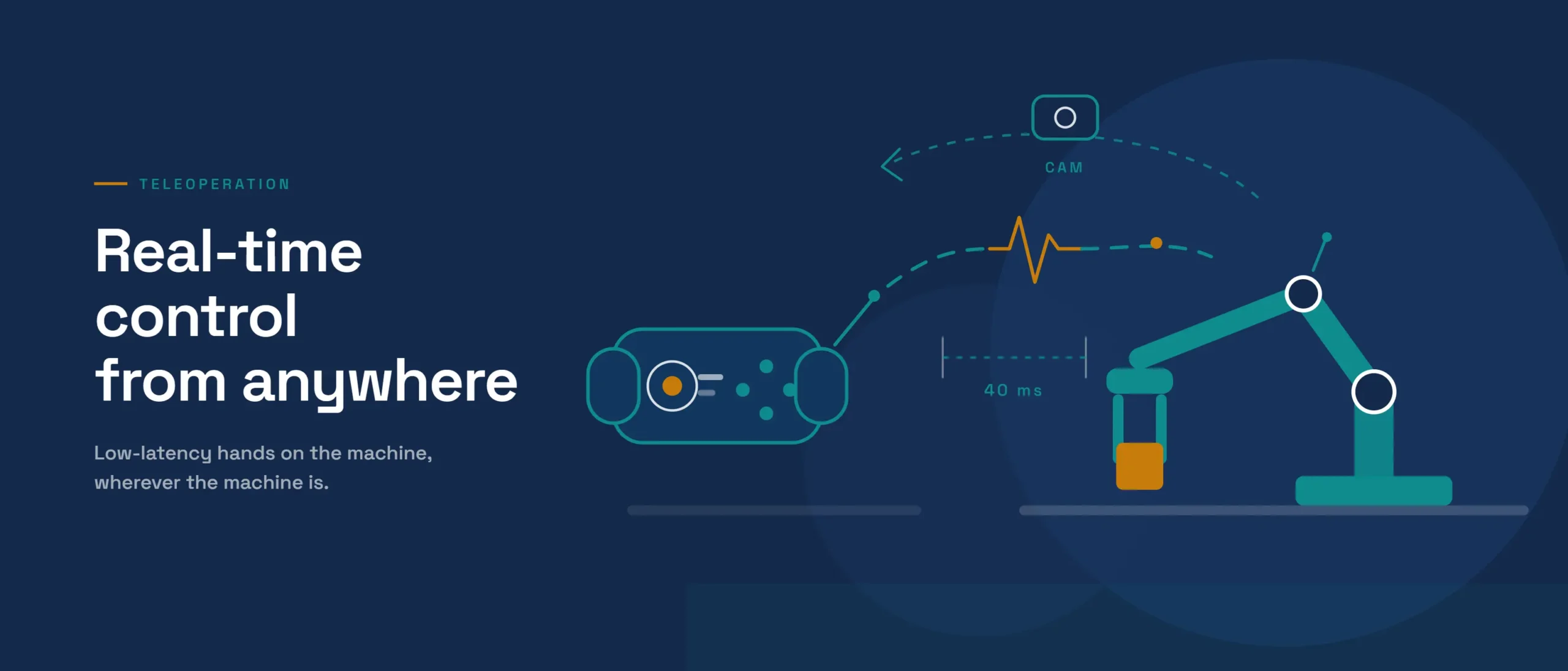
A useful mental model is a loop. The operator sees, hears, or feels what the robot senses, decides what to do, and sends a movement command. The robot executes it, the world changes, and fresh feedback returns to the operator. When that loop runs fast enough, the human feels present inside the machine. This sense of “being there” is called telepresence, and it is the quality that separates a smooth teleoperated robot from a frustrating one.
This control mode sits between two extremes. On one side is a fully manual machine, where a human is physically in the loop and on site. On the other side is full autonomy, where an onboard policy makes every decision. In a teleoperated robot, the human still makes the decisions, but the body doing the work is remote. That single design choice, keeping a person in command while moving the hands far away, is what unlocks dangerous, distant, and delicate jobs that neither pure automation nor bare human hands can safely do.
Teleoperation, telerobotics, and remote robot control
The terms overlap, but they are not identical. Telerobotics is the broader field that studies remote-controlled robots and the human factors, control theory, and interfaces behind them; teleoperation is the act of controlling one. Remote robot control is the everyday phrase for the same idea, and robot teleoperation is simply the same principle applied specifically to robots rather than to, say, a remote crane or a drone.
For clarity across this guide: when we say teleoperation we mean a human commanding a machine in real time from a distance. When we say telerobotics we mean the discipline around it. And when we describe a teleoperated robot, we mean the physical system on the receiving end of those commands. Keeping the vocabulary straight matters because buyers, researchers, and vendors often use these words loosely, which makes it hard to compare systems fairly.
A short history of teleoperated systems
Modern teleoperation began with a safety problem, not a robotics dream. In the late 1940s, engineer Raymond Goertz at Argonne National Laboratory needed to handle radioactive material without standing next to it. Around 1948 to 1949 he designed the first mechanical master-slave manipulator, a pair of linked arms where moving the master arm behind a shielded wall moved a slave arm in the hot cell, with force transmitted back through cables so the operator could feel the load. Goertz later filed a foundational patent for the bilateral manipulator, and the master-slave principle he established still underpins remote handling today.
The theory matured through the second half of the twentieth century. At the Massachusetts Institute of Technology, Thomas Sheridan and William Ferrell developed the ideas of supervisory control and telepresence, and Sheridan’s 1992 book “Telerobotics, Automation, and Human Supervisory Control” remains a standard reference. Their central insight was that a human need not micromanage every joint; the operator can supervise while the machine handles the fast, local details. This supervisory principle remains foundational to modern telerobotics.
Teleoperation then spread wherever people could not safely go: subsea remotely operated vehicles for offshore inspection, robotic arms in space such as the Space Shuttle’s Canadarm, and bomb-disposal robots for explosive ordnance disposal. Perhaps the most striking milestone came in medicine. On September 7, 2001, Professor Jacques Marescaux and his team performed the “Lindbergh Operation,” a remote gallbladder removal on a patient in Strasbourg, France, controlled by surgeons in New York. The team reported a mean signal time delay of about 155 milliseconds, low enough to operate safely across the Atlantic. That lineage is now routine at scale: according to Intuitive Surgical’s reported figures, surgeons performed about 3.15 million procedures with teleoperated da Vinci systems in 2025, roughly 18% more than the year before.
Types of teleoperation
There is no single kind of remote robot control. The right label depends on how much the human does, how much feedback returns, and how the delay is handled. The main types are direct control, bilateral (haptic) control, supervisory control, shared or traded control, and immersive telepresence. In telerobotics, these categories are less rival products than points on a spectrum that runs from full human control to full autonomy.
Direct (manual) teleoperation
The operator commands the robot’s motion continuously and in real time, often with a joystick, a game controller, or a leader arm that the follower robot mirrors. It is intuitive and precise, but it demands low latency and a fully engaged human.
Bilateral control with haptic feedback
Here forces flow both ways. The operator not only moves the robot but also feels the contact forces the robot encounters, through a haptic device. Bilateral control is what makes delicate tasks, such as surgery or assembling small parts, feel natural. It is also the hardest to stabilize when there is communication delay.
Supervisory control
The human sets goals or high-level commands and the robot executes the fine motion on its own, reporting back. This is the standard for high-latency links, such as commanding a rover on another planet, where round-trip delay makes direct control impossible.
Shared and traded control
Autonomy and the human blend. In shared control, the robot corrects or assists the operator’s inputs in real time (for example, avoiding a collision). In traded control, authority passes back and forth: the robot handles routine motion, and the human takes over for the hard parts.
Immersive telepresence
Using virtual reality headsets and motion tracking, the operator’s own body movements drive the robot, and the robot’s cameras and microphones feed back an “as if there” experience. This is increasingly used to drive teleoperated robots in humanoid form for large-scale data collection.
Comparison table: the main teleoperation approaches
The table below compares the main telerobotics approaches across the factors that decide real projects. Treat it as a starting map, not a verdict; the right choice depends on your task, your link, and your goals.
| Approach | Latency tolerance | Operator effort | Feedback to operator | Hardware cost | Best-fit use | Value as training data |
|---|---|---|---|---|---|---|
| Direct / manual | Low (needs fast link) | High, continuous | Visual, sometimes audio | Low to medium | Nearby, precise tasks | High, if actions are clean |
| Bilateral (haptic) | Very low | High, continuous | Force and visual | Medium to high | Surgery, fine assembly | Very high, rich contact signal |
| Supervisory | High (works with delay) | Low, intermittent | Status and telemetry | Medium | Space, deep sea, hazardous | Lower, sparse actions |
| Shared / traded | Medium | Medium | Visual plus assist cues | Medium to high | Semi-autonomous fleets | High, labels human intent |
| Immersive telepresence | Low to medium | High, embodied | Stereo vision, audio, some haptics | Medium to high | Humanoid manipulation, robot learning | Very high, natural demonstrations |
When each approach wins (the nuanced view)
No single mode of remote robot control is best; each wins under different constraints. Simplistic claims that one approach beats the rest usually ignore latency, task type, and cost, which together decide the outcome.
Direct and bilateral control win when the link is fast and the task is delicate. A surgeon operating a teleoperated robot in the same building can rely on haptics and near-zero delay, and the payoff is precision no human hand can match through a small incision. The moment delay grows, though, bilateral control becomes unstable, because the force you feel is stale by the time you react to it. Control theorists spent decades solving this with techniques such as wave-variable and passivity-based methods that keep delayed force loops stable.
Supervisory control wins when physics forbids real-time loops. Commanding a Mars rover means accepting minutes of round-trip delay, so the human plans and the robot executes. The trade-off is throughput: the operator waits, verifies, and sends the next plan, which is safe but slow.
Shared and traded control win in the messy middle, where robots are mostly capable but not fully trustworthy. A warehouse fleet may run autonomously until an edge case appears, then hand control to a remote human for a few seconds. Hybrids like this are where much of the industry is heading, because they let one operator supervise many robots, which is the economics that make remote robot control scale. In practice, most fielded teleoperated robots already sit somewhere on this human-to-autonomy spectrum rather than at either pole.
For teams whose goal is training data rather than production work, immersive telepresence and leader-follower rigs often win, because they produce the most natural, information-rich human demonstrations.
How to choose a robot teleoperation setup: a checklist
Choosing a robot teleoperation approach comes down to matching the control mode of your teleoperated robot to your link, your task, and your goal. Work through these steps in order.
1. Measure your latency budget. Time the real round-trip delay on your actual network. Under about 100 milliseconds, direct and bilateral control are comfortable; above a few hundred, lean supervisory or shared.
2. Define the task’s precision and contact needs. If the task involves force, fragile objects, or tight tolerances, prioritize haptic feedback; if not, visual feedback may be enough.
3. Decide how many robots per operator you need. One-to-one favors direct control; many-to-one demands autonomy plus shared or traded control.
4. Choose your feedback channels. List what the operator must see, hear, or feel to work safely, then pick hardware that delivers exactly that, no more.
5. Pin down the data goal. If you are collecting demonstrations for machine learning, optimize for clean, consistent, richly labeled actions, not just task success.
6. Plan for failure. Define what happens on a dropped link: safe stop, hold position, or autonomous recovery. Never ship a teleoperated robot without a fallback.
7. Pilot before you scale. Run a small, measured trial, review the recorded data, and only then commit to a full rollout.
The 5C Teleoperation Data Framework
Most guides stop at “the robot collects data.” The harder question is whether that data is any good. To answer it, our team uses a repeatable scorecard we call the 5C Teleoperation Data Framework. It rates a robot teleoperation program on five factors that predict whether its demonstrations will actually train a capable robot.
| The 5 C’s | Question it answers | Weak signal | Strong signal |
|---|---|---|---|
| Coverage | Does the data span the real task distribution? | One expert, one setting | Many operators, varied objects and scenes |
| Consistency | Are demonstrations repeatable and clean? | Jittery, contradictory motions | Smooth, comparable trajectories |
| Calibration | Are sensors, timestamps, and frames aligned? | Drifting clocks, unsynced cameras | Tight sync, known coordinate frames |
| Context | Is each action tied to intent and state? | Raw motion only | Actions labeled with goals and outcomes |
| Consent | Is the collection compliant and auditable? | Unknown provenance | Documented consent and audit trail |
Score each factor from 1 to 5 and multiply nothing; instead read the lowest score first, because in training data the weakest C usually caps the value of the whole dataset. A program that scores high on coverage but low on calibration will still produce models that behave unpredictably, because the robot cannot trust when or where an action happened.
Worked examples
A concrete before-and-after shows why the framework matters.
Before: A startup records 200 demonstrations of a robot teleoperated by a single engineer picking one type of cup on one table. The model learns to grasp that cup on that table and fails the moment the lighting, the cup, or the table changes. In 5C terms, coverage and context were weak, so the data looked large but taught little.
After: The same team runs a structured program: ten operators, dozens of objects, varied backgrounds, synchronized cameras, and every episode labeled with the goal and whether it succeeded. With stronger coverage, calibration, and context, a similar number of episodes now lets the teleoperated robot generalize across cups, tables, and lighting.
The research literature echoes this. Stanford’s Mobile ALOHA, a roughly $32,000 whole-body teleoperation system the authors compared in cost to a single industrial cobot, collected around 50 human demonstrations per task. On its own that was modest, but co-training those teleoperated demonstrations with a larger existing dataset raised success rates by up to 95% on some subtasks, according to the project’s published results. The lesson is consistent: teleoperated demonstrations are most powerful when they are diverse, clean, and combined thoughtfully, not merely numerous.
The data behind good teleoperation
The hardest part of using robot teleoperation for robot learning is rarely the robot; it is producing demonstrations that are diverse, consistent, compliant, and correctly labeled at scale. The teleoperated robot is the easy part; the data pipeline behind it is the hard part. Collecting a few hundred episodes in a lab is easy. Collecting tens of thousands across many operators, objects, and environments, with clean synchronization and documented consent, is an operations problem.
This is the work our team does. Graveiens AI runs managed, human-in-the-loop data collection programs and precise data annotation and labeling for AI teams, with an ISO 9001:2017 quality system and a trained, specialized workforce. For embodied AI specifically, teleoperated demonstrations pair naturally with first-person footage: our egocentric video data collection service captures the hand-object interaction and gaze-aligned task context that vision-language-action models learn from. The same pipelines support neighboring needs in computer vision, sensor fusion and LiDAR, and autonomous driving and ADAS, where the difference between a promising demo and a deployable model, whether the task is remote robot control or full autonomy, is almost always data quality, not model size.
If you are earlier in the pipeline, it helps to be clear on fundamentals first. Also read our guides to what training data really is and to choosing an AI training data company, and, for the perception side of robotics, how object detection works.
FAQ
What is teleoperation in simple terms?
Teleoperation is controlling a robot or machine in real time from a distance. You send movement commands over a link, the robot carries them out, and feedback comes back so you can react as if you were there.
What is the teleoperation robotics meaning?
In robotics, the teleoperation robotics meaning is a control mode where a human, rather than an autonomous onboard policy, decides the robot’s actions moment to moment. The robot is the body; the remote human is the brain.
Who invented teleoperation?
Raymond Goertz is widely credited with the first master-slave manipulator, built at Argonne National Laboratory around 1948 to 1949 to handle radioactive materials safely. The bilateral master-slave design he patented still shapes remote handling today.
What is the difference between teleoperation and telerobotics?
Teleoperation is the act of remotely controlling a machine; telerobotics is the broader field that studies remote-controlled robots, their interfaces, and their control theory. Every act of robot teleoperation is part of telerobotics, but telerobotics also covers the science behind it.
Is teleoperation the same as full autonomy?
No. In remote operation a human makes the decisions from a distance, while in full autonomy the robot decides for itself. Many real systems are hybrids, using shared or supervisory control that blends a remote human with onboard intelligence.
How is teleoperation used to train robots?
Humans teleoperate a robot to perform a task, and each demonstration is recorded as paired observations and actions. Those teleoperated demonstrations become imitation-learning data that teaches a policy to perform the task on its own. This robot teleoperation workflow is the backbone of modern imitation learning, which is why demonstration quality matters so much.
Why does latency matter in teleoperation?
Latency is the delay between command and feedback. Low latency lets a human control a teleoperated robot precisely and safely; high latency breaks direct control and forces supervisory approaches to remote robot control, where the human plans and the robot executes locally.
Is teleoperation still relevant in the age of AI?
Yes, arguably more than ever. As robots learn from human demonstrations, remote human operation of robots has become a primary way to generate that training data, and it also serves as the safety net when autonomy is not yet reliable.
About the authors
This guide was written by the Graveiens AI Research and Data Team and reviewed by a senior robotics data lead with more than a decade of experience running human-in-the-loop data operations for AI teams. Graveiens AI is an ISO 9001:2017 certified data services company serving AI and robotics teams across 25+ languages. Learn more on our About Us page and see how we work on our process page.
Conclusion
Teleoperation began as a way to keep humans out of harm’s way, and it has quietly become one of the most important ways to teach robots how to work. Whether the goal is to operate a teleoperated robot across an ocean, supervise a fleet through the messy middle of autonomy, or capture the clean, diverse demonstrations that modern models learn from, the winning choice in telerobotics is always a match between the control mode and the job. The systems win on latency, feedback, and cost; the data wins on coverage, consistency, calibration, context, and consent.
If you are turning teleoperated demonstrations into training data, the bottleneck is almost never ambition; it is data quality at scale. That is exactly what our team builds. To scope a pilot for robot-learning data collection or annotation, talk to the Graveiens AI team.
Sources
- Raymond Goertz and the first master-slave manipulator, Argonne National Laboratory: Wikipedia: Raymond Goertz
- Thomas B. Sheridan, “Telerobotics, Automation, and Human Supervisory Control,” MIT Press: MIT Press
- Lindbergh Operation, first transatlantic telesurgery (2001): Wikipedia: Lindbergh operation
- Intuitive Surgical da Vinci procedure and placement figures for 2025: Intuitive Surgical investor release
- Zhao et al., “Mobile ALOHA: Learning Bimanual Mobile Manipulation with Low-Cost Whole-Body Teleoperation” (Stanford, 2024): project page and paper

Jitendra Choubay is the CEO & Founder of Graveiens AI, leading a human-in-the-loop data services team that helps AI builders with data collection, annotation, consent-backed voice data, transcription and LLM fine-tuning. He writes on building better, ethically sourced AI training data.
Get the next Graveiens AI article
Expert notes on AI data, annotation, LLMs and eLearning — no spam, unsubscribe anytime.
Need AI Development? Data Annotation? eLearning?
Talk to Graveiens AI about data collection, annotation, voice data, RLHF/SFT, LLM evaluation and AI training data — invoiced only on approved work.
Contact Graveiens AI