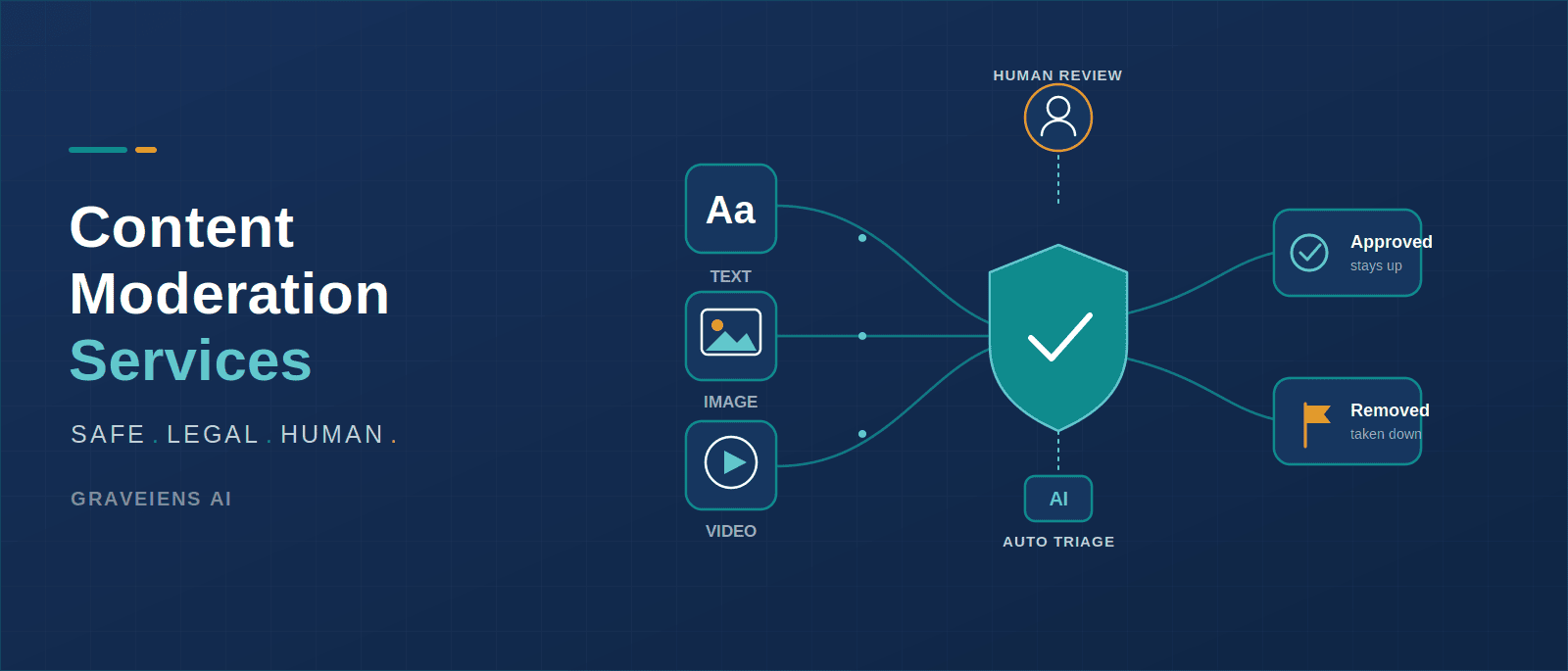
Content moderation services are managed programs of people, policy, and technology that review user-generated text, images, video, audio, and AI outputs to remove harmful or non-compliant material before it reaches your audience. In plain terms, they are how a platform decides what stays up and what comes down, at a speed and scale no in-house team can match alone. This guide explains what these services actually cover, the main types and trade-offs, how to compare providers, and a practical checklist you can use this quarter. You will also get an original decision matrix for matching the right approach to your risk and volume.
At a glance
| Question | Direct answer |
|---|---|
| What are content moderation services? | Outsourced or managed programs that review and act on user content using trained human reviewers, policy, and automation. |
| Why do they matter in 2026? | The content moderation market reached about USD 9.7 billion in 2023 and is forecast to hit USD 22.8 billion by 2030 (Grand View Research), driven by rising UGC volumes and new laws. |
| What content types are covered? | Text and chat, image moderation, video moderation, audio, and generative AI prompts and responses. |
| Human, AI, or both? | Hybrid (human-in-the-loop) is widely regarded as the most reliable model because automation misses context that trained reviewers catch. |
| What does the law require? | The EU Digital Services Act mandates transparency reporting and can fine platforms up to 6% of global annual turnover for non-compliance. |
| How do I choose a partner? | Score providers on policy fit, quality assurance, languages, turnaround, compliance, and reviewer wellbeing (see the checklist below). |
Table of contents
What are content moderation services?
Why content moderation matters right now
The main types of content moderation
UGC moderation: the volume problem
Image moderation and video moderation
AI, human, or hybrid: a comparison table
When each approach actually wins
The Graveiens Moderation Fit Matrix
How to choose a content moderation partner
A worked example: before and after
How good moderation is really built
Frequently asked questions
About the authors
Conclusion
Sources
What are content moderation services?
Content moderation services are managed programs that review user-generated content and enforce a platform’s rules across every format users can post. That means catching hate speech in a comment thread, nudity in an uploaded photo, graphic violence in a live stream, scam links in a chat, and unsafe answers produced by a generative model.
A modern service is not just a room of reviewers. It combines a written policy taxonomy, automated pre-filters that triage the easy cases, trained human reviewers who judge the hard ones, and a quality-assurance loop that measures whether decisions are correct and consistent. The human layer exists because most damaging content is not obvious: it is the borderline post, the coded slur, the satirical image, or the reclaimed word that automated filters routinely get wrong.
Providers usually deliver this as a fully managed team, an on-demand review queue, or a co-managed model where the platform sets policy and the partner supplies reviewers, tooling, and reporting. The best programs treat moderation as a living system that is calibrated against real examples, not a one-time setup.
Why content moderation matters right now
Two forces have turned content moderation from a cost center into a board-level priority: scale and law.
On scale, the numbers are moving fast. According to Grand View Research, the content moderation market was valued at roughly USD 9.7 billion in 2023 and is projected to reach USD 22.8 billion by 2030, a compound annual growth rate of about 13% from 2024 to 2030. North America accounted for 33.9% of global revenue in 2023, while Asia Pacific is expected to grow the fastest. The image segment held the largest revenue share in 2023, and video is forecast to grow fastest, at more than 14% annually. That last point matters because visual formats are the hardest and most expensive to review well.
On law, the regulatory floor has risen. The EU Digital Services Act now requires online platforms to publish transparency reports on their moderation activity, including how much content they remove and how accurate their automated systems are. Very large online platforms must report twice a year; other services report annually. Harmonized data collection under the Commission’s implementing rules began on July 1, 2025. Enforcement has teeth: fines can reach up to 6% of a provider’s global annual turnover, with periodic penalties of up to 5% of average daily worldwide turnover for continued non-compliance, according to guidance summarizing the DSA’s enforcement provisions. Getting moderation wrong is no longer just a reputational risk. It is a financial and legal one. In short, UGC moderation has moved from a back-office support function to a core operation with real legal stakes.
The main types of content moderation
Content moderation is usually organized in two ways: by the format being reviewed, and by when the review happens.
By format, the main types are text and chat moderation, image moderation, video moderation, audio and voice moderation, and moderation of generative AI outputs (prompts and model responses). Each has its own failure modes. Text hinges on language and context. Image moderation depends on recognizing unsafe visuals across cultures. Video moderation adds time, because harm can appear in a single frame buried in an hour of footage.
By timing, teams choose among several workflows:
- Pre-moderation, where content is reviewed before it goes live. Safest, but it adds latency and does not scale to high-velocity feeds.
- Post-moderation, where content publishes immediately and is reviewed shortly after. The common default for social and community platforms.
- Reactive moderation, which relies on user reports to surface problems. Cheap, but slow and easily gamed.
- Proactive moderation, where automation and reviewers hunt for violations before anyone reports them. Essential for the most serious harms.
Most mature platforms run a blend: proactive detection for severe categories, post-moderation for the long tail, and pre-moderation only for the highest-risk surfaces.
UGC moderation: the volume problem
UGC moderation is the discipline of reviewing user-generated content at internet scale, where millions of posts, uploads, and messages arrive every day and each one is a potential liability. The core challenge of UGC moderation is not any single decision. It is doing millions of them quickly, consistently, and in dozens of languages without burning out reviewers or drowning users in false removals.
Effective UGC moderation starts with triage, then routes each item to the right reviewer. Automated classifiers handle the clear cases (obvious spam, known illegal imagery) so that human attention is reserved for genuine judgment calls. It also depends on a precise policy taxonomy, because reviewers cannot apply a rule that is vague. A well-run user-generated content review program measures inter-reviewer agreement, tracks appeals, and feeds hard cases back into training so the whole system keeps improving.
Because UGC spans every format, strong programs coordinate text, image moderation, and video moderation under one policy rather than treating them as separate silos. That coordination is what keeps a coded caption from slipping through just because the image looked clean. In practice, mature UGC moderation is best thought of as one system with many inputs, not a stack of disconnected tools.
Image moderation and video moderation
Visual content is where moderation gets genuinely hard, which is why the fastest market growth is here. Getting image moderation and video moderation right is now a core competency for any platform that hosts uploads, not an afterthought.
Image moderation
Image moderation reviews photos, graphics, memes, and profile pictures for unsafe or non-compliant visuals, from explicit material to graphic violence to hate symbols. Automated vision models are strong on clear categories but weak on context: a medical photo, a piece of art, and an exploitative image can share visual features, and only a trained reviewer reliably tells them apart. Good image moderation pairs fast automated scoring with human review of the ambiguous middle, plus culturally aware reviewers who understand that a symbol or gesture can be benign in one region and hateful in another. Done well, image moderation protects users without erasing legitimate art, journalism, or medical content.
Video moderation
Video moderation is the most demanding format because harm is spread across time and sound. A single unsafe frame, a slur in the audio track, or a manipulated clip can violate policy inside otherwise ordinary footage. Effective video moderation combines frame sampling, audio transcription and review, and reviewers who can judge intent across a sequence rather than a still. For live video, the bar is higher still: decisions have to happen in seconds, which makes a well-drilled reviewer team and clear escalation paths non-negotiable. This is why video is both the fastest-growing and the most costly segment to staff correctly.
AI, human, or hybrid: a comparison table
The single most important choice a platform makes is who or what does the reviewing. Here is how the main models compare across the factors that decide quality and cost.
| Factor | AI-only automation | Human-only review | Hybrid (human-in-the-loop) | Crowdsourced / user reports |
|---|---|---|---|---|
| Speed at scale | Excellent | Poor | Very good | Moderate |
| Context accuracy | Weak on borderline cases | Strong | Strong | Inconsistent |
| Cost per item | Lowest | Highest | Moderate | Low |
| Multilingual nuance | Limited | Strong | Strong | Variable |
| Handles new harms | Slow to adapt | Fast | Fast | Slow |
| Auditability for regulators | Depends on logging | High | High | Low |
| Reviewer wellbeing risk | None | High exposure | Managed | Low |
| Best for | High-volume clear cases | Small, sensitive queues | Most real platforms | Supplemental signal only |
The pattern is consistent across independent research: automation is fast and cheap but struggles with context, while humans are accurate but do not scale. A 2025 study in Nature Human Behaviour found that automated systems frequently misjudge content because they cannot read context, sometimes flagging harmless posts, and that multimodal models paired with human judgment produce more context-sensitive decisions. Analysts at New America have documented similar limits in automated tools for years.
When each approach actually wins
The honest answer is that no single model is best for everyone, and anyone who says otherwise is selling something.
AI-only moderation wins when volume is enormous and the categories are unambiguous, such as filtering known illegal imagery by hash-matching or blocking obvious spam. It fails when nuance matters, because a classifier cannot tell satire from sincerity or reclaimed language from an attack.
Human-only review wins for small, high-stakes queues where every decision is sensitive, such as appeals, escalations, or trust-and-safety investigations. It does not scale to a firehose of daily uploads without unsustainable cost and reviewer strain.
Hybrid human-in-the-loop moderation wins for the vast majority of real platforms, because it puts automation on the easy 80% and skilled reviewers on the 20% that carries almost all the risk. This is the model most moderation programs are built around today, and for good reason.
Crowdsourced signals such as user reports are useful as an input, never as the system of record. They surface problems the platform missed, but they are slow, easily manipulated, and cannot be audited against a regulator’s standard.
The practical takeaway is that the right design is usually a layered one: automation for triage, humans for judgment, and clear rules for when a case jumps from one to the other.
The Graveiens Moderation Fit Matrix
To make the choice repeatable rather than a guess, we use a simple decision aid we call the Graveiens Moderation Fit Matrix. It maps two variables every platform can estimate: content risk (how much harm a missed item can cause) against content volume (how much arrives per day). The cell tells you where to invest first.
| Low volume | High volume | |
|---|---|---|
| Low risk | Automation with light spot-checks by humans; keep costs lean. | Automation-led triage with sampled human QA; scale the classifiers. |
| High risk | Human-led review with automation as an assistant; accuracy over speed. | Full human-in-the-loop program: proactive detection, trained reviewers, four-stage QA, and 24/7 escalation. |
The bottom-right quadrant, high risk and high volume, is where most large social, gaming, marketplace, and generative AI platforms actually sit, and it is where managed content moderation services earn their keep. It is also the quadrant where disciplined UGC moderation stops being optional and becomes a condition of staying online. The matrix is deliberately simple so any product or trust-and-safety lead can place their platform in it during a single meeting and leave with a defensible starting point.
How to choose a content moderation partner
Use this checklist to evaluate any UGC moderation provider. Score each item, because the gaps are where programs fail.
1. Policy fit. Can they adapt to your written taxonomy and edge cases, or do they force a generic rulebook onto your platform?
2. Quality assurance. Ask for their QA model. A serious partner runs multi-stage review, calibrates against a gold-standard test set, and reports accuracy after QA, not before.
3. Language and culture. Confirm real coverage in the languages and regions your users actually post in, with reviewers who understand local context.
4. Turnaround and coverage. Match their speed and hours to your risk. Live and high-severity surfaces need fast, around-the-clock response.
5. Compliance and auditability. Verify they can produce the logs and statements of reasons that laws like the DSA require, and ask about relevant certifications such as ISO 9001:2017.
6. Reviewer wellbeing. Sustainable programs limit exposure, rotate reviewers, and provide support. This is both an ethical duty and a quality safeguard, because burned-out reviewers make worse decisions.
7. Commercial fairness. Look for models that align payment with accepted quality, such as pay-on-approval pilots, rather than paying for volume regardless of accuracy.
If a provider cannot answer these clearly, treat that as your answer.
A worked example: before and after
Consider a fast-growing marketplace app flooded with new listings and messages.
Before: the team relied on an automated filter plus user reports. The filter blocked obvious profanity but missed scam listings written in careful language, and harmful items stayed live for hours until enough users complained. Appeals piled up, good sellers were wrongly removed, and the team could not produce a clean audit trail when regulators asked.
After: the platform layered a hybrid UGC moderation program on top. Automation triaged the clear cases, trained reviewers handled the borderline listings and messages against a tightened taxonomy, and a four-stage QA loop measured accuracy. Scam listings were caught proactively, false removals of legitimate sellers dropped because a human made the final call, and every action produced a logged reason ready for transparency reporting. The lesson is not that automation failed. It is that automation without human judgment left exactly the gaps that cost trust and invited legal risk.
How good moderation is really built
Reliable UGC moderation is a data-and-people problem before it is a software problem. The programs that hold up under audit share a few traits: a precise, versioned policy taxonomy; automation tuned to triage rather than to make final calls; trained multilingual reviewers who own the judgment layer; and a measurable quality-assurance workflow that treats accuracy as a number you improve, not a claim you make.
This is exactly where a specialist partner adds value. At Graveiens AI, our human-in-the-loop content moderation programs combine a customized policy taxonomy, trained reviewers across 25+ languages, and a four-stage QA loop, with ISO 9001:2017 certified processes and a pay-on-approval option for pilots so you only pay for review that meets the agreed bar. The same rigor that powers our data annotation and data collection work, where labeling accuracy is everything, is what makes moderation defensible rather than best-effort.
Moderation is also expanding into new modalities. Generative systems now need their outputs reviewed, which connects moderation directly to LLM evaluation and red-teaming. And as AI moves into robotics and embodied systems trained on first-person footage, the data behind those models, such as consent-backed egocentric video captured in real environments, needs the same careful review and governance that mature moderation programs already practice. The common thread is trustworthy human judgment applied to messy, real-world content.
For teams building the training pipelines underneath all of this, our guide to AI training data companies is a useful companion read, and if you are new to the fundamentals, start with what is training data.
Frequently asked questions
What is the difference between content moderation and content moderation services?
Content moderation is the act of reviewing and acting on user content. Content moderation services are the managed programs, combining people, policy, and technology, that a platform buys or builds to do that work reliably at scale.
Are content moderation services still needed if I use AI filters?
Yes. AI filters are excellent at triaging clear cases but weak on context, so they miss coded language, satire, and culturally specific harms. Independent research, including a 2025 Nature Human Behaviour study, shows human-in-the-loop review produces more context-accurate decisions than automation alone.
How much do content moderation services cost?
Pricing depends on volume, formats, languages, and turnaround. Visual formats like video moderation cost more than text because they take longer to review. Many providers offer usage-based or pay-on-approval pilot models so you can validate quality before committing.
What is UGC moderation?
UGC moderation is the review of user-generated content, such as posts, comments, images, and videos, at scale to enforce a platform’s rules and legal obligations. It combines automated triage with trained human reviewers.
What is the difference between image moderation and video moderation?
Image moderation reviews still visuals for unsafe content. Video moderation is harder because harm can appear in a single frame or in the audio, so it adds frame sampling, audio review, and time-based judgment, and for live streams it must happen in seconds.
Does the law require content moderation?
In many markets, effectively yes. The EU Digital Services Act requires transparency reporting on moderation and allows fines up to 6% of global annual turnover, so documented, auditable moderation is a compliance requirement, not an option.
Which is better, human or automated moderation?
For most platforms, a hybrid human-in-the-loop model is best. Automation handles the high-volume clear cases and humans handle the borderline judgments that carry the real risk. Pure automation is faster but less accurate on context.
About the authors
This guide was written by the Graveiens AI Trust and Safety Team, a group of moderation program managers, policy specialists, and multilingual reviewers who design and run human-in-the-loop review at scale, and reviewed by a senior trust and safety lead with over a decade of experience in online safety and data operations. Graveiens AI runs ISO 9001:2017 certified processes and supports moderation across 25+ languages. Learn more on our About page.
Conclusion
Well-run content moderation services are now the difference between a platform that earns trust and one that leaks it, and between passing a regulator’s audit and paying for failing it. The market is growing toward USD 22.8 billion by 2030 for a reason: user content keeps multiplying, harms keep evolving, and the law keeps tightening. Automation alone cannot carry that weight, and human-only review cannot scale to meet it, which is why the layered, human-in-the-loop model has become the sensible default. If you are ready to make your moderation accurate, multilingual, and audit-ready, talk to the Graveiens AI team on our contact page and we will help you design a program that fits your risk and volume.
Sources
- Grand View Research, Content Moderation Services Market Size Report, 2024 to 2030. https://www.grandviewresearch.com/industry-analysis/content-moderation-services-market-report
- European Commission, Commission harmonises transparency reporting rules under the Digital Services Act. https://digital-strategy.ec.europa.eu/en/news/commission-harmonises-transparency-reporting-rules-under-digital-services-act
- European Interactive Digital Advertising Alliance, Enforcement and Penalties under the EU Digital Services Act. https://edaa.eu/digital-services-act/enforcement-and-penalties/
- Davidson, T., Nature Human Behaviour (2025), Context-sensitive hate speech evaluations with multimodal large language models. https://www.nature.com/articles/s41562-025–02363‑7
- New America, The Limitations of Automated Tools in Content Moderation. https://www.newamerica.org/insights/everything-moderation-analysis-how-internet-platforms-are-using-artificial-intelligence-moderate-user-generated-content/the-limitations-of-automated-tools-in-content-moderation/

Jitendra Choubay is the CEO & Founder of Graveiens AI, leading a human-in-the-loop data services team that helps AI builders with data collection, annotation, consent-backed voice data, transcription and LLM fine-tuning. He writes on building better, ethically sourced AI training data.
Get the next Graveiens AI article
Expert notes on AI data, annotation, LLMs and eLearning — no spam, unsubscribe anytime.
Need AI Development? Data Annotation? eLearning?
Talk to Graveiens AI about data collection, annotation, voice data, RLHF/SFT, LLM evaluation and AI training data — invoiced only on approved work.
Contact Graveiens AI