TL;DR Key takeaways
- What is object detection? A computer vision task that finds and locates objects in an image or video by drawing a bounding box around each one and assigning it a class label.
- It answers two questions at once what is in the image and where it sits, which separates detection from plain image classification.
- It sits inside image processing and is closely related to image segmentation (also called picture segmentation), which labels objects at the pixel level.
- In 2026 the leading models are the transformer-based RF-DETR and the CNN-based YOLO26 family, measured on COCO using mean Average Precision (mAP).
- Every accurate detector is trained on human-labeled data the annotation and QA work Graveiens AI delivers for computer vision teams.
Who this article is for: ML engineers, product managers, founders and data leaders who need a clear, accurate definition of object detection and how it relates to image segmentation, picture segmentation and image processing.
What is object detection?
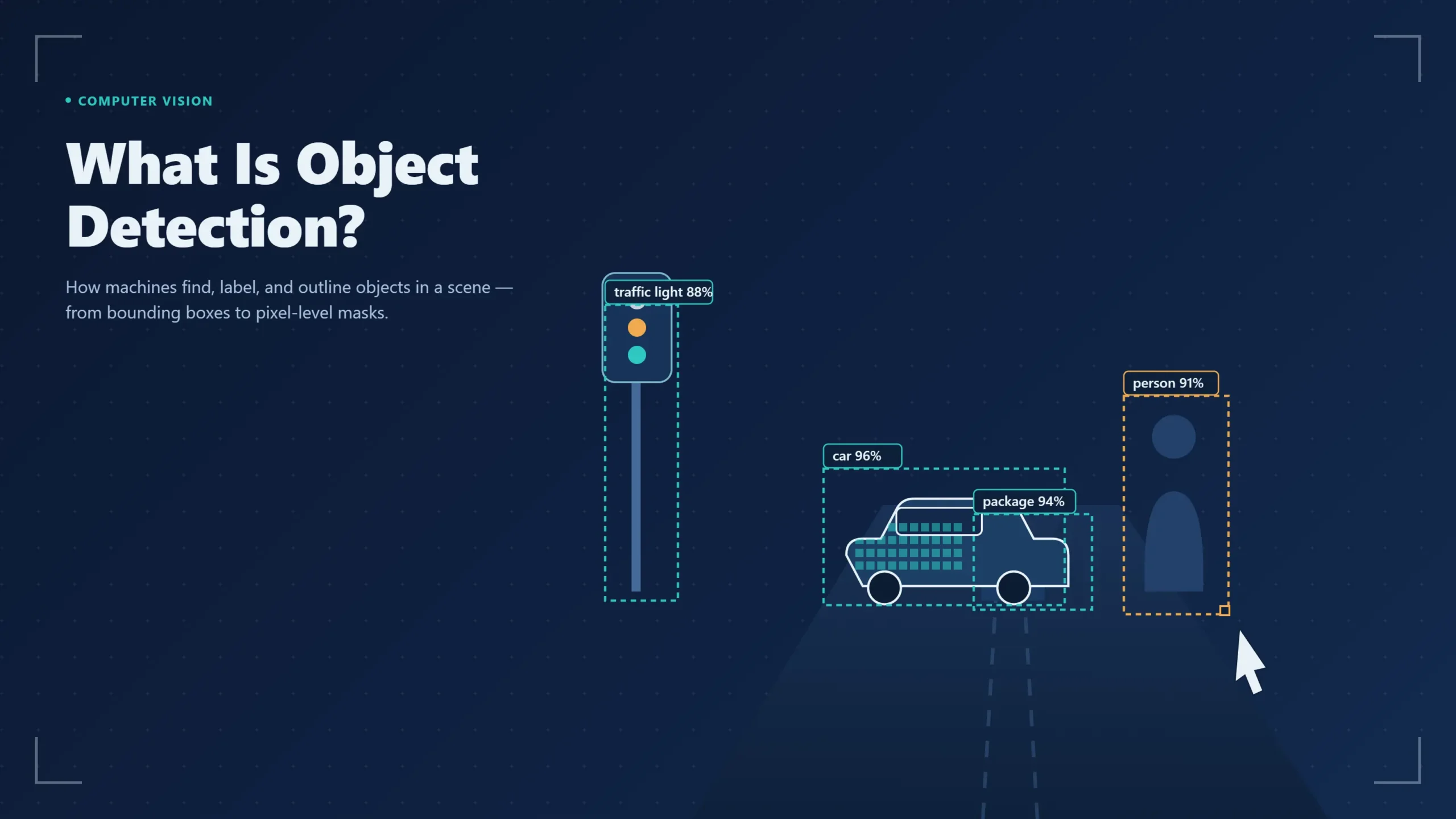
Object detection is a computer vision technique that identifies objects in an image or video and locates each one with a bounding box and a class label. In one pass, a detector tells you what objects are present car, pedestrian, traffic light and where each sits in the frame, as box coordinates plus a confidence score.
That dual output is the point. If you only wanted to know whether a cat appears somewhere in a photo, image classification would do. But the moment you need to count, track or measure objects, the answer to what is object detection becomes essential: it grounds recognition in precise spatial location.
Object detection is one of the most commercially important branches of image processing, powering self-driving perception, retail analytics, medical imaging and inspection. The broader computer vision market is valued at roughly $20–24 billion in 2026 and forecast to grow double-digits through the decade, with object detection cited as a leading driver.
How object detection works
Modern detection runs on deep neural networks trained on thousands to millions of labeled examples. The pipeline has four conceptual stages.
- Feature extraction. A backbone network builds a rich representation of edges, textures and shapes.
- Region proposal or dense prediction. The model proposes candidate locations where objects might be.
- Classification and box regression. For each candidate, it predicts a class and refines the box coordinates.
- Post-processing. Overlapping boxes are merged traditionally with NMS, though newer models remove this step.
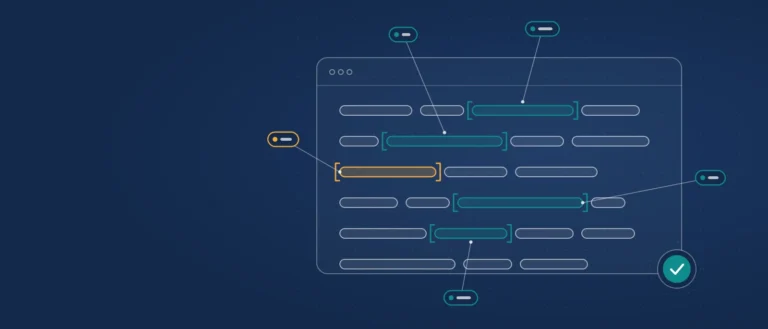
Every stage depends on label quality. A detector can only learn to find a defect, a tumor or a pedestrian if humans first drew accurate boxes around thousands of examples. That is why teams pair large-scale data collection with meticulous data annotation and labeling before training begins.
Object detection vs image classification
| Task | Question it answers | Output |
|---|---|---|
| Image classification | What is in the image? | A single label for the whole image |
| Object detection | What and where? | A labeled bounding box per object |
| Image segmentation | Which exact pixels? | A pixel-level mask per object |
Classification assigns one label to a whole picture. Object detection localizes every instance. When you need the exact silhouette rather than a rectangle, you move up to image segmentation. All three are stages on the same ladder of visual understanding, and most production systems combine them.
Image processing: the bigger picture
Image processing is the umbrella discipline of manipulating and analyzing digital images from low-level operations like resizing, denoising and edge detection to high-level tasks like object detection and image segmentation.
Classical image processing uses fixed mathematical operations; modern image processing increasingly learns the operation from data. Object detection is a high-level image processing task in this modern sense.
Robust image processing pipelines start with clean inputs. Before any model runs, raw images must be captured, de-duplicated and quality-checked work our data validation and computer vision teams handle so downstream image processing stays reliable.
Image segmentation vs object detection
Image segmentation is the computer vision task of classifying every pixel in an image, producing a precise mask rather than a coarse box. Where detection says “there is a car in this rectangle,” image segmentation says “these exact pixels are the car.”
- Semantic segmentation labels every pixel with a class but does not separate individual objects of the same class.
- Instance segmentation outlines each object separately, even when two cars overlap.
- Panoptic segmentation unifies both, labeling every pixel while distinguishing each instance.
The relationship is complementary. Many stacks run object detection to locate objects quickly, then apply image segmentation where fine boundaries matter. Because masks are far more time-consuming to label than boxes, high-quality image segmentation data is where an experienced partner adds the most value our computer vision annotation and sensor fusion and LiDAR teams deliver both.
Picture segmentation explained
You may see “picture segmentation” used as a synonym for image segmentation the two mean the same thing. Picture segmentation is the process of partitioning a picture into meaningful regions or objects at the pixel level. The goal is identical: assign every pixel to a region so the machine understands the exact shape of what it sees.
Picture segmentation is used heavily in medical imaging, satellite and geospatial analysis, and augmented and virtual reality giving detail that bounding-box detection cannot.
Foundation models such as Meta’s Segment Anything Model (SAM2) produce high-quality masks with minimal prompting, but human review remains essential on hard edges and occlusions. That human-in-the-loop step for picture segmentation is exactly what our specialized annotation workforce provides.
The best object detection models in 2026
| Model family | Architecture | Best for |
|---|---|---|
| RF-DETR | Transformer (DINOv2 + deformable attention) | Highest accuracy; first real-time past 60 mAP on COCO |
| YOLO26 | CNN, NMS-free dual-head | Fastest real-time inference on edge and mobile |
| SAM2 | Promptable transformer | Segmentation and mask generation |
RF-DETR (ICLR 2026) removes anchor boxes and NMS for end-to-end detection and became the first real-time model past 60 mAP on COCO. YOLO26 introduces a native NMS-free design that keeps it tiny and extremely fast ideal for edge devices in ADAS and autonomous systems.
Models are compared using mean Average Precision (mAP) on MS COCO, averaged across IoU thresholds from 0.50 to 0.95. But a COCO score rarely predicts performance on your data real gains come from fine-tuning on domain-specific, well-labeled images.
Real-world applications of object detection
- Automotive & ADAS detecting vehicles, pedestrians, and lanes for autonomous perception.
- Healthcare locating tumors and anomalies in medical imaging with box and mask precision.
- Retail & e‑commerce shelf monitoring and catalog tagging for retail and e‑commerce AI.
- Agritech spotting pests, weeds and crop stress for agritech platforms.
- Robotics & embodied AI grasping and navigation trained on egocentric, first-person video.
How object detection models are built: the data layer
An object detection model’s architecture is public and its code is downloadable, but its accuracy is decided by the labeled data behind it. This layer has three parts.
- Data collection capturing diverse, representative images that reflect real deployment conditions, via careful data collection and consent practices.
- Annotation of accurate bounding boxes for detection and pixel-perfect masks for segmentation, by trained computer vision annotators.
- Quality assurance: a multi-stage review that catches mislabels before they poison training, backed by data validation specialists.
Build a better vision model with Graveiens AI
We deliver this full pipeline: consent-backed data collection, box and pixel annotation, LiDAR and 3D labeling, and expert QA through a four-stage workflow certified to ISO 9001:2017. See how our process works, read why AI teams choose Graveiens AI, or book a low-risk pilot and pay only for deliverables you approve.
Frequently asked questions
What is object detection in simple terms?
Object detection is a computer vision task that finds objects in an image and draws a labeled box around each one, telling you both what the object is and where it is located.
What is the difference between object detection and image segmentation?
Object detection locates objects with rectangular bounding boxes, while image segmentation classifies every pixel to produce an exact mask of each object’s shape. Detection is faster and coarser; segmentation is more precise but more labor-intensive to label.
Is picture segmentation the same as image segmentation?
Yes. Picture segmentation and image segmentation are interchangeable terms for the same task: partitioning an image into meaningful regions by assigning every pixel to an object or class.
How does object detection relate to image processing?
Object detection is a high-level image processing task. Image processing is the broad discipline of analyzing and manipulating digital images, from simple filters to advanced deep-learning tasks like detection and segmentation.
What is the best object detection model in 2026?
There is no single best model. RF-DETR leads on accuracy (first real-time past 60 mAP on COCO), while YOLO26 leads on speed for edge deployment. The right choice depends on your accuracy and latency needs.
Conclusion
So, what is object detection? It is the computer vision task of finding and locating every object in an image with a labeled bounding box the foundation beneath autonomous vehicles, medical imaging and retail analytics. Understanding how it fits alongside image processing, image segmentation, and picture segmentation gives you the full map of visual AI.
Ready to build a better vision model?
Talk to the Graveiens AI team about a pilot bounding boxes, segmentation masks, LiDAR labeling or a full computer vision dataset and pay only for the deliverables you approve. graveiensai.com/contact-us

Jitendra Choubay is the CEO & Founder of Graveiens AI, leading a human-in-the-loop data services team that helps AI builders with data collection, annotation, consent-backed voice data, transcription and LLM fine-tuning. He writes on building better, ethically sourced AI training data.
Get the next Graveiens AI article
Expert notes on AI data, annotation, LLMs and eLearning — no spam, unsubscribe anytime.
Need AI Development? Data Annotation? eLearning?
Talk to Graveiens AI about data collection, annotation, voice data, RLHF/SFT, LLM evaluation and AI training data — invoiced only on approved work.
Contact Graveiens AI