| TL;DR: Key takeaways How does facial recognition work? It detects a face in an image, maps its unique features into a mathematical “faceprint” (an embedding), and compares that vector against stored faces to verify or identify a person. The pipeline has five stages: detection, alignment, feature extraction (embedding), matching, and liveness detection to block spoofing. It powers everyday tools, from photo-tagging apps, to phone unlock to a biometrics identity verification system used for KYC in banking. Modern face scans are extremely accurate: top algorithms in NIST testing match faces correctly more than 99.6% of the time on high-quality data. Every accurate system is trained on labeled, consent-backed human data, the computer vision annotation, and data collection work Graveiens AI delivers. |
Who this article is for: product managers, ML engineers, security and identity teams, and founders who want a clear explanation of how facial recognition works, plus how it relates to biometric authentication methods and identity verification.
How does facial recognition work?
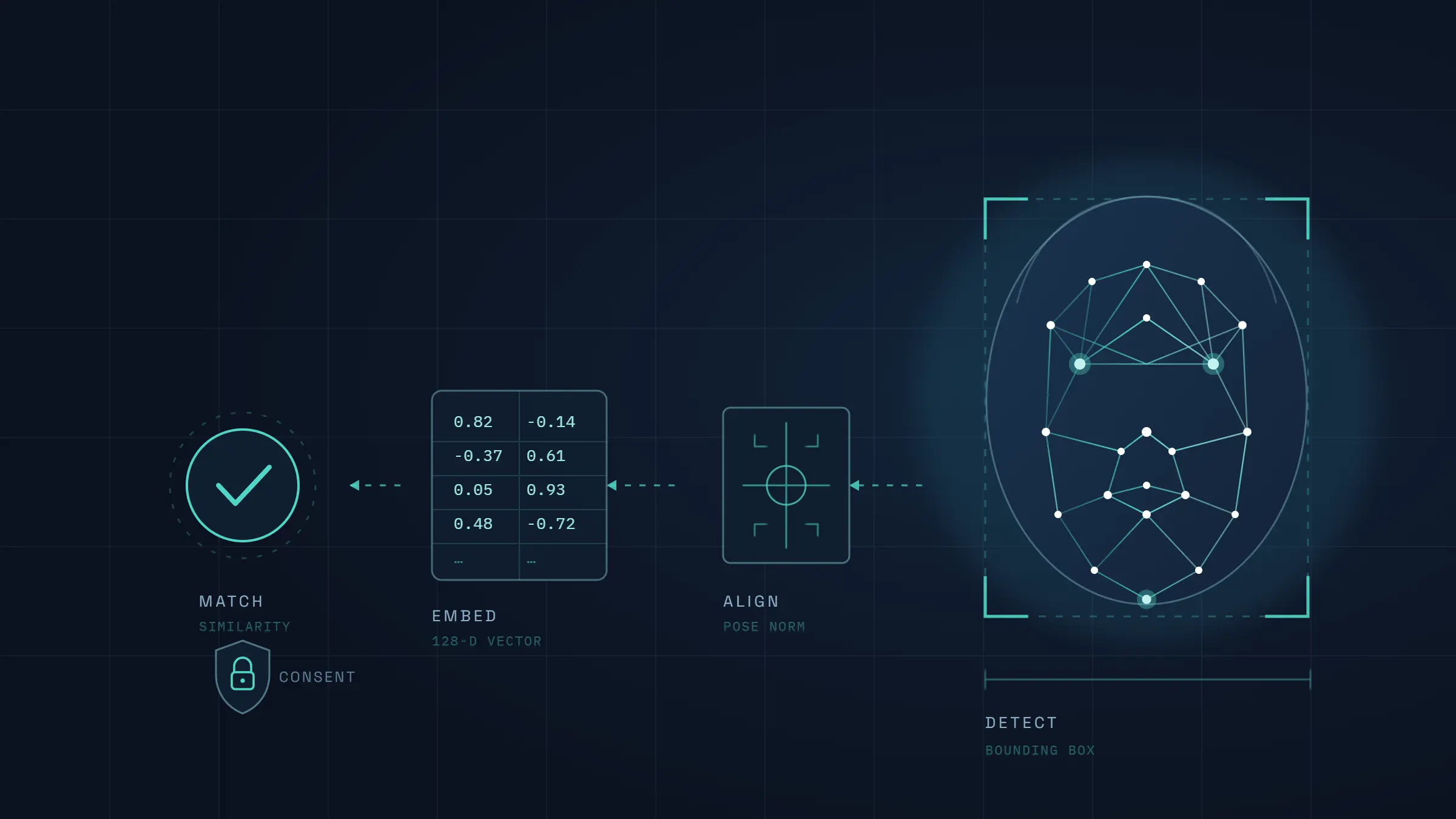
Facial recognition works by detecting a face in an image or video, converting its distinctive features into a numerical code called a faceprint, and comparing that code against one or more stored faceprints to confirm or discover a person’s identity. In plain terms, the software turns your face into math, then compares numbers.
A deep convolutional neural network studies the geometry of a face, the distances and relationships between hundreds of points, and compresses them into a compact vector, often 128 to 512 dimensions. Two images of the same person produce vectors that sit close together; two different people sit far apart.
Because it relies on a learned representation, modern facial recognition is robust to changes in lighting, angle, expression and aging. It is one of the fastest-growing branches of computer vision: the global facial recognition market is worth roughly $8.5 billion in 2026 and projected to nearly double by 2033.
The 5 stages of the facial recognition pipeline
- Detection. The system finds any faces in the frame, drawing a box around each, the same object detection task used across computer vision.
- Alignment. Faces are rotated, scaled and normalized so eyes, nose and mouth sit in standard positions.
- Feature extraction (embedding). A neural network converts the aligned face into a faceprint, the numerical vector that captures identity.
- Matching. The faceprint is compared against a database using a similarity score; passing a threshold is a match.
- Liveness detection. An anti-spoofing check confirms the input is a real, live person, not a photo, replay or mask.
Each stage depends on high-quality labeled data. That is why teams pair large-scale data collection with meticulous data annotation and labeling before training a face model. Weak or biased data at any stage is the single biggest cause of failure.
Verification vs identification
| Mode | Question | Example |
|---|---|---|
| Verification (1:1) | “Are you who you claim to be?” | Unlocking your phone; selfie vs ID photo |
| Identification (1:N) | “Who is this person?” | Searching a face against a large gallery |
Verification compares one live faceprint to one stored faceprint. Identification compares one probe face against a whole database of N faces. Verification underpins most consumer biometric authentication methods; identification is used in investigations, access control and de-duplication. The distinction matters for accuracy, privacy and regulation.
Facial recognition software for photos
The most familiar use is facial recognition software for photos, the feature in your phone gallery or cloud album that groups every picture of the same person together. It runs the same detect-align-embed-match pipeline, but instead of verifying against an ID, it clusters similar faceprints so all images of one person land in a single album.
The accuracy of any facial recognition software for photos still depends on training data that reflects real diversity, different ages, skin tones, lighting and occlusions like glasses or masks. Building that dataset responsibly is where consent-backed data collection and rigorous data validation matter, so a photo tagger works fairly for everyone.
How accurate are face scans?
In the U.S. NIST Face Recognition Vendor Test, the industry gold standard, the best algorithms match faces correctly more than 99.6% of the time on high-quality images, with error rates on some datasets as low as a quarter of one percent.
But accuracy is conditional. Face scans degrade with poor lighting, low resolution, extreme angles and heavy occlusion, and historically varied across demographic groups. Reducing that gap is a data problem: balanced, representative datasets and careful review shrink demographic error. Independent computer vision evaluation and QA turn a strong benchmark into dependable face scans in production.
Facial recognition among biometric authentication methods
Facial recognition is one of several biometric authentication methods, verifying identity using something you are rather than something you know or have. The main options include:
- Face recognition is fast, contactless, and hardware-light, working with any camera.
- Fingerprint is mature and cheap, but requires contact.
- Iris and retina are extremely accurate, but need special hardware.
- Voice is convenient for hands-free flows and is built on voice and speech data.
- Behavioral biometrics include typing rhythm, gait, or signature dynamics.
Face recognition has surged because it is frictionless and works on devices people already own. The strongest systems combine several modalities, face plus voice, into multi-factor biometrics that are far harder to spoof. Choosing the right mix of biometric authentication methods depends on the security level, hardware and user experience each application needs.
Facial recognition in identity verification
Beyond unlocking devices, facial recognition is the engine of the modern biometrics identity verification system used to onboard customers remotely. A typical system asks a user to photograph a government ID, then take a live selfie; facial recognition matches the two while liveness detection confirms a real person is present.
This is now standard in banking and fintech, where such a system automates Know Your Customer (KYC) checks that once required a branch visit. The broader identity verification market is worth roughly $15.8 billion in 2026, on its way to over $50 billion by 2034. Our banking and finance data programs support these document- and face-matching models, and a robust biometrics identity verification system is only as trustworthy as the consent-backed data used to train it.
Privacy, consent and responsible use
Because a face is permanent and hard to change, facial recognition raises real privacy questions. Regulations such as GDPR, Illinois’ BIPA, and a growing patchwork of state laws treat biometric data as especially sensitive. Responsible deployment means:
- Explicit consent and clear notice before capturing face data.
- Purpose limitation, meaning face scans are used only for the stated function.
- Security, including encrypting faceprints and storing them separately from personal data.
- Bias testing that validates accuracy across demographic groups.
- Human oversight that routes high-stakes matches through review and moderates misuse with content moderation workflows.
Models trained on consent-backed, well-documented data are more defensible and more accurate, which is why a vetted, specialized human workforce belongs in the loop for sensitive biometric programs.
How facial recognition systems are built: the data layer
A face model’s architecture is public, and its compute is buyable, but its accuracy and fairness are decided by the labeled data behind it. This layer has three parts.
- Data collection. Capturing diverse, consent-backed images across ages, skin tones and conditions via careful data collection practices.
- Annotation. Labeling landmarks, boxes, and attributes, plus genuine and spoofed samples for liveness, by trained computer vision annotators.
- Validation and evaluation. Multi-stage QA that catches label errors and demographic gaps, backed by data validation specialists.
| Build a better face model with Graveiens AITeams increasingly use generative AI to create synthetic faces that fill gaps and stress-test against deepfakes. We deliver the full pipeline, consent-backed collection, precise annotation and expert QA, through a four-stage workflow certified to ISO 9001:2017. See how our process works, read why AI teams choose Graveiens AI, or book a low-risk pilot. |
Frequently asked questions
Q. How does facial recognition work in simple terms?
A. It detects a face, turns its unique features into a numerical code called a faceprint, and compares that code to stored faceprints to verify or identify the person. In short, it converts your face into math and compares the numbers.
Q. What is the difference between face detection and facial recognition?
A. Face detection only finds where a face is (drawing a box around it). Facial recognition goes further, identifying whose face it is by generating and matching a faceprint.
Q. How accurate is facial recognition?
A. The best algorithms in NIST testing match faces correctly more than 99.6% of the time on high-quality images. Accuracy drops with poor lighting, low resolution, extreme angles or heavy occlusion, and can vary across demographic groups.
Q. Is facial recognition a biometric authentication method?
A. Yes. It is one of the leading biometric authentication methods, alongside fingerprint, iris, voice and behavioral biometrics. It is popular because it is contactless and works with any camera.
Q. How does facial recognition software for photos work?
A. It runs the same detect-align-embed pipeline, then clusters similar faceprints so every image of the same person is grouped into one album, no identity database required.
Q. What is a biometrics identity verification system?
A. It confirms a person’s identity by matching a live face scan to a trusted reference, such as a government ID photo, while liveness detection ensures a real person is present. It is widely used for remote KYC.
Q. Can facial recognition be fooled by a photo?
A. Modern systems use liveness detection to block spoofing with printed photos, video replays or masks, checking for depth, micro-movements or reflections before accepting a match.
Conclusion
So, how does facial recognition work? It detects a face, converts it into a mathematical faceprint, and matches that vector against stored faces, through a five-stage pipeline of detection, alignment, embedding, matching and liveness detection. From photo tagging to a bank’s identity verification system, the same core process, and the same reliance on accurate face scans, powers a fast-growing set of applications.
| Ready to build a better face model?Talk to the Graveiens AI team about a pilot, face annotation, liveness datasets or consent-backed data collection, and pay only for the deliverables you approve. graveiensai.com/contact-us |
Sources: NIST, Face Recognition Vendor Test (FRVT); Bipartisan Policy Center, FRT accuracy & performance; Grand View Research, facial recognition market; Fortune Business Insights, identity verification market; Microsoft Learn, face liveness detection.

Jitendra Choubay is the CEO & Founder of Graveiens AI, leading a human-in-the-loop data services team that helps AI builders with data collection, annotation, consent-backed voice data, transcription and LLM fine-tuning. He writes on building better, ethically sourced AI training data.
Get the next Graveiens AI article
Expert notes on AI data, annotation, LLMs and eLearning — no spam, unsubscribe anytime.
Need AI Development? Data Annotation? eLearning?
Talk to Graveiens AI about data collection, annotation, voice data, RLHF/SFT, LLM evaluation and AI training data — invoiced only on approved work.
Contact Graveiens AI