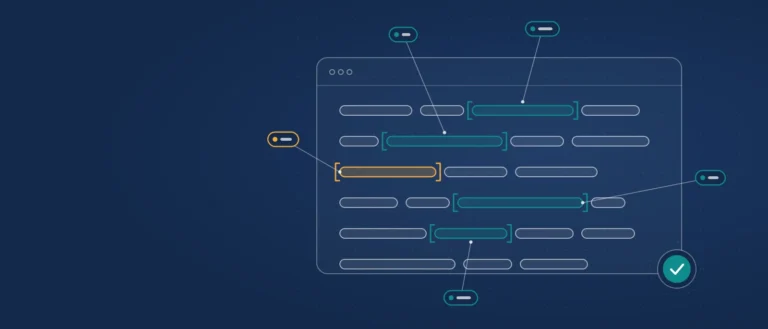
TL;DR: Key takeaways
Semantic segmentation is a computer vision task that labels every pixel in an image with a class, producing a precise mask instead of a bounding box.
It differs from instance segmentation, which separates each object, while this task groups all pixels of a class together. Panoptic segmentation combines both.
Beyond flat images, 3D segmentation extends the idea to point clouds and volumes, and automatic segmentation from foundation models like SAM 2.1 now speeds labeling dramatically.
The word “segmentation” also appears in language: word segmentation, or segmenting words in text, is a core step in NLP.
Every accurate model is trained on labeled data, the computer vision annotation and data collection work Graveiens AI delivers for AI teams.
Who this article is for: ML engineers, product managers, and data leaders who want a clear explanation of semantic segmentation, how it compares to related tasks, and how 3D segmentation, automatic segmentation, and word segmentation fit into the wider picture.
What is semantic segmentation?
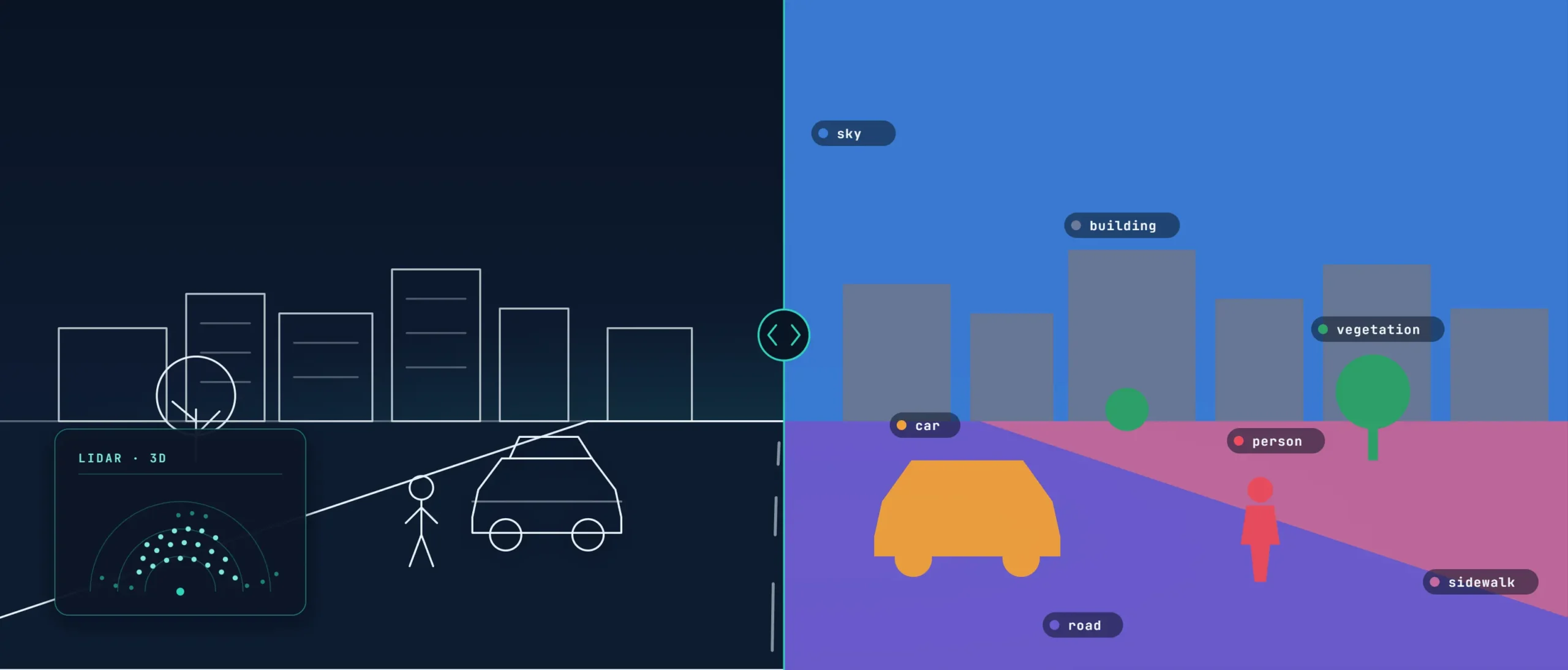
Semantic segmentation is a computer vision task that assigns a class label to every single pixel in an image, so the output is a dense mask that traces the exact shape of each region: road, sky, car, person, or background. Where image classification gives one label to a whole picture, this task answers a far more detailed question by segmenting the scene pixel by pixel.
That pixel-level precision is what makes it so valuable. A self-driving car does not just need to know a pedestrian is present; it needs the exact boundary of that pedestrian against the road. By segmenting every pixel into a category, the model gives machines a rich spatial understanding of a scene. It sits at the heart of modern computer vision, alongside classification and object detection.
One important limit defines the approach: standard segmentation of this kind does not separate individual objects of the same class. If three cars overlap, all their pixels are simply labeled “car.” Separating those instances is the job of the related tasks we cover next, but for dense scene understanding, segmenting each pixel by category is exactly what semantic segmentation is built to do.
Semantic vs instance vs panoptic segmentation
| Type | What it does | Example output |
|---|---|---|
| Semantic segmentation | Labels every pixel with a class, no object separation | All cars share one “car” mask |
| Instance segmentation | Separates each object, even in the same class | Car 1, Car 2, Car 3 as distinct masks |
| Panoptic segmentation | Combines both: every pixel labeled, each object distinct | Background classes plus separated objects |
In short, semantic segmentation is about what each pixel is, instance segmentation adds which object it belongs to, and panoptic unifies the two. Many production pipelines run pixel labeling for background and “stuff” categories, then layer instance methods on top for countable objects. Choosing the right variant is the first design decision, because it drives the entire annotation effort behind the model.
How segmentation works
Modern segmentation models run on deep neural networks built as an encoder-decoder. The encoder compresses the image into rich features, and the decoder upsamples them back to full resolution while segmenting every pixel into a class. Early architectures like U‑Net and DeepLab popularized this design; today, transformer-based models dominate.
Quality is measured with mean Intersection over Union (mIoU), which compares the predicted mask to the ground-truth mask across every class. The standard benchmarks are Cityscapes for street scenes and ADE20K for general scenes. A score of “57.7 mIoU on ADE20K” is shorthand for how faithfully a model is segmenting each pixel into the correct category.
Accuracy depends heavily on training data. Because a pixel-level mask is far more time-consuming to produce than a bounding box, high-quality datasets are expensive to build, which is why disciplined data annotation and labeling and rigorous data validation matter so much.
The best semantic segmentation models in 2026
| Model | Strength | Benchmark note |
|---|---|---|
| Mask2Former | Universal (semantic, instance, panoptic) | ~57.7 mIoU ADE20K; 81.6% Cityscapes |
| OneFormer | One model for all three tasks | Competitive with Mask2Former |
| SegFormer | Efficient, lightweight | 51.8% ADE20K, far fewer parameters |
| DeepLabV3+ | Proven CNN baseline | Strong, widely deployed |
| SAM 2.1 | Zero-shot, interactive, video | Prompt with points, boxes, masks |
Mask2Former set a high bar by handling semantic, instance, and panoptic tasks in one architecture. SegFormer is the go-to when you need efficient segmentation on the edge, and DeepLabV3+ remains a dependable CNN baseline. As always, a benchmark score rarely predicts performance on your data, so fine-tuning on domain-specific images is what turns a strong model into a reliable one.
Automatic segmentation with foundation models
The biggest recent shift is automatic segmentation powered by foundation models. Meta’s Segment Anything Model, now at SAM 2.1, produces high-quality masks from a simple prompt and tracks objects through video. This automatic segmentation has transformed labeling, because a model can propose masks that humans then refine, rather than tracing every boundary from scratch.
Automatic segmentation does not remove the need for people. Foundation models still miss hard edges, unusual objects, and domain-specific categories, so the output must be reviewed and corrected. The most efficient pipelines pair automatic segmentation with expert review: the model does the first pass, and a trained annotation workforce fixes what it gets wrong. That is why automatic segmentation is best treated as an accelerator, not a replacement for skilled labeling.
3D segmentation for point clouds and volumes
Segmentation is not limited to flat images. 3D segmentation extends the same pixel-labeling idea into three dimensions, assigning a class to every point in a point cloud or every voxel in a volume. For autonomous driving, 3D segmentation of LiDAR point clouds separates road, vehicles, pedestrians, and obstacles in space, which is why sensor fusion and LiDAR labeling is a specialized discipline.
3D segmentation is equally important in medical imaging, where segmenting an organ or tumor across a stack of CT or MRI slices produces a full volumetric mask for healthcare AI. The challenge is that 3D segmentation data is even harder to annotate than 2D, because labelers must reason about depth and occlusion. Robotics, ADAS and autonomous systems, and geospatial mapping all lean on accurate 3D segmentation.
Word segmentation: segmenting words in NLP
Segmentation is not only a vision concept. In natural language processing, word segmentation is the task of splitting text into meaningful units, and segmenting words correctly is the foundation of almost every language model. In English, spaces make segmenting words relatively easy, but the problem is genuinely hard in languages like Chinese, Japanese, and Thai, where text has no spaces between words.
Segmenting words there means deciding where one word ends and the next begins, and getting it wrong changes the meaning of a sentence. Modern systems handle segmenting words with subword methods like Byte Pair Encoding and WordPiece. Whether the goal is search, translation, or a chatbot, accurate word segmentation feeds downstream quality, which is why natural language processing teams treat segmenting words as a first-class step. Just as pixel labels power vision, correct word segmentation and clean text annotation power language models.
Real-world applications of segmentation
- Automotive and ADAS: segmenting road, lanes, and hazards for autonomous perception.
- Healthcare: 3D segmentation of organs and lesions in medical scans.
- Geospatial: segmenting satellite imagery into fields, roads, and buildings for mapping.
- AR and VR: segmenting foreground from background in real time for immersive experiences.
- Content platforms: segmenting sensitive regions to support content moderation.
How segmentation models are built: the data layer
A segmentation model’s architecture is public and its compute is buyable, but its accuracy is decided by the labeled data behind it. This layer has three parts.
- Data collection: capturing diverse images, video, and 3D scans that reflect real deployment conditions, through careful data collection.
- Annotation: pixel-perfect masks for 2D, point-level labels for 3D segmentation, and clean text spans for segmenting words, by trained computer vision annotators.
- Validation: multi-stage QA that catches mislabeled pixels before they poison training, backed by data validation specialists.
| Build a better segmentation model with Graveiens AITeams increasingly use generative AI and automatic segmentation to pre-label data, then route it through human review. We deliver the full pipeline, from consent-backed collection to precise 2D and 3D masks and expert QA, through a four-stage workflow certified to ISO 9001:2017. See how our process works, read why AI teams choose Graveiens AI, or book a low-risk pilot. |
Frequently asked questions
Q. What is semantic segmentation in simple terms?
A. It is a computer vision task that labels every pixel in an image with a category, producing a detailed mask rather than a box. It tells a machine exactly which pixels belong to the road, a car, a person, and so on.
Q. What is the difference between semantic segmentation and instance segmentation?
A. Semantic segmentation labels every pixel by class but does not separate individual objects, so all cars share one mask. Instance segmentation separates each object. Panoptic segmentation combines both.
Q. What is egocentric video?
A. Egocentric video is first-person footage recorded from a camera worn on the head or body, showing the world from the wearer’s point of view. It is used to train AR, robotics, and embodied AI systems that perceive from the first person.
Q. What is automatic segmentation?
A. Automatic segmentation uses models, especially foundation models like SAM 2.1, to generate masks with little or no manual tracing. It speeds up labeling, but the output usually needs human review to fix hard edges and domain-specific errors.
Q. What is word segmentation?
A. Word segmentation is the NLP task of splitting text into words or tokens. Segmenting words is straightforward in English but difficult in languages without spaces, such as Chinese, where it is essential for search, translation, and language models.
Q. How is segmentation accuracy measured?
A. The standard metric is mean Intersection over Union (mIoU), which compares the predicted mask to the ground-truth mask across every class. Common benchmarks are Cityscapes for street scenes and ADE20K for general scenes.
Q. Why does segmentation need so much labeled data?
A. Because a pixel-level or point-level mask is far more detailed than a bounding box, segmentation labels are time-consuming and expensive. Accurate, consistent human annotation is the biggest driver of real-world performance.
Conclusion
Semantic segmentation is one of the most powerful tools in computer vision because it understands a scene pixel by pixel rather than with a coarse box. Around it sits a family of related tasks: instance and panoptic segmentation for separating objects, 3D segmentation for point clouds and medical volumes, automatic segmentation for faster labeling, and word segmentation for splitting text in language models. Together they show how the simple idea of segmenting data into meaningful parts underpins modern AI.
| Ready to build a better segmentation model?Talk to the Graveiens AI team about a pilot, from pixel-level masks and 3D segmentation to text annotation, and pay only for the deliverables you approve. graveiensai.com/contact-us |
Sources: Mask2Former (Cheng et al.); SegFormer (Xie et al.); Label Your Data, image segmentation models 2026; Ultralytics, semantic segmentation docs.

Jitendra Choubay is the CEO & Founder of Graveiens AI, leading a human-in-the-loop data services team that helps AI builders with data collection, annotation, consent-backed voice data, transcription and LLM fine-tuning. He writes on building better, ethically sourced AI training data.
Get the next Graveiens AI article
Expert notes on AI data, annotation, LLMs and eLearning — no spam, unsubscribe anytime.
Need AI Development? Data Annotation? eLearning?
Talk to Graveiens AI about data collection, annotation, voice data, RLHF/SFT, LLM evaluation and AI training data — invoiced only on approved work.
Contact Graveiens AI