Last updated: October 2026
Key takeaways
- Indic speech data collection is the consented recording, transcription and labeling of speech in Indian languages, Hinglish and Indian-accented English for training and testing speech AI.
- Choose the data type by use case: scripted read speech for baselines and TTS, spontaneous and two-speaker conversations for voice agents, and natural code-switched audio for urban users.
- Plan coverage below the language level. A “Hindi” quota with no dialect, region, age, gender, device and noise targets will miss the speakers your product actually serves.
- Fix the Hinglish transcription convention (script choice plus language-span tags) in writing before recording starts. Changing it later means re-transcribing.
- Consent has to be explicit, purpose-specific and withdrawable. India’s DPDP Act 2023 and Rules 2025 are phasing in through 2027, and GDPR applies to speakers in the EU.
Voice products for India fail in predictable places: a caller switches from Hindi to English mid-sentence, an accent from eastern Uttar Pradesh trips the recognizer, or an agent built on clean studio audio meets a noisy two-wheeler street. Indic speech data collection is how you close those gaps on purpose instead of by accident.
This guide is for ASR, TTS and voice-agent teams buying Hindi, Hinglish and Indian-language voice data. It covers data types, dialect and demographic sampling, code-switching transcription, consent under India’s DPDP Act, cost drivers and a vendor scorecard you can use in your next RFP.
Scoping an Indic voice dataset? Request a free 30-minute sample set in your target language or book a 20-minute scoping call.
What is Indic speech data collection?
Indic speech data collection is the process of recruiting consenting speakers of Indian languages, recording them to a defined specification, and transcribing and labeling the audio so it can train or evaluate speech models. It covers the 22 scheduled languages, regional dialects, Hinglish and other code-switched speech, and Indian-accented English, delivered with speaker and recording metadata.
The work sits between linguistics and operations. A dataset is only useful if the right people are speaking, the audio matches your product’s channel, the transcripts follow one convention, and every file has a consent record behind it.
Three things make India harder than most markets:
- Scale of variation. The Constitution’s Eighth Schedule lists 22 languages, from Assamese to Dogri, per the Ministry of Home Affairs. Each has regional varieties that a single “language” label hides.
- Everyday code-switching. Urban speakers mix Hindi and English (Hinglish), or Tamil and English, within one sentence. Models trained on monolingual audio struggle with it.
- Script choices. The same spoken sentence can be written in Devanagari, in Roman script or in a mix. Your transcripts must pick one convention and hold to it.
In short: Indic speech data is consented audio plus transcripts plus metadata, built to a spec that reflects how your users actually speak. If you’re new to the idea of training data in general, our explainer on what training data is and how it shapes a model covers the basics.
Which types of Indic speech data do you need?
Most teams need a mix of five or six data types. Scripted read speech gives clean, controlled coverage for baselines and TTS. Spontaneous and two-speaker conversational speech reflects real usage for ASR and voice agents. Wake words, commands and natural Hinglish cover product-specific behavior. Indian-accented English supports agents serving English-first callers.
Pick types based on what the model will hear in production, not on what’s easiest to collect. Here’s how they map to use cases.
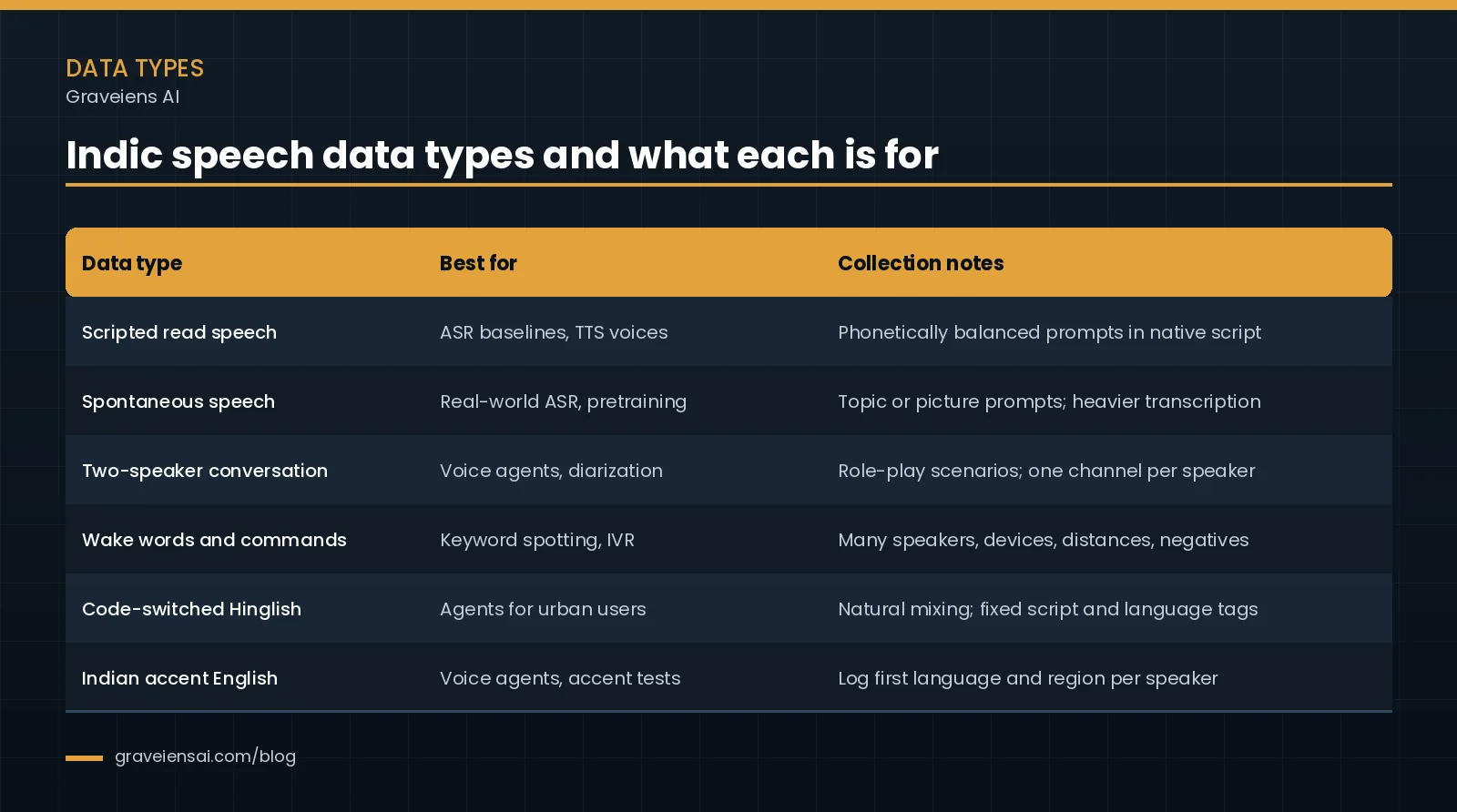
| Data type | Main use cases | Collection notes |
|---|---|---|
| Scripted read speech | ASR baselines, TTS voices, pronunciation coverage | Phonetically balanced prompts in native script. Check reading fluency. TTS usually needs studio-grade audio from a small set of voices. |
| Spontaneous (extempore) speech | ASR for real-world speech, speech model pretraining | Topic or picture prompts produce natural pauses, fillers and restarts. Transcription takes longer than for read speech. |
| Two-speaker conversational (call-centre style) | Voice agents, contact-centre ASR, diarization, speaker ID | Role-played scenarios such as banking, telecom or delivery. Record each speaker on a separate channel. Use fictional account details, never real ones. |
| Wake words and commands | On-device keyword spotting, IVR, assistants | Many speakers saying a few phrases, across distances, devices and noise. Include near-miss negatives. |
| Code-switched Hinglish | Voice agents and ASR for urban users | Elicit natural mixing through scenarios rather than forcing English words into scripts. Agree the script and tagging convention first. |
| Indian-accented English | Voice agents, global ASR fine-tuning, accent evaluation | Record each speaker’s first language and home region as metadata, so accent groups can be balanced and tested. |
Why voice agents need conversational, not just read, data
A voice agent has to handle turn-taking, interruptions, hesitations, and callers who restate a request three ways. Read speech contains none of that. The IndicVoices project from AI4Bharat made the same choice for its open corpus: of its 7,348 hours, 9% was read, 74% extempore and 17% conversational, according to the IndicVoices paper (ACL Findings 2024). For agent work, weight your budget toward the last two categories, and ask for consent-backed conversational speech data recorded on the channel your agent will use.
Indian accent English speech data
Many Indian callers start in English, then switch. Indian accent English speech data should be sampled by first language (a Tamil speaker’s English differs from a Punjabi speaker’s) and by region, not treated as one accent. Include domain vocabulary your agent will hear: product names, Indian place names, and amounts said in lakh and crore.
How do you plan language and dialect coverage?
Plan coverage in layers: pick languages from your user base, then set quotas inside each language for dialect or region, age, gender, device and recording environment. Write the quotas as targets with tolerances, track them per batch, and cap minutes per speaker so a few voices don’t dominate the dataset.
Start with the official picture. The Eighth Schedule’s 22 languages are Assamese, Bengali, Gujarati, Hindi, Kannada, Kashmiri, Konkani, Malayalam, Manipuri, Marathi, Nepali, Odia, Punjabi, Sanskrit, Sindhi, Tamil, Telugu, Urdu, Bodo, Santhali, Maithili and Dogri. The list was last expanded in 2004, per the MHA document cited above.
Then look underneath the labels. The Census of India 2011 language report (Paper 1 of 2018) started from 19,569 raw mother-tongue returns and rationalized them into 121 languages and 270 mother tongues with 10,000 or more speakers. The “Hindi” grouping alone, at 43.63% of the population, includes mother tongues such as Bhojpuri, Rajasthani, Chhattisgarhi and Awadhi. A Hindi speech dataset recorded only in Delhi will under-serve a large share of people the census counts as Hindi speakers.
Sampling quota planner
| Dimension | What to specify | Example planning choice |
|---|---|---|
| Dialect or region | States, districts or named varieties per language | Hindi split across western UP, Bihar (Bhojpuri-influenced), Rajasthan and Madhya Pradesh |
| Age | Age bands and minimum share per band | 18–25, 26–40, 41–60, 60+. Minors only with verifiable guardian consent. |
| Gender | Target split with a tolerance | Roughly balanced, with a tolerance band agreed per batch |
| Device and channel | Phone tiers, telephony, headset, far-field | Mix of budget and mid-range Android phones plus 8 kHz telephony for agent work |
| Environment | Noise conditions and their shares | Quiet room, home with TV, street, vehicle, open office |
| Speaker cap | Maximum audio per speaker | A per-speaker minute cap so no voice dominates |
| Literacy | Whether read tasks are required | Read tasks need fluent readers. Spontaneous tasks let you include speakers who don’t read the script. |
Two practical rules. First, decide which dimensions are hard quotas (must hit) and which are soft (best effort). Hard-to-reach groups, such as speakers over 60 in rural districts, take longer and cost more, so mark them early. Second, keep a held-out test set with its own speakers. If the same voice appears in training and test, your evaluation numbers will look better than reality.
How should Hinglish and code-switching speech data be transcribed?
Choose one script convention (mixed script, full Devanagari or full Roman), document it with examples, and tag the language of each word or span. Add rules for loanwords, numbers, named entities and fillers. Apply one Unicode normalization form. Then audit every batch against the guideline, because code-switched transcripts drift fast.
Code-switching speech data is where most Indic projects lose consistency. Take one spoken sentence, “kal ki meeting reschedule kar do” (“reschedule tomorrow’s meeting”). It can be written three valid ways:
| Convention | Example | Works well for | Watch-outs |
|---|---|---|---|
| Mixed script | कल की meeting reschedule कर दो | ASR that outputs native script with word-level language ID | Needs a rule for assimilated loanwords (ट्रेन or train?) |
| Full Devanagari | कल की मीटिंग रीशेड्यूल कर दो | Hindi-first ASR and TTS front ends | English words get many Devanagari spellings. A spelling lexicon is essential. |
| Full Roman | kal ki meeting reschedule kar do | Chat-style NLU that matches how users type | No single standard (“kar do” or “kardo”). Spelling must be fixed by lexicon. |
None of these is “correct” in the abstract. The right choice is the one that matches your model’s output and downstream use. What matters is that every transcriber makes the same choice for the same word.
Tagging language spans
Script alone doesn’t tell you the language. “Phone” written in Devanagari is still an English-origin word. So most code-switched specs add explicit language tags, at one of two levels:
- Word level: कल/hi की/hi meeting/en reschedule/en कर/hi दो/hi. This gives the most detail and supports language-ID training.
- Span level: mark each continuous run of one language. It’s faster to annotate and enough for many ASR tasks.
Your guideline should also settle these points before transcription starts:
- Loanword list. Which English-origin words count as assimilated Hindi (often “train”, “bus”, “phone”), and which get tagged as English.
- Numbers and amounts. Spoken form (“do baje”, “paanch lakh”) or digits. ASR training usually needs the spoken form.
- Named entities. Brand, person and place names, with a fixed spelling list.
- Fillers and disfluencies. Whether “matlab”, “haan” and false starts are kept, and how they’re marked.
- Normalization. One Unicode normalization form for all files, and a consistent nukta policy (for example, ज़ versus ज), so identical words don’t become different tokens.
- Romanization scheme. If you use Roman script, say whether it is informal “chat” spelling or a formal scheme such as ISO 15919.
The same logic applies to Tanglish (Tamil-English), Benglish and other pairs, and to Urdu, which uses Perso-Arabic script while sharing much of its spoken base with Hindi. For more on how transcripts feed recognition models, see our guide to AI transcription, accuracy and WER.
What consent and compliance does Indic voice data need?
Every speaker should give explicit, informed consent in a language they understand, for named purposes such as ASR training or synthetic voice creation, with an easy way to withdraw. In India this aligns with the DPDP Act 2023. For speakers in the EU, GDPR applies, and voice used to identify people can be special-category biometric data.
Consented voice data for AI is more than a signed form. It’s a chain of evidence linking each audio file to a specific person’s informed agreement for a specific use.
India: DPDP Act 2023 and DPDP Rules 2025
The Digital Personal Data Protection Act, 2023 (No. 22 of 2023) requires that consent be “free, specific, informed, unconditional and unambiguous with a clear affirmative action” (Section 6). It also requires that withdrawing consent be as easy as giving it.
The DPDP Rules, 2025 were published as G.S.R. 846(E), dated 13 November 2025, and announced by MeitY the next day. They commence in phases. As of October 2026, per the Rules’ commencement clause:
- Rules 1, 2 and 17 to 21 (definitions and the Data Protection Board) took effect on publication.
- Rule 4 (consent managers) takes effect one year after publication, in November 2026.
- Rules 3, 5 to 16, 22 and 23 (including notice, security safeguards, breach reporting and children’s data) take effect eighteen months after publication, around May 2027.
Industry reports in 2026 said MeitY had consulted on shortening parts of this timeline. Check the current notification before you finalize your compliance plan. Either way, build to the 2027 standard now. Datasets you collect today will still be in use when the full rules apply.
EU speakers: GDPR
If you record speakers located in the EU, the GDPR is likely to apply. Treat voice recordings as personal data. Where voice is processed to uniquely identify someone (speaker ID or voice biometrics), it becomes biometric data under Article 9’s special categories. Processing it is then prohibited unless an exception applies, and for data collection that exception is usually explicit consent. Take legal advice on your specific setup.
What a consent record should hold
- Pseudonymous participant ID linked to every file they contributed
- The notice shown, its version and its language
- Each purpose consented to, as separate items (ASR training, evaluation, TTS, voice cloning)
- Who will receive the data, and how long it will be retained
- How the participant can withdraw, and what happens to their files if they do
- Timestamp and form of the affirmative action
- Guardian details and verification for any minor
Purpose limitation in practice: consent to “speech recognition research” doesn’t cover cloning someone’s voice. If TTS or synthetic voice is in scope, ask for it as a separate, clearly explained opt-in. Also keep personal data out of the audio. Use fictional names and account numbers in role-plays, and redact any personal details that come up in spontaneous speech.
How does an Indic speech data collection project run?
A well-run project moves through six stages: a written specification, speaker recruitment with consent, managed recording, transcription and annotation, quality assurance, and delivery with full metadata. A short pilot through all six stages, in one language, catches most problems before you commit to full volume.
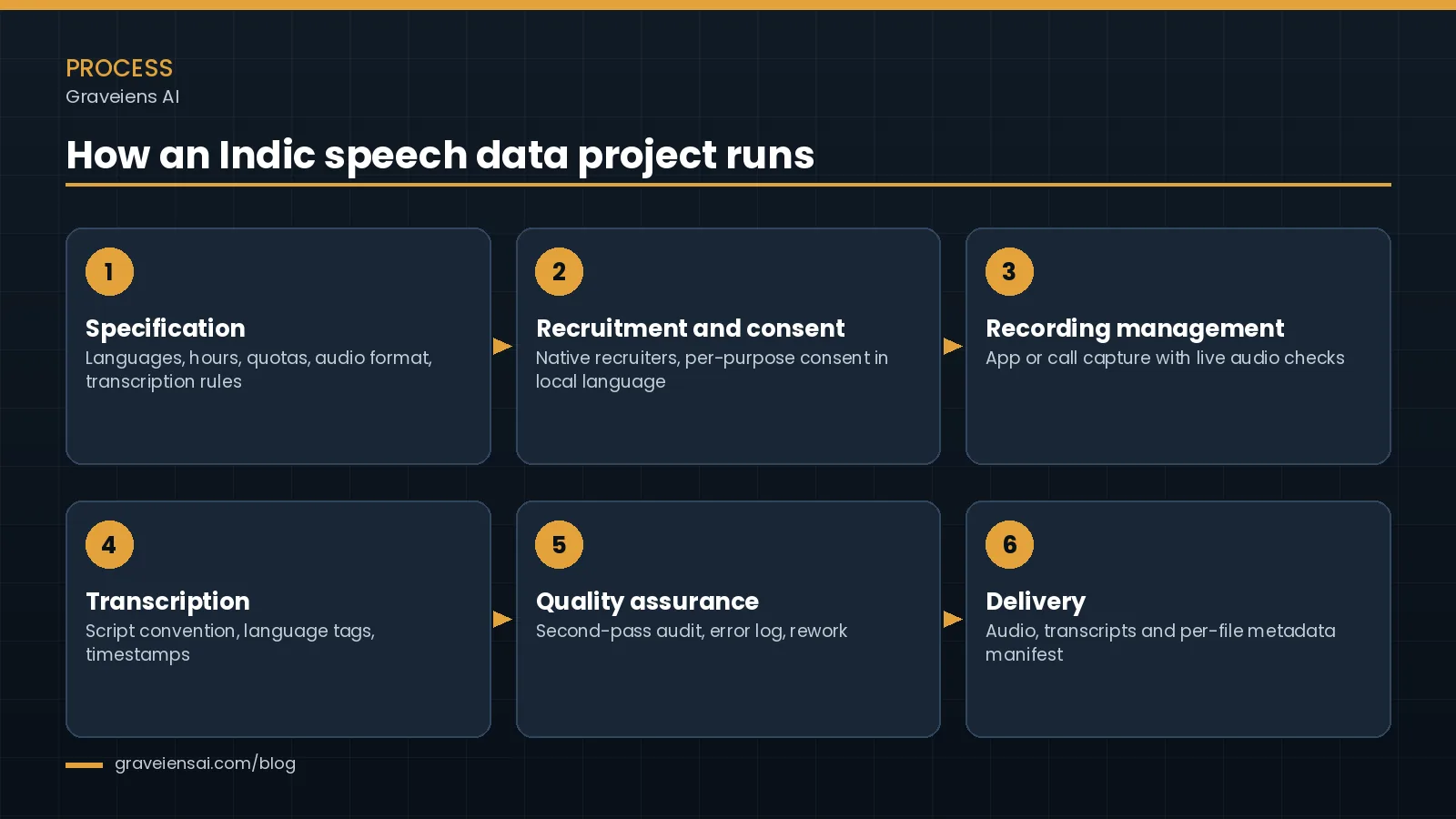
- Specification. Languages, hours, data types, quotas, audio format (for example, 16 kHz 16-bit mono WAV for ASR, 8 kHz for telephony, 48 kHz for TTS), the transcription convention and the acceptance criteria.
- Speaker recruitment and consent. Native-speaker recruiters source participants against the quotas. Each person gets the notice in their language, gives consent per purpose, and is screened for language fluency and duplicate enrollment.
- Recording management. Prompts and scenarios are served through a recording app or call setup. Automatic checks flag clipping, silence, wrong sample rate and background noise at capture time, so speakers can re-record on the spot.
- Transcription and annotation. Native-speaker transcribers follow the written guideline: script convention, language tags, timestamps, speaker turns, and noise and event tags. Our audio transcription services page covers the verbatim and time-aligned options.
- Quality assurance. A second reviewer audits a sample (or every file, for evaluation sets), with errors logged by type. Batches below the agreed threshold go back for rework.
- Delivery with metadata. Audio, transcripts and a manifest with speaker ID, language, dialect or region, age band, gender, device, environment and consent reference for each file.
How much does speech data collection cost per hour?
Speech data collection cost per hour depends on language rarity, how spontaneous the speech is, unique speakers per hour, audio spec, recording environment, transcription depth, QA level and licensing terms. Read speech in a widely spoken language with light transcription sits at the low end. Exclusive conversational data in a rare dialect sits at the high end.
Instead of trusting a single per-hour figure, ask any vendor to price against your spec and to show how each driver below moves the number.
| Cost driver | Pushes cost down | Pushes cost up |
|---|---|---|
| Language rarity | Hindi, Bengali, Marathi, Tamil, Telugu | Smaller languages and named dialects with few available speakers |
| Speech type | Scripted read speech | Spontaneous and two-speaker conversation, which take more setup and harder transcription |
| Speakers per hour | Fewer speakers recording longer sessions | Many unique speakers, each contributing a few minutes |
| Audio specification | 16 kHz mono on smartphones | 48 kHz studio capture, multi-channel or far-field arrays |
| Environment | Speakers’ own homes, uncontrolled | Studio booths or specific controlled noise conditions |
| Transcription depth | Orthographic transcript only | Verbatim with timestamps, language-span tags, diarization and event labels |
| QA level | Sample-based audit | 100% second-pass review and double transcription for test sets |
| Demographic quotas | Loose targets | Hard quotas for hard-to-reach groups, such as rural speakers over 60 |
| Licensing | Non-exclusive licence | Exclusive rights or full ownership transfer |
Two levers usually save the most money without hurting quality. First, transcribe only what you’ll train on. Spontaneous audio can be collected at volume and transcribed in phases. Second, separate the evaluation set. Spend on 100% QA for a smaller, carefully balanced test set, and use sample-based QA for bulk training data.
How to choose an Indic speech data vendor: an 8‑point scorecard
Score each vendor from 0 to 2 on eight checks: a real sample in your language, consent artefacts, speaker provenance, quota reporting, a written transcription guideline, measurable QA, audio spec checks and clear licensing. A score of 14 to 16 means ready to pilot. 10 to 13 means pilot with conditions. Below 10, keep looking.
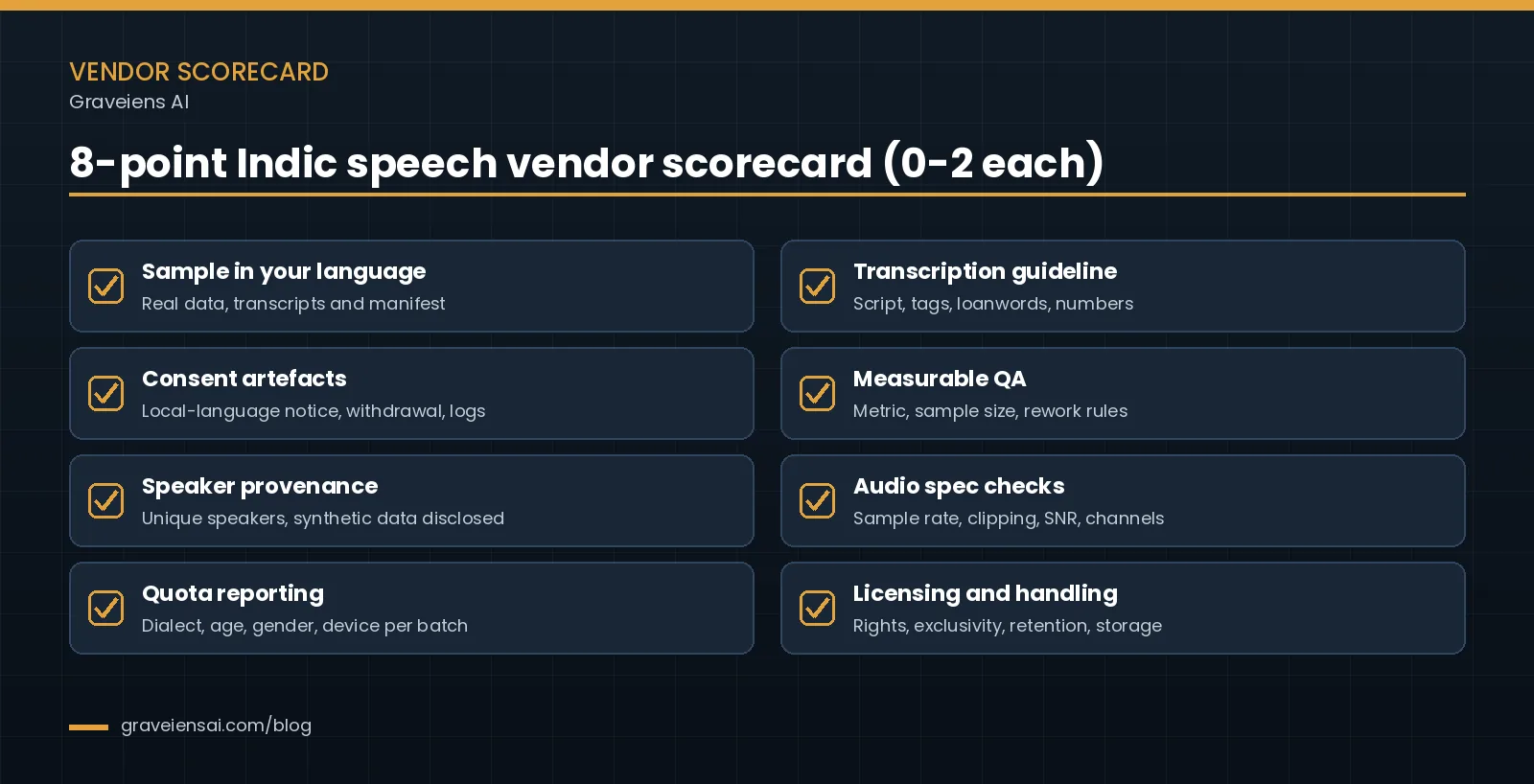
- Sample in your language. A real sample set in your target language and data type, with transcripts and a metadata manifest. Not a generic demo reel.
- Consent artefacts. The participant notice in the local language, the per-purpose consent screen, the withdrawal process, and consent records linked to file IDs.
- Speaker provenance. Real, unique speakers with duplicate checks. Any synthetic or augmented audio is disclosed and labeled.
- Quota reporting. Per-batch reports of actual dialect, age, gender, device and environment shares against your targets.
- Written transcription guideline. Covers script convention, language tags, loanwords, numbers, fillers and normalization, with worked examples.
- Measurable QA. A defined metric (such as transcript error rate on an audited sample), the sample size, rejection reasons and rework rules.
- Audio spec checks. Automated checks for sample rate, bit depth, clipping, silence, signal-to-noise and channel separation.
- Licensing and data handling. Clear rights grant, exclusivity terms, storage location, retention and deletion, and any sub-processors.
Add one commercial test on top: does the vendor invoice only for files that pass your acceptance criteria? Paying for accepted files keeps both sides focused on the same quality bar.
Want to run this scorecard on us? Request a free 30-minute sample set in your target language and score it against your own spec, or scope a pilot billed only on approved files.
Common mistakes in Indic speech data projects
- Treating “Hindi” as one accent. Without dialect and region quotas, the dataset skews to whoever was easiest to recruit.
- Forcing code-switching into scripts. Scripted Hinglish sounds unnatural. Use scenarios that make people mix languages the way they normally do.
- Studio audio for a phone product. If users call over telephony, record and test at telephony quality.
- Changing the transcription convention mid-project. It splits your data into inconsistent halves. Lock it after the pilot.
- Vague consent. A single “AI research” checkbox won’t cover voice cloning or resale. Name each purpose.
- Speaker overlap between training and test sets. It inflates evaluation results and hides real-world errors.
How Graveiens AI delivers Indic speech data
Graveiens AI runs Indic voice projects on an explicit-consent workflow: participant onboarding → recording management → metadata tagging → QA. Every contributor is onboarded with consent before recording, every file carries metadata, and every batch passes QA before delivery. You’re invoiced only for approved files, which keeps a first pilot low-risk.
Indic languages we cover: Hindi, Urdu, Bengali, Marathi, Gujarati, Punjabi, Assamese, Telugu, Tamil, Malayalam, Kannada, Odia, Konkani and Nepali, plus Indian English. These sit within our wider coverage of 25+ languages, and both scripted and conversational collection are available on our voice and speech data services page.
How a typical engagement runs:
- Scoping. We turn your use case into a written spec covering data types, quotas, audio format, the code-switching convention and acceptance criteria. For anything outside our standard catalogue, we scope it with you.
- Pilot. One language and one data type, end to end, so you can check audio, transcripts and metadata against your spec before scaling.
- Scale-up. Batch-wise delivery with quota reporting, transcription by native speakers, and the same QA gate on every batch.
- Language support. Translation, localization of prompts and scripts, and subtitling are available through our language and localization services.
Graveiens AI is ISO 9001 certified. We don’t promise accuracy gains for your model. That depends on your architecture and evaluation. What we commit to is data that matches the spec you sign off.
How many hours of Indic speech data do I need?
It depends on whether you’re training from scratch, fine-tuning an existing multilingual model or only building an evaluation set. Fine-tuning usually needs far less than training from scratch. For scale, the IndicVoices paper reported a median of 73 transcribed hours per language in 2024. Start with a pilot, measure errors on a held-out test set, then add hours where the model is weakest.
What is the difference between a Hindi speech dataset and a Hinglish speech dataset?
A Hindi speech dataset is mostly monolingual Hindi, often with a few established English loanwords. A Hinglish speech dataset captures natural switching between Hindi and English within and across sentences, the way many urban speakers talk. Hinglish data needs language-span tags and a fixed script convention, and it’s essential for voice agents serving metro users.
Should Hinglish be transcribed in Devanagari or Roman script?
Either can work. Mixed script (Hindi in Devanagari, English in Roman) suits ASR with word-level language ID. Full Devanagari suits Hindi-first systems. Full Roman matches how users type in chat. Pick the convention that matches your model’s output, document it with examples, and tag language spans so the choice doesn’t erase which language was spoken.
Is consent required to collect voice data in India?
Yes. A voice recording is personal data, and India’s DPDP Act 2023 requires consent that is free, specific, informed, unconditional and unambiguous, given through a clear affirmative action and as easy to withdraw as to give. The DPDP Rules 2025 phase in through 2027. Use per-purpose consent in the speaker’s language, with records linked to each file.
What audio format should Indic speech data be delivered in?
For most ASR work, 16 kHz, 16-bit, mono, uncompressed WAV is a common choice. For telephony or contact-centre models, 8 kHz audio matches the production channel. TTS voices usually need 44.1 or 48 kHz studio recordings. For conversations, ask for separate channels per speaker, and always get a manifest with speaker and recording metadata.
Can I use IndicVoices or Mozilla Common Voice instead of custom collection?
Public datasets such as IndicVoices, Mozilla Common Voice and resources shared through India’s Bhashini mission are useful for research, pretraining and benchmarking. Before using one commercially, check its license terms. Also check whether its speakers, domains and recording conditions match your product. Most teams combine public data with custom collection for their own domain, channel and code-switching needs.
What drives speech data collection cost per hour?
The main drivers are language rarity, spontaneous versus read speech, the number of unique speakers per hour, audio specification (16 or 48 kHz), recording environment, transcription depth, QA level, demographic quotas and licensing exclusivity. Ask vendors to price against your written spec and show how each driver changes the figure, rather than quoting a flat rate.
Request a free 30-minute sample set in your target language
Tell us your language, data type and audio spec. We’ll record and transcribe a 30-minute sample set, free of charge, for you to check against your own acceptance criteria. If you go ahead, the pilot is billed only on approved files.
Request your free sample set · Ask us for the Indic speech scoping worksheet covering language, quota and consent fields.
Sources
- Ministry of Home Affairs, Government of India. Languages included in the Eighth Schedule of the Constitution.
- Office of the Registrar General and Census Commissioner, India. Language (Paper 1 of 2018), Census of India 2011.
- Ministry of Law and Justice. The Digital Personal Data Protection Act, 2023 (No. 22 of 2023), official text hosted by MeitY.
- Javed et al. IndicVoices: Towards building an Inclusive Multilingual Speech Dataset for Indian Languages. Findings of ACL 2024.
- Ministry of Electronics and Information Technology. Digital Personal Data Protection Rules, 2025, G.S.R. 846(E), Gazette of India, 13 November 2025 (published on meity.gov.in).
- Digital India Corporation, MeitY. Bhashini, National Language Translation Mission (bhashini.gov.in).

Jitendra Choubay is the CEO & Founder of Graveiens AI, leading a human-in-the-loop data services team that helps AI builders with data collection, annotation, consent-backed voice data, transcription and LLM fine-tuning. He writes on building better, ethically sourced AI training data.
Get the next Graveiens AI article
Expert notes on AI data, annotation, LLMs and eLearning — no spam, unsubscribe anytime.
Need AI Development? Data Annotation? eLearning?
Talk to Graveiens AI about data collection, annotation, voice data, RLHF/SFT, LLM evaluation and AI training data — invoiced only on approved work.
Contact Graveiens AI