Last updated: October 2026
Key takeaways
- Humanoid robot training data is time-synced, multimodal data: video, depth, joint states, actions, and language. It teaches perception, task meaning, and motor control together.
- No single source covers everything. Egocentric video brings breadth, teleoperation brings robot-native actions, simulation brings scale, and motion capture brings whole-body movement.
- Published recipes such as NVIDIA’s GR00T N1 arrange data as a pyramid. Web and human video form the base, synthetic data the middle, and scarce real-robot data the top.
- Most dataset problems come from gaps in sync, calibration, and consent, not from too little volume. Write those specs before anyone records.
- Start with a small pilot tied to one skill, with clear acceptance criteria and payment only for files that pass review.
For most robotics teams, humanoid robot training data becomes the bottleneck right after the first demo. A model can borrow vision and language skills from the web. It cannot borrow the motion of opening a fridge door with a hand that has your robot’s joints, cameras, and reach.
This guide is for teams that need to build or buy that data. It covers what humanoids actually learn from and how each source is collected. It also shows how the mix shifts by training stage and which sync and consent specs decide whether a file is usable. It ends with a practical way to scope your first data program.
Planning a capture program? Scope a pilot billed only on approved files.
What is humanoid robot training data?
Humanoid robot training data is a set of time-aligned recordings that pair what a robot, or a human stand-in, sees and senses with what it does next. A useful episode combines camera video, often depth, body and joint states, actions, and a language instruction. That lets a model learn perception, task intent, and motor control together.
In short: it is demonstration data with a clock, a body, and a goal attached. Like most robot learning from demonstration data, each step pairs an observation with the action a demonstrator took.
It helps to split what a humanoid must learn into four layers. Each data source covers some layers well and others poorly.
- Perception. Objects, hands, surfaces, and people, seen from many angles and in many lighting conditions.
- Task semantics. What “put the cup away” means, which steps it involves, and when each step is done.
- Actions and proprioception. Joint positions, hand or gripper states, end-effector poses, and sometimes forces, tied to each frame.
- Whole-body control. Balance, stepping, reaching high and low, and carrying objects while moving.
Web video is rich in the first two layers and thin on the last two. That is why physical AI data programs look so different from image-labeling projects. For the wider context, see our guide to physical AI and robotics training data. If you are newer to the modeling side, our explainer on how robots learn covers the basics.
The embodiment gap
Every source except teleoperation on your own robot carries an embodiment gap. A human head camera sits at a different height and angle from a robot’s cameras. Human hands, arm lengths, and joint limits also differ from the robot’s.
So data recorded on one body has to be translated to another. The EgoHumanoid team, for example, built two alignment steps for this. One is view alignment, which reduces differences caused by camera height and perspective. The other is action alignment, which maps human motion into a kinematically feasible action space for the humanoid (Shi et al., arXiv 2602.10106).
Where does humanoid robot training data come from? Four sources compared
Humanoid robot training data comes from four main sources: egocentric video of people doing tasks, teleoperation of the target robot, simulation and synthetic generation, and motion capture of human bodies. Each teaches a different layer. Real programs blend them, using cheap, broad sources for general priors and robot-native data for final control.
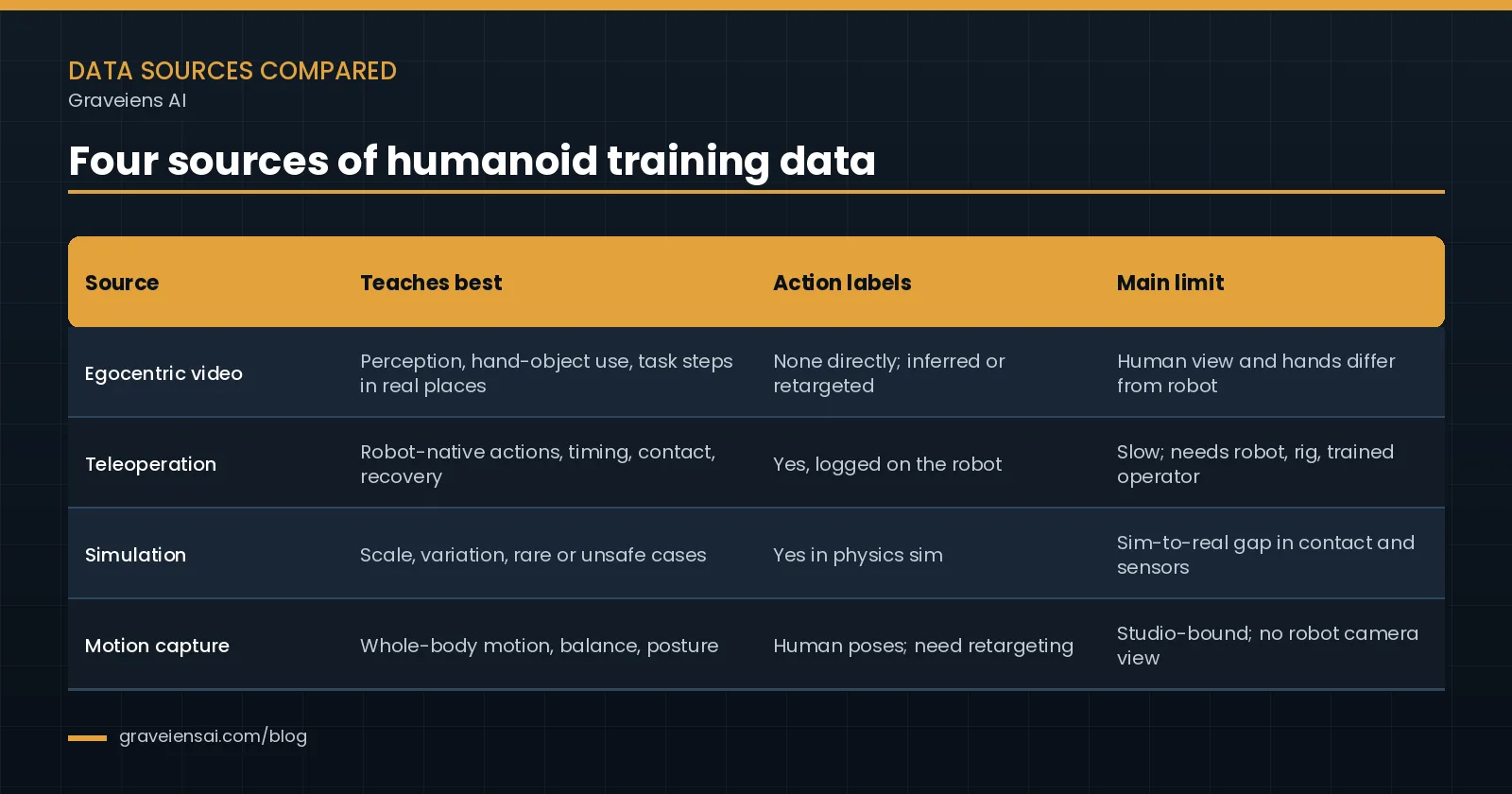
| Source | What it teaches best | Action labels | Main limit |
|---|---|---|---|
| Egocentric human video | Perception, hand-object interaction, and task steps across many real places | None directly; inferred, retargeted, or learned as latent actions | Human viewpoint and hands differ from the robot’s |
| Teleoperation on the robot | Robot-native actions, timing, contact, and recovery | Yes; joint states and commands logged on the robot | Slow and hardware-bound; each hour needs a robot, a rig, and a trained operator |
| Simulation and synthetic data | Scale, variation, and rare or unsafe cases | Yes in physics simulation; inferred for generated video | Sim-to-real gap in contact, materials, and sensor noise |
| Motion capture | Whole-body kinematics, balance, and natural posture | Human body poses that need retargeting to robot joints | Usually studio-bound; no robot camera view unless paired with one |
Egocentric video for robotics
Egocentric video is first-person footage of people doing real tasks, recorded from a head-mounted or chest-mounted camera. It is the cheapest way to cover many homes, kitchens, shops, and work sites. It also captures hands and objects from a viewpoint close to a humanoid’s head camera.
Scale and variety are its strengths. As of October 2026, the Ego4D project site lists 3,670 hours of video from 923 participants in 74 locations across 9 countries. The team deliberately used seven different head-mounted camera models to avoid overfitting to a single device (Ego4D).
The catch is actions. Human video has no joint commands. The GR00T N1 paper notes that its human video datasets lack explicit action labels. They still capture “affordances, task semantics, and natural motion patterns.” To use that footage for control, the authors trained a latent-action model and an inverse dynamics model to add pseudo-actions (NVIDIA, arXiv 2503.14734).
Custom collection closes gaps that public sets leave open. Examples include your target tasks, your environments, and a camera rig matched to your robot’s field of view. That is the work our egocentric video data collection service is built around.
Teleoperation data
In teleoperation, a trained operator drives the real robot, or a matched rig, through a task in real time. Control comes through leader-follower arms, a VR headset with controllers, or similar devices. Because the robot logs its own joint states and commands, the action labels are native. Nothing has to be estimated.
The cost is throughput. DROID, a large open dataset for a single robot arm rather than a humanoid, shows the effort involved. Its team collected 76,000 demonstration trajectories, or 350 hours, across 564 scenes and 86 tasks. The work took 50 data collectors on three continents about 12 months. Each station paired a 7‑DoF arm with two adjustable stereo cameras, a wrist stereo camera, and a VR headset for teleoperation (DROID).
For humanoids, teleoperation data usually sits at the top of the stack, where it anchors the policy to the actual hardware. See our teleoperation data services for how operator sessions are run.
Simulation and synthetic data
Simulation produces labeled trajectories at a scale real capture cannot match. It also handles cases you cannot safely stage, like a dropped glass near a person. The GR00T N1 team started from a few dozen teleoperated source demonstrations. From those, a simulation tool called DexMimicGen generated 540,000 new demonstrations for 54 source-and-target combinations in tabletop tasks.
The same paper used video-generation models to create “neural trajectories.” This grew its in-house teleoperation data from 88 hours to roughly 827 hours. The pattern is consistent: synthetic data multiplies a real seed. It does not replace it, because contact physics, materials, and sensor noise still differ from the real world. Our simulation and synthetic data work follows the same principle.
Motion capture and human-to-humanoid retargeting
Motion capture records full-body pose using optical markers, inertial suits, or VR trackers. It is the best source for balance, stepping, crouching, and natural posture. Those are exactly the whole-body control skills that hand-focused video misses.
Mocap data must be retargeted to the robot’s skeleton, which means respecting joint limits, foot contacts, and mass distribution. It also lacks a robot-view camera, so pair it with a head or chest camera if you are training a vision-driven policy.
How should the data mix change by task stage?
The mix should move from broad to robot-specific as training progresses. Early pretraining favors large volumes of human and web video for general priors. Middle stages add simulation and synthetic data for scale. Final post-training leans on teleoperation from the target robot, plus evaluation sets recorded in real deployment settings.
The GR00T N1 paper describes this as a data pyramid. Web data and human videos form the base. Synthetic data from physics simulation or neural generation forms the middle. Real-robot data completes the top. In the authors’ words, “data quantity decreases, and embodiment-specificity increases, moving from the bottom to the top.”
| Stage | Goal | Main sources | What to check |
|---|---|---|---|
| Pretraining | Visual and behavioral priors | Web video, public and custom egocentric video | Variety of places, objects, and hands; license terms |
| Skill expansion | More task variants and rare cases | Simulation, synthetic augmentation, motion capture | Randomized scenes; sim assets that match real objects |
| Embodiment post-training | Robot-native control for target skills | Teleoperation on the target robot or a matched rig | Sync, calibration, success labels, recovery demos |
| Evaluation | Measure real performance | Held-out real episodes in deployment-like settings | Never mixed into training; covers edge cases |
There is no universal ratio. Avoid copying a mix from a paper. The right weighting depends on your model, your robot, and how far your target tasks sit from public data.
The GRASP test: five questions for any humanoid dataset
Before you pay for a batch of data, whether public, synthetic, or custom, run it through five questions. We call this the GRASP test. It turns a vague “is this useful?” into a scorecard your ML lead, ops lead, and legal reviewer can all read.
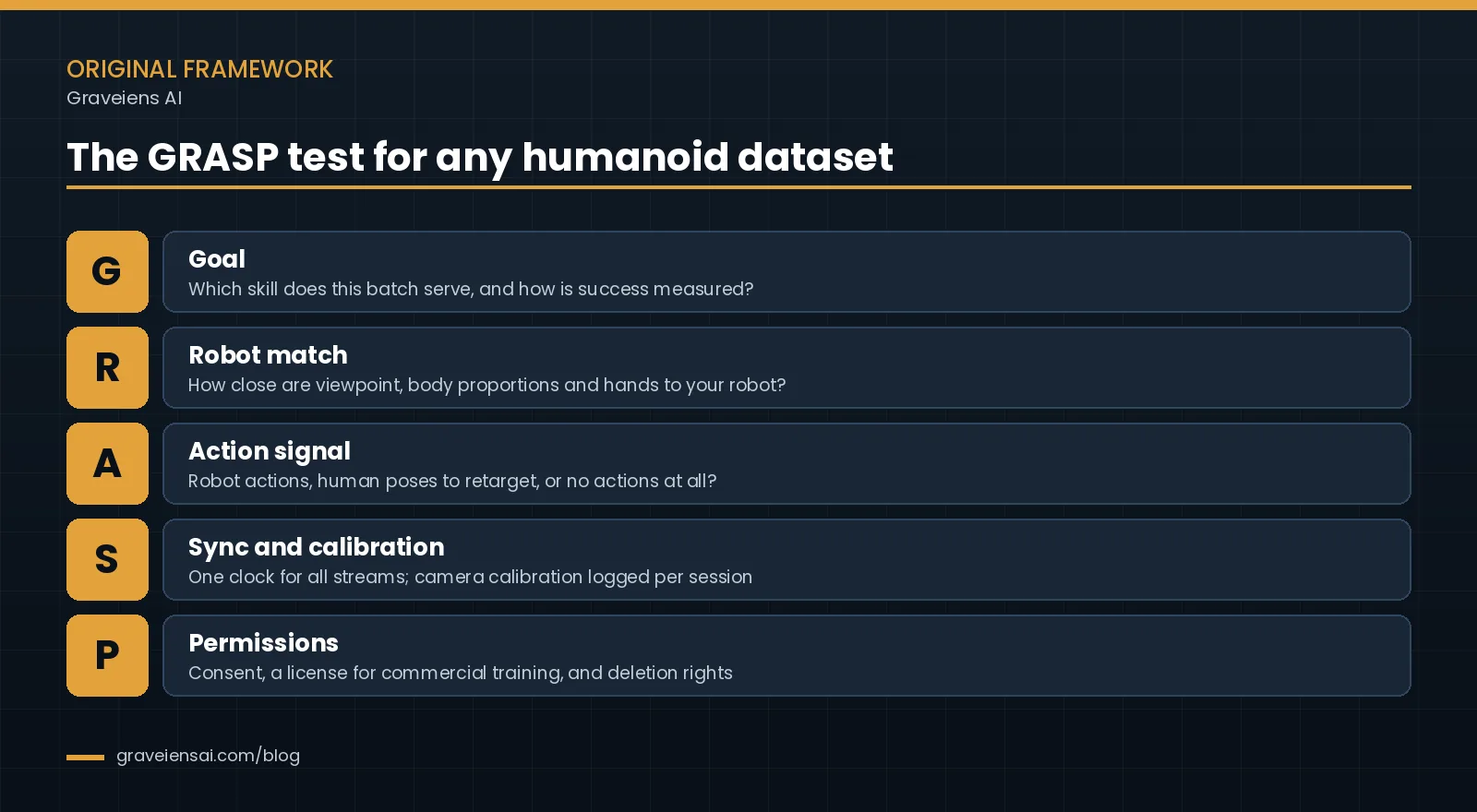
- G: Goal. Which skill does this batch serve, and how will you measure success? A batch without a target skill is just storage cost.
- R: Robot match. How close are the viewpoint, body proportions, and hands to your robot? Check camera height, field of view, and hand type.
- A: Action signal. Does the data carry robot actions, human poses that need retargeting, or no actions at all? Know this before you budget for labeling.
- S: Sync and calibration. Are all streams on one clock? Are camera intrinsics and extrinsics logged for every session?
- P: Permissions. Do you hold consent, a license that covers commercial training, and the ability to honor deletion requests?
How to score it. Rate each letter 0, 1, or 2. A zero on S or P is a stop, because no model fix repairs bad timing or missing consent. A low R score is fine for pretraining but not for post-training. A low A score means you need a plan, such as retargeting or latent actions, before the data earns its keep.
Public egocentric video, for instance, can score well on G for perception pretraining. It usually scores low on R and A. Its P score depends on the license; Ego4D, for example, requires you to sign a license agreement before download. Teleoperation on your own robot scores high on R and A, but cost limits its volume.
Turning GRASP into a capture spec? Ask us for the CAPTURES checklist, a field-by-field list of the sync, metadata, and consent items to agree before a pilot.
What quality and sync specs should a humanoid dataset meet?
A humanoid dataset should put every stream on one clock and log camera calibration per session. It should record joint states and actions at the robot’s control rate and segment episodes with language and success labels. Write these as numeric acceptance criteria before capture, so reviewers approve or reject each file against the same rules.
In short: if it is not in the spec, it will not be in the data.
- One clock. Use hardware sync or a shared time source across cameras, IMUs, and robot logs. Keep per-frame timestamps, not per-file ones, and set a maximum allowed offset in the spec.
- Calibration. Log intrinsics and extrinsics for every camera, and re-check them whenever a rig is moved or bumped. DROID covers 1,417 camera viewpoints with stereo calibration. Even so, in April 2025 its team released improved calibrations for 36,000 episodes. Treat calibration as part of the deliverable, because fixing it later is expensive.
- Rates. State frame rate, resolution, and control rate up front. GR00T N1’s action module generates motor actions at 120 Hz. At rates like that, a few frames of drift between video and joint states turns into label noise.
- Episode structure. Each episode needs a clear start and end, a language instruction, and a success or failure flag. Keep recovery attempts instead of trimming them, because they teach the policy how to fix mistakes.
- Metadata. Record rig ID, environment type, lighting, objects, a pseudonymous participant ID, and a consent reference.
- Coverage plan. Plan variation across rooms, objects, lighting, operators, and devices. Ego4D’s choice of seven camera models to avoid single-device overfitting is a good model.
- Format. Match your training loader. DROID, for example, ships episodes that pair exterior and wrist camera images with an action and a language instruction at each step.
Common quality failures
- Dropped frames hidden by re-encoding, which breaks frame-to-action alignment.
- Slow clock drift across long sessions that nobody measured.
- Hands leaving the frame during the critical grasp.
- Operators moving unnaturally fast or slow to “finish the episode.”
- Failures trimmed out, leaving the policy with no examples of recovery.
Consent and privacy in humanoid robot data collection
Humanoid robot data collection often happens in homes, shops, and work sites. That means it records faces, voices, screens, documents, and bystanders, not just the task. Consent has to cover the participant, the site, and anyone else likely to appear. Every file should be traceable back to that consent.
- Participant consent. Get explicit, informed consent that names the purpose (robot model training), the data types captured, retention, and how to withdraw.
- Site permission. Get written permission from the owner or operator of each location.
- Bystanders. Decide in advance whether to avoid them, blur them, or obtain their consent, and brief capture teams on the rule.
- De-identification. Blur faces and readable screens where consent does not cover them, and review a sample before delivery.
- Operators count too. In teleoperation, cameras and microphones may capture the operator, so they need consent as well.
- Public datasets have terms. Ego4D states that collecting partners hold consent or release forms for all videos and that most videos were de-identified before release. Access still requires a signed license agreement, so check that your use fits it.
Teams collecting in India should map their consent flow to the Digital Personal Data Protection Act, and teams capturing in the EU to the GDPR. Our guide to choosing an egocentric data collection vendor shows which consent records to ask for before you sign.
How do you scope a humanoid data program?
Scope a humanoid data program around one or two target skills, not a data volume. Map your robot’s cameras and body, pick sources with the GRASP test, and write a capture spec with acceptance criteria. Then run a small pilot. Scale only after reviewed files show the spec works in your training pipeline.
Put simply, treat humanoid robot training data as a product with a spec, not a commodity bought by the hour.
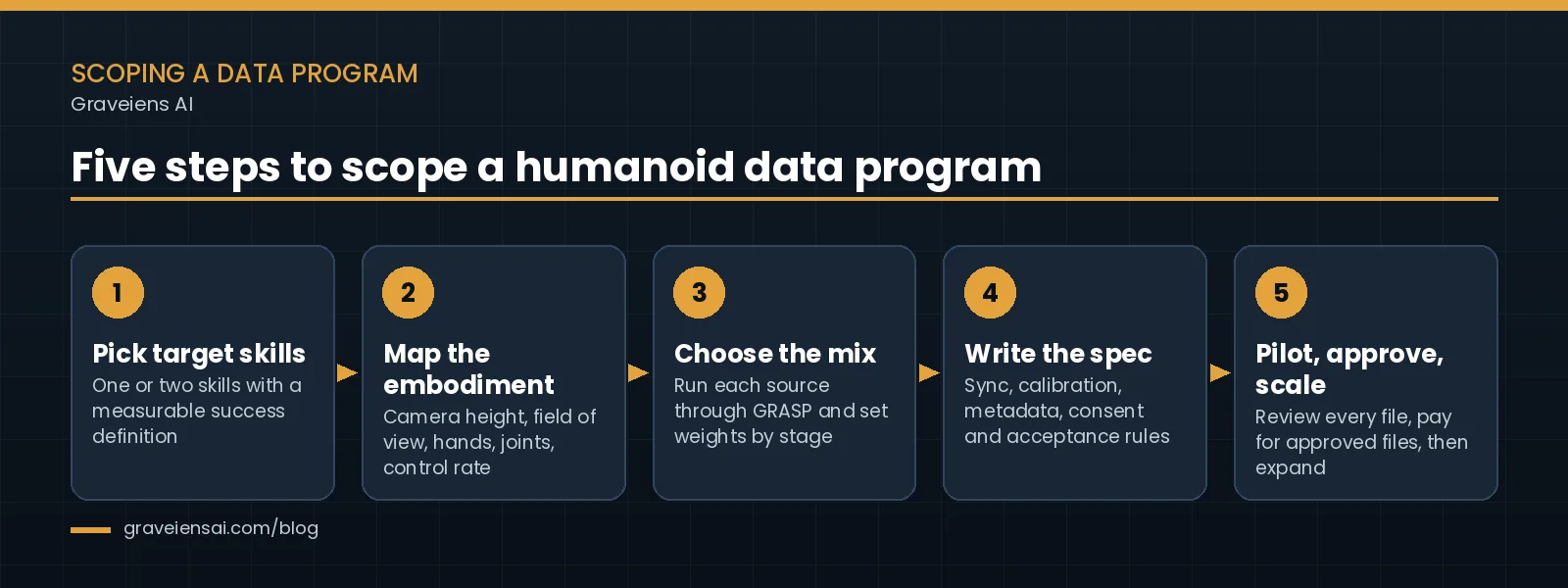
- Pick target skills. Choose one or two skills, such as “load a dishwasher rack,” with a success definition you can measure on the robot.
- Map the embodiment. List camera positions, field of view, hand type, degrees of freedom, and control rate. This becomes the reference for rig design.
- Choose the mix. Run each candidate source through GRASP. Decide what comes from public data, custom egocentric capture, simulation, and teleoperation.
- Write the spec. Set sync tolerance, calibration routine, metadata fields, consent forms, and per-file acceptance rules. Include what counts as a rejected file.
- Pilot, approve, scale. Capture a small batch, review every file against the spec, and load approved files into your pipeline. Fix the spec, then expand.
What drives cost and effort
Exact budgets depend on your scope, but the same drivers show up in every program.
- Task complexity. Bimanual, long-horizon, or contact-heavy tasks take longer per episode and need more operator training.
- Robot time. Teleoperation volume is capped by the number of robots or matched rigs available.
- Environment access. Homes and industrial sites take time to recruit, schedule, and clear for consent.
- Sensor stack. Depth, stereo, IMUs, and gloves add setup, calibration, and storage.
- Annotation depth. Step segments, language labels, and hand keypoints each add review passes.
- Rejection rate. A tight spec raises early rejections but lowers rework later.
- Privacy processing. Blurring and consent review scale with how public the capture setting is.
Mistakes to avoid
- Buying hours instead of skills. Volume without a target skill rarely moves a policy.
- Ignoring viewpoint. A chest camera and a head camera teach different things.
- Treating calibration as an afterthought.
- Throwing away failed attempts.
- Evaluating in the same rooms you trained in.
How Graveiens AI supports humanoid data programs
Graveiens AI runs human data collection for physical AI teams, with consent and file-level review built into the workflow. Here is what that looks like for humanoid robot training data.
- Explicit-consent collection. Every project follows the same path: participant onboarding, then recording and capture management, then metadata tagging, then QA.
- Rigs matched to your robot. We use head-mounted smartphone rigs, action cameras, stereo and depth rigs, VR headsets, AI smart glasses, and custom rigs matched to a robot’s camera field of view.
- Real environments. We capture at industrial sites, in agricultural work, in households, on retail floors, and in kitchens.
- Teleoperation and simulation. These are newer offerings, and we are onboarding pilot partners. Teleoperation uses trained operators on leader-follower and VR rigs. Simulation work builds on open tools so outputs stay portable.
- Language coverage. We support 25+ languages, including deep Indic coverage, for spoken task narration and instructions.
- Billing on approved files. You pay for deliverables that pass the acceptance criteria agreed at scoping.
- Certified quality system. Graveiens AI is ISO 9001 certified.
Need something outside that list, such as full-body motion capture? We scope this with you.
Frequently asked questions
What data are humanoid robots trained on?
Humanoid robots are trained on a blend of sources. These include web and human video, egocentric recordings of people doing tasks, simulation and synthetic trajectories, motion capture, and teleoperation data recorded on the robot itself. The broad sources teach perception and task meaning. Robot-native data teaches the exact joint-level actions, timing, and contact the policy needs to control real hardware.
How is humanoid robot data collected?
Teams collect it in four main ways. People wear head or chest cameras while doing real tasks. Trained operators teleoperate the robot through demonstrations. Simulators generate trajectories at scale. Motion capture systems record full-body movement. Every stream is time-synced, calibrated, labeled with the task, and reviewed against acceptance criteria before training.
Can humanoid robots learn from human videos?
Yes, with extra work. Human video teaches perception, task steps, and how hands interact with objects, but it has no robot actions. Researchers infer actions with latent-action or inverse dynamics models, or retarget human motion to the robot. They also align viewpoints. Human video then supplements, rather than replaces, a smaller set of robot-native demonstrations.
What is teleoperation data in robotics?
Teleoperation data is recorded while a human operator controls a robot in real time, using leader-follower arms, VR controllers, or similar devices. The robot logs its own joint states, commands, and camera feeds. That makes the action labels native to the hardware, which is why teleoperation usually anchors the final training stage.
Is synthetic data enough to train a humanoid robot?
Not on its own. Simulation and generated video add scale, variation, and rare cases cheaply. Published work such as GR00T N1 uses them to multiply a small set of real demonstrations. But contact physics, materials, and sensor noise still differ from reality. Real teleoperation and real-world evaluation data remain necessary to close that gap.
How much training data does a humanoid robot need?
There is no fixed number. It depends on the model, the robot, and how far the target skills sit from public data. A better approach is to scope by skill. Define success for one or two tasks, run a pilot, and measure results on the robot. Then scale the sources that move performance.
Do you need consent to record egocentric video for robot training?
Yes. Egocentric footage captures the wearer and often bystanders, homes, screens, and voices. Get explicit, informed consent from participants and site owners. Set rules for bystanders, de-identify where consent does not reach, and link every file to its consent record. In India, align the process with the Digital Personal Data Protection Act.
Scope a pilot billed only on approved files
Tell us your robot, your target skills, and where it will work. We will propose a capture mix, a spec with acceptance criteria, and a small pilot. You pay only for files that pass review.
Scope a pilot billed only on approved files. You can also ask us for the CAPTURES checklist.
Sources
- NVIDIA et al., “GR00T N1: An Open Foundation Model for Generalist Humanoid Robots,” arXiv:2503.14734. arxiv.org/abs/2503.14734
- DROID Dataset Team, “DROID: A Large-Scale In-the-Wild Robot Manipulation Dataset,” project page. droid-dataset.github.io
- Ego4D Consortium, “Egocentric 4D Perception (Ego4D),” project site. ego4d-data.org
- Shi et al., “EgoHumanoid,” arXiv:2602.10106 (v2, June 2026). arxiv.org/abs/2602.10106
About the author
Graveiens AI Editorial Team. The Graveiens AI editorial team writes about human data for AI: egocentric and robotics data collection, teleoperation, speech data, annotation, and evaluation. Our guides draw on how we scope, capture, and review consent-based data programs for AI teams.

Jitendra Choubay is the CEO & Founder of Graveiens AI, leading a human-in-the-loop data services team that helps AI builders with data collection, annotation, consent-backed voice data, transcription and LLM fine-tuning. He writes on building better, ethically sourced AI training data.
Get the next Graveiens AI article
Expert notes on AI data, annotation, LLMs and eLearning — no spam, unsubscribe anytime.
Need AI Development? Data Annotation? eLearning?
Talk to Graveiens AI about data collection, annotation, voice data, RLHF/SFT, LLM evaluation and AI training data — invoiced only on approved work.
Contact Graveiens AI