Last updated: October 2026
Key takeaways
- A speaker consent form template for AI work must name AI training as a purpose, list every data item you collect, and give separate opt-ins for extra uses such as synthetic voice.
- A voice recording is personal data when the speaker can be identified. Under GDPR it becomes special-category biometric data only when you process it to uniquely identify a person, for example by building voiceprints.
- India’s DPDP Act requires consent that is free, specific, informed, unconditional and unambiguous, with withdrawal as easy as giving consent. Speakers under 18 need verifiable consent from a parent or lawful guardian.
- Withdrawal should stop future use and delete files you hold. Tell speakers upfront what cannot be undone, such as a model already trained on their audio.
- Keep each consent record apart from the audio, linked by a consent ID, so you can show who agreed to what, when, and on which form version.
A speaker consent form template is the document a person uses to agree, by signature or another clear action, to having their voice recorded and used to train AI. Most templates online are media releases written for podcasts and events.
They rarely mention model training, synthetic voices, or what happens when someone changes their mind. This guide gives voice-AI teams a checklist of what the form must include and plain-English sample clauses. It also covers minors, withdrawal, and storing consent records that will stand up to an audit.
Need an editable version? Ask us for the editable speaker consent template and we will send it with review notes for your counsel.
Why does voice data need explicit consent?
Voice data needs explicit consent because a recording is personal data whenever the speaker can be identified. AI training is also a use most people would not expect. Consent is often the clearest legal basis for collecting it. Under GDPR it must be freely given, specific, informed and unambiguous, and the collector must be able to prove it.
GDPR Article 4(11) defines consent as a statement or “clear affirmative action” that signals agreement. Article 7 adds three duties that shape every voice data consent form. You must be able to demonstrate consent. The request must be clearly separate from other terms and written in plain language. And it must be as easy to withdraw consent as to give it.
Is a voice recording biometric data?
Not automatically, and precision matters here. Article 4(14) defines biometric data as personal data from specific technical processing that allows or confirms the unique identification of a person. Article 9 lists biometric data as a special category only when used “for the purpose of uniquely identifying a natural person.”
So a read-speech recording collected for speech recognition is personal data, but usually not special-category data. If you extract voiceprints for speaker verification, the same audio moves into Article 9, and you generally need explicit consent. Content can also trigger Article 9. A corpus of speech from people with a health condition reveals health data.
What India and Illinois add
India’s Digital Personal Data Protection (DPDP) Act, 2023 sets its own bar in Section 6(1). Consent must be “free, specific, informed, unconditional and unambiguous with a clear affirmative action.” It must also be limited to the data needed for the stated purpose. For a fuller view of the Indian rules, read our guide to DPDP Act obligations for AI training data.
In the US, Illinois’s Biometric Information Privacy Act lists voiceprints as biometric identifiers. Section 15 (740 ILCS 14/15) requires written notice of the purpose and length of use, plus a written release, before collection. It also requires a public retention and destruction schedule.
In short: treat every recording as personal data, treat voiceprints as sensitive, and write consent that you can prove later.
How the speaker consent lifecycle works
Consent is not a single signature. It is a record that has to follow the audio from first contact to final deletion. A speaker consent form template is only the second of five stages.
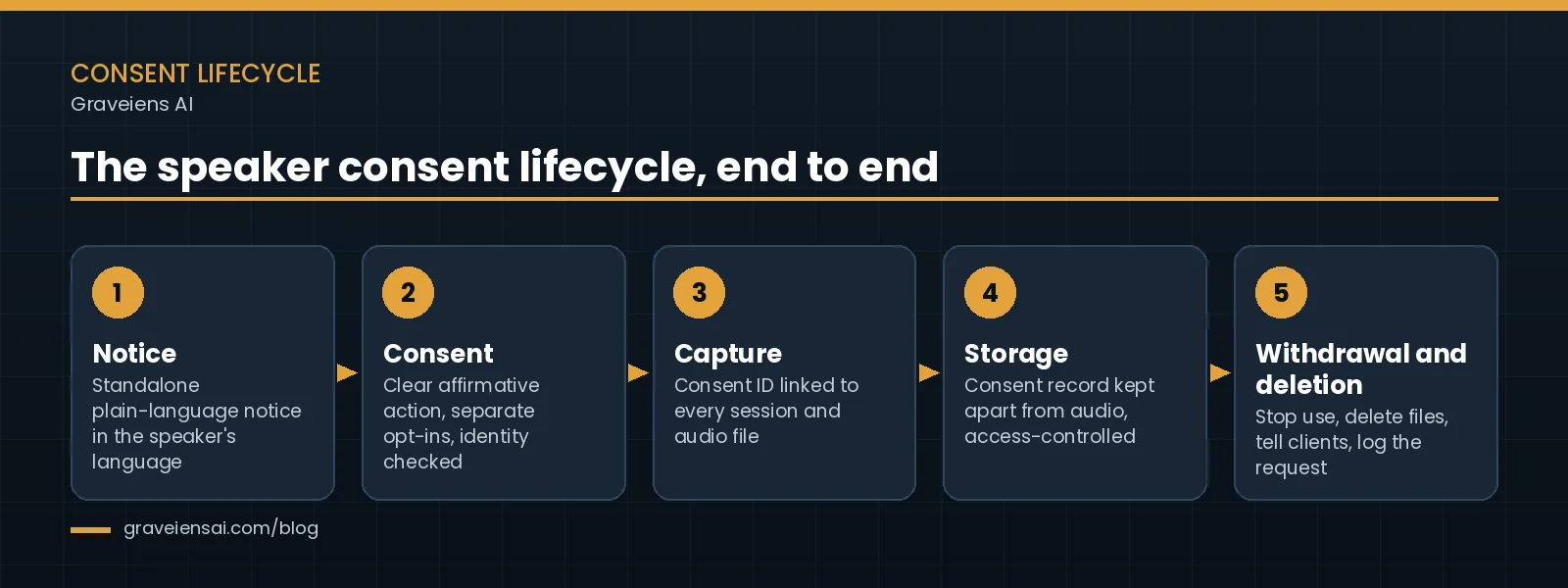
- Notice. Give the speaker a standalone, plain-language notice in their own language before anything is recorded.
- Consent. Collect a clear affirmative action, such as a signature or an unticked box the speaker ticks. Record each optional use separately.
- Capture. Tag every session and audio file with the speaker’s consent ID, so scope travels with the data.
- Storage. Keep consent records apart from the audio, with access limited to the people who need them.
- Withdrawal and deletion. Stop use, delete the files you hold, notify downstream clients, and log the request.
India’s DPDP Rules, 2025 make the notice stage concrete. Rule 3 says the notice must be understandable on its own, without reference to other documents. It must give an itemized description of the personal data and the specified purpose. It must also give a link and other means to withdraw consent, exercise rights, and complain to the Data Protection Board.
The Rules were published in the Gazette on 13 November 2025 and announced by the Press Information Bureau on 14 November 2025. As of October 2026, Rule 3 is not yet in force. It applies eighteen months after publication, so from May 2027. Building to it now saves a redesign later.
What must a speaker consent form template include?
A speaker consent form template must identify who is collecting the data, list every item collected, and state each purpose, including AI training. It must also say who receives the data, how long it is kept, and how to withdraw. Optional uses need separate, unticked opt-ins, and the form must be in a language the speaker reads.
We call this the 10-point speaker consent checklist. Use it to review any participant consent AI dataset form, whether you write it yourself or receive it from a vendor.
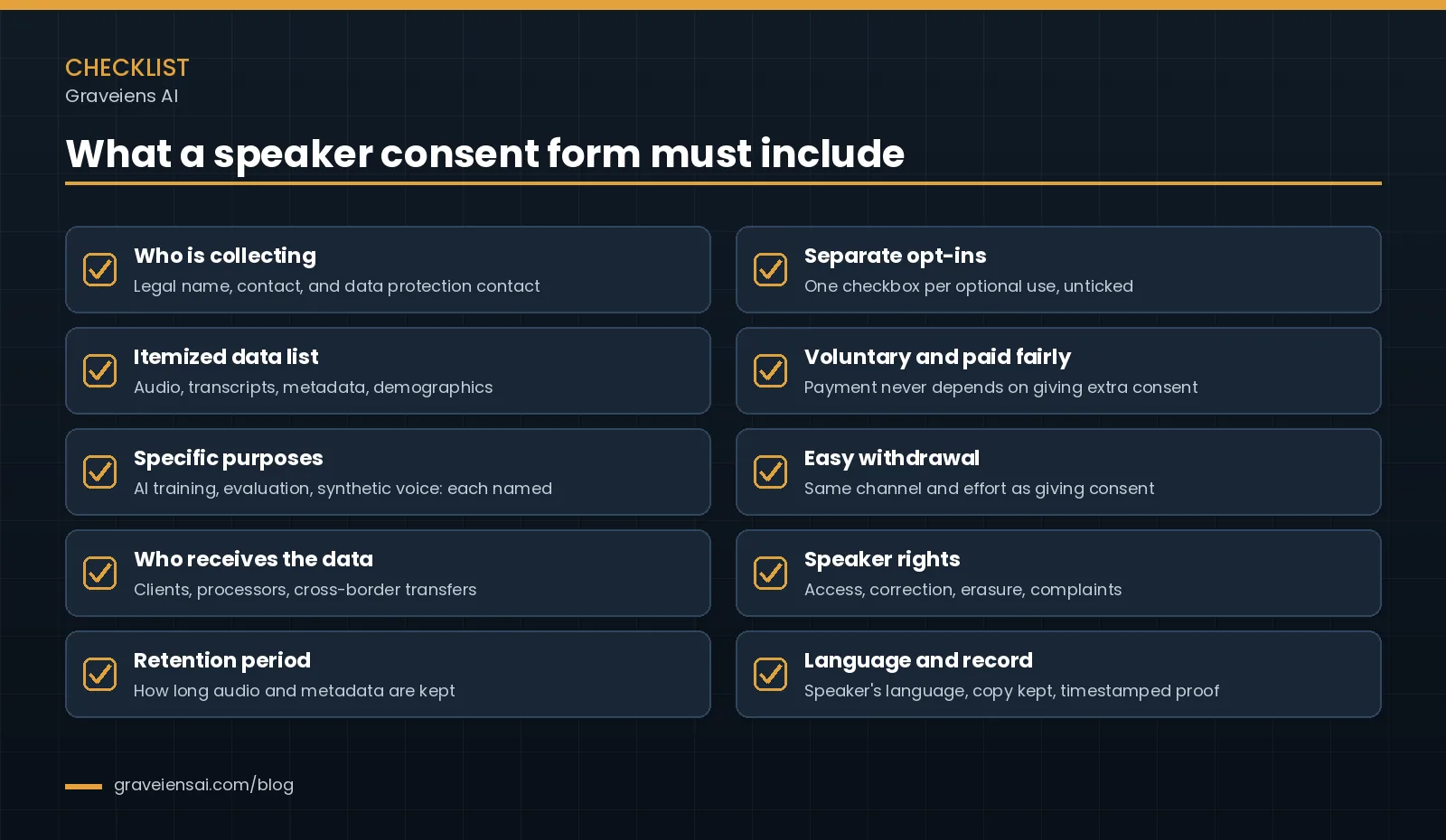
- Who is collecting. Legal entity name, contact details, and a data protection contact.
- Itemized data list. Audio, transcripts, and each metadata field, such as age range, gender, first language, region, and device.
- Specific purposes. Name each one: training speech models, testing them, and any synthetic voice use.
- Who receives the data. Clients, processors, and any cross-border transfer.
- Retention period. How long audio and metadata are kept, and when they are deleted.
- Separate opt-ins. One unticked box per optional use. Never bundle them into the main agreement.
- Voluntary and paid fairly. State that payment does not depend on agreeing to optional uses.
- Easy withdrawal. The same channel and effort as giving consent, plus a plain note on what cannot be undone.
- Speaker rights. Access, correction, erasure, and how to complain to a regulator.
- Language and record. The speaker’s own language, a copy for them, and timestamped proof for you.
Point 7 is the one most often missed. Under GDPR Article 7(4) and the “unconditional” test in DPDP Section 6(1), tying pay to extra consent can undermine whether that consent was freely given.
Planning a voice collection? Ask us for the editable speaker consent template, or see how our consent-first data collection services run participant onboarding end to end.
Sample clauses in plain English
Below is original sample wording for audio recording consent for AI training. Sample wording — have your counsel review. This is not legal advice. Adapt it to your jurisdiction, your clients, and your actual practices.
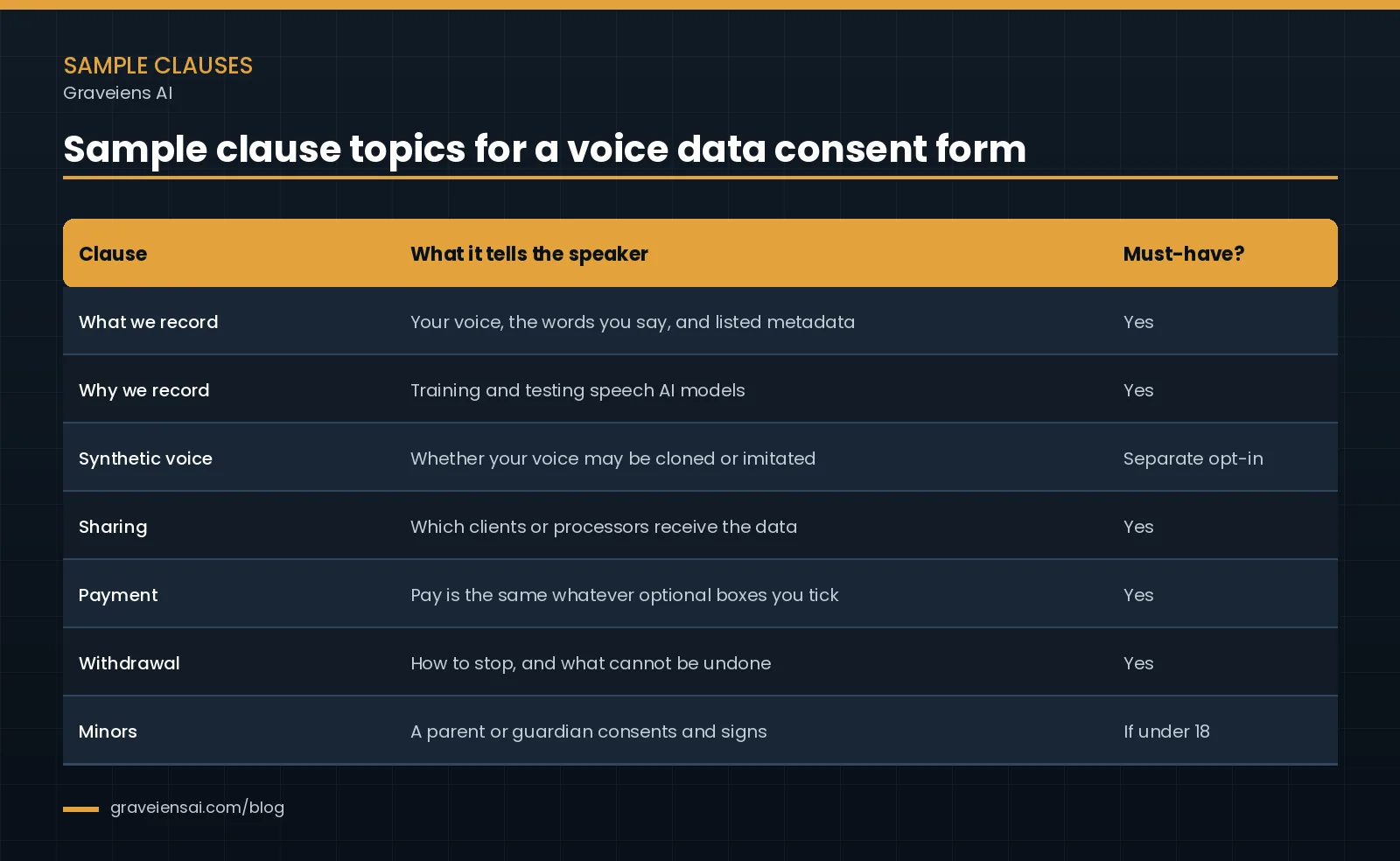
What we record
“We will record your voice while you read sentences and answer short questions. We will also keep a written transcript and these details: your age range, gender, first language, home region, and the device you used. Your name will not appear in the audio file names.”
Why we record
“We will use your recordings to train and test computer systems that recognize or produce speech. These systems may be built into products made by us or by the companies we work for.”
Synthetic voice (separate opt-in)
“Optional. Tick this box only if you agree that your recordings may be used to create a computer-generated voice that sounds like you. If you leave it blank, we will not use your recordings this way. Your payment is the same either way.”
Sharing and transfers
“We will share your recordings only with the companies that hire us to build speech systems, and with service providers who store or check the data for us. They may use them only for the purposes on this form. Your data may be stored outside your country, and we will tell you where.”
Choice and payment
“Taking part is your choice. You will be paid as set out in your task sheet. Saying no to any optional use will not change your payment.”
Withdrawal
“You can withdraw at any time using the same app or link you used to sign up, or by emailing our data protection contact. We will stop using your recordings, delete the files we hold, and ask the companies we shared them with to delete their copies. We cannot remove what a computer system has already learned from your recordings before you withdrew.”
Retention
“We will keep your recordings only as long as the purposes above need them, and no longer than the period shown on this form. We keep a record of your consent for longer, so we can show that you agreed.”
Note the difference from a model release for voice. A media release grants rights to publish a recording. A data consent form covers how personal data is processed. Voice AI projects usually need both, often in one document with clearly separate sections.
How should you handle minors and sensitive data?
Treat minors and sensitive data as separate, stricter tracks. In India, anyone under 18 is a child, and you need verifiable consent from a parent or lawful guardian before processing. Avoid scripts that draw out health, religion, or other sensitive details unless the project truly needs them and has explicit consent.
The DPDP Act defines a child as under 18 in Section 2(f). Section 9(1) requires verifiable parental or guardian consent before processing a child’s data. The same rule covers a person with a disability who has a lawful guardian. Section 9(3) bars tracking, behavioral monitoring, and targeted advertising aimed at children. The DPDP Rules, 2025 set out how verifiable consent is obtained.
GDPR Article 8 sets 16 as the age of consent for online services offered directly to children. Member States may lower it, but not below 13. Controllers must make reasonable efforts to verify parental consent. A simple, conservative rule for global projects is to require a guardian’s consent for every speaker under 18.
Good practice for children’s speech data:
- Get the guardian’s consent and the child’s own agreement, explained in age-appropriate words.
- Record the method used to verify the guardian, not copies of their identity documents.
- Keep school names, full names, and locations out of prompts and metadata.
- Have a supervising adult present during recording sessions.
What happens when a speaker withdraws consent?
When a speaker withdraws, you must stop processing their data for consent-based purposes and delete or anonymize what you hold. Processing done before withdrawal stays lawful under both GDPR and the DPDP Act. Revocable consent only works if the form explains, upfront, which steps can be reversed and which cannot.
DPDP Section 6(6) requires the Data Fiduciary to stop processing within a reasonable time and to make its processors stop too. The PIB release on the 2025 Rules notes that rights requests must be answered within a maximum of 90 days. Use this withdrawal decision table to plan each case.
| Where the data is | What you do | What the speaker hears |
|---|---|---|
| Raw audio, not yet delivered | Delete audio, transcripts, and metadata. Log the deletion. | “Your recordings have been deleted.” |
| Delivered to a client dataset | Send the consent ID and file list to the client with a deletion request. Track confirmation. | “We have asked our client to delete your recordings.” |
| Derived data (labels, features) | Delete or anonymize records linked to the consent ID. | “Related labels have been removed.” |
| Model already trained | Exclude the files from future training runs. | “Future versions will not use your audio. Past training cannot be reversed.” |
| The consent record itself | Mark it withdrawn and keep it as proof, per your counsel’s retention advice. | “We keep a record that you agreed and later withdrew.” |
How should you store consent records?
Store each consent record as its own entry, separate from the audio. Give it a unique consent ID and write that ID into every file’s metadata. Capture the form version, language, timestamp, method, and each opt-in. Restrict access and keep an unchangeable change log. Retain the record while you hold the data, plus any period your counsel advises.
| Field | Why it matters | Example |
|---|---|---|
| Consent ID | Links the speaker’s choices to every file | Random code, not a name |
| Form version and language | Proves what the speaker actually read | v3, Hindi |
| Timestamp and method | Shows when and how consent was given | App checkbox, e‑signature |
| Opt-ins chosen | Limits each file to agreed uses | Training yes, synthetic voice no |
| Verification method | Supports age and guardian checks | Guardian verified by phone OTP |
| Withdrawal status | Drives deletion and client notices | Withdrawn, deletion confirmed |
Two habits make audits easier. Version every speaker consent form template and never edit a live one. And run a monthly check that every audio file maps to an active consent ID.
How Graveiens AI approaches speaker consent
Consent is built into how we run voice and speech data collection. Every project follows the same four steps: participant onboarding with explicit consent, recording management, metadata tagging, and QA. Consent IDs travel with each file through all four.
- Explicit-consent onboarding in the speaker’s language, across 25+ languages with deep Indic coverage.
- Metadata tagging that ties every recording to its consent scope.
- A pay-for-approved-deliverables workflow, so you pay only for files that pass your review.
- ISO 9001 certified quality management.
Consent wording varies by country, client, and use case, so we scope this with you and your counsel. For language-specific planning, see our guide to Indic speech data collection.
Get the editable speaker consent template
We share an editable speaker consent form template on request. It follows the 10-point checklist above, with the sample clauses laid out as separate sections and opt-ins. Ask us for the editable speaker consent template through our contact form. Have your counsel review it before use.
Frequently asked questions
Is a voice recording biometric data under GDPR?
Not by default. A recording is personal data if the speaker can be identified. It becomes special-category biometric data under Article 9 only when it goes through technical processing to uniquely identify a person, such as creating voiceprints for speaker verification. If your project does that, plan for explicit consent and extra safeguards.
Can we train AI on old recordings collected for another purpose?
Be careful. Consent covers the specific purposes stated when it was given. Recordings collected for customer service or research may not cover AI training. Check the original notice and legal basis with your counsel. Often the safest route is fresh consent with a new notice that names AI training clearly.
Is recorded verbal consent valid for voice data collection?
Under GDPR, consent can be a statement or a clear affirmative action, so a recorded verbal statement can work if you can prove it later. Store the recording, the script read to the speaker, and the date. Some laws, such as Illinois’s BIPA for voiceprints, require a written release instead.
Do we need separate consent for voice cloning?
Treat it as separate. Creating a synthetic voice that sounds like a speaker is a distinct purpose with different risks from speech recognition training. Give it its own unticked opt-in, explain it plainly, and make sure saying no does not change the speaker’s payment or participation.
What language should a voice data consent form be in?
Use a language the speaker reads comfortably. In India, DPDP Section 6(3) requires consent requests in clear and plain language. Speakers must be able to read them in English or any language in the Eighth Schedule to the Constitution. For low-literacy speakers, add a read-aloud version.
How long should we keep speaker consent records?
Keep consent records at least as long as you hold the related audio, and often longer so you can prove consent if a dispute arises. There is no single global figure. Agree a retention period with your counsel and state it on the form. For Illinois voiceprints, follow BIPA’s destruction schedule.
Start with consent you can prove
Ask us for the editable speaker consent template, with review notes for your counsel. Want to hear the result first? Request our free 30-minute speech sample set, collected with explicit consent and tagged metadata.
Sources
- Regulation (EU) 2016/679 (General Data Protection Regulation), Articles 4, 7, 8 and 9, EUR-Lex
- The Digital Personal Data Protection Act, 2023 (No. 22 of 2023), Ministry of Electronics and Information Technology
- Digital Personal Data Protection Rules, 2025, G.S.R. 846(E), Gazette of India, 13 November 2025
- Government notifies DPDP Rules to empower citizens and protect privacy, Press Information Bureau, 14 November 2025
This article is general information, not legal advice. Illinois BIPA references are to 740 ILCS 14/15 as published by the Illinois General Assembly.
About the author
Graveiens AI Editorial Team. We write about consent-backed data collection, speech and voice datasets, and human-in-the-loop data for AI teams.

Jitendra Choubay is the CEO & Founder of Graveiens AI, leading a human-in-the-loop data services team that helps AI builders with data collection, annotation, consent-backed voice data, transcription and LLM fine-tuning. He writes on building better, ethically sourced AI training data.
Get the next Graveiens AI article
Expert notes on AI data, annotation, LLMs and eLearning — no spam, unsubscribe anytime.
Need AI Development? Data Annotation? eLearning?
Talk to Graveiens AI about data collection, annotation, voice data, RLHF/SFT, LLM evaluation and AI training data — invoiced only on approved work.
Contact Graveiens AI