Last updated: November 2026
Key takeaways
- A wake word dataset needs four sample types: positives, near-miss phrases, other speech and background noise. Positives teach the trigger; the other three keep false wakes down.
- Coverage matters more than raw clip count. Plan speakers, accents, ages, devices, distances and rooms as a grid, then fill each cell.
- Split train, validation and test sets by speaker, never by clip, or your false reject numbers will look better than they are.
- Build separate false accept (hours of non-wake audio) and false reject (held-out positives) test sets before you train.
- Record explicit, purpose-specific consent and a retention rule for every speaker. Withdrawal must be as easy as giving consent under the GDPR.
A wake word dataset decides whether your device wakes up when a user says its name, and stays quiet when they don’t. Most voice-product teams in smart home, automotive, wearables and apps find that public keyword spotting data doesn’t contain their brand phrase, their microphones or their rooms. This guide is for product, ML and data leads speccing custom wake word data collection. You’ll get a five-step process, the VOICES coverage framework, a sample-type matrix, sizing logic for false accept and false reject testing, and the consent and retention points to settle before the first recording.
Want to hear the audio quality first? Request our FREE 30-minute speech sample set.
What is a wake word dataset?
A wake word dataset is a labeled collection of short audio clips used to train and test a model that listens for one trigger phrase, such as a product name. It holds positive clips of the phrase, plus near-miss phrases, other speech and background noise, all tagged with speaker, device, distance and room metadata.
Wake word detection is a narrow form of keyword spotting. A keyword spotting dataset may teach a model dozens of command words. A wake word model usually listens for one phrase, runs on a low-power chip, and is always on. That makes false wakes far more costly than in most speech tasks.
Public corpora show what this kind of data looks like. The Speech Commands dataset released by Google researchers contains 105,829 one-second utterances of 35 words from 2,618 speakers (Warden, 2018). The Hey Snips dataset holds wake word recordings from more than 2,200 speakers, plus general sentences used as negatives (Coucke et al., 2019). For multilingual keywords, MLCommons’ Multilingual Spoken Words Corpus lists more than 340,000 keywords in 50 languages, about 23.4 million one-second examples, under a CC-BY 4.0 license, as of November 2026 (MLCommons).
These sets are excellent for research and prototyping. They rarely match a commercial product, though. Your phrase is new, your microphone array is specific, and your users speak in kitchens, cars and gyms, not in a quiet room at a laptop.
In short: a wake word dataset is a coverage problem. You need your exact phrase, said by the people who will use it, captured on your hardware, in the places they will use it.
How does wake word data collection work?
Wake word data collection runs in five stages: write a spec, recruit consenting speakers, record across devices and rooms, run QA and metadata tagging, then deliver speaker-split sets. Each stage locks a decision the next one depends on, so changes are cheapest during the spec and most expensive after recording starts.
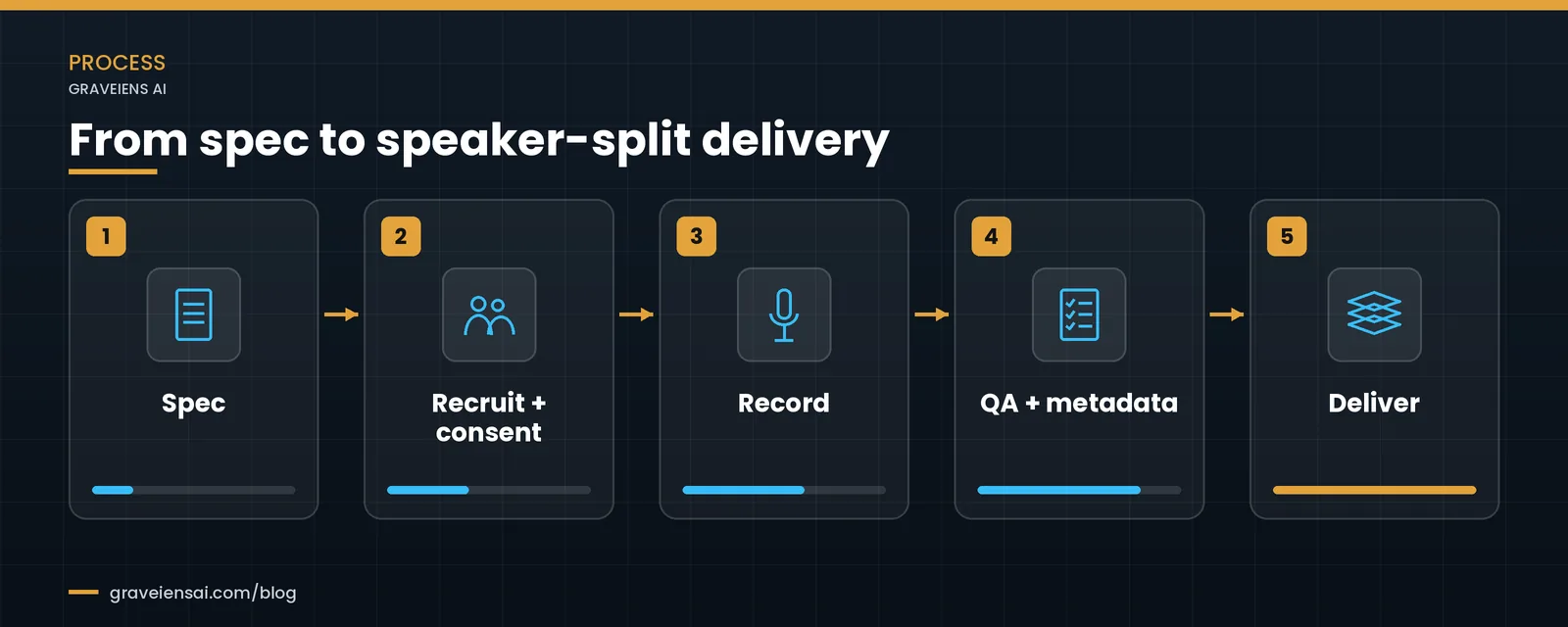
- Write the spec. Fix the exact phrase and its allowed variants, the target languages and accents, device list, distances, room types and noise sources. Add the near-miss phrase list and the speaker split plan. Agree the acceptance criteria for a “good” clip here.
- Recruit speakers and collect consent. Recruit against quotas for accent, age band and gender. Each speaker signs explicit consent for the stated purposes before any recording. Our speaker consent form template guide covers the clauses, so we won’t repeat them here.
- Record across devices and rooms. Capture each speaker on the target hardware, or the closest proxy, at near and far distances. Rotate rooms and noise conditions by script so no speaker only appears in one setting.
- Run QA and tag metadata. Check every clip for clipping, truncation, wrong phrase and silence. Tag speaker ID, device, mic position, distance, room, noise type and phrase type. Rejected clips are re-recorded, not patched.
- Deliver speaker-split sets. Ship training, validation and test partitions with no speaker shared across them. Include a separate false accept set of long non-wake audio and a manifest that maps every file to its metadata.
Teams building full conversational assistants need a very different collection plan. If that’s your case, see our guide to voice agent training data.
In short: decide phrase, speakers, devices, rooms and splits on paper first. Recording is the expensive step, so it should only execute a plan.
The VOICES framework for wake word dataset coverage
We use a six-part checklist to scope hotword training data. We call it VOICES: Variants, Origins, Inputs, Conditions, Evaluation and Safeguards. Each letter is a coverage axis. If one axis is thin, the model will fail in exactly that slice of real use, and the failure usually shows up after launch.
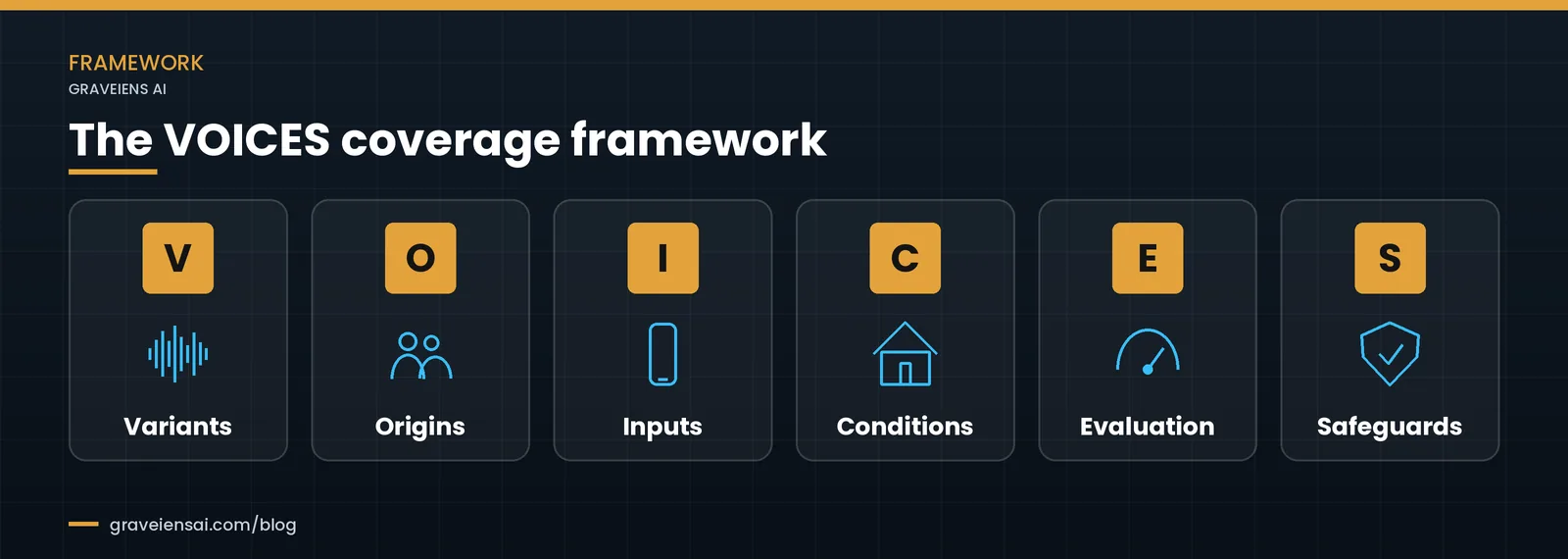
V: Variants of the phrase and its near-misses
List how real users will say the phrase. Include natural speed changes, stress patterns, a pause between words, and the phrase run into a command (“Hey Nova, lights off”). Then list near-miss phrases that sound similar but must not trigger. Good sources are rhymes, shared syllables, the brand name used in normal conversation, and common words that share the first sound.
O: Origins, meaning speaker diversity
Speaker diversity is the axis most often under-specified. Set quotas for accent or region, age band, and gender. If children or older adults will use the device, recruit them on purpose, with the extra consent steps that minors need. Cap clips per speaker so a few prolific voices can’t dominate. The Hey Snips test set, for example, caps positives at 10 utterances per speaker (Coucke et al., 2019).
I: Inputs, meaning devices and microphones
Record on the hardware that will ship, or the closest available proxy. Microphone type, array geometry, enclosure and onboard processing all change the signal the model sees. If you support several device families, such as a speaker, a car head unit and a wearable, each needs its own share of the data.
C: Conditions, meaning distance, rooms and noise
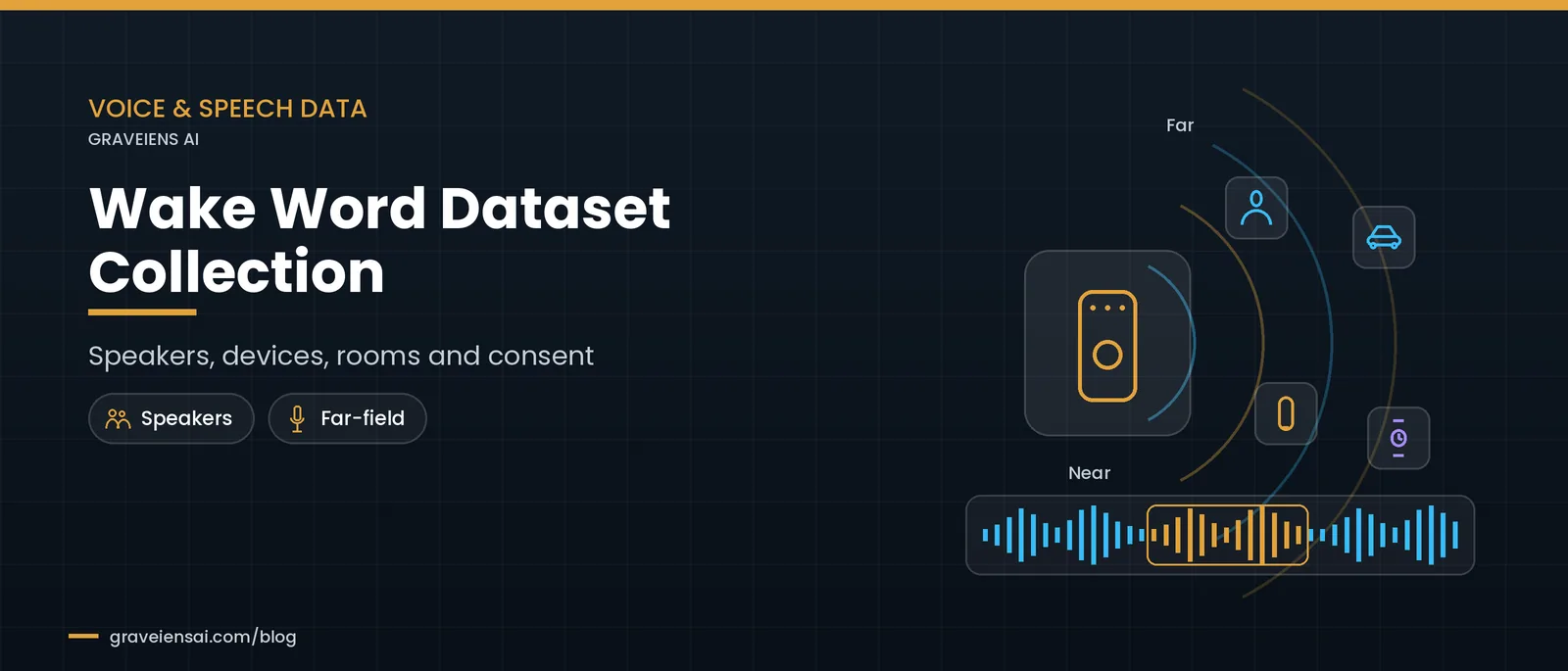
Far-field audio is speech captured at a distance from the microphone, where room reverberation and noise make up a bigger share of the signal. Plan near-field and far-field positions, several room sizes and surfaces, and the noise your users live with: TV, music, cooking, road noise, wind, other talkers.
E: Evaluation sets for false accept and false reject
Define the test sets before training starts. You need held-out positives from unseen speakers to measure false rejects, and long stretches of non-wake audio to measure false accepts per hour. Both should mirror the condition mix you expect in the field.
S: Safeguards for consent, retention and access
Every clip should trace back to a consent record that names its purposes. Set a retention period, an access list and a deletion path before collection starts. These safeguards also make the data easier to audit later.
In short: VOICES turns “we need wake word data” into six checkable lines in a spec. Any line left blank is a known gap, not a surprise.
Turn VOICES into your spec. Request the VOICES checklist, or scope a pilot billed only on approved files.
Which sample types does a keyword spotting dataset need?
A keyword spotting dataset for a wake word needs four sample types: positive clips of the exact phrase, near-miss phrases that sound similar, other everyday speech, and background noise without speech. Positives teach the model to trigger. The other three teach it when not to, and supply the audio for false accept testing.
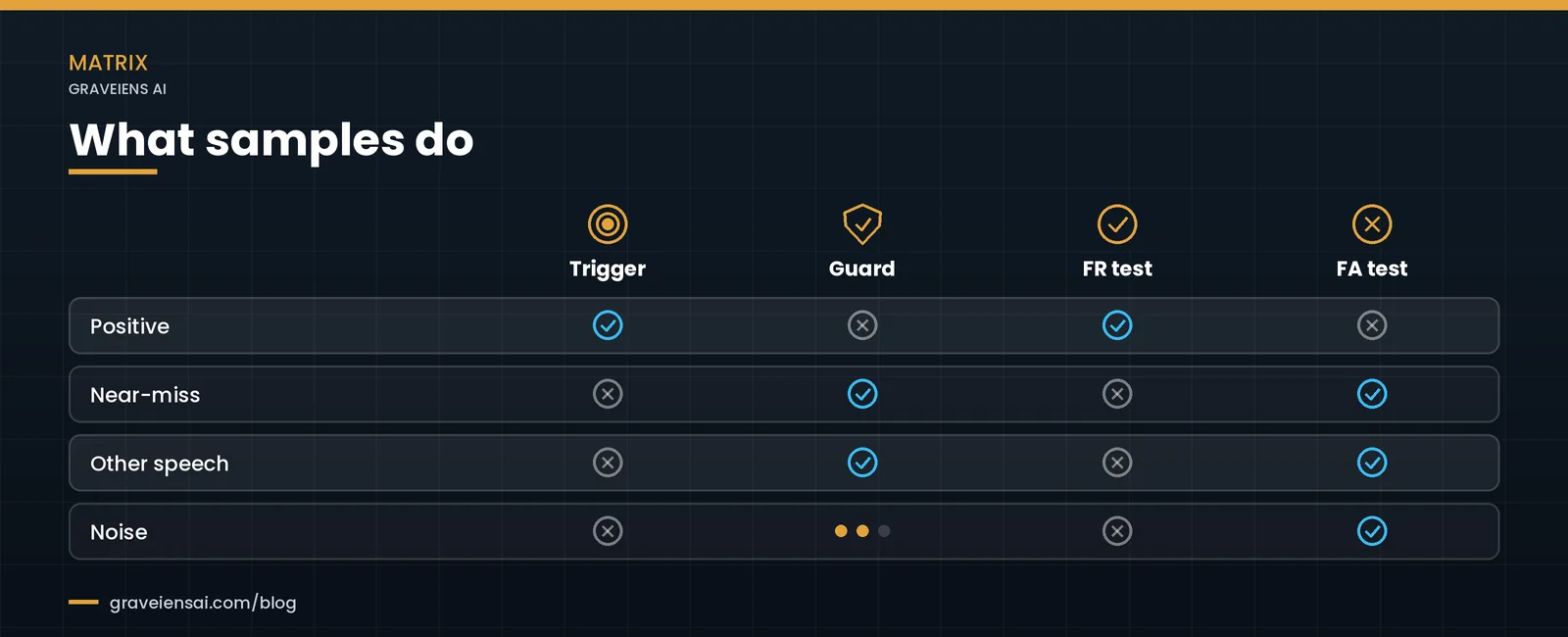
| Sample type | What it is | What it trains | What it tests |
|---|---|---|---|
| Positive | The exact wake phrase, in natural variants | Detection of the trigger | False reject rate |
| Near-miss | Similar-sounding phrases and partial matches | Rejection of confusable audio | Hard false accepts |
| Other speech | Everyday talk, commands, TV and radio speech | Rejection of general speech | False accepts per hour |
| Background | Room noise, music, appliances, road noise | Noise tolerance; also used for mixing | False accepts in silence and noise |
Near-miss phrases deserve special care. They are cheap to record during the same session as positives, and they target the errors users notice most. Ask each speaker to read a short list of confusable phrases in the same rooms and on the same devices. That way, the only difference between a positive and a near-miss is the phrase itself.
Other speech should resemble real household and in-car talk, not only read sentences. Long, unscripted recordings work well for false accept testing because they include the pauses, overlaps and laughter that trip detectors. If you need these recordings transcribed to confirm that the wake phrase never occurs, budget for that review step.
In short: positives alone produce a model that wakes up too often. Plan near-misses, other speech and noise with the same care as the phrase itself.
How do you measure false accept and false reject?
False reject rate is the share of real wake phrases the model misses. False accept rate is how often it wakes without the phrase, usually counted per hour of non-wake audio. You tune a detection threshold that trades one against the other, so both test sets must exist before you compare models.
The two errors pull in opposite directions. Lower the threshold and the device hears more real requests, but wakes more often by mistake. Raise it and false wakes drop, while users repeat themselves. Product teams usually fix a false accept budget first, then compare models on false reject rate at that point.
The Hey Snips paper shows this pattern. Its authors report results at a threshold of 0.5 false alarms per hour on their negative test set. That set holds roughly 20,000 general sentences from 1,469 speakers. Its positive test set has 2,588 utterances from 520 speakers (Coucke et al., 2019). Treat these as a published reference, not a target for your product.
Three rules keep these numbers honest:
- Split by speaker. No speaker in the test set should appear in training. Clip-level random splits leak voices and make false reject look lower than it will be in the field.
- Report by slice. Break results down by accent, age band, device, distance and noise. A good average can hide a far-field or accent slice that fails badly.
- Keep the test set frozen. Version it, and don’t add hard examples you mined from it back into training without building a fresh test set.
In short: false accept and false reject are two sides of one threshold. Build both test sets early, split them by speaker, and report every number by slice.
How big should a wake word dataset be?
There is no universal clip count for a wake word dataset. Size follows coverage: the number of speakers, accents, device families, distances, rooms and noise types you must represent, multiplied by enough clips per cell to train and to test. Start from your evaluation targets and slices, then work backward to recording hours.
Published datasets give a sense of scale. Speech Commands draws on 2,618 speakers for 35 words. Hey Snips draws on more than 2,200 speakers for one phrase. Both are research sets, and neither was sized for a specific device or market. Your number depends on your slices and your false accept budget.
A practical way to size a pilot:
- List every slice you must report on, such as accent by device by distance.
- Set a minimum number of unique test speakers per slice, so each slice result is not driven by a handful of voices.
- Add training speakers on top, with no overlap, and cap clips per speaker.
- Size the false accept set in hours of audio, matched to the environments you expect.
- Run a pilot, read the slice results, and expand only the slices that fail.
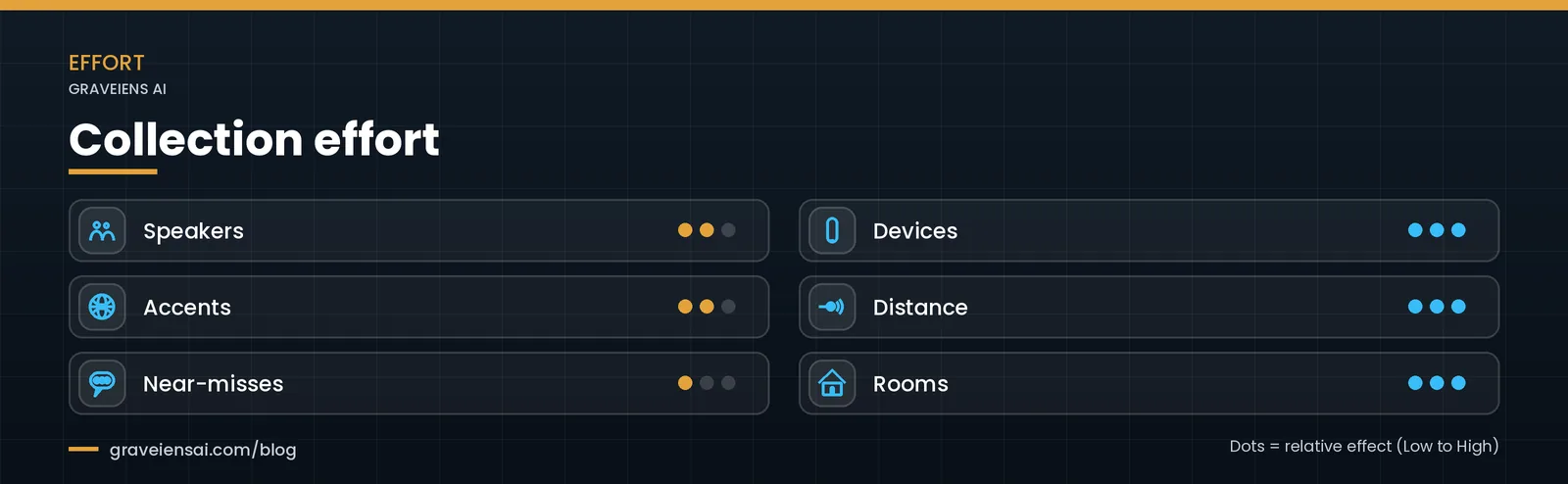
Effort does not grow evenly. Adding near-miss phrases costs a few extra minutes per session. Adding a device family, a far-field position or a new room type multiplies the number of sessions, because each speaker must be recorded under each condition. Synthetic speech and noise mixing can stretch training data, but real speakers on real hardware should anchor your test sets.
For the general price drivers behind any speech project, see our breakdown of speech data collection cost per hour.
In short: size by slices, not by a headline clip count. Pilot first, measure by slice, then scale the slices that need it.
Common mistakes in hotword training data
Most wake word data problems are planning problems that only show up in field testing. These are the ones we see most often in specs:
- Near-field only. Every speaker records at arm’s length on a phone. The model then struggles across a living room or from the back seat.
- Too few speakers, too many clips each. Hundreds of repetitions from a small group teach the model those voices, not the phrase.
- Read-aloud negatives. Negatives recorded as scripted sentences miss the overlaps, TV audio and casual speech that cause false wakes at home.
- No near-miss list. Without confusable phrases, the model has never been told what “almost” sounds like.
- Clip-level splits. The same voice lands in training and test, and the false reject rate looks better than reality.
- Thin metadata. If clips lack device, distance and room tags, you cannot find which slice is failing, so you can’t fix it.
- Consent that doesn’t match use. Recordings gathered for one purpose get reused for another, such as voice cloning, without fresh consent.
In short: most fixes are cheap at the spec stage. Far-field coverage, speaker caps, near-miss lists and speaker splits all cost little to plan and a lot to retrofit.
Consent, retention and privacy for wake word recordings
Wake word clips are short, but they are still voice recordings of identifiable people. Treat them as personal data. In the EU, the GDPR requires that consent can be withdrawn at any time, and that withdrawal be as easy as giving consent (GDPR, Article 7(3)). Voice data processed to uniquely identify a person can also fall under the GDPR’s stricter rules for biometric data.
In the US, state privacy laws such as California’s CCPA give consumers rights over their personal information, including deletion. Check which laws apply to your speakers and your company with counsel.
Practical safeguards for a wake word project:
- Purpose-specific consent. Name each use, such as wake word training, evaluation and internal testing. Don’t bundle in unrelated uses.
- A traceable consent ID. Link every clip to its speaker’s consent record, so a withdrawal can remove all of that speaker’s files.
- Pseudonymous speaker IDs. Keep names and contact details out of the audio metadata. Store them separately with tighter access.
- A stated retention period. Decide how long raw audio and derived features are kept, and who deletes them.
- Minors handled separately. If children’s voices are in scope, use guardian consent and age-appropriate information.
For multilingual programs, including Indic languages, our Indic speech data collection guide covers recruitment and consent details by region.
This section is general information, not legal advice. Confirm your obligations with qualified counsel in each market where you collect or use data.
In short: consent, retention and deletion should be designed into the dataset, with every clip traceable to a speaker’s consent record.
How Graveiens AI approaches wake word data collection
Graveiens AI runs explicit-consent data collection for voice and speech programs. Our workflow moves from participant onboarding to recording and capture management, then metadata tagging and QA. Every speaker agrees to clear, stated purposes before recording starts.
- Language coverage. We work across 25+ languages, including deep Indic coverage and European languages such as Italian.
- Spec-first scoping. We build the VOICES grid with you: phrase variants, speaker quotas, devices, distances, rooms and evaluation sets. Anything outside our standard catalogue, we scope with you.
- Pay for approved deliverables. Pilots are billed only on approved files, so you judge quality before you scale.
- Quality system. Graveiens AI follows a documented QA process with multi-level human review.
Learn more about our voice and speech data services and our wider consent-backed data collection work.
Frequently asked questions
Can I use public datasets like Speech Commands for a commercial wake word?
Public sets are useful for prototyping and pre-training, but check each license before commercial use. MLCommons’ Multilingual Spoken Words Corpus, for example, is released under CC-BY 4.0. Even with a permissive license, public corpora rarely contain your exact brand phrase, your microphones or your rooms, so most product teams still collect custom positives, near-misses and evaluation sets.
How many speakers do I need for a wake word dataset?
There is no fixed number. Start from the slices you must report on, such as accent, age band, device and distance. Set a minimum of unique test speakers per slice, then add separate training speakers with a cap on clips per speaker. For scale, the public Hey Snips dataset used more than 2,200 speakers for a single phrase.
What is a good false accept rate for a wake word?
It depends on your product and how often users tolerate accidental wakes. Research papers often report false reject rate at a fixed false accept rate. The Hey Snips paper, for example, reports results at 0.5 false alarms per hour on its negative test set. Set your own budget from user research, then compare models at that point.
Should I use synthetic or TTS audio for wake word training?
Synthetic speech can add phrase variety and help early prototypes, and noise mixing can stretch real recordings. It doesn’t replace real speakers on real hardware, especially for testing. Keep your false reject and false accept test sets made of real, consented recordings that match your device and field conditions, so your metrics reflect actual users.
What is far-field audio, and why does it matter for wake words?
Far-field audio is speech captured at a distance from the microphone, typically across a room or a car cabin. Reverberation and background noise make up a larger share of the signal. Smart speakers and in-car systems are mostly used this way, so a dataset recorded only at close range will overstate how well the model performs in practice.
What metadata should each wake word recording include?
At minimum, include a pseudonymous speaker ID, accent or region, age band, gender, device and microphone, distance, room type, noise condition, phrase type (positive, near-miss, other speech or background) and a consent record ID. This lets you split by speaker, report results by slice and remove a speaker’s files if they withdraw consent.
Are wake word recordings biometric data under the GDPR?
Voice recordings of identifiable people are personal data. They can also count as biometric data when processed to uniquely identify someone, which brings stricter rules. A wake word model that detects a phrase is different from speaker identification, but your use and processing matter. This is general information, not legal advice, so confirm your position with counsel.
How long should we keep wake word recordings?
Keep them only as long as the stated purpose needs, and say so in the consent form. Many teams keep raw audio until the model and its test sets are frozen, then review whether to delete or keep under a documented reason. Whatever you choose, make sure a withdrawal request can find and remove every clip from that speaker.
Start with a sample, not a promise
Hear the audio quality, review the metadata and check the consent trail before you commit. Graveiens AI offers a FREE 30-minute speech sample set, pilots billed only on approved files, and spec-first scoping with the VOICES checklist.
Request the FREE 30-minute speech sample set or book a 20-minute scoping call.
Sources
- Warden, P. (2018). Speech Commands: A Dataset for Limited-Vocabulary Speech Recognition. arXiv:1804.03209. https://arxiv.org/abs/1804.03209
- Coucke, A., Chlieh, M., Gisselbrecht, T., Leroy, D., Poumeyrol, M., and Lavril, T. (2019). Efficient Keyword Spotting Using Dilated Convolutions and Gating. ICASSP 2019. arXiv:1811.07684. https://arxiv.org/abs/1811.07684
- MLCommons. Multilingual Spoken Words Corpus (dataset page, accessed November 2026). https://mlcommons.org/datasets/multilingual-spoken-words/
- Regulation (EU) 2016/679 (General Data Protection Regulation), Article 7(3). EUR-Lex. https://eur-lex.europa.eu/eli/reg/2016/679/oj/eng

Jitendra Choubay is the CEO & Founder of Graveiens AI, leading a human-in-the-loop data services team that helps AI builders with data collection, annotation, consent-backed voice data, transcription and LLM fine-tuning. He writes on building better, ethically sourced AI training data.
Get the next Graveiens AI article
Expert notes on AI data, annotation, LLMs and eLearning — no spam, unsubscribe anytime.
Need AI Development? Data Annotation? eLearning?
Talk to Graveiens AI about data collection, annotation, voice data, RLHF/SFT, LLM evaluation and AI training data — invoiced only on approved work.
Contact Graveiens AI