Last updated: November 2026
Key takeaways
- Voice agent training data is two-sided, conversational audio with transcripts and labels. It must match the channel, accents, noise and turn-taking your agent will face live.
- Each part of the stack needs different data: ASR needs transcribed audio, the dialog layer needs labeled conversations, and TTS needs clean, consented voice recordings.
- Phone agents need 8 kHz telephony audio in the mix. Record each speaker on a separate channel, and never upsample narrowband audio and call it wideband.
- Word error rate (WER) is the standard ASR metric, but it depends on clear transcription and normalization rules.
- Voice can be biometric data. Collect with explicit, documented consent under GDPR, BIPA-style laws and the CCPA.
Many voice agents sound great in a demo and stumble on the first real call. The caller is on a noisy phone line, speaks with a regional accent, and talks over the agent mid-sentence. The model never heard anything like that in training.
Voice agent training data closes that gap, if it is built for real conversations. This guide covers what ASR, dialog and TTS models each need, how to plan coverage, and how to collect, transcribe and check speech data with consent in place.
Want to hear the difference first? Request our free 30-minute speech sample set in the language and setting you care about.
What is voice agent training data?
Voice agent training data is recorded speech, usually two-sided conversations, paired with time-aligned transcripts, speaker labels and task labels. It teaches a phone or app agent to hear callers, follow the dialog and respond. Good data mirrors live use: real channels, accents, background noise, interruptions and the tasks callers actually bring.
In short: general speech data teaches a model to transcribe. Voice agent data teaches it to hold a conversation.
The difference shows up in the details. A read-speech corpus has one speaker, clean audio and complete sentences. A real support call has two speakers, overlaps, fillers like “um,” half-finished thoughts and long pauses. Your data needs both, in proportions that match your use case.
What data does each part of a voice agent need?
Most voice agents chain three models. Speech recognition (ASR) turns caller audio into text. A language model or dialog manager decides what to say. Text-to-speech (TTS) speaks the reply. Each layer has its own data needs, and a gap in one shows up as a failure in the whole call.
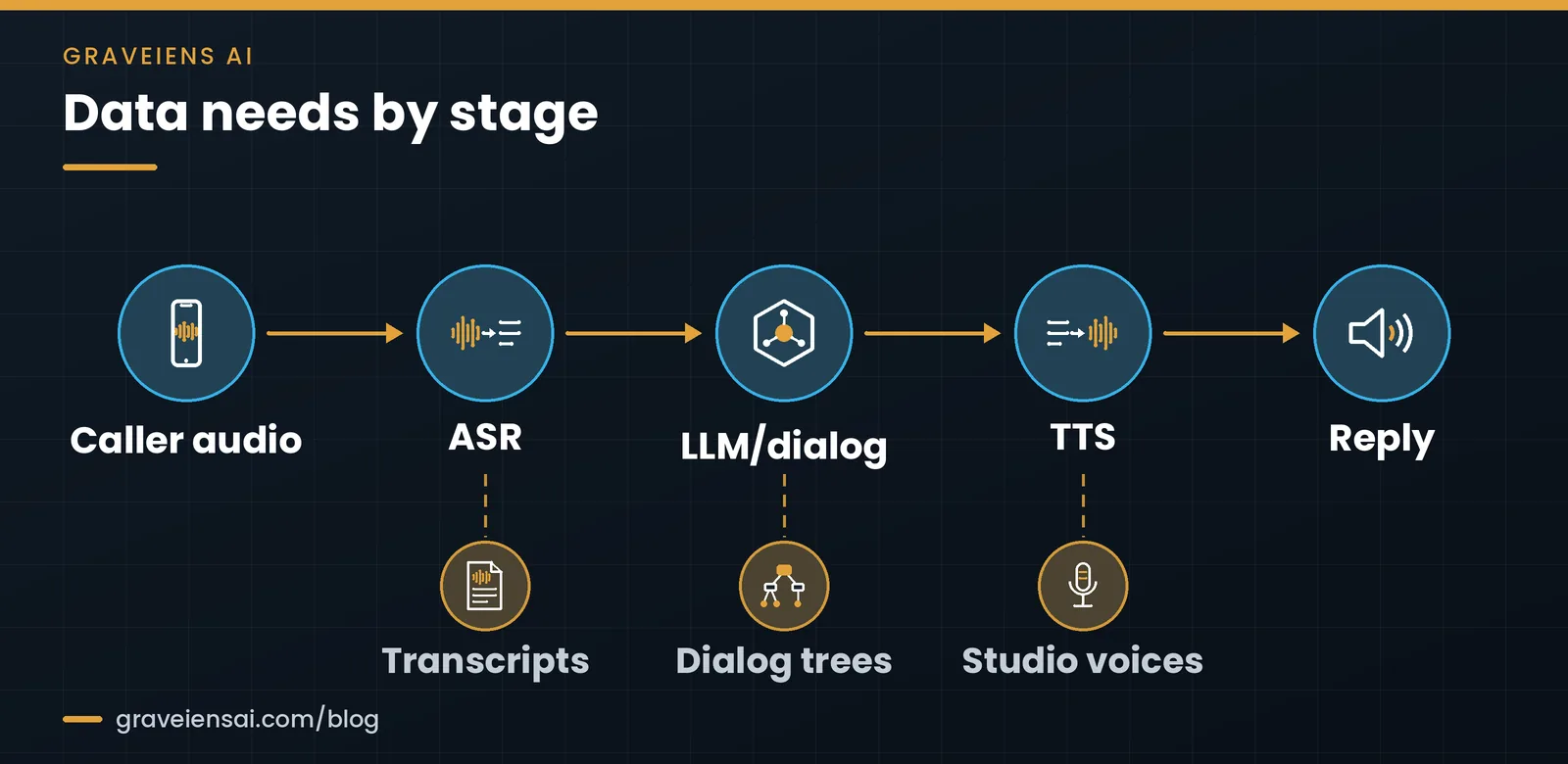
| Component | Data it needs | Common gap |
|---|---|---|
| ASR | Audio with verbatim, time-aligned transcripts | Too little phone-line, accented or noisy speech |
| Turn-taking and endpointing | Two-channel audio with overlap and pause timing | Single-channel mixes that hide who spoke when |
| LLM or dialog layer | Multi-turn transcripts with intents, entities and outcomes | Only “happy path” dialogs, no corrections or confusion |
| TTS | Clean studio recordings with exact scripts | Missing voice-talent consent for synthetic voice use |
| Evaluation | Held-out calls that match production | Testing on the same speakers used in training |
For speech-to-speech models that skip the text layer, the same rules apply. They still need natural two-sided audio, with each speaker on a separate channel.
How is voice agent training data collected?
A reliable collection runs in six steps: consent, script design, recording, transcription, QA and delivery. Consent comes first because it shapes everything else, from what you can record to how long you can keep it. Skipping a step usually means re-recording later, which costs more than doing it right once.
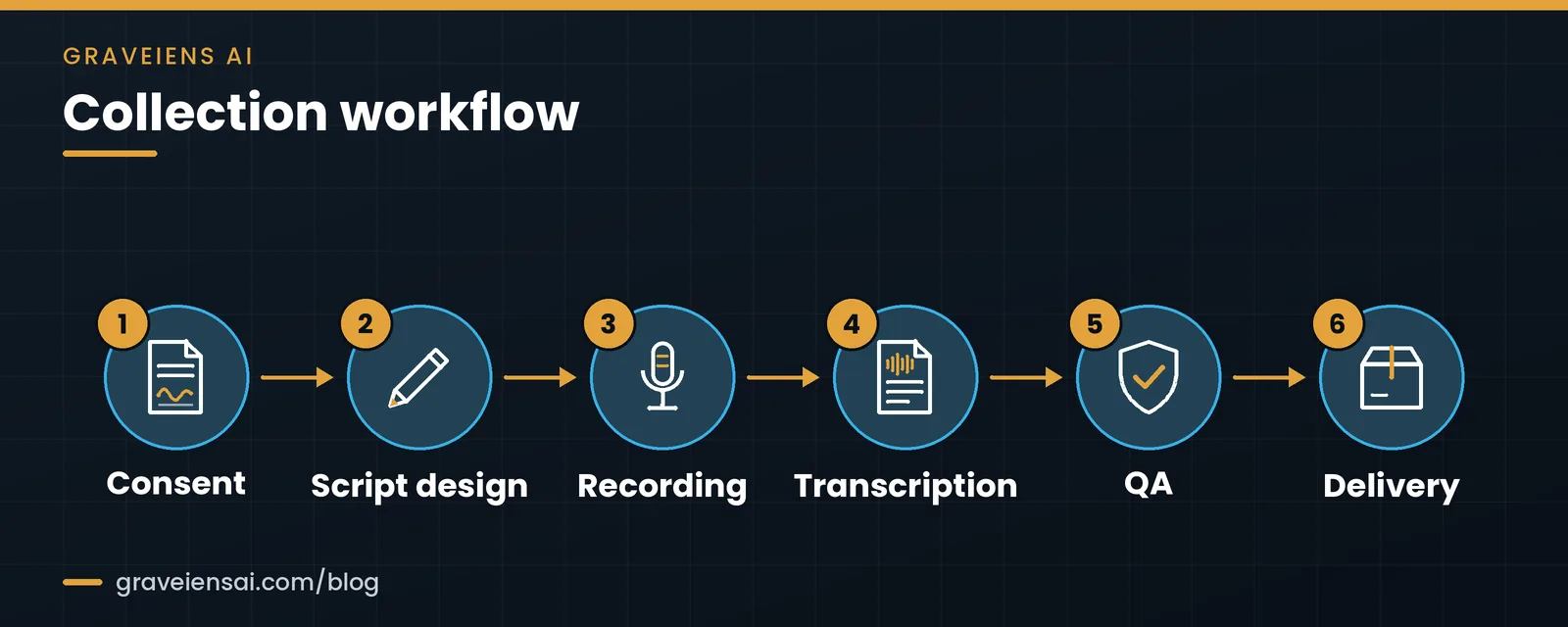
- Consent. Explain the purpose, the uses, retention and withdrawal. Capture a signed record for each speaker. Our speaker consent form template lists the fields to include.
- Script design. Write scenarios, prompts or role-play briefs from your real call reasons. Include names, numbers, addresses and product terms.
- Recording. Capture on the target channels and devices, with each speaker on a separate track. Log device, environment and sample rate as metadata.
- Transcription. Transcribe verbatim to a written style guide, with speaker turns, timestamps and tags for noise and overlap.
- QA. Check audio quality, transcript accuracy, label consistency and metadata completeness on a defined sample.
- Delivery. Ship audio, transcripts, metadata and consent references in an agreed format, with a short QA report.
The Six-Axis Voice Coverage Matrix
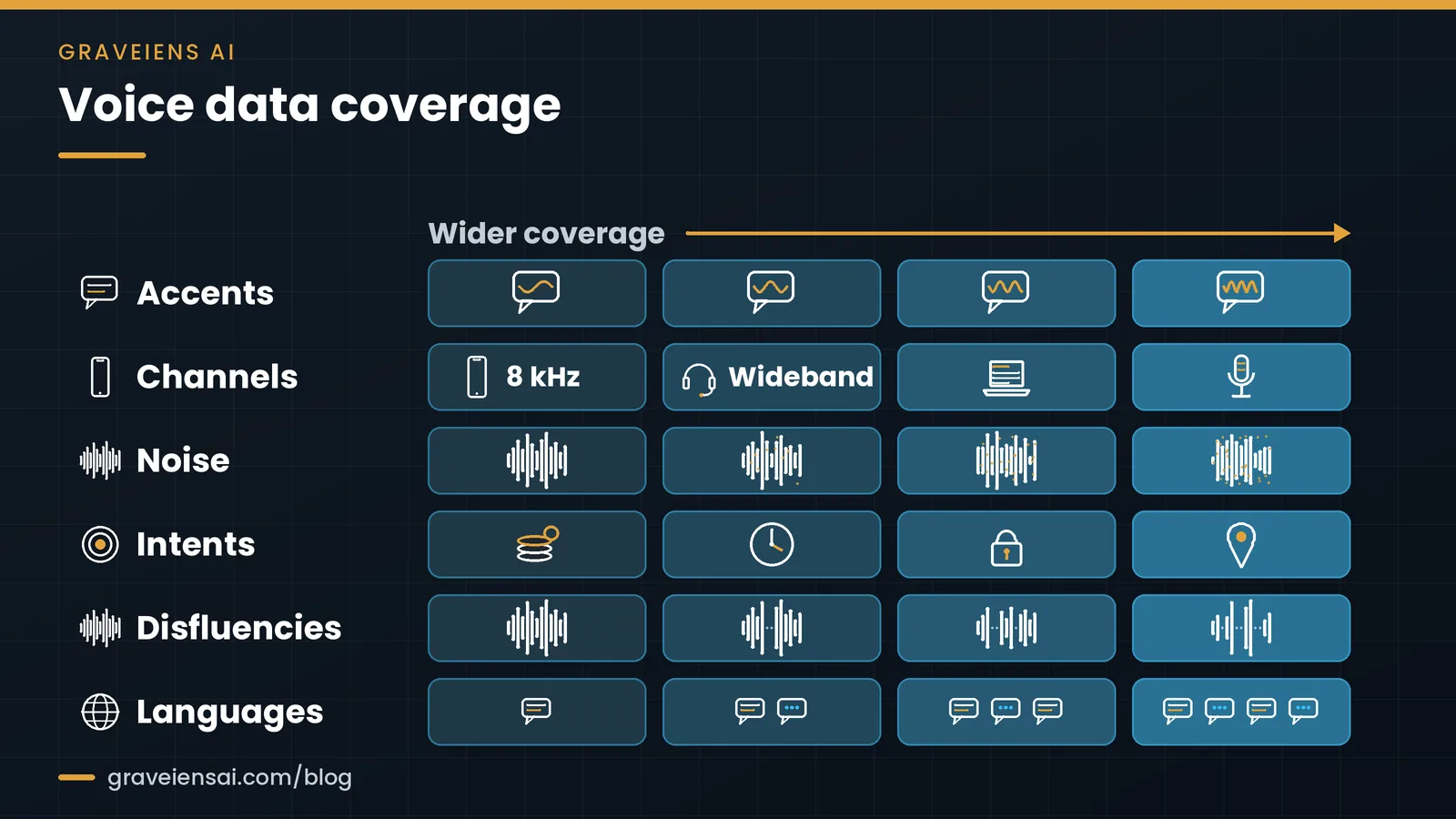
Coverage is where most voice datasets fall short. We plan collections with a simple tool: the Six-Axis Voice Coverage Matrix. List your target values on each axis, then fill a grid to check that every combination that matters has enough examples. The six axes are accents, channels, noise, intents, disfluencies and languages.
1. Accents
List the regional and second-language accents of your real callers, not just the “standard” one. Spread recordings across many speakers rather than a few long sessions. More speakers usually means wider coverage of voices and speaking styles.
2. Channels: 8 kHz telephony vs wideband
Classic phone calls carry narrowband audio, sampled at 8 kHz. App and web calls often use wideband codecs, such as ITU‑T G.722, which carries audio up to about 7 kHz. As of November 2026, NIST’s OpenASR21 evaluation plan still describes conversational telephone speech as two channels, distributed separately, at 8 kHz or higher sample rates.
Three rules help. Record each speaker on a separate channel. Keep the native sample rate in metadata. And never upsample 8 kHz audio and label it wideband, because the missing frequencies do not come back.
3. Noise
Record in the places callers really are: cars, kitchens, streets, open offices and speakerphones. Added synthetic noise helps, but it rarely captures echo, crosstalk and phone-line artifacts. Tag the environment for every file.
4. Intents
Map scripts to your top call reasons and the entities inside them. Include hard cases: spelled names, account numbers, dates, addresses and corrections such as “no, I said fifteen.”
5. Disfluencies and turn-taking
Real speech is messy. Capture fillers, false starts, repairs, backchannels like “mm-hmm,” long pauses and barge-in, when a caller talks over the agent. Separate channels let you label overlap timing, which turn-taking and endpointing models need.
6. Languages
List each language and locale, plus code-switching where callers mix languages. A Spanish line in Texas and one in Madrid need different speakers. The same applies to Italian, Hindi or French across regions.
Need coverage across several languages or accents? Scope a pilot billed only on approved files, or start with the free 30-minute speech sample set.
Should you use scripted, role-play or spontaneous speech?
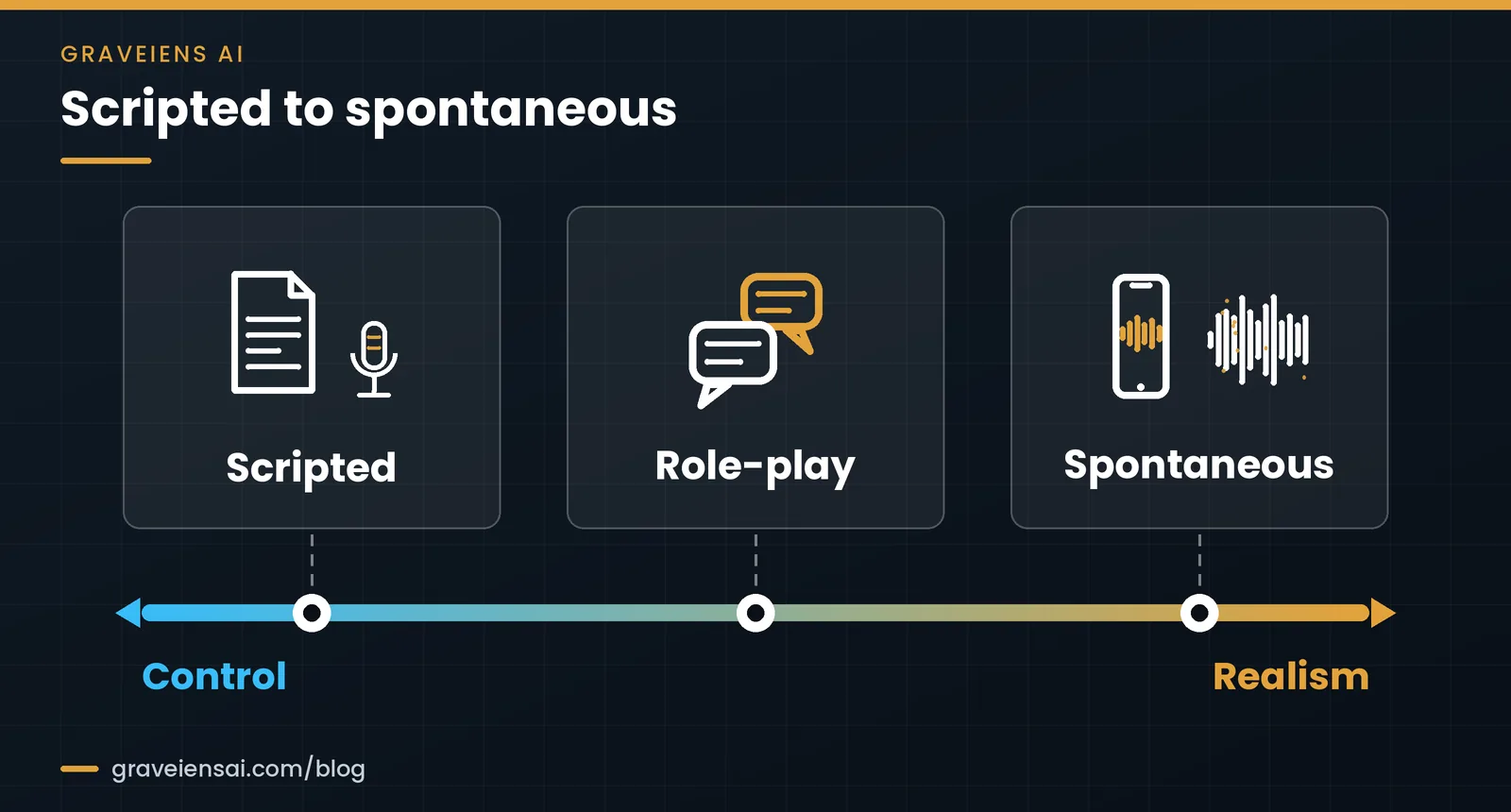
Use all three, in proportions that match your goal. Scripted speech gives control and exact transcripts. Role-play adds natural turn-taking around real tasks. Spontaneous conversation gives the most realism but the least control. Most voice agent projects lean on role-play, then add scripted prompts for hard entities and spontaneous speech for realism.
| Type | Best for | Watch out for |
|---|---|---|
| Scripted | Entities, wake words, TTS, exact coverage | Reading voice, few disfluencies |
| Role-play | Task dialogs, turn-taking, barge-in | Actors drifting from real caller behavior |
| Spontaneous | Natural speech, fillers, overlaps, evaluation | Uneven coverage, heavier transcription work |
Whatever the mix, keep a held-out test set of speakers who never appear in training data.
How do you measure voice data quality?
Start with clear transcription rules, then measure. Word error rate (WER) is the standard ASR metric. NIST defines it as deletions plus insertions plus substitutions, divided by the number of words in the human reference transcript. Lower is better. But WER only means something when the reference transcripts follow consistent rules.
That is why transcription conventions matter. NIST’s OpenASR21 plan tags hesitations, noise, overlap and foreign words, and treats some tokens as optional when scoring. Your style guide should settle the same questions:
- How to write fillers, false starts and cut-off words.
- How to tag noise, laughter, music, silence and overlap.
- Whether numbers, dates and acronyms are written as words or digits.
- How to mark unclear speech and foreign words.
Beyond WER, track audio checks such as clipping, silence and channel errors. Add transcript accuracy on a double-reviewed sample, label agreement between annotators, and metadata completeness. For more on transcript workflows, see our guide to AI transcription.
Consent and compliance mistakes to avoid
Voice is personal data, and it can be biometric data. The European Data Protection Board’s guidelines on virtual voice assistants treat voice data used to identify a person as biometric personal data. When voice is processed to uniquely identify a person, GDPR requires an Article 9 condition as well as an Article 6 legal basis.
US law adds its own rules. As of November 2026, the Illinois Biometric Information Privacy Act (BIPA) lists “voiceprint” as a biometric identifier. California’s CCPA defines biometric information to include voice recordings from which a voiceprint can be extracted. This is not legal advice, so check your plans with counsel.
Common mistakes we see:
- Vague consent. “Recordings may be used to improve services” does not cover AI training or synthetic voices.
- No withdrawal path. Speakers need a way to withdraw, and you need a way to find and remove their files.
- Reusing call-center logs blindly. Customer calls were recorded for another purpose. Check notice, consent and local law first.
- Cloning voices without a talent agreement. TTS voice talent should give explicit, specific consent for synthetic use.
- Weak metadata. Without speaker IDs, demographics and consent links, you cannot prove coverage or honor deletion requests.
How Graveiens AI approaches voice agent training data
Graveiens AI collects, transcribes and checks speech data for conversational AI teams in the US and EU. Our voice and speech data work follows an explicit-consent workflow: participant onboarding, recording management, metadata tagging and QA.
- Languages. We cover 25+ languages, including Indian and European languages such as Italian. See our notes on Indic speech data collection.
- Transcription. Our transcription teams work to your style guide, with speaker turns, timestamps and event tags.
- Quality. Graveiens AI is ISO 9001 certified, and pilots are billed only on approved deliverables.
We do not promise model accuracy gains. We give you consented, well-labeled data and the QA evidence to judge it.
Frequently asked questions
What data do you need to train a voice agent?
You need transcribed conversational audio for speech recognition, labeled multi-turn dialogs for the language or dialog layer, and clean, consented recordings if you build a custom TTS voice. The audio should match your live channel, accents and noise. You also need a held-out test set of real or realistic calls from speakers not used in training.
How much speech data does a voice agent need?
There is no universal number. It depends on your base model, languages, channel and how far your callers differ from its training data. Most teams start with a focused pilot, measure results on a held-out test set from real callers, then expand coverage where errors cluster. Speaker variety often matters as much as total hours.
Is 8 kHz audio good enough for voice agent training?
For phone agents, yes. 8 kHz narrowband audio should be part of the mix because that is what callers send over classic phone lines. If your agent also runs in apps or on the web, add wideband audio too. Record at the native rate, keep each speaker on a separate channel, and do not upsample narrowband audio.
What is word error rate (WER)?
Word error rate is the standard accuracy metric for speech recognition. Per NIST, it is the number of deletions, insertions and substitutions in the system output, divided by the number of words in the human reference transcript. Lower is better. WER is only comparable when both tests use the same transcription and normalization rules.
Is voice data considered biometric data?
It can be. The EDPB treats voice used to identify a person as biometric personal data, and GDPR adds stricter rules when voice is used to identify someone. Illinois BIPA lists voiceprints as biometric identifiers, and California’s CCPA covers voice recordings from which a voiceprint can be extracted. Use explicit, documented consent and get legal advice for your case.
Should voice agent data be scripted or spontaneous?
Most projects use a blend. Role-play gives natural turn-taking around real tasks. Scripted prompts cover hard entities such as names, numbers and addresses, and support TTS. Spontaneous conversation adds realism and makes a strong test set. Set the mix based on where your agent fails today and what your live callers sound like.
Hear real conversational data before you commit
Get a free 30-minute speech sample set in your language, accent and channel. Then scope a pilot billed only on approved files.
Request your free speech sample set or ask us for the Six-Axis Voice Coverage Matrix checklist.
Sources
- NIST: OpenASR21 Challenge Evaluation Plan (WER definition, telephone speech specs, normalization)
- EDPB: Guidelines 02/2021 on virtual voice assistants, version 2.0
- Illinois General Assembly: 740 ILCS 14/10, BIPA definitions
- California Legislative Information: Civil Code 1798.140, CCPA definitions
About the author
Graveiens AI Editorial Team. Our editorial team writes about speech data, AI training data and data compliance for AI builders in the US and EU. The team works alongside our voice collection, transcription and QA leads, so each guide reflects how real projects run.

Jitendra Choubay is the CEO & Founder of Graveiens AI, leading a human-in-the-loop data services team that helps AI builders with data collection, annotation, consent-backed voice data, transcription and LLM fine-tuning. He writes on building better, ethically sourced AI training data.
Get the next Graveiens AI article
Expert notes on AI data, annotation, LLMs and eLearning — no spam, unsubscribe anytime.
Need AI Development? Data Annotation? eLearning?
Talk to Graveiens AI about data collection, annotation, voice data, RLHF/SFT, LLM evaluation and AI training data — invoiced only on approved work.
Contact Graveiens AI