Last updated: November 2026
Key takeaways
- Multilingual LLM evaluation measures how well a model answers real users in each language it serves, not how well it handles English questions run through machine translation.
- Translated English benchmarks carry Western-centric content and translationese. The Global-MMLU authors found 28% of MMLU questions need culturally sensitive knowledge.
- A useful human-rated test set has native-written prompts per locale, an anchored LLM evaluation rubric, calibrated native-speaker evaluators and per-language agreement checks.
- Report results per language and per task. A single averaged score hides the weak locales your users will notice first.
- Start with a small pilot (2 to 4 languages, a few task types), check inter-rater agreement, then scale the languages that matter most to your markets.
Multilingual LLM evaluation tells you whether your model works for real users in Italian, German, Polish, Hindi or Tamil, not just in English. Most teams shipping GenAI into several markets start with a translated English benchmark. The scores look fine. Then support tickets arrive from Milan and Mumbai.
This guide is for US and EU LLM teams that need a human-rated test set across languages. You will get a step-by-step build process, a rubric template, rater calibration and agreement guidance, a pilot sizing table, and the NATIVE framework as a checklist.
Planning a multilingual evaluation? Scope a pilot billed only on approved files.
What is multilingual LLM evaluation?
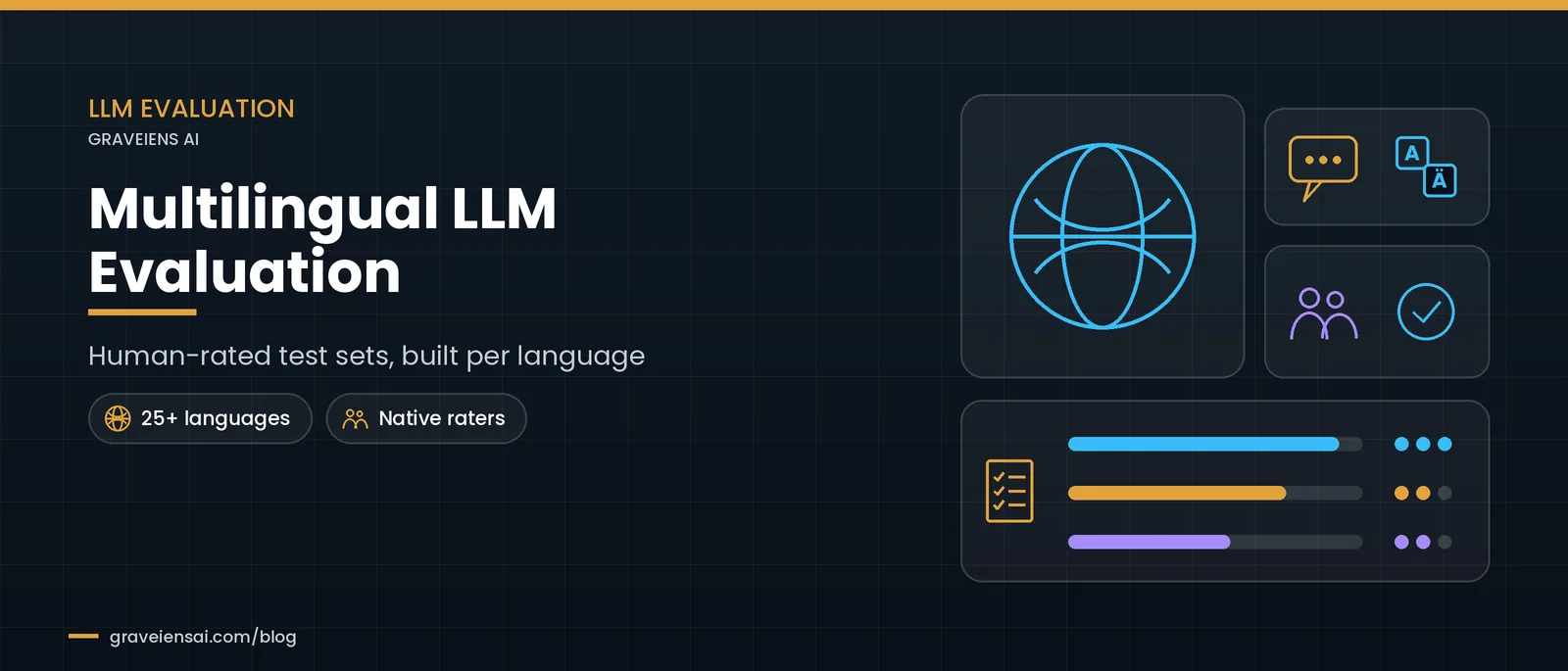
Multilingual LLM evaluation is the process of testing a large language model in each language it serves, using prompts, references and raters native to that language. It checks accuracy, fluency, cultural fit and instruction following per locale. It goes beyond translated English benchmarks, which miss how real users write and what they expect.
Think of it as three layers. Automatic metrics give you fast, cheap signals. LLM-as-judge scoring adds scale for open-ended answers. Native human raters provide the ground truth. Human evaluation of LLMs is the reference that both other layers must be checked against.
This post covers quality and capability. Safety testing across languages is a different job with different prompts and raters. We cover it in our guide to multilingual LLM red teaming. Ongoing production monitoring is also separate; see continuous AI model evaluation.
In short: multilingual LLM evaluation is per-language testing with native prompts and native judgment, used as the reference point for every automated score.
Why do translated English benchmarks mislead?
Translated benchmarks mislead because they test English content in another script. Questions keep US and European assumptions, and machine translation adds stiff, unnatural phrasing called translationese. Models can score well on these sets yet fail on the questions real users in Warsaw or Chennai actually ask, in the way they actually ask them.
The research is clear on the content problem. In the Global-MMLU paper (arXiv 2412.03304), the authors found that 28% of MMLU questions require culturally sensitive knowledge. Among questions that need geographic knowledge, 84.9% focus on North America or Europe. They also report that model rankings change when you score only the culturally sensitive subset.
That last point matters for buyers. If rankings shift on culturally loaded questions, a vendor or model choice based on a translated benchmark can be the wrong choice for your market.
Translationese and the sentence-level trap
Parallel test sets still have a place. FLORES-200, built for Meta’s No Language Left Behind project, provides 3,001 professionally translated sentences from 842 web articles across about 200 languages. It is a strong benchmark for machine translation.
But a sentence-level translation set does not tell you whether a chatbot gives a helpful, polite, locally correct answer to a multi-turn request. For that, you need prompts written by native speakers about local tasks, scored against a rubric.
In short: use translated and parallel sets for cheap regression checks, not as proof that your model serves each market well.
How do you build a human-rated multilingual test set?
Build it in five steps: scope the locales and tasks, have native speakers write prompts, anchor a rubric with scored examples, calibrate raters on gold items, then score and report per language. Run a small pilot first. Fix the rubric where raters disagree before you add more languages or more items.
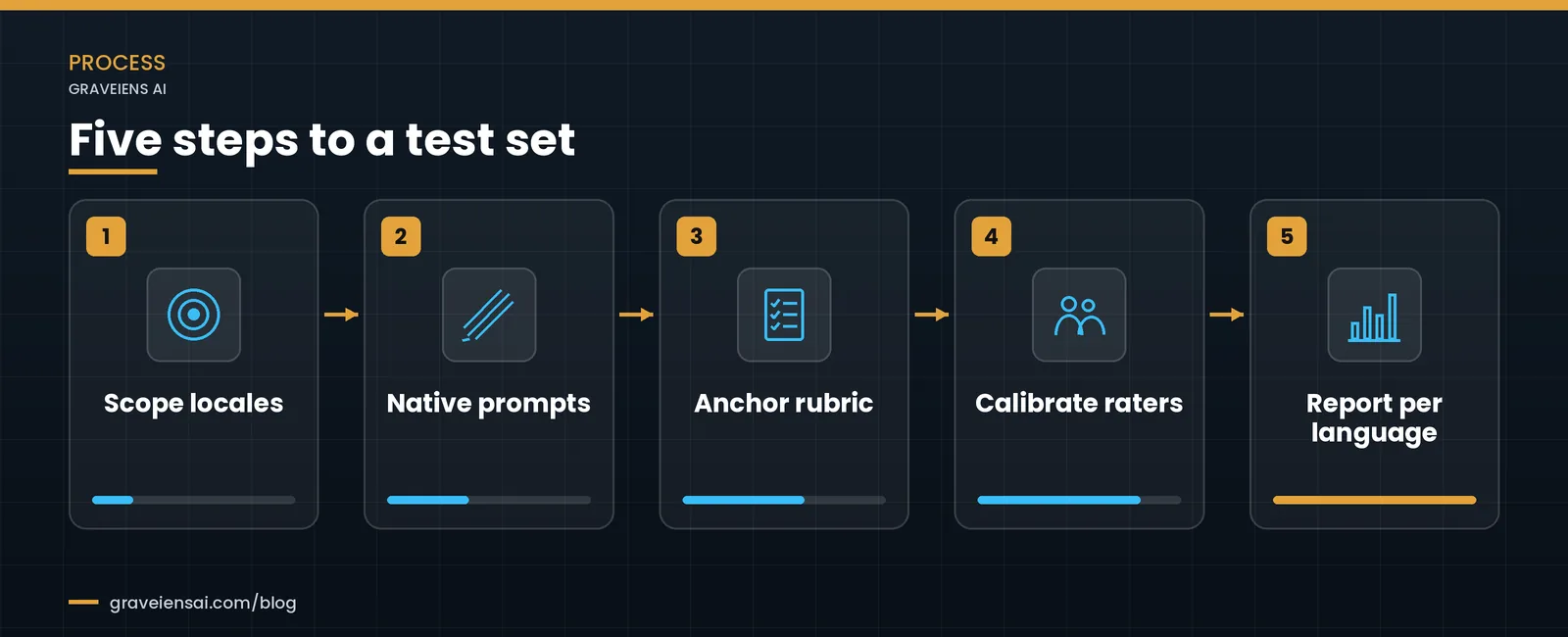
- Scope locales and tasks. List the markets you ship to and the jobs users give the model there. A German insurance assistant and an Italian retail chatbot need different prompts. Name the language variety too: Brazilian or European Portuguese, Hindi in Devanagari or romanized Hinglish.
- Write native prompts. Brief native speakers to write realistic requests for each task. Ask for local entities, units, dates, honorifics and formality levels. Translate only a small control set from English, so you can compare.
- Anchor the rubric. Define each scoring dimension and attach a scored example for every scale point, in each language. Anchors stop raters from drifting toward their own taste.
- Calibrate raters. Run a calibration round on gold items with known scores. Discuss disagreements, update the guidelines, and repeat until agreement is stable.
- Score and report per language. Collect at least two ratings per item for a sample, compute agreement per language, and publish a scorecard by language and task.
Test-set design per locale
Keep the task mix consistent across languages so you can compare. Let the content vary. A tax question in Poland should cite Polish rules; the equivalent prompt in Spain should cite Spanish ones.
Tag every item with metadata: language, script, task type, difficulty, domain, and whether it was native-written or translated. Those tags let you slice results later without rebuilding the set.
Code-switching prompts
Real users mix languages. Hinglish in India, English tech terms inside German or Italian sentences, Spanish and English in US support chats. Add code-switching prompts as a named slice of the test set, not as noise.
Rate two things on these items: did the model understand the mixed input, and did it reply in the register the user would expect? Some users want a reply in the mixed style; others want the dominant language. Your rubric should say which is correct for each product.
In short: native prompts, consistent task coverage, rich metadata and a deliberate code-switching slice make the test set reusable across releases.
The NATIVE framework for multilingual LLM evaluation
We use a six-part checklist, the NATIVE framework, to decide whether a language is ready to report. If any letter fails, the scores for that language are not yet decision-grade.
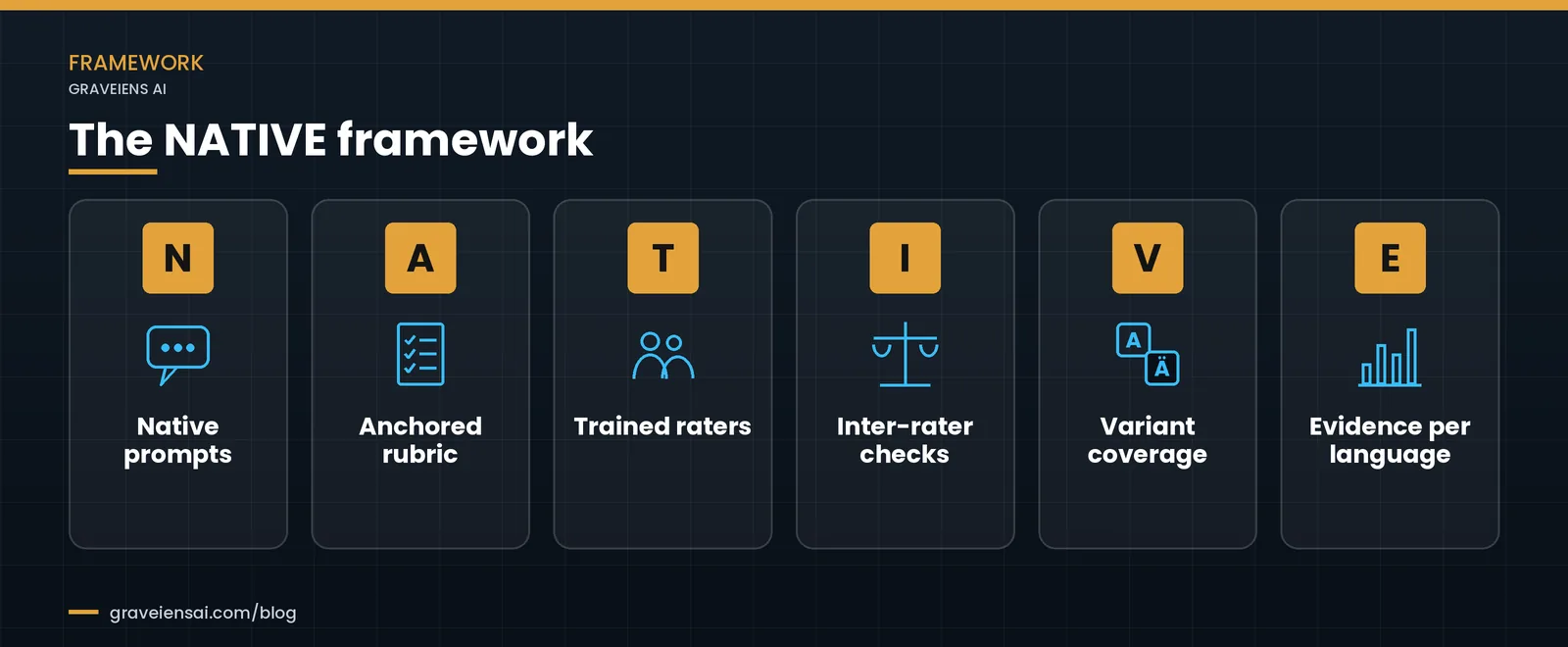
- N: Native prompts. Most items are written by native speakers about local tasks, with a small translated control set.
- A: Anchored rubric. Every dimension has a definition and a scored example per scale point, in that language.
- T: Trained raters. Native-speaker evaluators pass a calibration round on gold items before live scoring.
- I: Inter-rater checks. A share of items gets two or more ratings, and agreement is computed per language.
- V: Variant coverage. Scripts, regional varieties, formality levels and code-switching are covered where users need them.
- E: Evidence per language. Results are reported per language and task, with sample sizes and agreement, not one global average.
An LLM evaluation rubric you can adapt
Keep the rubric short. Four to six dimensions on a 1 to 5 scale work for most chat and assistant tasks. Use the same dimensions in every language, with locale-specific anchors.
| Dimension | What raters check | Example anchor for a low score |
|---|---|---|
| Task success | Did the answer do what the user asked? | Answers a different question |
| Factual accuracy | Are claims correct for this locale? | Cites a US rule to a German user |
| Fluency and naturalness | Would a native speaker write this? | Literal, word-for-word phrasing |
| Register and politeness | Is formality right for the context? | Informal tu/du with a bank customer |
| Cultural fit | Are names, units, dates and examples local? | Miles and MM/DD dates in Italy |
| Language fidelity | Does it reply in the expected language or mix? | Switches to English mid-answer |
For specialist domains such as legal, medical or financial content, pair language raters with subject experts. Our domain expert evaluation page explains how that pairing works.
In short: a short rubric with anchored examples in every language beats a long rubric that raters interpret differently.
Want a second pair of eyes on your rubric or locale plan? Book a 20-minute scoping call, or request the NATIVE checklist.
How do you recruit and calibrate native-speaker evaluators?
Recruit evaluators who are native or near-native in the target variety, live in or know the market, and pass a short screening test on your rubric. Then calibrate them on gold items with known scores, review disagreements together, and re-check agreement on a fixed schedule so drift is caught early.
Screening criteria
- Native fluency in the exact variety you ship (for example, Swiss German differs from German German).
- Recent exposure to the market: local news, services, slang and formality norms.
- Strong writing skills in the language, shown on a short sample task.
- Domain knowledge where the task needs it, verified by a test, not a CV line.
- A pass on a small set of gold items scored against your anchors.
Calibration that sticks
Start each language with a calibration batch of gold items. Every rater scores them alone. Then a lead rater walks the group through disagreements and updates the guidelines with the new edge cases.
Keep seeding gold items into live batches. If a rater drifts on gold items, pause and recalibrate before their scores enter the report. This is standard practice in LLM evaluation services and it matters more across languages, because a lead reviewer may not read every language.
In short: screen for the exact variety, calibrate on gold items, and keep auditing with hidden gold throughout the project.
Which inter-rater agreement metrics should you use?
Use Cohen’s kappa for two raters on categorical labels, and Krippendorff’s alpha for more raters, ordinal 1 to 5 scores or missing ratings. For side-by-side preference tasks, report pairwise agreement too. Always compute agreement per language, because one weak locale can hide behind a healthy overall number.
Agree on a target agreement floor before scoring starts. Low agreement usually points to an unclear rubric, missing anchors or a weak calibration round, not to bad raters. Fix the guideline, rerun calibration, then score again.
Report raw percent agreement next to the chance-corrected number. Stakeholders understand the first; statisticians trust the second.
Automatic metrics, LLM-as-judge, or native raters?
You need all three, in different roles. The matrix below keeps the claims general on purpose: results vary by language, task and judge model.
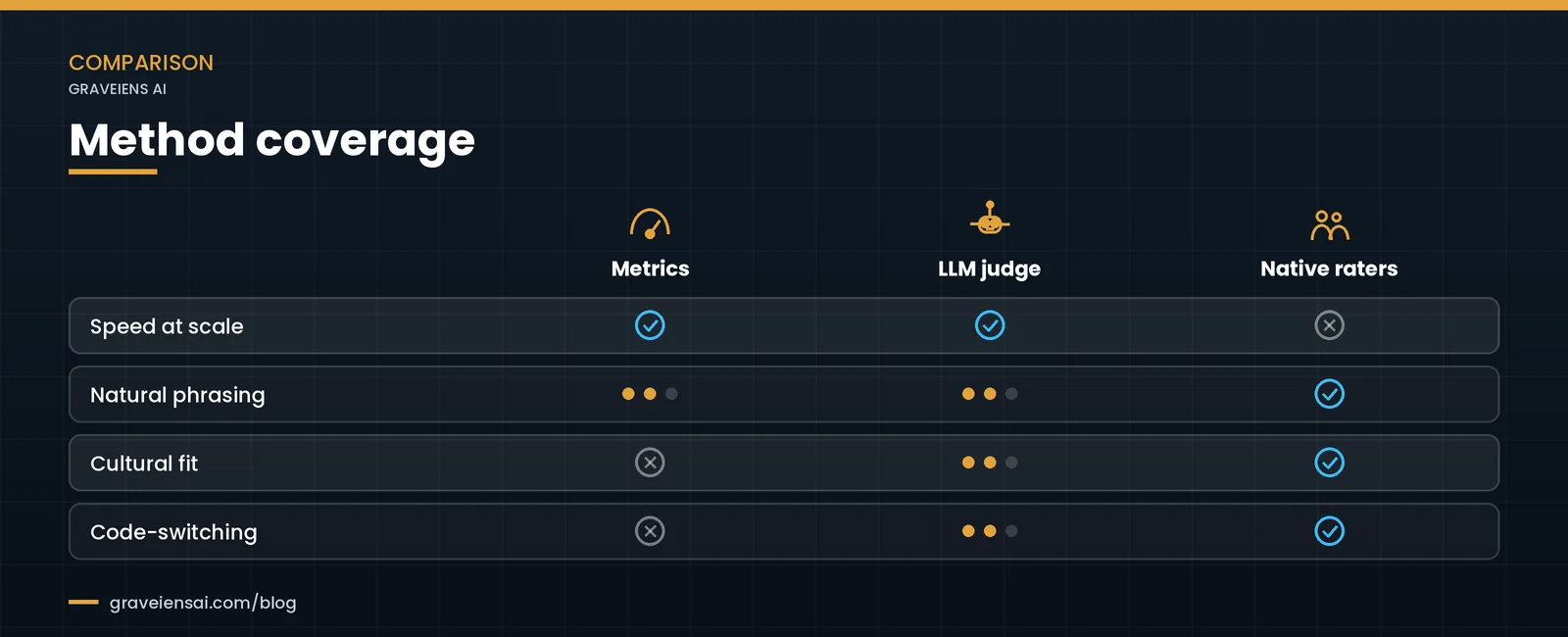
Use native-rater scores to check your LLM judge per language. Compute agreement between the judge and each human rater, not one pooled number. Where the judge agrees well, let it carry routine regression runs. Where it does not, keep humans in the loop.
In short: kappa or alpha, computed per language, with human ratings as the reference for any automated judge.
How much effort does a multilingual LLM benchmark pilot take?
Effort depends mainly on the number of languages, items per locale, domain depth and raters per item. A focused pilot covers 2 to 4 languages and a few task types, with double rating on a sample. That is enough to test the rubric and agreement before you commit to a larger multilingual LLM benchmark.
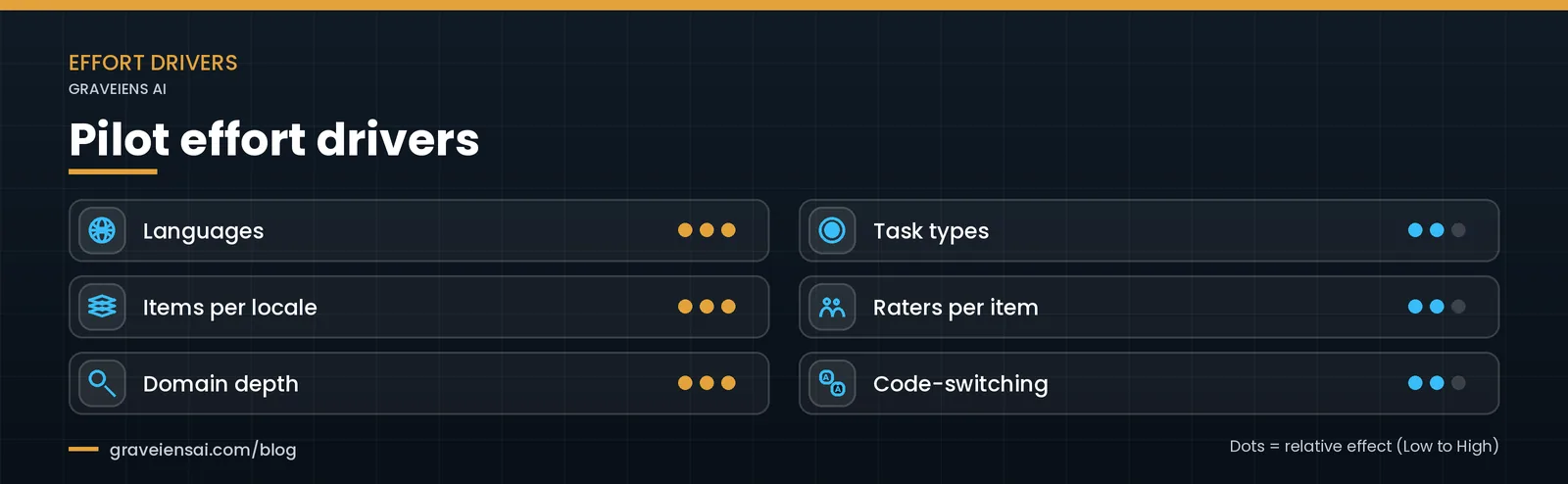
| Driver | Why it adds effort | How to keep the pilot lean |
|---|---|---|
| Number of languages | Each needs its own raters, anchors and gold items | Start with your top revenue or risk markets |
| Items per locale | More items narrow the uncertainty per task | Size per task slice, not per language total |
| Domain depth | Specialist raters are scarcer and slower | Pair one expert with language raters |
| Task types | Each task needs its own rubric anchors | Pick 2 to 3 tasks users do most |
| Raters per item | Double rating multiplies rating volume | Double-rate a sample, single-rate the rest |
| Code-switching and scripts | Extra variants mean extra prompt writing | Add one variant slice where users need it |
Here is a simple worked example. Three languages, 150 prompts each, two model variants and double rating on a 30% sample gives 900 primary ratings plus 270 overlap ratings. The arithmetic helps you plan rater hours and turnaround before anyone writes a prompt.
In short: languages and domain depth drive effort most; double-rating a sample keeps agreement checks affordable.
How should you score and report results per language?
Publish a scorecard per language and task, not one global average. Each cell should show the mean score, the number of items, inter-rater agreement and the top failure types. This makes weak locales visible and gives engineers concrete examples to fix in the next data or training round.
Borrow the multi-metric idea from Stanford’s HELM (Holistic Evaluation of Language Models). HELM measures seven metrics, including accuracy, calibration, fairness, bias, toxicity and efficiency, rather than accuracy alone. Your scorecard can follow the same logic with your rubric dimensions.
- Show each rubric dimension separately, then a weighted overall score.
- Add item counts and agreement next to every score.
- Flag languages where the LLM judge and human raters disagree.
- List the five most common failure types per language, with examples.
- Compare against the previous model version on the same items.
For EU teams, per-language evidence also supports compliance conversations. Under Article 15 of the EU AI Act (Regulation (EU) 2024/1689), providers of high-risk AI systems must declare accuracy levels and the relevant accuracy metrics in the instructions for use. Not every LLM product is high-risk, so check scope with your legal team.
Failures found here become training data. Weak answers can be rewritten into supervised examples or ranked as preference pairs; our supervised fine-tuning vs RLHF guide explains which route fits which failure.
In short: per-language, per-task scorecards with counts and agreement turn evaluation into a fix list.
Common mistakes in multilingual LLM evaluation
- Averaging across languages. A strong English and Spanish score can mask a weak Polish or Marathi score.
- Translating the rubric without new anchors. Raters need examples that sound like their language, not translated English examples.
- Hiring bilinguals for the wrong variety. A Hindi rater may not judge Tamil, and a Castilian Spanish rater may miss Mexican usage.
- Trusting the LLM judge everywhere. A judge that agrees with humans in French may not agree in Bengali. Check per language.
- Skipping code-switching. If your users mix languages, a monolingual test set overstates quality.
- Mixing safety and quality items. Keep adversarial and quality prompts in separate sets with separate raters and rubrics.
- One-off testing. A test set is an asset. Version it, refresh a slice each quarter, and rerun it on every major model change.
How Graveiens AI approaches multilingual evaluation
Graveiens AI runs human evaluation in 25+ languages, including deep Indic coverage and European languages such as Italian. Our language services team helps write native prompts and locale anchors, and our evaluation teams score outputs against your rubric.
We scope rater profiles, task mix and agreement targets with you before work starts. Pilots are billed only on approved deliverables, so you pay for files that meet the agreed acceptance criteria. Graveiens AI follows a documented QA process with multi-level human review.
We do not promise model-accuracy gains. We deliver a test set, ratings and per-language findings your team can act on.
Frequently asked questions
What is the difference between multilingual LLM evaluation and red teaming?
Multilingual LLM evaluation measures quality and capability: task success, accuracy, fluency and cultural fit in each language. Red teaming deliberately attacks the model to find unsafe or policy-breaking behavior. The prompts, raters and rubrics differ, so keep them in separate test sets. Many teams run both before a launch in a new market.
How many prompts per language do you need for an LLM evaluation pilot?
There is no universal number. Size each task slice so the results are stable enough to compare models, then check agreement on a double-rated sample. A practical route is to start with two or three tasks per language, review the score variance after the first batch, and add items only where the uncertainty is still too wide to support a decision.
Can an LLM-as-judge replace native-speaker evaluators?
Not on its own. An LLM judge is fast and cheap for regression runs, but its agreement with humans varies by language and task. Use native-speaker ratings as the reference, measure judge-human agreement per language, and let the judge carry routine runs only where it agrees well. Recheck after model or prompt changes.
Which inter-rater agreement score is best for LLM evaluation?
Krippendorff’s alpha suits most LLM rating projects because it handles more than two raters, ordinal 1 to 5 scales and missing ratings. Cohen’s kappa works for two raters with categorical labels. Report raw percent agreement alongside the chance-corrected score, and compute both per language rather than pooled across the whole test set.
Should I translate my English test set or write new prompts?
Do both, in different proportions. Write most items natively so they reflect local tasks, phrasing and expectations. Keep a small translated control set so you can compare languages on identical content. Translated items alone carry English-centric topics and translationese, which can make a model look better or worse than real users will find it.
How do you evaluate code-switching in LLM outputs?
Add a dedicated slice of prompts that mix languages the way your users do, such as Hinglish or English terms inside German. Rate whether the model understood the mixed input and whether it replied in the expected language or mix. Define the correct reply style per product in the rubric, because user expectations differ by market.
Which European and Indic languages should a multilingual LLM benchmark cover first?
Start with the languages that carry your revenue, user volume or regulatory exposure. For many US and EU teams that means German, French, Spanish, Italian and Polish, plus Hindi and one or two other Indic languages if India is a growth market. Add regional varieties and code-switching where your user data shows demand.
Build your multilingual test set with native-speaker raters
Tell us your languages, tasks and launch dates. We will propose a pilot scope, rater profile and rubric plan.
Graveiens AI follows a documented QA process with multi-level human review. Pilots are billed only on approved deliverables.
Sources
- Singh, S. et al. Global MMLU: Understanding and Addressing Cultural and Linguistic Biases in Multilingual Evaluation. arXiv:2412.03304. https://arxiv.org/abs/2412.03304
- Meta AI / NLLB Team. FLORES-200 evaluation benchmark, README (facebookresearch/flores; repository archived, read-only). https://github.com/facebookresearch/flores/blob/main/flores200/README.md
- Liang, P. et al. Holistic Evaluation of Language Models (HELM). Stanford CRFM. arXiv:2211.09110. https://arxiv.org/abs/2211.09110
- Regulation (EU) 2024/1689 (Artificial Intelligence Act), Article 15. EUR-Lex. https://eur-lex.europa.eu/eli/reg/2024/1689/oj/eng

Jitendra Choubay is the CEO & Founder of Graveiens AI, leading a human-in-the-loop data services team that helps AI builders with data collection, annotation, consent-backed voice data, transcription and LLM fine-tuning. He writes on building better, ethically sourced AI training data.
Get the next Graveiens AI article
Expert notes on AI data, annotation, LLMs and eLearning — no spam, unsubscribe anytime.
Need AI Development? Data Annotation? eLearning?
Talk to Graveiens AI about data collection, annotation, voice data, RLHF/SFT, LLM evaluation and AI training data — invoiced only on approved work.
Contact Graveiens AI