Last updated: November 2026
Key takeaways
- Action segmentation annotation gives every stretch of an untrimmed video a start time, an end time and a class label, including idle time, so models learn both what happens and when.
- Most quality problems start in the spec, not with the annotators: a loose verb-noun taxonomy, vague boundary rules or no policy for overlap and idle frames.
- Score segment QA with three metrics together: frame-wise accuracy, edit score and segmental F1 at IoU thresholds such as 10%, 25% and 50%.
- For egocentric footage, align narrations to segments, flag actions that are not visible, and confirm participant consent before any frame is labeled.
- Run a pilot on representative clips, set acceptance gates from the annotator-versus-annotator baseline, and pay only for approved files.
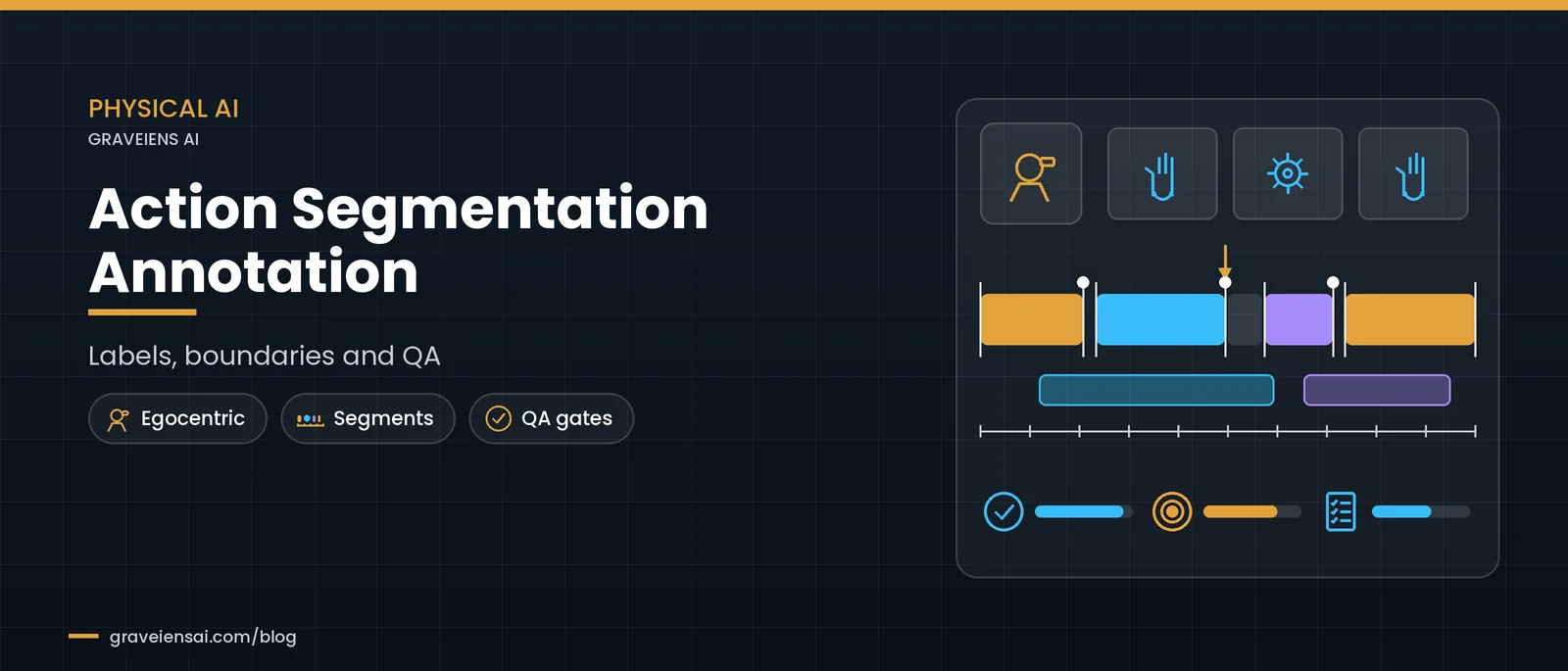
Action segmentation annotation turns long, untrimmed video into a timeline of labeled actions, each with a start, an end and a class. For robotics and physical-AI teams training on egocentric (head-mounted) footage, these labels decide whether a policy learns clean task steps or noisy guesses. Yet many requests for proposals stop at “label the actions.”
This guide is for ML leads and data buyers in the US and EU who must write the spec and accept the delivery. You get a taxonomy method, boundary rules, an overlap and idle policy, segment agreement metrics, a file format and a pilot plan.
Scoping a segmentation project? Request a sample dataset or book a 20-minute scoping call with our robotics data team.
What is action segmentation annotation?
Action segmentation annotation is the process of splitting an untrimmed video into consecutive time segments and giving each segment one action label. Every frame ends up in an action or in a background class. The output is a list of start and end timestamps with labels, used to train and test temporal action segmentation models.
In short: segmentation labels the whole timeline. Detection labels only the actions you care about. Recognition labels clips that were already cut.
The difference matters when you write a statement of work. A vendor quoting “action labels” may mean one class per pre-cut clip. A segmentation model needs dense labels across the full video, with no unexplained gaps.
| Task | Input | Label output | Typical metric |
|---|---|---|---|
| Action recognition | Trimmed clip with one action | One class per clip | Top‑1 / Top‑5 accuracy |
| Temporal action detection | Untrimmed video | Sparse start–end intervals with classes | mAP at IoU thresholds |
| Temporal action segmentation | Untrimmed video | Dense labels: every frame, incl. background | Frame accuracy, edit score, F1@IoU |
The EPIC-KITCHENS-100 benchmark shows the split in practice. Its recognition challenge scores top‑1 and top‑5 accuracy on trimmed segments. Its detection challenge scores mean average precision at IoU 0.1 to 0.5 on untrimmed video [1].
For robot learning data, segments do real work. They mark skill boundaries for imitation learning, sub-goals for task planners and search keys for retrieval. Our guide to physical AI and robotics training data covers where segmented video sits among real, simulated and teleoperated sources.
How does an action segmentation annotation project run?
A sound action segmentation annotation project runs in five stages: ingest consented footage with metadata, fix the taxonomy and boundary rules, segment the timeline, review against agreement gates, and deliver in a validated schema. Each stage has an exit check. Skipping the taxonomy stage is the most common cause of rework later.
In short: spend early effort on the spec and a gold set. Labeling speed follows.
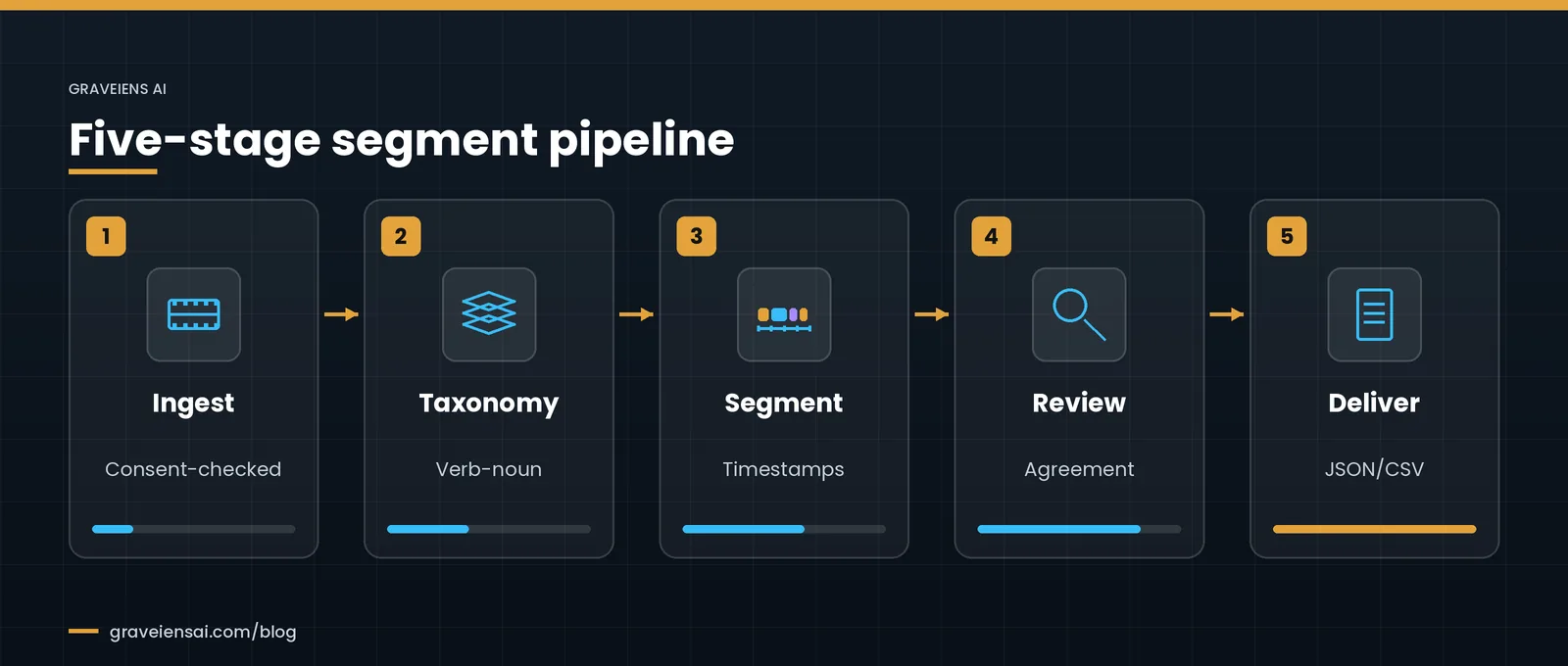
- Ingest. Confirm each video has a consent record, a device ID, frame rate and duration. Split very long recordings into working chunks with overlap, so no action is cut at a chunk edge.
- Taxonomy. Freeze the verb and noun lists, class definitions and boundary rules. Build a gold set of 10 to 20 clips labeled by your own experts.
- Segment. Annotators mark start and end points on a timeline view. If narrations exist, they start from narration timestamps and refine the edges.
- Review. A second annotator labels a sample of each batch. Reviewers compare segment lists with agreed metrics and send failures back with notes.
- Deliver. Export to the agreed JSON or CSV schema. Run automatic checks for gaps, overlaps, invalid class IDs and timestamps past the video end.
How do you build a verb-noun action taxonomy?
Build a verb-noun action taxonomy by listing the verbs and objects that matter for your model, merging synonyms into classes, and writing a one-line definition with start and end cues for each verb. Pair verbs and nouns as separate fields, so “open drawer” and “open fridge” share the verb “open” but keep distinct nouns.
In short: separate verbs from nouns, merge synonyms early, and define every class with visible cues.
EPIC-KITCHENS-100 is the clearest public example. It has about 90,000 action segments labeled with 97 verb classes and 300 noun classes, drawn from 100 hours of head-mounted video in 45 kitchens [1]. Its authors parsed free-form narrations into verbs and nouns, then grouped near-synonyms into classes [3]. That step turns thousands of spoken words into a fixed label set.
A verb-noun split also helps with rare pairs. Separate fields let the model share what it learns about “open” across every object.
Choose a granularity level per use case
Pick the level of detail before labeling starts. Most robot learning projects use one to three levels:
- Activity (minutes): “make coffee” or “restock shelf.” Good for planning and video search.
- Step (seconds): “fill kettle” or “scan barcode.” Good for task planners and anticipation models.
- Atomic action (often under a few seconds): “grasp cup,” “pour,” “release.” Good for imitation learning and policy training.
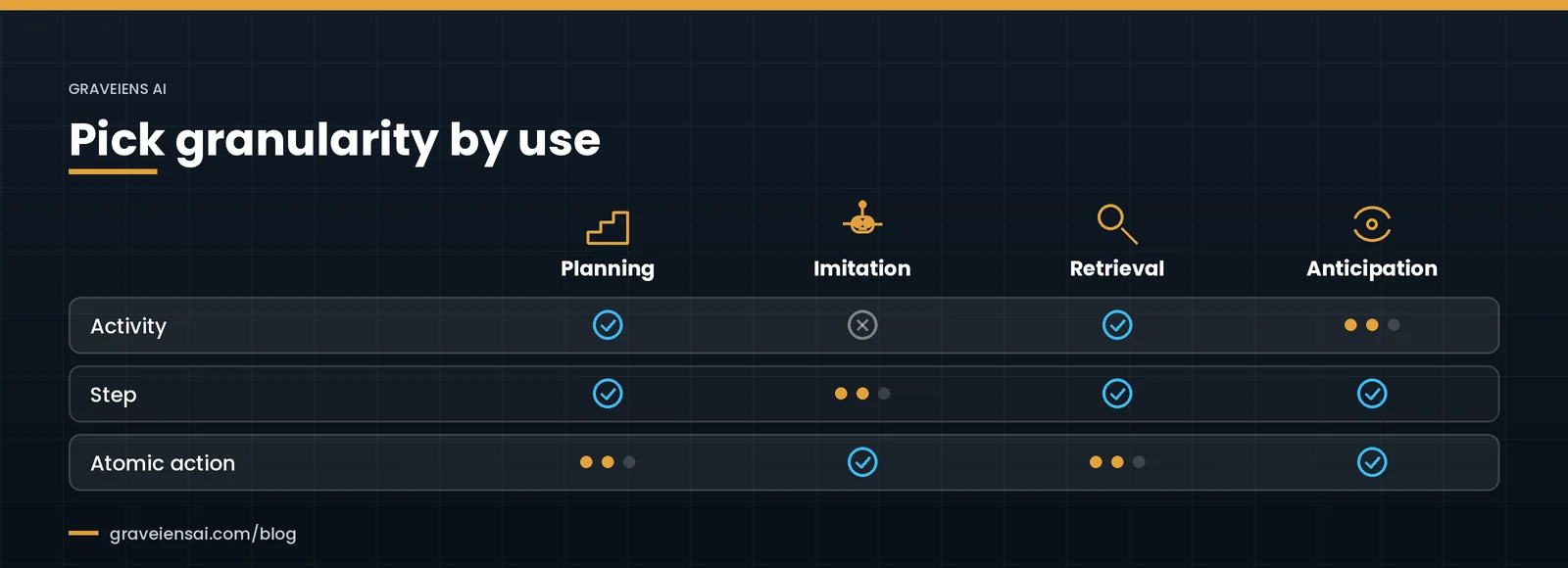
If you need more than one level, label them as nested layers that share boundaries. Each atomic action should sit inside one step, and each step inside one activity.
Write class definitions annotators can apply
A class name alone is not a definition. For each verb, write five fields:
- A one-sentence meaning in plain language.
- The visible start cue, such as “hand begins moving toward the object.”
- The visible end cue, such as “object released and hand withdrawn.”
- One include example and one exclude example.
- The nearest confusable class and how to tell them apart.
Keep an “other” or “unlisted action” class for real actions outside the taxonomy. Track how often it is used. A rising share tells you the taxonomy needs a new class.
Action boundary labeling rules that survive review
In action segmentation annotation, boundaries cause more disagreement than class labels. Research on egocentric object interactions found that the same action, such as “pour,” received very different start and end times across datasets and even within one dataset. The authors proposed “Rubicon Boundaries,” which split an action into a pre-actional phase (reaching, preparing) and an actional phase (the goal-directed motion) [2].
Your spec should state which phase counts as the action. For grasp-heavy robot data, many teams start the segment at first hand motion toward the object. Others start at contact. Either works if everyone applies the same rule.
Useful boundary rules for egocentric video:
- Define start and end by a visible event, not by intent.
- Set a minimum segment length. EPIC-KITCHENS-100 required actions to be at least 0.5 seconds long [3].
- State whether consecutive actions may overlap. EPIC-KITCHENS-100 allowed this, but an action could not start before the previous action’s start time [3].
- Set a frame tolerance for review, such as a few frames at your capture rate, and write it down.
- Tell annotators to step frame by frame near boundaries, not scrub at full speed.
Multiple annotators also help. In the original EPIC-KITCHENS work, four annotators labeled each batch of narrated actions. The team kept the best-agreeing annotation. It merged that with the next best when their IoU was above 0.5, because a single annotation tended to be too tight [4].
Background, idle and “not visible” frames
Every frame in a segmentation dataset needs a label. Frames between actions should get an explicit background or idle class, not be left blank. Blank gaps look the same as missed labels during QA.
Egocentric video adds a second case: the action happens, but the camera does not show it. The wearer looks away, or a hand blocks the view. Add a “not visible” flag so annotators can record this without guessing. EPIC-KITCHENS let annotators mark an action as not visible for this reason [4].
Overlapping and concurrent actions
People use two hands. One hand holds a jar while the other twists the lid. A single-lane timeline cannot express that without losing information.
- Single lane: one label per frame. Choose a priority rule, such as “dominant hand wins.” Simple to score with standard metrics.
- Multi-lane: one track per hand or per agent. Richer for bimanual robot policies, but each lane must be scored separately.
Decide this before the pilot. Changing from one lane to two after delivery means relabeling. If you also need per-frame hand geometry, treat it as a separate task; our hand pose annotation guide covers that layer.
Narration alignment for egocentric video annotation
Narrations are short sentences describing what the camera wearer does. They are cheaper to collect than full segments, and they seed the taxonomy for action segmentation annotation. They are not segments, though. A narration usually carries one timestamp, not a start and an end.
EPIC-KITCHENS-100 collected narrations with a “Pause-and-Talk” interface, where narrators pause the video to describe each action. Narrations were collected in multiple languages, then translated, parsed into verbs and nouns, and given start and end boundaries in a separate pass [3].
Ego4D took a similar path at larger scale. It holds 3,670 hours of daily-life video from 931 camera wearers across 74 locations in 9 countries. Its narrations are dense, timestamped sentences written in the form “#C C does something,” where “#C” marks the camera wearer [5].
A practical alignment method:
- Collect narrations in the participant’s language, then translate them to your label language.
- Map each narration to a verb class and noun class from the frozen taxonomy.
- Use the narration timestamp as an anchor, then mark the true start and end around it.
- Flag narrations with no matching visible action for review, not for deletion.
The SPLICE framework for an action segmentation spec
We use a six-part checklist to turn a vague action segmentation annotation request into a spec any team can label against. We call it SPLICE.
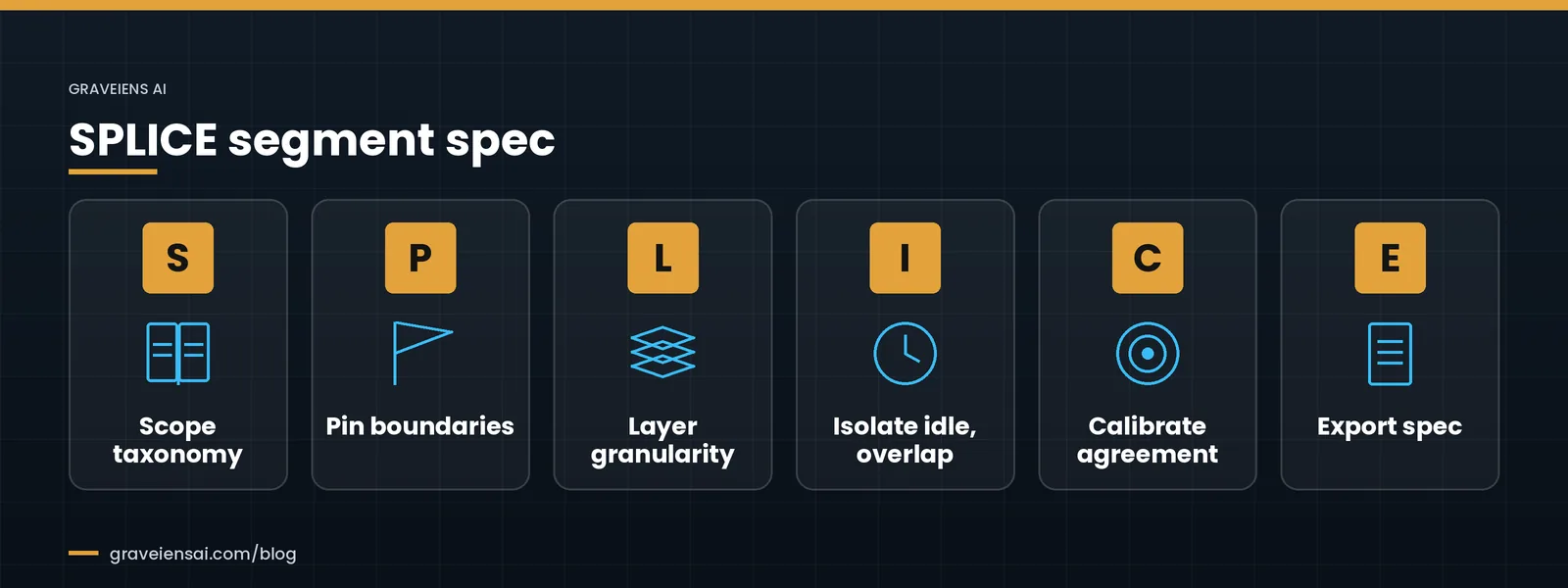
- S — Scope the taxonomy. Freeze verb and noun lists, definitions and the “other” class. Version the file.
- P — Pin the boundaries. State start and end cues, the minimum length and the review tolerance in frames.
- L — Layer the granularity. Choose activity, step or atomic levels and how they nest.
- I — Isolate idle and overlap. Define the background class, the “not visible” flag and single-lane or multi-lane rules.
- C — Calibrate agreement. Label a gold set, measure annotator-versus-annotator scores, and set gates from that baseline.
- E — Export the spec. Fix the schema, time units, frame rate field and validation rules before the first delivery.
Lock all six before the pilot. Changes after that point should go through a versioned change log, so earlier batches can be relabeled or flagged.
Want SPLICE as a one-page form? Request the SPLICE checklist, or scope a pilot billed only on approved files.
Which agreement metrics should you use for segment QA?
Use three metrics together: frame-wise accuracy, segmental edit score and segmental F1 at IoU thresholds of 10%, 25% and 50%. Frame accuracy shows overall label overlap. Edit score checks the order of actions. F1@IoU checks whether each segment matches in class and timing. Apply them between annotators and against your gold set.
In short: no single number is enough. Frame accuracy can look high while segments are fragmented.
Lea and colleagues introduced the segmental F1 score to penalize over-segmentation while tolerating small timing shifts. A predicted segment counts as a match when its class is right and its IoU with a reference segment passes a threshold [6]. Most later segmentation papers report F1 at 10%, 25% and 50% alongside edit score and frame accuracy.
| Metric | What it measures | What it catches | Blind spot |
|---|---|---|---|
| Frame-wise accuracy | Share of frames with the same label | Wrong classes over long spans | Short segments and fragmentation |
| Edit score | Similarity of the ordered segment sequence | Missing, extra or split segments | Exact boundary timing |
| F1@10 / 25 / 50 | Segment matches at IoU thresholds | Class plus timing errors per segment | Agreement inside long segments |
These are model metrics, but they also work well for inter-annotator agreement in action segmentation annotation. Treat one annotator as reference and the other as prediction, then swap and average. A low F1@50 with a high F1@10 usually means annotators agree on what happened but not exactly when.
Set QA gates from a pilot baseline
There is no universal pass mark. Agreement depends on class count, granularity and footage. Set gates from your own pilot instead:
- Gate 0 — spec sign-off. Your ML team and the annotation lead label the gold set and agree on it.
- Gate 1 — annotator qualification. Each annotator labels gold clips and must reach the agreed scores before live work.
- Gate 2 — batch sampling. A fixed share of each batch is double-labeled and scored against the pilot baseline.
- Gate 3 — schema validation. Automatic checks for gaps, overlaps in single-lane tracks, unknown class IDs and timestamps past the video end.
- Gate 4 — client acceptance. You review a sample and approve or return the batch with reasons.
Our broader video annotation playbook covers QA for boxes, masks and tracks. The gates above are specific to temporal segments.
What file format should segment labels use?
Use JSON or CSV with one record per segment. Include video ID, start and end in seconds and frames, frame rate, verb, noun, lane and annotator ID. Include a taxonomy version field. Seconds keep labels portable across re-encodes; frames keep them exact for training.
In short: store both seconds and frames, and version the taxonomy inside every file.
Public datasets with action segmentation annotation follow this pattern. EPIC-KITCHENS-100 publishes its annotations in a public repository as CSV files with start and stop times, verb and noun classes and narration text [1]. A minimal JSON record might look like this:
{
  "video_id": "ego_000123",
  "fps": 30,
  "taxonomy_version": "v1.2",
  "segments": [
    {"start_s": 12.40, "end_s": 14.10, "start_f": 372, "end_f": 423,
     "verb": "open", "noun": "drawer", "lane": "right_hand",
     "visible": true, "annotator": "A07", "review": "approved"}
  ]
}
Agree on three details up front. First, whether end times are inclusive or exclusive. Second, which frame rate applies if the device recorded at a variable rate. Third, how the background class is written, so empty arrays never stand in for idle time.
What drives effort in action segmentation annotation?
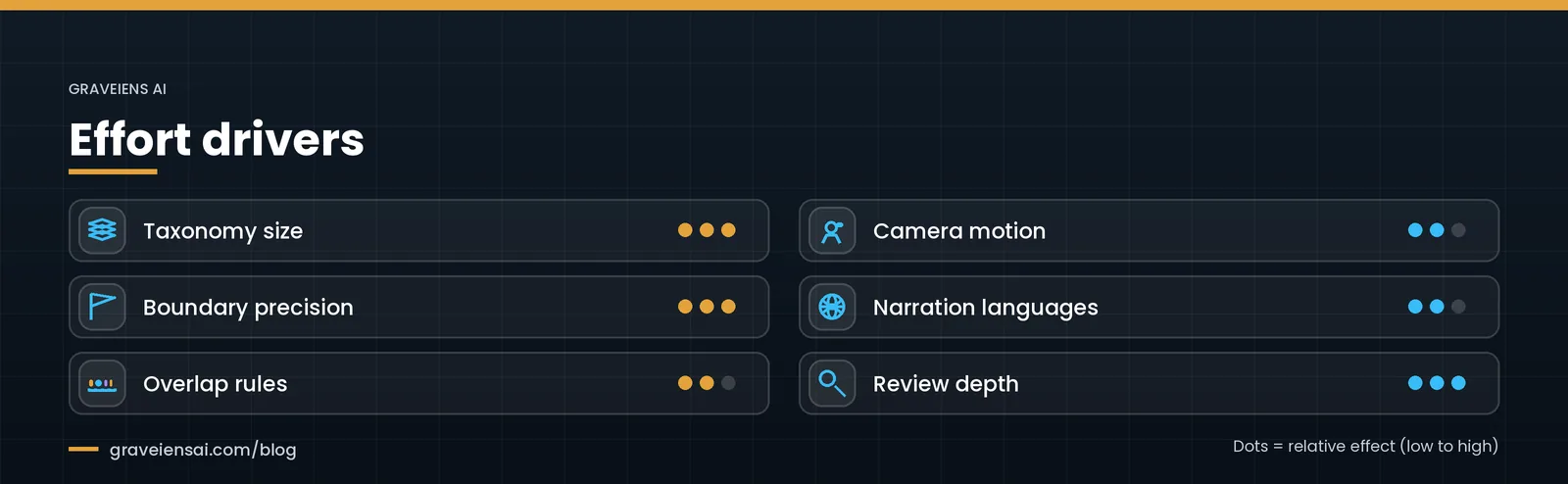
Effort in action segmentation annotation rises with taxonomy size, boundary precision, overlap rules, camera motion, narration languages and review depth. Clip length matters less than how many actions each minute contains. A busy kitchen minute can hold many more segments than a minute of walking, so price and plan by action density.
In short: density and precision drive effort more than raw hours.
| Driver | Why it adds effort | How to control it |
|---|---|---|
| Taxonomy size | More classes means more look-up and more confusable pairs | Start lean; add classes when “other” grows |
| Boundary precision | Tight tolerances need frame-by-frame stepping | Match tolerance to what the model needs |
| Overlap rules | Multi-lane tracks multiply passes per video | Use multi-lane only for bimanual tasks |
| Camera motion | Head turns and blur hide hands and objects | Use the “not visible” flag, not guesses |
| Narration languages | Each language needs native narrators and translation | Fix the label language early |
| Review depth | Double-labeling raises cost per approved minute | Sample by batch; raise depth only on failures |
Ask any provider to state these assumptions in the quote. Two quotes for the same hours of action segmentation annotation can describe very different work.
Common mistakes, consent and compliance checks
The same few problems show up across action segmentation annotation projects:
- Labeling before the gold set exists. Without it, nobody can say whether a batch is right.
- Leaving gaps unlabeled. Missing background labels hide missed actions.
- Mixing granularity levels in one lane. “Make coffee” and “grasp cup” should never sit side by side.
- Changing the taxonomy mid-project without versions. Earlier batches silently become inconsistent.
- Scoring with frame accuracy alone. Fragmented segments pass while the model learns noise.
Consent comes before any action segmentation annotation starts. Egocentric video often captures faces, voices, homes and workplaces. Under the EU GDPR, consent must be “freely given, specific, informed and unambiguous,” given by a statement or a clear affirmative action (Article 4(11)) [7]. Check that consent covers annotation and model training, not only recording. Plan how bystanders are handled, and keep consent records linked to video IDs so a withdrawal can be traced to every derived label file. Ask your counsel which legal basis applies to your project.
How Graveiens AI approaches action segmentation annotation
As of November 2026, Graveiens AI holds 150,000+ consent-backed egocentric videos captured across seven device families. Every recording goes through an explicit-consent workflow: participant onboarding, recording and capture management, metadata tagging, then QA. That gives segmentation work a clean starting point, with consent and device metadata attached.
We support narration in 25+ languages, including deep Indic coverage and European languages such as Italian. Narrations can then be mapped to one shared label taxonomy. Our egocentric video data collection service handles capture, and our data annotation service covers labeling and review.
Taxonomies, granularity and acceptance gates differ for every robot and task, so we scope each action segmentation annotation project with you. Pilots are billed only on approved deliverables, and Graveiens AI is ISO 9001 certified.
Frequently asked questions
What is the difference between action segmentation and action detection?
Action segmentation labels every frame of an untrimmed video, including background, so the output is a complete timeline. Action detection finds only the action instances of interest and returns sparse start and end intervals with classes. Segmentation is usually scored with frame accuracy, edit score and F1@IoU, while detection is usually scored with mAP at IoU thresholds.
How many action classes should a segmentation taxonomy have?
There is no fixed number. Start with the verbs and objects your model must tell apart, merge synonyms, and keep an “other” class. EPIC-KITCHENS-100 used 97 verb classes and 300 noun classes for kitchen activity. Many robot projects need far fewer. Add classes only when the “other” share grows in review.
How precise do action boundaries need to be?
As precise as your model needs and no more. Policy learning from atomic actions often needs tight, frame-level edges. Planning and retrieval can tolerate looser ones. Write the tolerance in frames into the spec, define visible start and end cues, and measure boundary agreement with F1 at 25% and 50% IoU during the pilot.
What is a good inter-annotator agreement score for segments?
No universal pass mark exists, because agreement depends on class count, granularity and footage. Measure annotator-versus-annotator frame accuracy, edit score and F1@10, 25 and 50 on a pilot gold set. Then set batch gates relative to that baseline. Watch the gap between F1@10 and F1@50, which shows boundary disagreement.
Can narrations replace segment labels?
Not on their own. Narrations usually carry one timestamp per action, not a start and an end, and may describe actions the camera never shows. They are a strong starting point: map each narration to taxonomy classes, use its timestamp as an anchor, then mark true boundaries and flag any narration with no visible action.
Should idle time be labeled in action segmentation?
Yes. Give idle or transition frames an explicit background class instead of leaving them blank. Blank gaps look identical to missed actions during QA, and many segmentation models expect every frame to carry a label. A separate “not visible” flag handles actions that happen off camera in egocentric video.
What file format is best for temporal action segmentation labels?
JSON or CSV both work if the schema is fixed. Store one record per segment with video ID, start and end in seconds and frames, frame rate, verb, noun, lane, visibility and review status. Add a taxonomy version to every file, and state whether end times are inclusive or exclusive.
Do you need consent to annotate egocentric video in the EU?
Egocentric video usually contains personal data, so GDPR applies. Where consent is the legal basis, it must be freely given, specific, informed and unambiguous under Article 4(11). Confirm that consent covers annotation and model training, plan for bystanders, and keep consent records linked to video IDs. Check the right legal basis with counsel.
Get segment labels you can train on
Send us a sample of your footage and your draft taxonomy. We will return a scoped pilot plan with boundary rules, agreement gates and a delivery schema.
Scope a pilot billed only on approved files · Request a sample dataset · Book a 20-minute scoping call
Sources
- EPIC-KITCHENS-100 dataset page, University of Bristol and University of Catania. epic-kitchens.github.io/2022 (accessed November 2026).
- Moltisanti, D., Wray, M., Mayol-Cuevas, W. and Damen, D. “Trespassing the Boundaries: Labeling Temporal Bounds for Object Interactions in Egocentric Video.” ICCV 2017. arXiv:1703.09026.
- Damen, D. et al. “Rescaling Egocentric Vision: Collection, Pipeline and Challenges for EPIC-KITCHENS-100.” International Journal of Computer Vision 130, 33–55 (2022). arXiv:2006.13256.
- Damen, D. et al. “Scaling Egocentric Vision: The EPIC-KITCHENS Dataset.” ECCV 2018. arXiv:1804.02748.
- Grauman, K. et al. “Ego4D: Around the World in 3,000 Hours of Egocentric Video.” CVPR 2022. arXiv:2110.07058.
- Lea, C., Flynn, M. D., Vidal, R., Reiter, A. and Hager, G. D. “Temporal Convolutional Networks for Action Segmentation and Detection.” CVPR 2017. arXiv:1611.05267.
- Regulation (EU) 2016/679 (General Data Protection Regulation), Article 4(11). EUR-Lex.

Jitendra Choubay is the CEO & Founder of Graveiens AI, leading a human-in-the-loop data services team that helps AI builders with data collection, annotation, consent-backed voice data, transcription and LLM fine-tuning. He writes on building better, ethically sourced AI training data.
Get the next Graveiens AI article
Expert notes on AI data, annotation, LLMs and eLearning — no spam, unsubscribe anytime.
Need AI Development? Data Annotation? eLearning?
Talk to Graveiens AI about data collection, annotation, voice data, RLHF/SFT, LLM evaluation and AI training data — invoiced only on approved work.
Contact Graveiens AI