Last updated: November 2026
Key takeaways
- An RLHF data provider recruits, trains and manages the human raters who produce preference data: pairwise choices, rankings, rubric scores and SFT demonstrations.
- Judge a provider on rater expertise, versioned guidelines, calibration, agreement metrics, QA layers with hidden gold tasks, data security, consent and language coverage.
- Ask for inter-rater agreement reported with its method, such as Krippendorff’s alpha or Cohen’s kappa, plus sample size. A bare percentage tells you little.
- Run a paid pilot on your own model outputs, then score every shortlisted vendor with the six-part RATERS scorecard before you sign a volume contract.
Your reward model learns whatever your raters reward. That makes choosing an RLHF data provider a decision about people, guidelines and quality control, not only about price per task.
This guide is for ML leads, post-training teams and procurement owners at US and EU LLM and GenAI companies. You will learn what human preference data you can buy, what to check in a vendor, and how to design a pilot that exposes real rater quality. You also get a simple scorecard, a list of red flags and the EU AI Act points worth raising early.
Comparing vendors right now? Book a 20-minute scoping call and we will help you shape a pilot billed only on approved files.
What is an RLHF data provider?
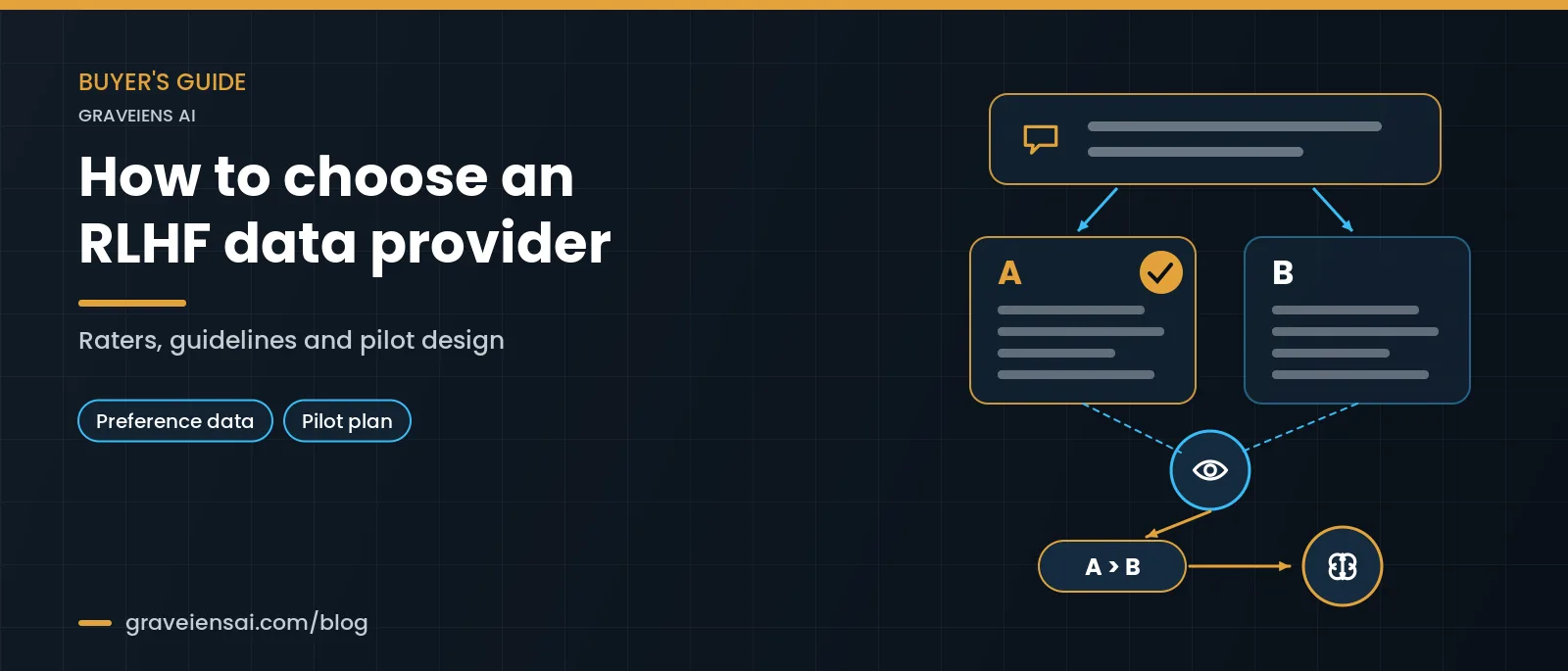
An RLHF data provider is a company that supplies the human judgments used to align a language model. Trained raters compare, rank, score or write model responses against your guidelines. The provider recruits and vets those raters, runs calibration and quality checks, and delivers clean preference data for reward modeling or direct preference optimization.
The classic recipe comes from the InstructGPT paper by Ouyang et al. (2022). Labelers first wrote demonstrations of the desired behavior for supervised fine-tuning. They then ranked several model outputs per prompt, and those rankings trained a reward model used for reinforcement learning [1].
The same paper shows why the people matter. The authors hired about 40 contractors and selected them through a screening test that measured how well they handled sensitive prompts [1].
Direct Preference Optimization (DPO), introduced by Rafailov et al. in 2023, changed the training step but not the data need. DPO fits the model to human preferences with a simple classification loss and no separate reward model [2]. It still needs pairs of a preferred and a rejected response, labeled by people you can trust.
If you need the basics first, read our plain-English explainer on what RLHF is. If you are still deciding between methods, our guide to supervised fine-tuning vs RLHF covers when each one fits.
In short: you are not buying labels. You are buying a managed group of qualified raters, a guideline system and a QA process that turn your model’s outputs into reliable preference signals.
Provider, platform or partner?
A labeling platform gives you tools, and you supply the raters. A managed RLHF data provider supplies raters, project management and QA. An RLHF data partner usually goes further: it adapts guidelines as your model changes and feeds findings back into your training loop.
What should you evaluate in an RLHF data provider?
Evaluate seven things. Check who the raters are, how guidelines are written, how raters are calibrated and how agreement is measured. Then check which QA layers and gold tasks catch errors, how data is secured, and whether the provider covers your languages and consent needs. Ask for evidence, not a slide.
Rater expertise and domain experts
General raters can judge tone, safety and instruction following. Code, medicine, law, finance and STEM reasoning need people who can verify correctness. A fluent but wrong answer will beat a terse correct one if the rater cannot tell the difference.
Ask how raters are screened, which credentials are checked and how domain fit is tested on your task. Ask what share of the pool has worked on preference tasks before. For specialist reviews, look for a dedicated domain-expert evaluation bench rather than generalists with a short briefing.
Guidelines and calibration
Guidelines turn your values into repeatable decisions. Good ones define each criterion, rank criteria when they conflict, and show worked examples for edge cases such as refusals, partial answers and ties.
Calibration makes the guidelines real. Raters label the same practice set, compare answers with a reference, and discuss disagreements before production starts. Ask how often calibration repeats, who owns the guideline changelog, and how a rule change reaches every rater the same day.
Inter-rater agreement: what the metrics mean
Inter-rater agreement tells you whether raters apply the guidelines the same way. Raw percent agreement is easy to read, but it ignores matches that happen by chance.
- Cohen’s kappa compares two raters and corrects for chance agreement.
- Fleiss’ kappa extends the idea to several raters on categorical labels.
- Krippendorff’s alpha works with any number of raters, missing ratings and nominal, ordinal or interval data. A value of 1 means perfect reliability; 0 means agreement no better than chance [3].
Preference work is partly subjective, so some disagreement is normal. InstructGPT reported that its training labelers agreed with each other 72.6 ± 1.5% of the time [1]. The useful question is where raters disagree and why. Ask for agreement by task type, language and difficulty, with the metric, sample size and tie handling stated.
QA layers and gold tasks
One reviewer is not a QA system. Strong programs stack layers: rater self-checks, lead review on a sample, hidden gold tasks, expert audits on hard items and your own acceptance review.
Gold tasks are the honest signal. They sit unmarked in the queue, so a rater cannot try harder on them. Ask how often gold tasks appear, what happens when a rater misses them, and whether you can add your own.
Throughput and turnaround
Speed only matters if quality holds as the team grows. Ask how many calibrated raters are ready per language and domain. Ask how new raters join mid-project and how agreement is tracked as volume rises.
Security, data handling and consent
Your prompts and model outputs are sensitive. Ask where data is stored and who can access it. Check whether raters work in controlled environments and how data is deleted at project end.
Confirm in the contract that you own all preference data and rationales. Ask how rater consent and fair working terms are documented. For red-teaming and harmful-content tasks, ask about opt-in policies and rater wellbeing support.
Multilingual coverage
Native-speaker raters catch tone, politeness and cultural errors that a bilingual reviewer may miss. Ask for per-language calibration and per-language agreement, not one blended number. Our post on multilingual LLM red teaming shows how these gaps surface in safety work.
How to design an RLHF pilot that reveals real rater quality
Design an RLHF data provider pilot like a small production run. Write a clear spec, calibrate raters on a shared practice set, hide gold tasks with known answers in the queue, and run a batch of your own model outputs. Then measure agreement, audit a sample with your experts, and score the vendor before you scale.
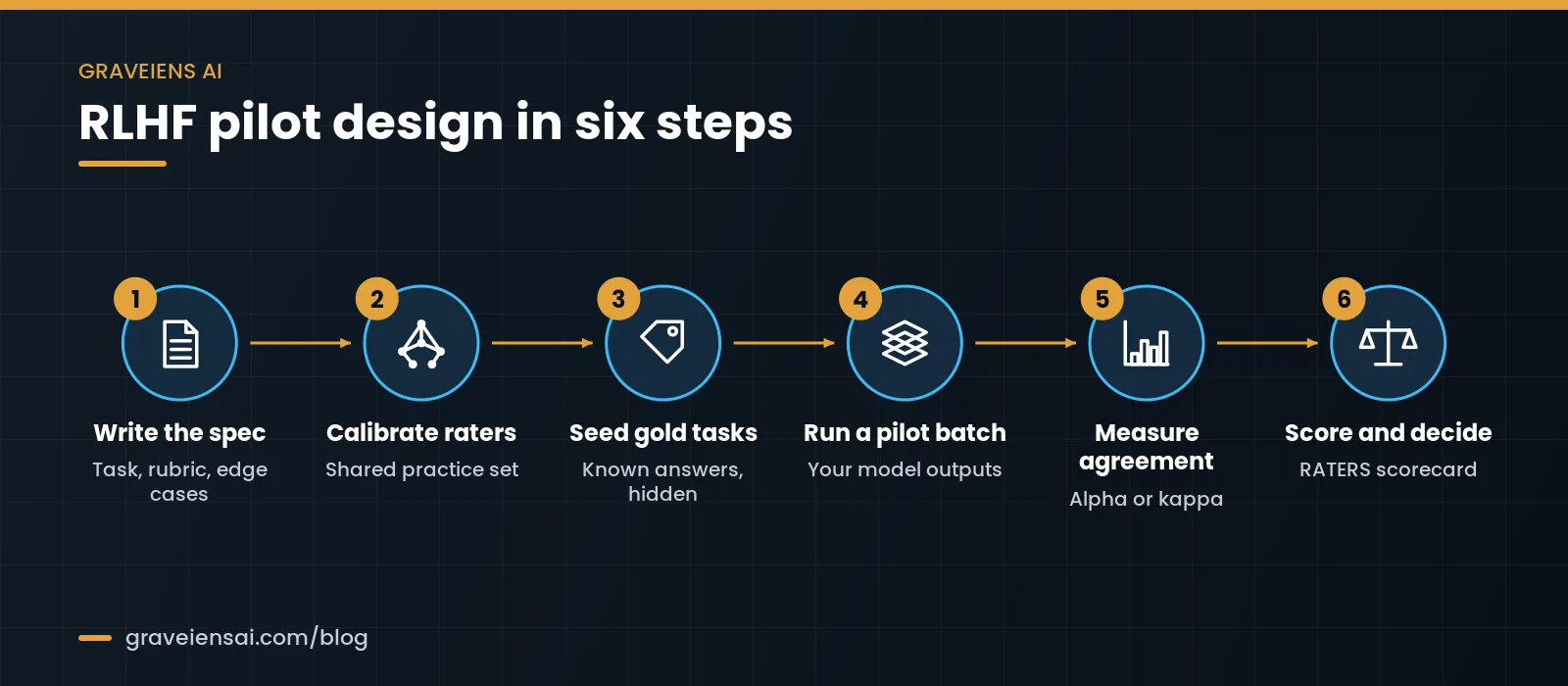
- Write the spec. Define the task type, rating criteria, tie rules and output format. Include examples of good, poor and borderline responses.
- Calibrate raters. Give every rater the same practice set. Review disagreements together and update the guidelines before live work starts.
- Seed gold tasks. Prepare items with expert-agreed answers. Mix them into the queue without marking them.
- Run a pilot batch on your outputs. Use prompts and responses from your current model, not the vendor’s library. Cover every task type, language and difficulty tier you plan to scale.
- Measure agreement and accuracy. Put a subset through multiple raters to compute agreement. Check gold-task accuracy per rater, and have your own experts audit a random sample.
- Score and decide. Rate the vendor with the RATERS scorecard below.
Include hard cases on purpose, such as multi-turn chats, code, refusals and prompts where both answers are flawed. Easy items make every vendor look good.
In short: a pilot should test the provider’s process, not just its output. Watch how they handle confusion, feedback and guideline changes.
The RATERS scorecard: how to compare RLHF data partners
We built the RATERS scorecard to make vendor comparisons evidence-based. Score each dimension from 0 to 3. A 0 means no evidence. A 1 means a claim only. A 2 means a documented process. A 3 means the process held up in your pilot.
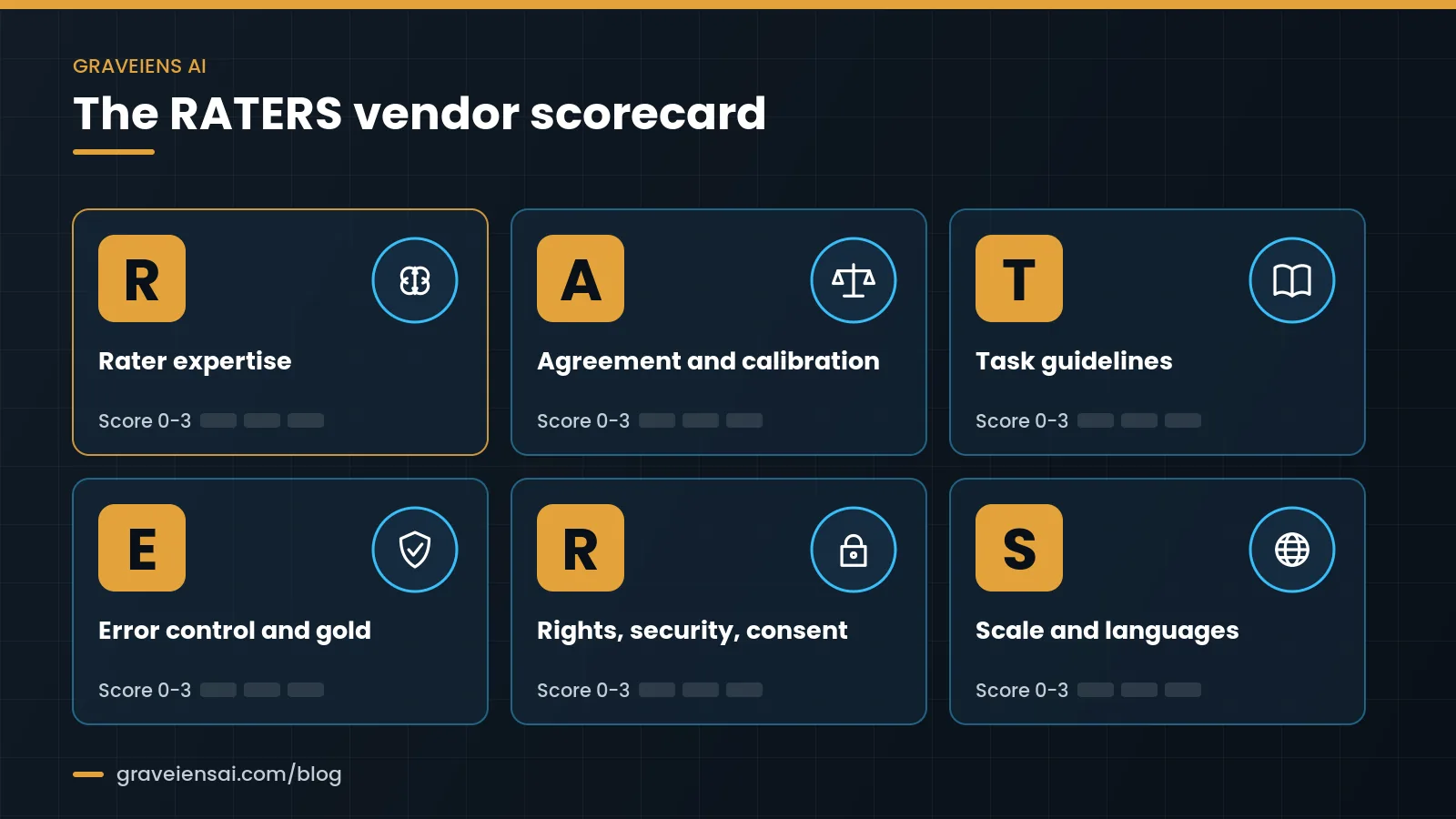
- R – Rater expertise: screening method, credential checks and proven domain fit on your task.
- A – Agreement and calibration: named metric, sample size, calibration cadence and per-language results.
- T – Task guidelines: clear criteria, conflict rules, worked edge cases and a versioned changelog.
- E – Error control: stacked QA layers, hidden gold tasks, rater feedback loops and expert audits.
- R – Rights, security and consent: data ownership, access controls, deletion, rater consent and wellbeing.
- S – Scale and languages: calibrated capacity per language and domain, ramp plan and stable quality at volume.
Weight the dimensions to match your risk. A red-teaming program should weight rights, security and rater expertise most. A multilingual assistant should weight scale and languages higher. Keep weights fixed so every RLHF data provider is judged on the same terms.
Want to test a provider the right way? Scope a pilot billed only on approved files, run on your own model outputs.
Which preference data type fits your project?
Use pairwise comparisons for most reward modeling and DPO work, because they are fast and consistent. Use rankings when you need more signal per prompt. Use rubric scores when you need to diagnose specific failures. Use SFT demonstrations when the model cannot yet produce a good answer to compare.
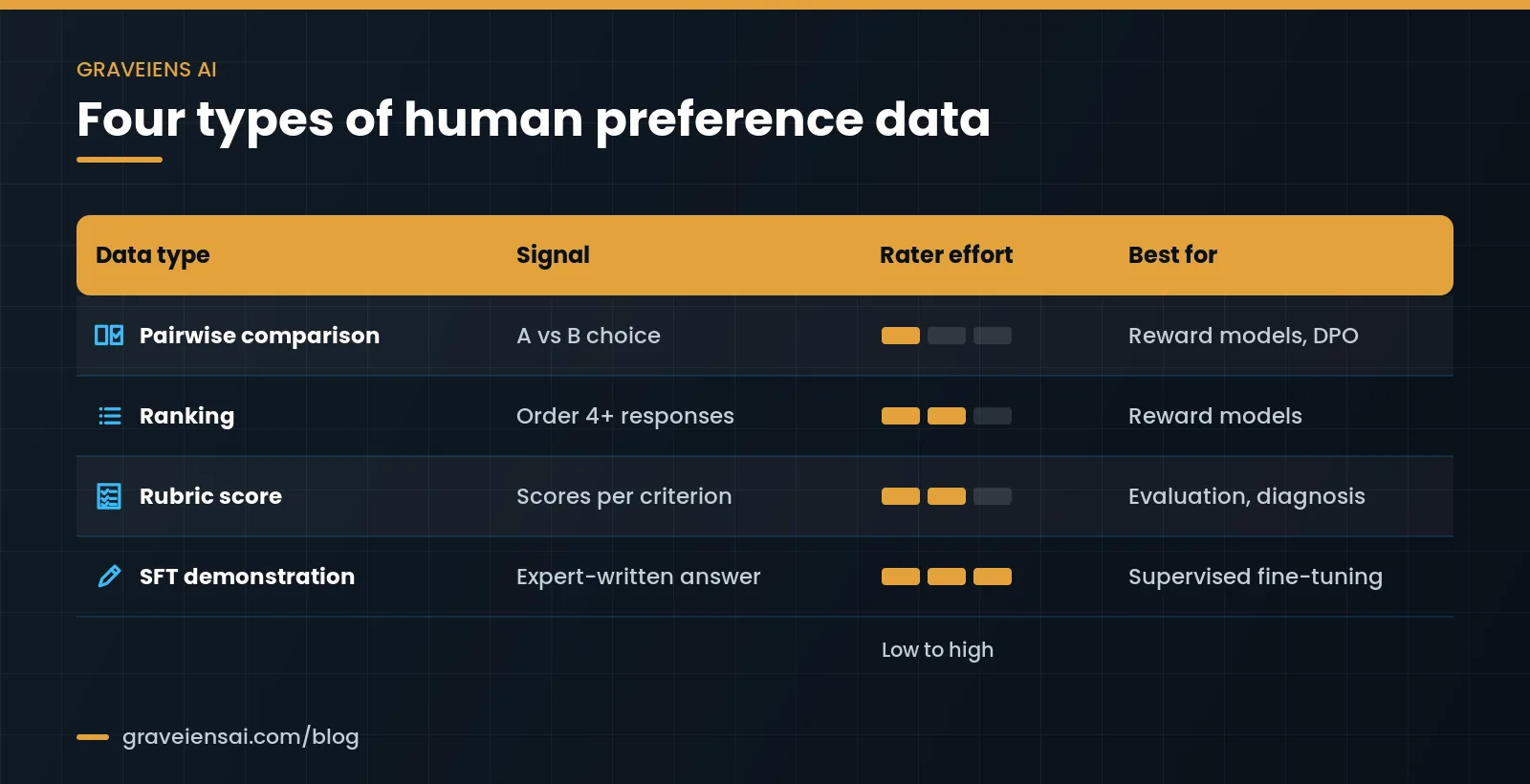
| Data type | What raters do | Strengths | Watch-outs |
|---|---|---|---|
| Pairwise comparison | Choose the better of two responses, often with a strength rating and a short rationale | Fast, simple to calibrate; direct input for reward models and DPO | Loses detail on why; needs clear tie rules |
| Ranking | Order several responses to one prompt from best to worst | More comparisons per prompt; InstructGPT ranked 4 to 9 responses at a time [1] | Slower per item; mid-rank positions are harder to agree on |
| Rubric scores | Score each response on named criteria such as accuracy, helpfulness and safety | Shows which criterion failed; useful for evaluation and dashboards | Scale drift between raters; needs anchored score definitions |
| SFT demonstrations | Write the ideal response from scratch | Teaches new behavior the model cannot yet show | Highest effort; quality depends on writer expertise |
Many programs combine types: demonstrations first, pairwise data next, and rubric scores for ongoing LLM evaluation programs.
What drives the effort and cost of RLHF data?
Effort and cost rise with rater expertise, task length and complexity, the number of responses per prompt, rationale requirements, rater overlap, QA depth, language mix, turnaround and security setup. Expert-heavy, multilingual, multi-turn work costs more per item than short general-domain comparisons. Scope these drivers before you compare quotes.
- Rater profile. Credentialed domain experts take longer to source and calibrate than general raters.
- Task shape. Long contexts, multi-turn chats, code execution and tool use all add time per item.
- Rationales. Written explanations improve auditability but add effort to every item.
- Overlap and QA depth. More raters per item, more gold tasks and more expert audits raise confidence and cost together.
- Languages. Each language needs its own native raters and calibration.
- Guideline churn. Frequent rule changes trigger recalibration and rework.
Give every RLHF data provider the same spec. A quote that looks low often assumes less overlap, fewer audits or less qualified raters.
Red flags and compliance checks before you sign
A weak RLHF data provider usually shows warning signs early. Watch for these in proposals, demos and pilots.
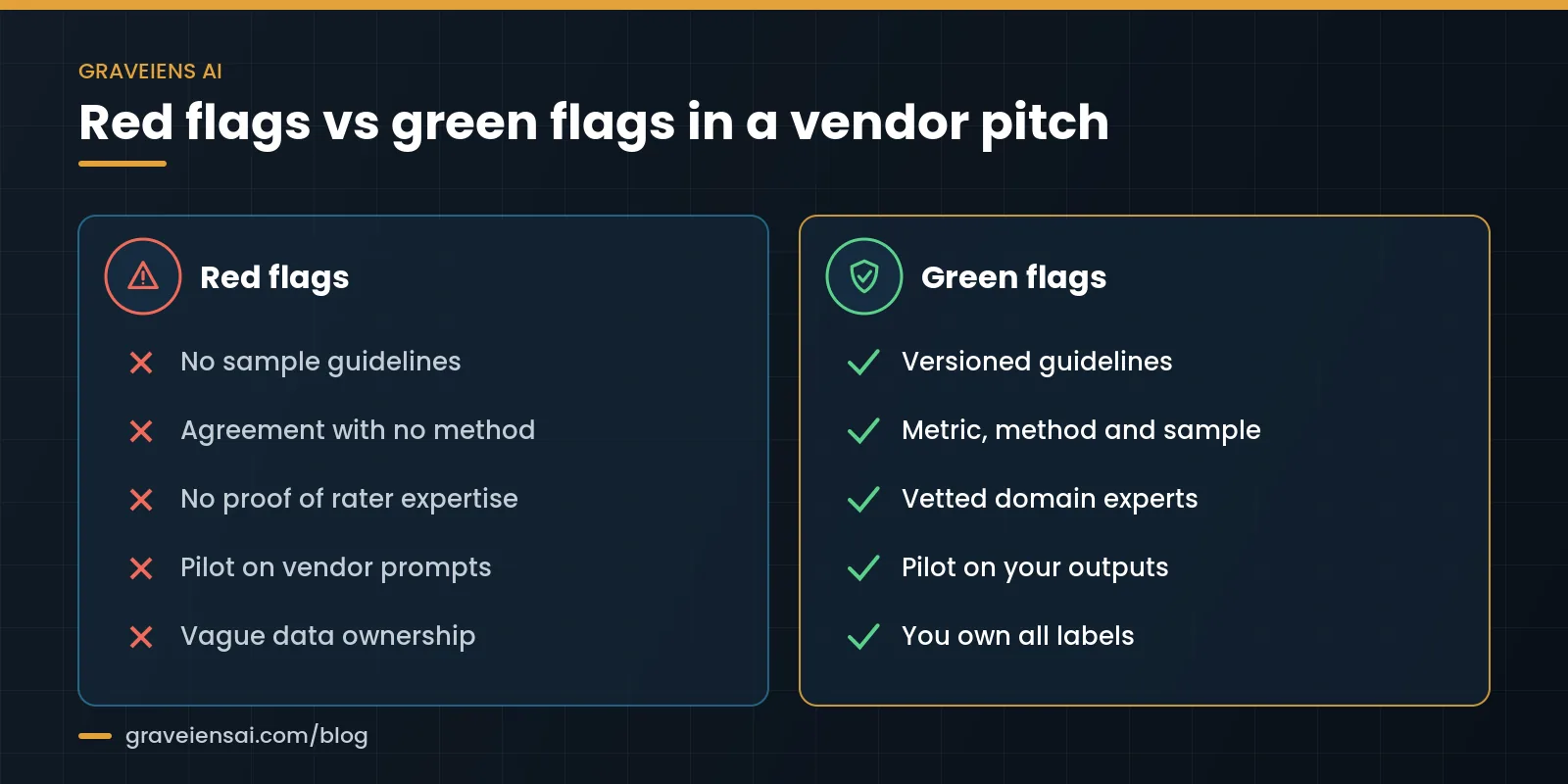
- No sample guidelines. If they cannot show an anonymized guideline, they may not have a guideline system.
- Agreement with no method. A single percentage with no metric, sample size or task breakdown is marketing, not measurement.
- No proof of rater expertise. “Domain experts” with no screening method or credential check rarely survive a gold-task audit.
- Pilot on vendor prompts only. Library prompts hide how raters handle your model’s real failure modes.
- Vague data ownership. Any clause that lets the vendor reuse your preference data is a deal breaker.
- Accuracy promises. No honest provider can promise a model gain. Data quality is one input among many.
EU AI Act: what GPAI providers should ask
Obligations for providers of general-purpose AI (GPAI) models under the EU AI Act entered into application on 2 August 2025. The Commission’s enforcement powers apply from 2 August 2026, and models placed on the market before 2 August 2025 must comply by 2 August 2027 [4].
The Commission has also published a template for the public summary of training content [4]. If you are a GPAI provider, ask your RLHF data provider for provenance, consent and processing records your compliance team can use. This is not legal advice; confirm scope with counsel.
How Graveiens AI approaches RLHF and alignment data
Graveiens AI delivers RLHF and alignment data services alongside domain-expert evaluation, a frontier expert network, LLM evaluation and red teaming. We work in 25+ languages, including Italian and deep Indic coverage, so per-language calibration is part of the plan from day one.
Our data collection follows an explicit-consent workflow: participant onboarding, then capture management, then metadata tagging, then QA. Graveiens AI is ISO 9001 certified.
We work on a pay-for-approved-deliverables basis. Your pilot is billed only on files you approve, so you judge rater quality on your own outputs before you scale. For task types or domains outside our standard catalogue, we scope this with you.
Frequently asked questions
What is the difference between an RLHF data provider and a data labeling company?
A data labeling company usually tags objects, text or audio against fixed classes. An RLHF data provider manages raters who judge model outputs against nuanced guidelines, often with rationales. It needs deeper calibration, domain experts and agreement tracking, because preference judgments are partly subjective and change as your model improves.
Is DPO data different from RLHF preference data?
The data looks the same. Both use a prompt with a preferred and a rejected response. The difference is in training. Classic RLHF trains a reward model, then optimizes the policy with reinforcement learning. DPO fits the model directly to the preference pairs with a classification-style loss. One well-run preference dataset can support both.
Which inter-rater agreement metric should we ask for?
Ask for a chance-corrected metric. Cohen’s kappa suits two raters, Fleiss’ kappa suits several raters on categorical labels, and Krippendorff’s alpha handles any number of raters, missing ratings and ordinal or interval scales. Whatever the metric, ask for the sample size, the task breakdown and how ties were treated.
How many raters should label each preference pair?
There is no single right number. A common approach is to put a subset of items through multiple raters to measure agreement, then use single labels plus audits for the rest. Raise overlap for subjective, safety-critical or expert tasks. Lower it once agreement and gold-task accuracy are stable.
How long should an RLHF pilot run?
Long enough to complete calibration, at least one guideline revision and an expert audit of a random sample. Rushing past calibration hides the very problems you want to find. Size the pilot to cover every task type, language and difficulty tier you plan to scale, rather than to a fixed calendar date.
Who should own the preference data and rationales?
You should. The contract should give you full ownership of prompts, responses, preferences, rationales and metadata, with no vendor right to reuse them. It should also cover deletion at project end and access controls during the work. The same terms should cover pilot data, even if you do not go ahead.
Can an RLHF data provider support languages other than English?
Yes, if it has native-speaker raters and calibrates each language separately. Ask for per-language agreement and gold-task results, not one blended score. Check that guidelines are localized with examples in each language, because tone and politeness norms vary across cultures.
Ready to test an RLHF data provider on your own outputs?
Share your task type, languages and domains. We will propose a pilot with calibrated raters, hidden gold tasks and clear acceptance criteria, billed only on approved files.
Scope a pilot billed only on approved files or book a 20-minute scoping call.
Sources
- Ouyang, L. et al. (2022). Training language models to follow instructions with human feedback. arXiv:2203.02155.
- Rafailov, R. et al. (2023). Direct Preference Optimization: Your Language Model is Secretly a Reward Model. arXiv:2305.18290.
- Krippendorff, K. (2011). Computing Krippendorff’s Alpha-Reliability. Annenberg School for Communication, University of Pennsylvania.
- European Commission. Guidelines for providers of general-purpose AI models. Shaping Europe’s digital future.
About the author
Graveiens AI Editorial Team. The Graveiens AI Editorial Team writes about RLHF, LLM evaluation and multilingual training data for teams building generative AI. The team draws on hands-on work designing rater guidelines, QA workflows and pilots across 25+ languages.

Jitendra Choubay is the CEO & Founder of Graveiens AI, leading a human-in-the-loop data services team that helps AI builders with data collection, annotation, consent-backed voice data, transcription and LLM fine-tuning. He writes on building better, ethically sourced AI training data.
Get the next Graveiens AI article
Expert notes on AI data, annotation, LLMs and eLearning — no spam, unsubscribe anytime.
Need AI Development? Data Annotation? eLearning?
Talk to Graveiens AI about data collection, annotation, voice data, RLHF/SFT, LLM evaluation and AI training data — invoiced only on approved work.
Contact Graveiens AI