Quick answer: RLHF (Reinforcement Learning from Human Feedback) is a machinelearning technique that aligns large language models with human preferences. It works in three stages: supervised finetuning on example responses, training a reward model on humanranked outputs, and optimizing the model with reinforcement learning (usually PPO) so it generates answers people actually prefer. RLHF is the method that turned raw language models into helpful, safe assistants like ChatGPT and Claude.
Reinforcement Learning from Human Feedback (RLHF) sits at the core of modern AI alignment. Below, our team breaks down what RLHF is, how it works step by step, how it differs from supervised finetuning, where reinforcement learning is applied beyond chatbots, and the newer alternatives teams are adopting in 2026. This guide is written for AI and ML teams evaluating how to align, evaluate, and finetune their own models with highquality human preference data.
Key takeaways
- What is RLHF: it is a threestage method (SFT, reward modeling, and reinforcement learning) that aligns large language models to human preferences.
- What is RLHF used for: making assistants such as ChatGPT and Claude more helpful, honest, and safe.
- SFT meaning: SFT means supervised finetuning, the first stage of the RLHF pipeline where a model learns from labeled demonstrations.
- RLHF vs supervised learning: supervised learning imitates correct answers, while RLHF optimizes for ranked human preferences.
- RLHF vs fine tuning: finetuning is the umbrella term, and RLHF vs fine tuning simply means RLHF is one method within finetuning.
- Reinforcement learning applications: rewardbased learning powers robotics, recommendations, games, and many systems beyond language models.
What is RLHF (Reinforcement Learning from Human Feedback)?
So, what is RLHF exactly? What is RLHF in one sentence: it is a training method that uses human judgments as the reward signal to teach a model what “good” looks like. Instead of learning only from a fixed dataset of correct answers, the model learns from human preferences people compare and rank competing model responses, and those rankings train a separate reward model. The language model is then optimized to maximize that reward, nudging its behavior toward outputs humans rate as more helpful, honest, and harmless.
The technique matters because raw pretrained large language models predict the next token from internetscale text they are fluent but not necessarily helpful, truthful, or safe. RLHF closes the gap between “statistically likely” text and “what a human actually wanted,” which is why it became the backbone of instructiontuned assistants. The human signal usually comes from trained annotators and subjectmatter experts producing ranked preference data through a rigorous annotation workflow.
How does RLHF work? The three stages
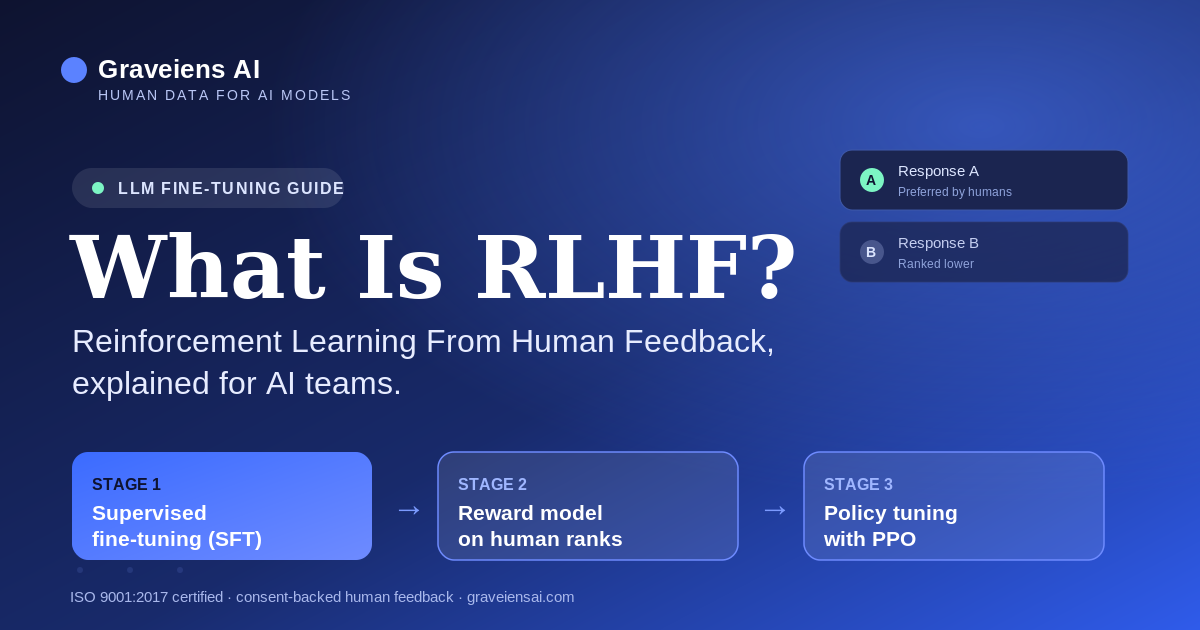
RLHF follows a threestage pipeline: (1) supervised finetuning, (2) reward model training, and (3) reinforcementlearning policy optimization. Each stage depends on the one before it, and human feedback is the fuel for stages two and three.
Stage 1: Supervised finetuning (SFT)
The process starts with a pretrained language model that is finetuned on a curated set of highquality promptandresponse examples written or approved by humans. This supervised finetuning step teaches the model the format, tone, and instructionfollowing behavior expected of an assistant. It gives reinforcement learning a sensible starting policy instead of a blank slate, which makes the later optimization far more stable.
Stage 2: Training the reward model
Next, the SFT model generates multiple responses to the same prompt, and human annotators rank or compare them from best to worst. These comparisons train a separate neural network the reward model to predict a numerical score that reflects human preference. A wellbuilt reward model can then score new, unseen responses automatically, acting as a scalable standin for human judgment. The quality of this stage lives or dies on the consistency of the preference data, which is why many teams rely on a vetted expert workforce for the hardest prompts.
Stage 3: Policy optimization with PPO
Finally, the language model (now the “policy”) generates responses, the reward model scores them, and a reinforcementlearning algorithm updates the policy to earn higher rewards. The standard algorithm is Proximal Policy Optimization (PPO), chosen for its stability it clips each update so the model never changes too drastically in one step. A KLdivergence penalty keeps the policy close to the original SFT model, preventing it from drifting into “rewardhacking” gibberish that games the score without being genuinely better. The output of this stage is an aligned model that reliably prefers responses humans rate highly.
The RLHF loop at a glance:
- Prompt is sent to the policy model.
- The policy generates one or more candidate responses.
- The reward model scores each response for human preference.
- PPO updates the policy to increase the expected reward, with a KL penalty as a guardrail.
- Repeat across many prompts until the model is aligned.
What does SFT mean? SFT meaning and supervised finetuning defined
SFT stands for supervised finetuning training a pretrained model on labeled inputoutput pairs so it reproduces demonstrated behavior. The SFT meaning in machine learning is straightforward: in practice, SFT uses nexttoken prediction on curated examples to teach a model format, task structure, and instruction following. It is usually the first step of the RLHF pipeline, but it is also a complete finetuning method on its own when you simply want a model to imitate highquality demonstrations. If you have a clear “right answer” for every prompt, SFT alone is often enough; when “good” is subjective and better expressed as a preference between options, RLHF adds the extra signal SFT cannot capture.
People search for the SFT meaning constantly because “SFT” appears in almost every LLM training paper. The SFT meaning is consistent everywhere: whenever you see SFT, the SFT meaning is supervised finetuning on labeled demonstrations. Keep the SFT meaning separate from RLHF the SFT meaning is imitation of correct examples, while RLHF is optimization against human preference. Understanding the SFT meaning first makes the rest of the RLHF pipeline much easier to follow. If you remember one thing about the SFT meaning, remember that the SFT meaning is demonstrationbased training, and that the SFT meaning stays the same no matter which lab or framework you read.
Both approaches depend on clean, wellspecified data. Teams building instruction datasets, demonstrations, or preference pairs often pair SFT and RLHF inside a single program something our supervised finetuning and RLHF data services are designed to support end to end.
RLHF vs supervised finetuning (RLHF vs fine tuning)
Whether you frame it as RLHF vs supervised learning or RLHF vs fine tuning, the core difference is the same: supervised finetuning teaches a model to imitate correct examples, while RLHF teaches it to optimize for human preferences using a reward signal. Finetuning is the broad category (adjusting a pretrained model on new data); SFT and RLHF are two methods within it. The RLHF vs supervised learning question really comes down to signal: SFT shows the model what to say, while RLHF teaches it which of several plausible answers people prefer. The table below compares them directly.
| Dimension | Supervised finetuning (SFT) | RLHF |
|---|---|---|
| What it learns from | Labeled promptresponse examples | Human preference rankings between responses |
| Training signal | Nexttoken prediction (imitation) | Reward model score (optimization) |
| Best when | There is one clear correct answer | “Good” is subjective or openended |
| Models involved | One model | Up to four: policy, reference, reward, value |
| Compute cost | Lower and simpler | Higher and more complex |
| Typical output | Correct format and task behavior | Helpful, safe, preferencealigned behavior |
To summarize the RLHF vs supervised learning comparison: RLHF vs supervised learning is about optimization versus imitation, and the RLHF vs fine tuning comparison is about method versus category. If your team is debating RLHF vs supervised learning for a new model, start with the data you can produce clear demonstrations favor SFT, while ranked preferences unlock RLHF. In practice the RLHF vs fine tuning decision is rarely eitheror, because most pipelines run SFT and then RLHF in sequence.
Most production pipelines use both: SFT first to establish competent behavior, then RLHF (or a preference method like DPO) to refine it. If you are weighing which approach fits your model, our team can help you scope demonstration and preference datasets and route the hardest cases to domain expert reviewers.
Why RLHF matters for large language models
A natural followup to what is RLHF is what is RLHF actually good for. RLHF is what makes large language models usable as assistants rather than raw text predictors. It improves helpfulness, reduces harmful or offtopic outputs, and teaches models to follow instructions and refuse unsafe requests. The gains are strongest on openended tasks summarization, dialogue, reasoning explanations, and creative writing where there is no single correct answer and quality is a matter of human judgment.
- Alignment: outputs match human intent and values, not just statistical likelihood.
- Safety: models learn to avoid harmful, biased, or misleading responses.
- Helpfulness: answers become more relevant, complete, and wellstructured.
- Controllability: teams can steer tone and behavior through the preference data they collect.
These benefits only materialize when the preference data is consistent and expertreviewed. Rushed or noisy rankings teach the reward model the wrong lesson, so quality assurance on the human feedback layer is decisive the same principle behind rigorous LLM evaluation and redteaming.
Reinforcement learning applications beyond LLMs
Reinforcement learning applications extend far beyond chatbots to any system that learns by trial and error to maximize a reward. RLHF is one highprofile example, but reinforcement learning applications appear across many domains where an agent must make sequential decisions. The most common reinforcement learning applications include:
- Robotics: teaching robots to walk, grasp, and manipulate objects through rewarddriven practice.
- Autonomous systems: decisionmaking for selfdriving perception and control stacks.
- Recommendation engines: optimizing what to show next to maximize longterm engagement.
- Game playing: superhuman agents in Go, chess, and complex video games.
- Operations and logistics: routing, scheduling, energy management, and resource allocation.
- Finance: portfolio and trading strategies framed as sequential decisions under uncertainty.
What unites these reinforcement learning applications with RLHF is the reward signal. In games or robotics the reward is often automatic (a score, a completed task); in language alignment it must be learned from people, because “a good answer” cannot be measured by a simple rule. That humandefined reward is exactly what preference data and highquality data collection provide for generative AI.
Seen this way, RLHF is simply one of the newest reinforcement learning applications: it takes the same rewarddriven paradigm behind robotics and gameplaying agents and points it at language. Understanding the wider family of reinforcement learning applications makes it clearer why human feedback is so valuable in most reinforcement learning applications the reward is given for free, but in generative AI the reward must be built from careful human preference data. This is why teams studying reinforcement learning applications for language models invest so heavily in expert data.
RLHF alternatives: DPO, RLAIF, and newer methods
As of 2026, RLHF remains the conceptual foundation of alignment, but many teams replace classic PPObased RLHF with simpler or cheaper methods. The most common alternatives are:
- DPO (Direct Preference Optimization): removes the separate reward model and reframes preference learning as a classification problem over chosen vs. rejected pairs. It needs only two models instead of four and is simpler and faster to run.
- RLAIF (RL from AI Feedback): uses a strong “judge” model to rank responses instead of humans, cutting labeling cost often used alongside, not instead of, human review for sensitive domains.
- KTO, GRPO, and DAPO: newer preferenceoptimization variants chosen based on data availability, compute budget, and whether outputs are automatically verifiable.
Even with these alternatives, human preference data does not disappear DPO still needs chosen and rejected pairs, and RLAIF judges are calibrated against human labels. Highstakes and specialist domains (medical, legal, finance) continue to rely on expert humans, whether the final algorithm is PPO, DPO, or a hybrid. This is where a generativeAI and RLHF partner earns its keep.
Common RLHF challenges and best practices
The hardest part of RLHF is not the algorithm it is producing consistent, highsignal human feedback at scale. From running preference programs, our teams see the same failure modes and safeguards repeat:
- Reward hacking: models exploit quirks in the reward model. Guard with KL penalties, diverse prompts, and continuous evaluation.
- Annotator inconsistency: vague guidelines produce noisy rankings. Fix with clear rubrics, calibration rounds, and interannotator agreement checks.
- Bias in preferences: labelers can encode unintended bias. Mitigate with diverse, wellbriefed reviewer pools and audit trails.
- Domain difficulty: technical prompts need experts, not generalists. Route STEM, medical, legal, and finance prompts to subjectmatter reviewers.
The practical takeaway: treat the humanfeedback layer as an engineering system with its own quality assurance. A measured, multistage review process create, internal review, client review, and rework keeps preference data reliable enough for the reward model to trust. You can see how that fourstage quality workflow runs before any labels reach your model.
How Graveiens AI supports RLHF and finetuning programs
Graveiens AI is an ISO 9001:2017certified, humanintheloop data services company that delivers the preference data, demonstrations, and expert evaluation RLHF and SFT depend on. Our STEM, medical, legal, and finance subjectmatter experts produce ranked preference data and reference answers under strict rubrics, and every dataset passes a fourstage QA workflow with consentfirst sourcing and full audit trails.
Whether you are building an instruction dataset for supervised finetuning, ranked pairs for a reward model, or a redteam set for conversational AI and natural language processing systems, you are invoiced only for deliverables you approve which keeps pilots close to zerorisk.
Ready to improve your model’s alignment with expert human feedback? Send us a sample task and book a lowrisk RLHF pilot we will scope a batch, deliver it through our QA workflow, and you approve before scaling.
Quick glossary: RLHF, SFT, and related terms
- What is RLHF: reinforcement learning from human feedback aligning a model to ranked human preferences.
- SFT meaning: supervised finetuning the SFT meaning is training on labeled demonstrations, usually the first RLHF stage.
- RLHF vs supervised learning: optimization against preferences versus imitation of correct answers.
- RLHF vs fine tuning: RLHF vs fine tuning means RLHF is a specific method inside the broader finetuning category.
- Reinforcement learning applications: robotics, recommendations, games, logistics, and finance are classic reinforcement learning applications, and RLHF now joins that list of reinforcement learning applications for language models.
The bottom line
So, what is RLHF, and why does it matter? What is RLHF at its heart is a bridge between raw model capability and real human preference. Once you understand the SFT meaning, the RLHF vs supervised learning distinction, the RLHF vs fine tuning relationship, and the wider set of reinforcement learning applications, RLHF stops being a buzzword and becomes a practical, buildable process one that lives or dies on the quality of your human feedback data.
Frequently asked questions about RLHF
What is RLHF in simple terms?
What is RLHF in simple terms? RLHF is teaching an AI what people prefer by having humans rank its answers, then training the model to produce more of the preferred answers. In short, what is RLHF: it turns human preference into a reward the model learns to maximize.
What is the SFT meaning in RLHF?
The SFT meaning is supervised finetuning. In the RLHF pipeline, the SFT meaning refers to the first stage, where a pretrained model is trained on labeled demonstrations before any reward modeling begins. Knowing the SFT meaning helps you tell it apart from the reinforcementlearning stage that follows. Put simply, the SFT meaning is demonstration training, and the SFT meaning never changes across frameworks.
RLHF vs supervised learning and RLHF vs fine tuning what is the difference?
RLHF vs supervised learning: supervised learning copies correct examples, while RLHF optimizes for humanranked preferences. RLHF vs fine tuning: finetuning is the broad category of adapting a model, and RLHF is one finetuning method within it. So the RLHF vs supervised learning gap is about the training signal, and the RLHF vs fine tuning gap is about scope.
What does RLHF stand for?
RLHF stands for Reinforcement Learning from Human Feedback. It is a technique that finetunes AI models, especially large language models, using human preference rankings as the reward signal, so the model learns to produce outputs people prefer.
Is RLHF the same as finetuning?
No. Finetuning is the broad practice of adjusting a pretrained model on new data. RLHF is one specific finetuning method that uses a reward model and reinforcement learning. Supervised finetuning (SFT) is another method that trains the model to imitate correct examples. RLHF usually builds on top of SFT.
What is the difference between RLHF and SFT?
SFT teaches a model to copy demonstrated correct answers using nexttoken prediction. RLHF teaches a model to optimize for human preferences using a reward model and reinforcement learning. SFT is simpler and best when there is one clear correct answer; RLHF is better when quality is subjective, such as dialogue, summarization, or safety.
What is a reward model in RLHF?
A reward model is a neural network trained on humanranked responses to predict a numerical score for how much a person would prefer a given output. During reinforcement learning, it acts as a scalable standin for human judgment, scoring the language model’s responses automatically.
What algorithm does RLHF use?
The classic RLHF pipeline uses Proximal Policy Optimization (PPO) for the reinforcementlearning step because it is stable and prevents overly large updates. Many teams now use simpler alternatives such as DPO (Direct Preference Optimization), GRPO, or KTO depending on cost and data.
What is RLAIF and how is it different from RLHF?
RLAIF (Reinforcement Learning from AI Feedback) replaces human rankers with a strong AI model that judges responses, reducing labeling cost. It often matches RLHF on some tasks, but its judge model is calibrated against human labels, and sensitive domains still rely on human experts.
Do I still need human data if I use DPO or RLAIF?
Yes. DPO still requires chosen and rejected response pairs created from human preferences, and RLAIF judges are validated against human labels. Highquality, consistent human feedback remains the foundation of preferencebased alignment regardless of the algorithm.
How is RLHF used in real products?
RLHF is used to align assistants such as ChatGPT and Claude, making them more helpful, honest, and safe. It is applied to chat models, coding assistants, summarizers, and contentmoderation systems, anywhere human preference defines a good response better than a fixed label.
Note: RLHF concepts and algorithms evolve quickly. This guide reflects best practices as of 2026; the underlying principle aligning models to wellcollected human preferences remains constant.
Sources and further reading
This guide is grounded in the primary research that established and advanced RLHF. For readers who want to go deeper, the foundational and current papers are listed below.
- Christiano et al. (2017), “Deep Reinforcement Learning from Human Preferences” the paper that introduced learning rewards from human comparisons: arxiv.org/abs/1706.03741
- Schulman et al. (2017), “Proximal Policy Optimization “Algorithms“the PPO algorithm used in classic RLHF: arxiv.org/abs/1707.06347
- Ouyang et al., OpenAI (2022), “Training Language Models to Follow Instructions with Human Feedback” (InstructGPT) RLHF applied to LLMs: arxiv.org/abs/2203.02155
- Rafailov et al. (2023), “Direct Preference Optimization (DPO)” the rewardmodelfree alternative to RLHF: arxiv.org/abs/2305.18290
- Lee et al. (2023), “RLAIF: Scaling RLHF with AI Feedback”: arxiv.org/abs/2309.00267
- Hugging Face, “Illustrating Reinforcement Learning from Human Feedback (RLHF)” a wellcited technical primer: huggingface.co/blog/rlhf
About the authors: This article was produced by the Graveiens AI modeltraining team practitioners who build supervised finetuning demonstrations, ranked preference data, and expert LLM evaluation sets for AI labs and enterprises. Our reviewers include STEM, medical, legal, and finance subjectmatter experts working under an ISO 9001:2017certified, fourstage quality workflow.

Jitendra Choubay is the CEO & Founder of Graveiens AI, leading a human-in-the-loop data services team that helps AI builders with data collection, annotation, consent-backed voice data, transcription and LLM fine-tuning. He writes on building better, ethically sourced AI training data.
Get the next Graveiens AI article
Expert notes on AI data, annotation, LLMs and eLearning — no spam, unsubscribe anytime.
Need AI Development? Data Annotation? eLearning?
Talk to Graveiens AI about data collection, annotation, voice data, RLHF/SFT, LLM evaluation and AI training data — invoiced only on approved work.
Contact Graveiens AI