Last updated: November 2026
Key takeaways
- Amazon Mechanical Turk permanently closed on September 30, 2026. Its worker type is also gone from SageMaker Ground Truth and Amazon Augmented AI, so every HIT pipeline needs a new home.
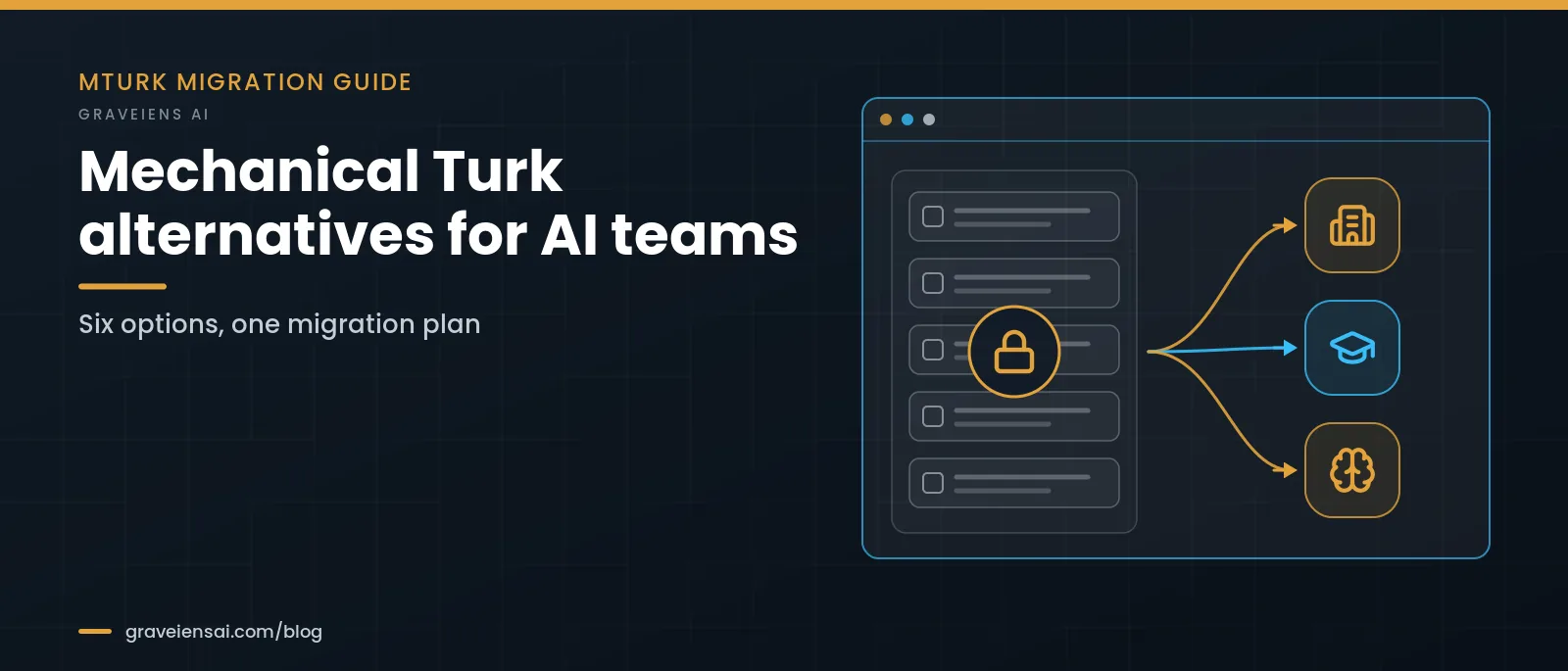
- The best Mechanical Turk alternatives are option types, not one platform: managed annotation vendors, research participant panels, expert networks, in-house tooling with contractors, other crowd marketplaces, and LLM pre-labeling with human review.
- Pick an option for each task with the SCOPE check: data Sensitivity, task Complexity, Output volume, Proof of quality and Economics.
- Migrate in seven steps: inventory HITs, classify tasks, rewrite guidelines, build gold sets, pilot, set QA metrics, then cut over one task type at a time.
- Fair worker pay and a GDPR- or CCPA-ready processing contract are cheaper to build in on day one than to retrofit after an audit.
If your team ran surveys, labeling jobs or human review on MTurk, the shutdown left a hole in your data pipeline. This guide compares Mechanical Turk alternatives for ML teams, AI labs and academic researchers in the US and EU.
You will get six option types with when-to-use advice, a comparison table, the SCOPE decision check and a seven-step playbook for moving HITs without losing quality. We also cover worker pay, consent and GDPR or CCPA data handling, so the new setup holds up in an audit as well as in production.
Moving MTurk work right now? Scope a pilot billed only on approved files.
What happened to Amazon Mechanical Turk?
Amazon Mechanical Turk permanently closed on September 30, 2026. HIT submission stopped that day, and unsubmitted HITs expired. Requesters had until October 30, 2026, to approve work and pay bonuses. As of November 2026, the MTurk site says the service is no longer available and points to no replacement.
The wind-down came in stages. On June 30, 2026, AWS announced service availability changes that moved SageMaker Ground Truth, Amazon Augmented AI (A2I) and the Mechanical Turk workforce option into maintenance. From July 30, 2026, none of the three accepted new customers. Amazon then announced the full closure to workers and requesters in late August 2026.
According to the official MTurk closure FAQ, three points still matter for former requesters:
- Prepaid balances. Amazon says a full refund should arrive within 30 days of the September 30 closure. If it has not, contact MTurk customer service.
- Approvals and bonuses. The window closed on October 30, 2026. Completed HITs that nobody reviewed were auto-approved.
- Transaction history. It stays available until January 28, 2027. Export it now for audit, tax and research records.
The closure also reached AWS labeling tools. The same FAQ confirms that the Mechanical Turk worker type is no longer available for Ground Truth labeling jobs or A2I human review workflows. AWS documentation says existing Ground Truth customers can keep using the service with a private workforce of their own staff or contractors, or with a vendor workforce.
In short: MTurk is gone and the payment deadlines have passed. Your job now is to export records and rebuild each pipeline on a workforce that fits the task.
What are the best Mechanical Turk alternatives?
The best Mechanical Turk alternatives depend on the work your HITs did. Labeling and AI evaluation fit managed annotation vendors or expert networks. Academic surveys fit research participant panels. Sensitive, steady work fits in-house tooling with contracted reviewers. Simple, low-risk microtasks can move to another self-serve crowd marketplace or to LLM pre-labeling with human review.
Most “alternatives” lists rank platforms by name. That approach breaks down because MTurk did several jobs at once. One requester used it for bounding boxes, another for a psychology experiment, and a third for checking chatbot answers. Below, each option type is matched to the job it does best.
1. Managed annotation and data-services vendors
A managed vendor recruits, trains and supervises the workforce for you. You hand over guidelines and data. You get back labeled files that have already passed the vendor’s review. This is the closest swap for teams that used MTurk for crowdsourced data labeling at volume.
- When to use: steady or large labeling volume, tasks that need training, and work with personal data that an open crowd should never see.
- Quality control: ask for gold-set accuracy, inter-annotator agreement and a written rework policy.
- Consent and privacy: expect a data processing agreement and a list of sub-processors.
- Cost model: per item, per hour or per approved deliverable.
Our guide to data annotation outsourcing covers vendor selection, pricing models and in-house trade-offs in more depth.
2. Research participant panels for academic surveys
Academic researchers commonly move surveys and behavioral experiments to research participant panels. These platforms pre-screen participants, track demographics and support informed-consent flows that ethics boards expect. They are a poor fit for high-volume labeling but a strong fit for studies.
- When to use: surveys, experiments, user studies and any HIT that collected opinions rather than labels.
- Quality control: attention checks, demographic prescreens and rebuilt exclusion lists, because MTurk worker IDs do not carry over.
- Consent and privacy: put the consent form inside the study and check where the panel stores data.
- Cost model: participant payment plus a platform fee set by the panel.
3. Specialist expert networks
Some HITs asked for judgment a general crowd could not give: medical text, legal clauses, code, math or a rare language. Expert networks supply vetted domain specialists. Teams use them for LLM evaluation, preference ranking, rubric scoring and reference answers.
- When to use: rubric-based grading, side-by-side model comparisons and domain QA.
- Quality control: calibration rounds, double review and adjudication by a lead expert.
- Consent and privacy: NDAs matter, because experts often see unreleased model outputs.
- Cost model: hourly or per task at specialist rates, with fewer items of higher value.
If you are comparing providers for this kind of work, our buyer’s guide to choosing AI training data companies lists the questions to ask before you sign.
4. In-house HITL tooling plus contractors
Here you run the labeling tool yourself and staff it with employees or contracted reviewers. This gives the most control over data, guidelines and human-in-the-loop data flows. It also makes you the operator, so recruiting, training, payroll, QA and tool upkeep sit with your team.
- When to use: highly sensitive data, steady volume, or guidelines that change every week.
- Quality control: you design it, including gold sets, review queues and audit sampling.
- Consent and privacy: data stays in your environment, and contractor agreements must cover confidentiality and deletion.
- Cost model: tool licenses, management time and contractor pay, which are fixed costs even in slow weeks.
5. Other self-serve crowd marketplaces
Self-serve marketplaces work most like MTurk. You post tasks, set pay and accept or reject work. They suit short, simple, low-risk microtasks. The trade-off is the one MTurk always had: you own task design and quality control, and you see little about who did the work.
- When to use: simple classification, data cleanup and short validation tasks with no personal data.
- Quality control: qualification tests, several workers per item and hidden gold items.
- Consent and privacy: treat the crowd as open and send only de-identified data.
- Cost model: per-task pay plus a platform commission.
AWS documentation told requesters not to share personal or confidential information with the MTurk workforce. Keep that rule on any open crowd.
6. LLM-assisted pre-labeling with human QA
Many tasks that once needed several crowd workers can now start from a model draft. A language or vision model pre-labels each item, and trained reviewers accept, fix or reject it. Synthetic examples can also fill rare classes. Human review stays essential, because model drafts fail quietly on edge cases.
- When to use: high-volume text or image tasks with clear labels, or bootstrapping a new taxonomy.
- Quality control: track how often reviewers edit drafts, and audit a random sample of accepted items.
- Consent and privacy: confirm your contracts allow sending the data to a model provider.
- Cost model: model usage plus reviewer time, so savings depend on how often drafts need fixing.
One more warning applies to every option. Crowd workers can paste chatbot output into free-text tasks. If your HITs asked people to write, add checks for machine-written answers.
| Option type | Best for | Main watch-out | Typical cost model |
|---|---|---|---|
| Managed annotation vendor | Steady labeling volume, sensitive data | Guideline handover takes real effort | Per item, hour or approved deliverable |
| Research participant panel | Surveys and experiments | Not built for bulk labeling | Participant pay plus platform fee |
| Expert network | LLM evaluation and domain QA | Slower to staff, higher rates | Hourly or per task |
| In-house tooling plus contractors | Sensitive or fast-changing work | You carry the operating load | Fixed tooling plus contractor pay |
| Self-serve crowd marketplace | Simple, low-risk microtasks | Quality control is on you | Per task plus commission |
| LLM pre-labeling plus human QA | High-volume, well-defined labels | Quiet errors on edge cases | Model usage plus review time |
The graphic and table below compare structural facts, not ratings. Each cell follows from how the option type works, as described above. AWS workforce documentation draws the same lines: a vendor-managed workforce, a private workforce you choose, and the open MTurk crowd. “Depends” means it varies by provider or contract, so ask before you sign.
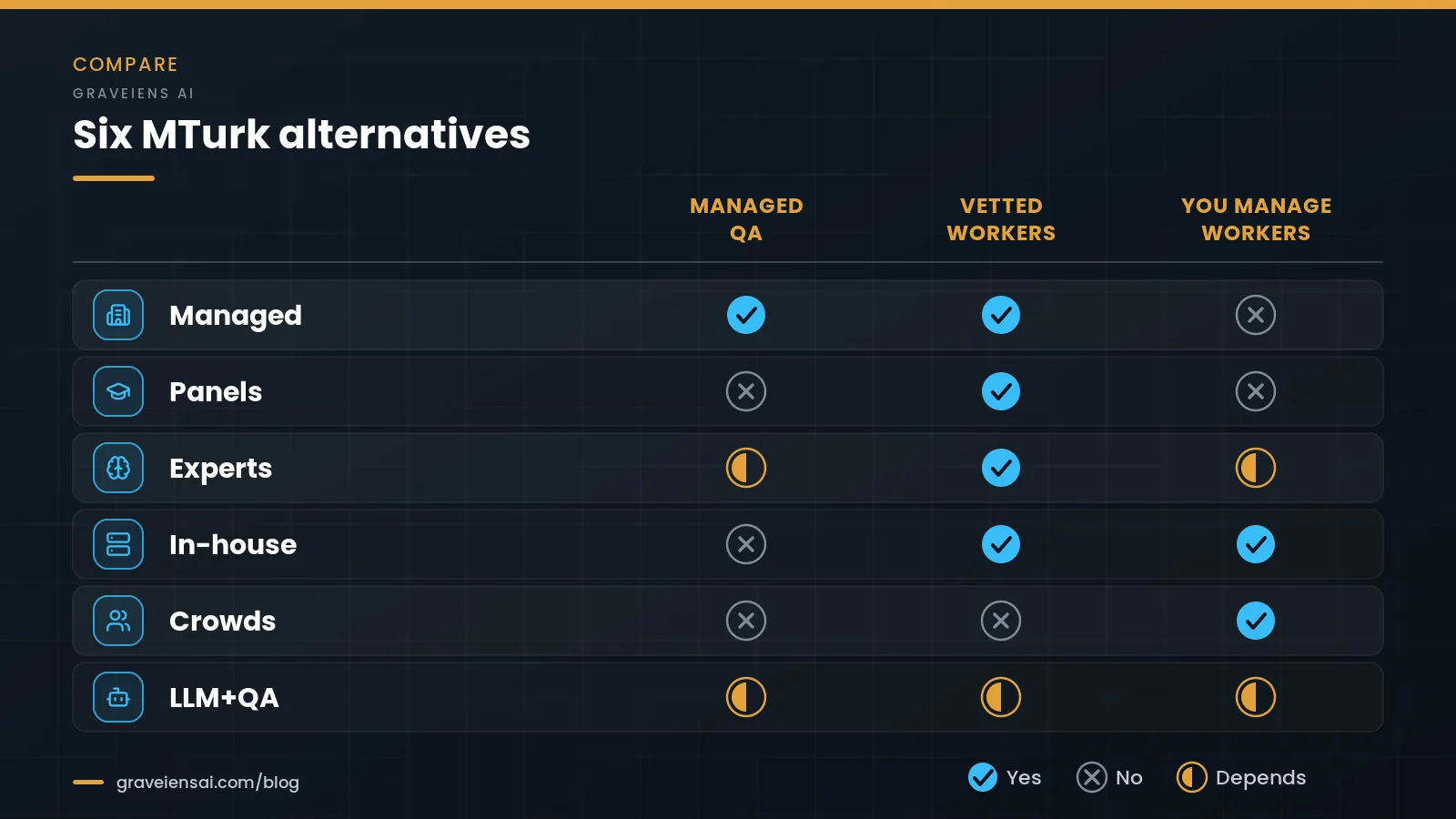
| Option type | Managed QA included | Vetted workers | You manage the workers |
|---|---|---|---|
| Managed annotation vendor | Yes: files pass the vendor’s review before delivery | Yes: the vendor recruits and trains them | No: the vendor supervises them |
| Research participant panel | No: you build attention checks and exclusions | Yes: participants are pre-screened | No: the panel recruits participants |
| Expert network | Depends on the network and contract | Yes: vetted domain specialists | Depends on the network and contract |
| In-house tooling plus contractors | No: you design QA | Yes: you choose the workers | Yes: recruiting, training and payroll sit with you |
| Self-serve crowd marketplace | No: quality control is on you | No: open crowd, unless you add qualification tests | Yes: you post tasks, set pay and accept or reject work |
| LLM pre-labeling plus human QA | Depends on who reviews the drafts | Depends on who supplies reviewers | Depends on who supplies reviewers |
One fact holds in every row. If a provider processes personal data for you, the European Commission says its duties must be set out in a contract. The GDPR section below covers what that means.
In short: Match each option to a job, not to a brand. Most teams end up with two: one for volume and one for judgment-heavy or sensitive work.
How do you migrate MTurk HITs to a new workforce?
Migrate MTurk HITs in seven steps. Inventory every HIT type, classify each by risk and skill, and rewrite guidelines for the new workforce. Build gold sets from trusted past answers, run a paid pilot, and set QA metrics with pass thresholds. Then cut over in stages. Most of the effort goes into guidelines and gold sets, not data transfer.
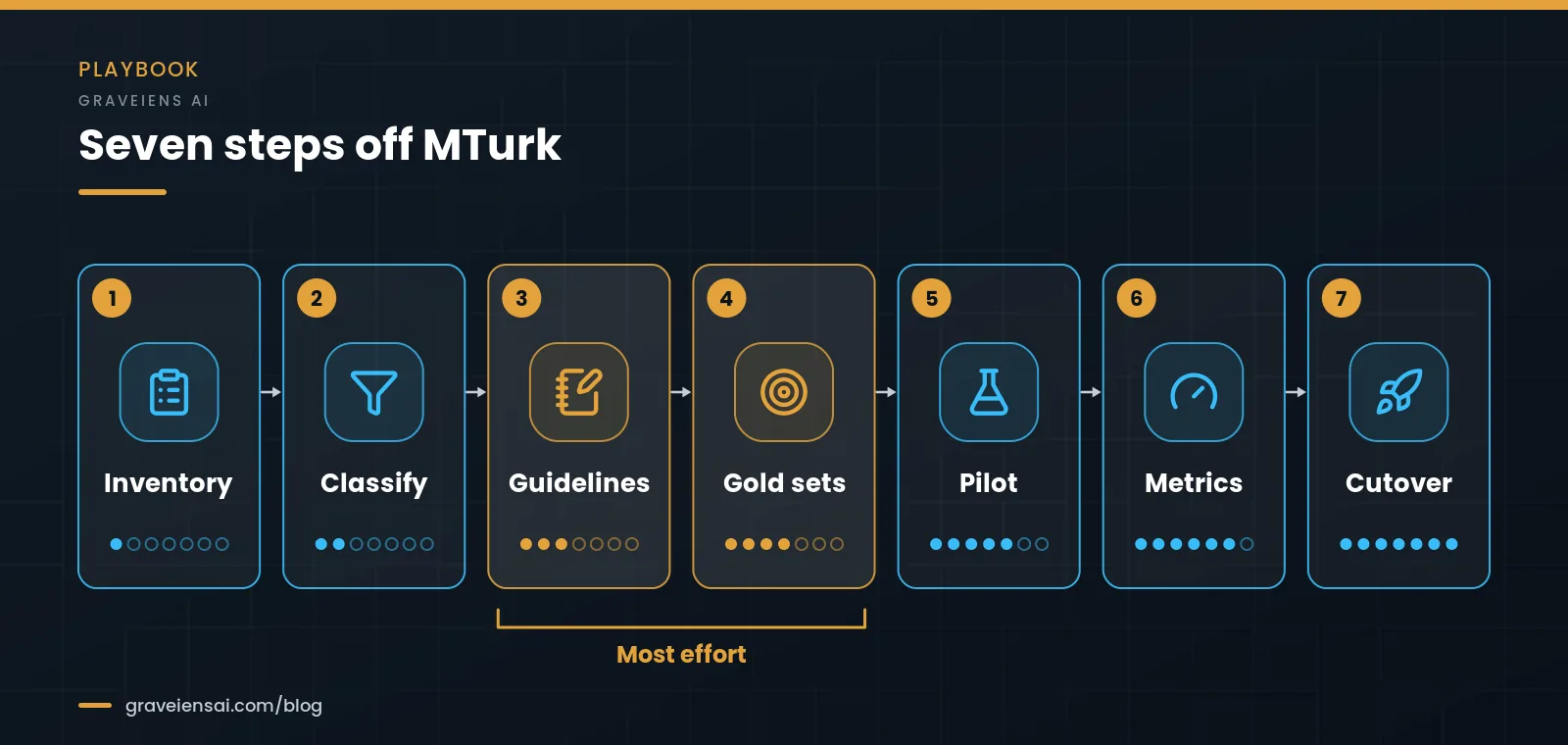
Step 1: Inventory your HITs
List every HIT type with its template, qualifications, pay rate, monthly volume and the team that uses the output. Pull batch result files, qualification lists and approval history while you still can, since transaction history disappears after January 28, 2027.
Step 2: Classify each task
Tag each HIT type by data sensitivity, skill needed and volume pattern. The SCOPE check in the next section does this in five questions. Flag tasks a model could pre-label, and tasks that should never leave your environment.
Step 3: Rewrite the guidelines
MTurk templates were short because tasks were tiny and workers were anonymous. A new workforce needs full guidelines: definitions, positive and negative examples, edge cases and an escalation path. Version every document so you can trace a label back to the rule in force.
Step 4: Build gold sets
Pick items from past batches where workers agreed and an expert confirmed the answer. Add the hard cases on purpose. Then mix hidden gold items into production at a steady rate, so accuracy is measured all the time, not only at launch.
Step 5: Run a paid pilot
Send a representative slice, including edge cases, to the new workforce. Agree on acceptance criteria before you see results. Compare pilot output with your MTurk-era labels on the same items to spot drift early.
Step 6: Set QA metrics
Track gold-set accuracy, inter-annotator agreement such as Cohen’s kappa or Krippendorff’s alpha, rework rate and turnaround. Write the pass thresholds into the contract or statement of work. That way, “good enough” is a number, not a debate.
Step 7: Cut over in stages
Move one HIT type at a time. If a production model depends on the data, run old and new outputs side by side for a short period. Then retire the old templates and archive the records with your data lineage notes.
In short: Treat the move as a data-quality project, not a procurement task. Guidelines and gold sets carry most of the risk, so give them most of the time.
Which MTurk alternative fits your work? Use the SCOPE check
Use the SCOPE check to choose an MTurk alternative for each task type. Score five things. Start with data Sensitivity, judgment Complexity and Output volume over time. Then add the Proof of quality you must show and the Economics of the pricing model. The pattern of answers points to one option type, or a blend of two.
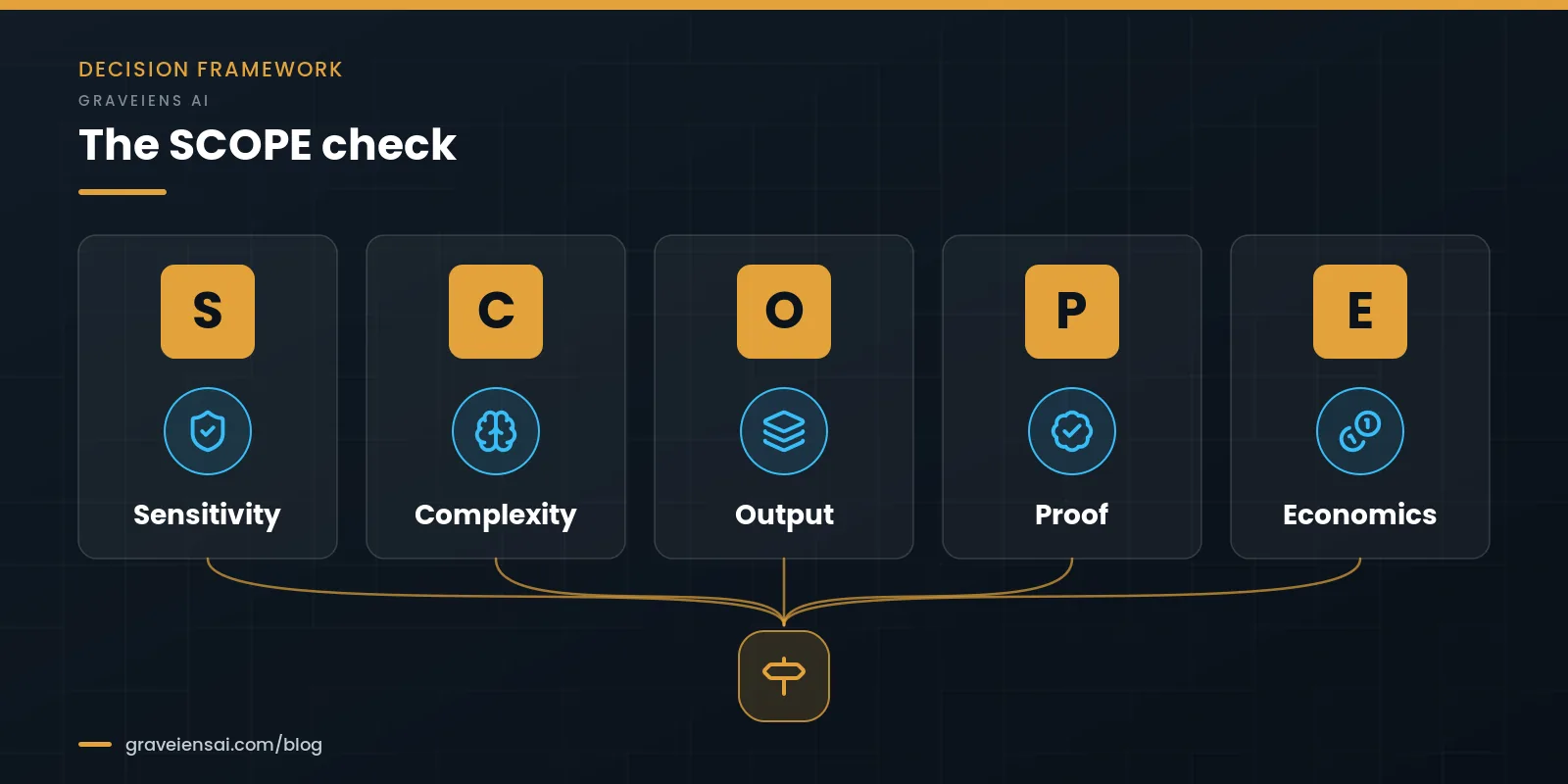
- S: Sensitivity. Does the task touch personal data, biometrics, health records or confidential IP? If yes, rule out open crowds. Use a managed vendor under a processing contract, or keep it in-house.
- C: Complexity. Can a trained generalist do it after reading the guidelines, or does it need a domain expert? Expert work points to an expert network. Generalist work points to a managed vendor or a crowd.
- O: Output volume. Is this a one-off study, a burst or a continuous stream? One-off surveys suit a research panel. Continuous streams suit a managed vendor or an in-house team.
- P: Proof. Who will check quality: your team, a journal reviewer, a regulator or a customer? More scrutiny means you need an audit trail with gold scores, reviewer IDs and consent records.
- E: Economics. Will you pay per task, per hour or per approved deliverable? Count your own management and review time and a fair pay floor, not just the unit price.
Here is an illustrative example. A product team used MTurk for two things: tagging catalog images and running a yearly customer survey. The image tags score low on sensitivity and need only generalist skill. They run continuously, and only your own team checks them. So they fit a managed vendor or LLM pre-labeling with review. The survey collects opinions once a year and feeds a published report, so it fits a research participant panel.
In short: Run SCOPE per task type, not per company. Two tasks from the same team can land on two different options, and that is normal.
Want a second opinion on your SCOPE scores? Send us one HIT template and we will scope a pilot billed only on approved files. Request the SCOPE checklist (mention “SCOPE checklist” in your message and we’ll email the one-page PDF).
What do Mechanical Turk alternatives cost?
Costs depend more on the task than on the platform. The main drivers are skill level, review depth, data sensitivity, volume pattern, guideline churn and worker pay floors. MTurk-era prices are a weak baseline, because many teams paid for speed and absorbed quality checks themselves. Compare total cost per accepted item instead.
| Cost driver | Why it moves cost | How to keep it in check |
|---|---|---|
| Skill level | Experts cost more per hour than generalists | Route only hard items to experts |
| Review depth | Each extra review pass adds labor | Use gold-set results to tune overlap |
| Data sensitivity | Vetting, secure setups and contracts add overhead | De-identify data before it leaves you |
| Volume pattern | Bursty work needs standby capacity | Share forecasts and batch steady work |
| Guideline churn | Every change means retraining and rework | Freeze guidelines during production runs |
| Pay model | Per-task pay can reward speed over care | Pay on approved output with fair hourly floors |
A simple formula keeps comparisons honest. Add the provider’s charges to your internal review hours times your loaded hourly cost. Then divide by the number of items that passed acceptance. An option with a higher unit price can still win if it cuts your rework.
Watch for hidden costs on the cheap end. Self-serve crowds often need several workers per item to reach a usable agreement level, and someone on your side must design, monitor and adjudicate. Those hours belong in the total.
In short: Compare cost per accepted item, including your own team’s time. Unit prices alone hide rework, review and management effort.
How do you protect workers and data after MTurk?
Protect workers by paying for real task time, explaining rejections and paying for qualification work. Protect data by sending only what each task needs, signing a processing contract with any vendor, and recording consent when people contribute personal data. GDPR and CCPA both expect you to know who handles personal data and why.
Fair pay and worker treatment
Worker advocates criticized MTurk for years over low pay, mass rejections and opaque account suspensions. A migration is a chance to fix those habits in your own process.
- Price tasks from the median completion time in your pilot, not from a guess.
- Set an hourly floor that respects minimum-wage norms where your workers live.
- Explain every rejection, avoid bulk rejections and give workers a way to appeal.
- Pay for training rounds and qualification tests.
- Ask any vendor how its workers are paid and how disputes are handled.
GDPR and CCPA data handling
Under the GDPR, a vendor that labels personal data on your behalf usually acts as a processor. The European Commission explains that a processor’s duties must be set out in a contract, including what happens to the data when the contract ends. A processor may only bring in a sub-processor with the controller’s prior written authorization.
In California, the CCPA, as explained by the state Attorney General, gives consumers rights over their personal information. They can ask a business to disclose, delete or correct it, and to limit use of sensitive personal information. Sensitive information includes biometric data processed to identify a person. A deletion request must also reach your service providers.
- Minimize first. Strip names, emails, account IDs and faces before data reaches any workforce that does not need them.
- Record consent for new data. When you collect voice, video or images of people, log the purpose, retention period and how to withdraw.
- Map your sub-processors. Know every company and country that touches the data, including the vendor’s own subcontractors.
- Plan deletion. Agree how labeled copies, worker caches and backups are deleted when the project ends.
This section is general information, not legal advice. Ask your privacy counsel how GDPR, CCPA and any state biometric laws apply to your specific project.
Common migration mistakes
- Copying MTurk templates as they are, with one-line instructions and no edge cases.
- Losing qualification and exclusion lists, then re-surveying the same people.
- Running a pilot with no acceptance criteria agreed in advance.
- Comparing unit prices while ignoring internal review time.
- Sending raw personal data to an open crowd because “it was fine before.”
- Moving every HIT type in one weekend instead of one at a time.
In short: Fair pay, clear rejections and a written processing contract protect your data quality and your audit trail at the same time.
How Graveiens AI approaches MTurk migrations
Graveiens AI runs a managed annotation workforce for teams that need labeled, reviewed or newly collected data. For MTurk migrations, we start with your HIT inventory and one pilot task type. Then we agree acceptance criteria with you before any work begins.
- Pay only for approved work. You are invoiced only on approved deliverables, so a pilot carries little risk.
- Quality management. Graveiens AI is ISO 9001 certified.
- Consent-first collection. Our explicit-consent process runs from participant onboarding to recording and capture management, metadata tagging and QA.
- Language coverage. We work in 25+ languages, including Indian languages and European languages such as Italian.
- Physical AI data. We hold 150,000+ consent-backed egocentric videos across seven device families.
- Speech tasks. Teams moving audio HITs can request a free 30-minute speech sample set.
Depending on the task, we can take on data annotation and labeling, consent-backed data collection or independent data validation of output from another provider. Team size, turnaround and pricing depend on your tasks, so we scope these with you.
Frequently asked questions about Mechanical Turk alternatives
Is Amazon Mechanical Turk still available?
No. Amazon Mechanical Turk permanently closed on September 30, 2026. HIT submission stopped that day and unsubmitted HITs expired. The window to approve work and pay bonuses ended on October 30, 2026. Transaction history remains available until January 28, 2027, so export any records you need for audits, tax or research before then.
What is the best Mechanical Turk alternative for AI data labeling?
For steady labeling volume, a managed annotation vendor is usually the closest replacement, because it supplies trained workers and review. For expert judgment, such as LLM evaluation, use an expert network. For simple, de-identified microtasks, another crowd marketplace or LLM pre-labeling with human review can work. Run a paid pilot before you commit.
What is the best MTurk alternative for academic research?
Academic researchers commonly use research participant panels for surveys and behavioral experiments. These platforms pre-screen participants and support consent flows that ethics boards expect. Rebuild your attention checks and exclusion lists, update your ethics approval to name the new platform, and note the platform change in your methods section.
Does the MTurk shutdown affect SageMaker Ground Truth?
Yes. The Mechanical Turk worker type is no longer available for Ground Truth labeling jobs or Amazon Augmented AI human review workflows. Both services closed to new customers on July 30, 2026. AWS says existing customers can keep using them with a private workforce or a vendor workforce.
How long does it take to migrate MTurk HITs?
It depends on how many HIT types you ran and how complete your old instructions were. Moving files is quick. Rewriting guidelines, building gold sets and running a pilot take most of the time. Migrating one task type at a time keeps production running while you learn.
How do I keep crowdsourced data labeling GDPR and CCPA compliant?
Send each workforce only the data its task needs, sign a processing contract with any vendor that handles personal data, and know every sub-processor involved. Record consent when you collect new personal data such as voice or video. This is general information, not legal advice, so confirm details with your privacy counsel.
How should I set worker pay after leaving MTurk?
Base pay on the median time workers actually take in your pilot, then set an hourly floor that respects minimum-wage norms where they live. Pay for qualification and training tasks, explain rejections, and avoid bulk rejections. Fair pay also tends to reduce rushed, low-quality work.
Your HITs need a new home
Send us one MTurk task template and your acceptance criteria. We will scope a pilot billed only on approved files. Request the SCOPE checklist to plan the rest of the move (mention “SCOPE checklist” in your message and we’ll email the one-page PDF).
Sources
- Amazon Mechanical Turk, “Closure FAQs” (accessed November 2026): https://www.mturk.com/help
- Amazon Web Services, “AWS Service Availability Updates,” June 30, 2026: https://aws.amazon.com/about-aws/whats-new/2026/06/aws-service-availability/
- European Commission, “What is a data controller or a data processor?”: https://commission.europa.eu/law/law-topic/data-protection/rules-business-and-organisations/obligations/controllerprocessor/what-data-controller-or-data-processor_en
- State of California Department of Justice, Office of the Attorney General, “California Consumer Privacy Act (CCPA)”: https://oag.ca.gov/privacy/ccpa
About the author
Graveiens AI Editorial Team. The Graveiens AI Editorial Team writes practical guides on data collection, annotation and human-in-the-loop workflows for AI teams. The team draws on day-to-day delivery work with annotators, reviewers and consent-backed data collection programs.

Jitendra Choubay is the CEO & Founder of Graveiens AI, leading a human-in-the-loop data services team that helps AI builders with data collection, annotation, consent-backed voice data, transcription and LLM fine-tuning. He writes on building better, ethically sourced AI training data.
Get the next Graveiens AI article
Expert notes on AI data, annotation, LLMs and eLearning — no spam, unsubscribe anytime.
Need AI Development? Data Annotation? eLearning?
Talk to Graveiens AI about data collection, annotation, voice data, RLHF/SFT, LLM evaluation and AI training data — invoiced only on approved work.
Contact Graveiens AI