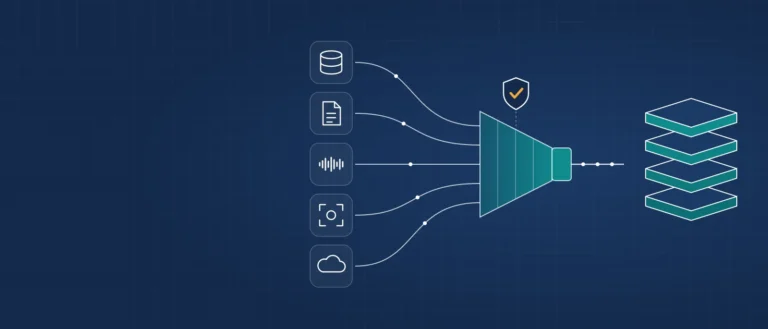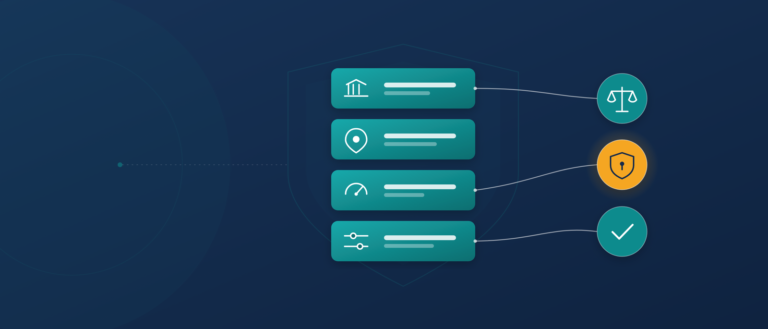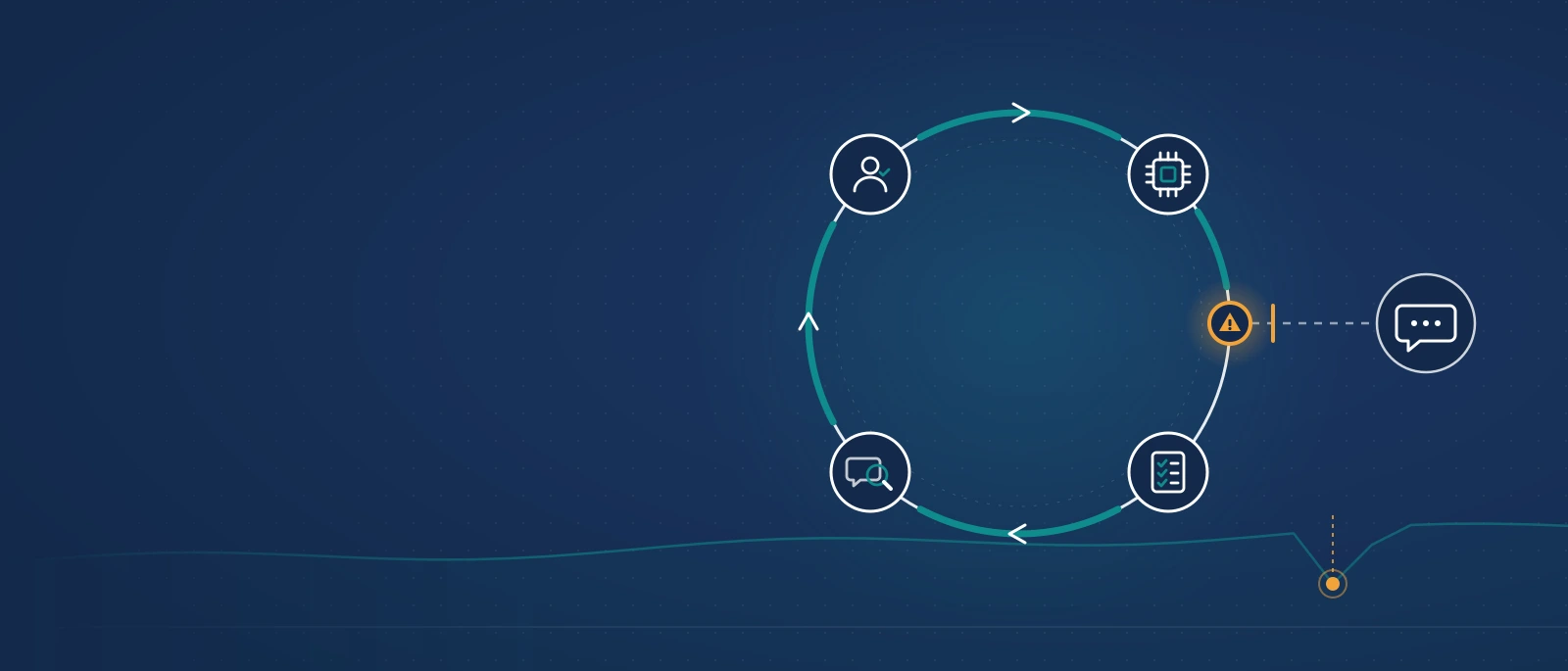
Continuous AI model evaluation is the practice of testing an AI model on every change and on a sample of live traffic, so quality drops, unsafe answers and hallucinations are caught by your team before users find them.
A model that passed its launch benchmark is not guaranteed to keep passing. Vendors upgrade models, prompts get edited, retrieval documents go stale and users ask questions nobody tested. Continuous AI model evaluation turns quality from a one-time sign-off into a running measurement, with clear thresholds for when a human must step in.
At a glance
| Question | Short answer |
|---|---|
| What is continuous AI model evaluation? | Ongoing testing of a model on every change and on sampled live traffic. |
| Why does it catch more failures? | It re-tests after model, prompt, data and user changes, when most regressions appear. |
| Which LLM evaluation methods does it use? | Regression suites, LLM-as-a-judge, human expert review and groundedness checks. |
| What is RAG and grounded LLM evaluation? | Scoring retrieval quality and faithfulness to sources, not only the final answer. |
| Does it replace human review? | No. Judges scale the work; calibrated experts keep the judges honest. |
| Who needs it most? | Teams running customer-facing, regulated or multilingual LLM products. |
Contents: Definition | Why models fail quietly | LLM evaluation fundamentals | LLM evaluation methods | RAG and grounded LLM evaluation | TRACE Score | Checklist | Examples | Cost | Mistakes | FAQ
What is continuous AI model evaluation?
Continuous AI model evaluation means running a defined set of quality, safety and task checks automatically whenever the AI system changes, and scoring a sample of real production interactions on a schedule. Results are tracked against thresholds, and failures trigger alerts, human review or a rollback.
It borrows from continuous integration. OpenAI’s evaluation guide tells teams to “set up continuous evaluation (CE) to run evals on every change, monitor your app to identify new cases of nondeterminism, and grow the eval set over time.” Microsoft Foundry now samples production agent runs and scores them automatically. For background, see our guide to what a large language model is.
Why AI models fail quietly after launch
A launch benchmark measures one model, one prompt and one dataset on one day. Production changes all four, which is why continuous AI model evaluation catches failures that launch testing misses.
The clearest public evidence comes from Lingjiao Chen, Matei Zaharia and James Zou. Testing hosted GPT‑4 in March and June 2023, they found its accuracy at identifying prime numbers fell from 84% to 51%. Their conclusion: the “same” LLM service can change substantially in a short time. That finding is the core case for continuous AI model evaluation.
Four triggers cause most silent regressions:
- Model changes: a vendor updates a version or you fine-tune a new one.
- Prompt changes: one edit fixes a case and breaks five others.
- Data changes: retrieval documents change underneath the model.
- User changes: new languages, intents and adversarial users arrive.
Regulators expect the same. NIST’s AI Risk Management Framework (MEASURE 2.4) says AI system behaviour should be “monitored when in production.” Article 72 of the EU AI Act requires post-market monitoring of high-risk systems across their lifetime. In India, MeitY’s AI Governance Guidelines (5 November 2025) propose a national AI incident database and human-in-the-loop safeguards at critical decision points. None prescribes a tool, but all assume continuous AI model evaluation or something close to it.
LLM evaluation fundamentals: what to measure
LLM evaluation fundamentals do not change when testing becomes continuous: define “good” for your use case, build a reference set that represents it and choose scorers you trust. Continuous AI model evaluation simply repeats those LLM evaluation fundamentals on every change.
Apply the LLM evaluation fundamentals across five metric areas:
- Task quality: correctness, completeness and instruction following.
- Grounding: whether claims are supported by the provided sources.
- Safety and policy: refusals, harmful content, bias and data leakage.
- Experience: tone, format, language match and latency.
- Cost: tokens and tool calls per resolved task.
The most neglected of the LLM evaluation fundamentals is the golden set: a versioned collection of prompts with approved answers or grading rubrics. Unless it is refreshed from production logs, it stops representing what users ask. Clean reference data is where data validation pays off. Teams that master these LLM evaluation fundamentals find every later method easier to trust.
LLM evaluation methods compared
No single technique covers every failure. Strong continuous AI model evaluation programmes combine LLM evaluation methods and send each question to the cheapest method that answers it reliably.
| Method | Best for | Catches | Misses | Relative cost | When to choose |
|---|---|---|---|---|---|
| Public benchmarks | Model selection | General capability gaps | Your domain and users | Low | Shortlisting models |
| Offline regression suite | Every release | Known failures returning | New failures | Low | Gate every deploy |
| LLM-as-a-judge on live samples | Scale | Relevance, tone, rubric breaches | Subtle domain errors | Medium | High-traffic products |
| Human expert review | High-stakes answers | Domain errors, cultural nuance | Rare cases in small samples | High | Regulated or expert domains |
| Groundedness metrics | Retrieval apps | Unsupported claims | Wrong source documents | Low to medium | Any RAG system |
LLM-as-a-judge needs a caveat. In the MT-Bench study by Zheng and colleagues, strong judges such as GPT‑4 reached over 80% agreement with human preferences, about the level humans reach with each other. The same paper documents position, verbosity and self-enhancement bias. Among LLM evaluation methods, judges should therefore be calibrated against expert labels before you trust them at scale.
Automated LLM evaluation methods are usually stronger for volume and speed. Human LLM evaluation methods are preferable when an error is costly, the domain is specialised or the language is under-represented in the judge’s training data. A hybrid mix usually wins.
Also read: How to choose among AI training data companies
RAG and grounded LLM evaluation
RAG and grounded LLM evaluation scores a retrieval-augmented system at two points: did it fetch the right context, and did the answer stay faithful to it? A fluent answer can still be wrong if retrieval pulled an outdated policy, which is why RAG and grounded LLM evaluation belongs inside continuous AI model evaluation.
The RAGAS framework (Es et al., 2023) splits RAG and grounded LLM evaluation into retrieval relevance, faithfulness to retrieved passages and generation quality, often without human-written reference answers. In production, extend RAG and grounded LLM evaluation with three checks:
- Source freshness: flag answers citing documents past their review date.
- Citation accuracy: confirm each cited passage supports the sentence.
- No-answer behaviour: test whether the system admits it does not know.
For Indian deployments, run RAG and grounded LLM evaluation separately for English, Hindi and code-mixed Hinglish queries, because an average score can hide a failing language. Native reviewers from a language and localisation team make slice-level review reliable.
The TRACE Score: a maturity framework for continuous AI model evaluation
The TRACE Score shows whether a continuous AI model evaluation programme will catch failures early. Score each factor from 1 (absent) to 5 (mature).
| Factor | What to evaluate | Score 1 | Score 5 |
|---|---|---|---|
| T: Triggers | What starts a run | Manual, pre-launch only | Every change plus live sampling |
| R: Reference sets | Golden set freshness | Written once | Versioned, refreshed monthly |
| A: Assessors | Who scores outputs | Unchecked single judge | Judges calibrated to expert labels |
| C: Coverage | Slices and risk areas | Averages only | Per-language, per-intent, adversarial |
| E: Escalation | What happens on failure | Unread dashboard | Owners, alerts, rollback paths |
How to read it: 5 to 12 means users are your alarm system. 13 to 19 catches known regressions but misses new ones. 20 to 25 means failures usually surface in your pipeline first. Fix the lowest factor first.
Assessors and Coverage are where most teams stall, because both need skilled human judgement. Specialist LLM evaluation services fill that gap with domain experts who write rubrics, label calibration sets and review escalated outputs.
How to set up continuous AI model evaluation: a 7‑step checklist
- Define success per use case, with a measurable threshold for each metric.
- Build a golden set of real prompts labelled by people who know the domain.
- Wire the regression suite into your release pipeline so no change ships without it.
- Sample live traffic and score it with a calibrated judge.
- Route low-scoring and high-risk outputs to human expert review.
- Set alert thresholds, name an owner per metric and document the rollback path.
- Add every confirmed production failure to the golden set, then re-measure.
Steps 2 and 5 depend on reliable human labels, the part of continuous AI model evaluation that tools cannot supply. A vetted workforce of subject-matter experts is often faster than training generalists for medical, legal or financial content.
Also read: Data annotation outsourcing: the complete guide
Illustrative examples of continuous AI model evaluation
These are illustrative scenarios, not client results.
Example 1: model upgrade in a bilingual support bot. An Indian fintech assistant passed English launch tests, but after a vendor upgrade its Hindi answers filled with English banking jargon. Decision: add a Hindi slice and a language-match metric. Expected outcome: the next faulty upgrade is blocked before customers see it.
Example 2: stale documents in an HR assistant. Faithfulness scores looked healthy, yet the assistant quoted a replaced leave policy. Decision: add source freshness to RAG and grounded LLM evaluation. Expected outcome: answers citing expired documents are flagged automatically.
Example 3: safety drift after a prompt edit. A friendlier prompt lowered refusal rates on unsafe requests. Decision: add an adversarial set built with red-teaming and RLHF data. Expected outcome: safety regressions fail the release gate.
What does continuous AI model evaluation cost?
Cost depends on traffic, sampling rate and review volume, so treat this as a planning method, not a price.
Monthly cost = (sampled interactions × judge cost each) + (escalated interactions × review cost each) + tooling and storage + golden set upkeep.
Illustrative calculation: 200,000 monthly conversations sampled at 5% gives 10,000 judged conversations. At a 2% escalation rate, experts review 200 a month. Insert your own pricing and reviewer rates; escalation volume usually drives cost more than the judge. The return is incidents avoided.
Common mistakes
- Trusting an uncalibrated judge. Judges are cheap to switch on, so biases go unchecked. Compare judge scores with expert labels quarterly.
- Reporting only averages. A 92% overall score can hide a failing language. Report by slice.
- A stale golden set. Written once at launch, it drifts from reality. Refresh it monthly.
- Alerts without owners. Assign one owner and one action per threshold.
Also read: Content moderation services: types, costs and how to choose
FAQ on continuous AI model evaluation
What is continuous AI model evaluation in simple terms?
Continuous AI model evaluation is testing an AI model all the time rather than once. It re-checks the model whenever the model, prompt or data changes and regularly scores a sample of real conversations. When scores fall below agreed thresholds, humans review the problem.
How is continuous evaluation different from monitoring?
Monitoring tracks operational signals such as latency, errors and cost. Continuous AI model evaluation scores what the model actually says for accuracy, grounding and safety. Production teams need both, and many platforms show them side by side.
What are the main LLM evaluation methods?
The main LLM evaluation methods are public benchmarks, offline regression suites, LLM-as-a-judge scoring, human expert review and groundedness metrics for RAG systems. Each catches different failures, so mature programmes combine them and reserve human review for high-risk outputs.
Can an LLM judge replace human reviewers?
Not fully. MT-Bench research found strong LLM judges agreed with humans over 80% of the time, but also showed position, verbosity and self-enhancement biases. Among LLM evaluation methods, judges work best for scale when calibrated regularly against expert labels.
How often should a model be re-evaluated?
Run the regression suite on every model, prompt or data change, and score sampled live traffic daily or continuously. Recheck judge calibration and refresh the golden set at least monthly, and immediately after a major model release.
Is continuous evaluation required by law in India?
As of September 2026, India has no single AI law mandating it. MeitY’s AI Governance Guidelines recommend incident reporting and human oversight, and sector regulators may add their own rules. This is not legal advice; confirm your obligations with counsel.
What is RAG and grounded LLM evaluation?
RAG and grounded LLM evaluation checks whether a retrieval system fetched relevant, current sources and whether the answer stays faithful to them. It catches hallucinations that answer-only scoring misses, especially when documents change often.
What is a golden set?
A golden set is a versioned collection of test prompts with approved answers or grading rubrics. It is one of the LLM evaluation fundamentals because it anchors every run, so domain experts should label it and refresh it with real failures.
About the authors
Written by the Graveiens AI Team, which provides human-in-the-loop data services including LLM evaluation, RLHF data and multilingual review across 25+ languages . Learn more about Graveiens AI. Facts were checked against the primary sources below on 23 September 2026.
Conclusion
Continuous AI model evaluation catches failures before users do because it re-tests the model when failures actually appear: after model upgrades, prompt edits, data changes and shifts in user behaviour. The strongest programmes pair regression suites and calibrated judges with expert review, report by slice and treat RAG and grounded LLM evaluation as its own discipline.
Use the TRACE Score to find your weakest factor and fix it first. If you need domain experts to build golden sets, calibrate judges or review multilingual outputs, the Graveiens AI evaluation team supports that work with a four-stage QA workflow and pay-for-approved-work terms. Write to info@graveiens.com to discuss your use case.
Sources
- Chen, Zaharia and Zou, “How is ChatGPT’s behavior changing over time?” (arXiv, 2023)
- Zheng et al., “Judging LLM-as-a-Judge with MT-Bench and Chatbot Arena” (arXiv, 2023)
- Es et al., “Ragas: Automated Evaluation of Retrieval Augmented Generation” (arXiv, 2023)
- OpenAI, Evaluation best practices
- NIST AI RMF Playbook, MEASURE function
- EU AI Act, Article 72: Post-market monitoring
- MeitY, India AI Governance Guidelines (November 2025, PIB)
- Microsoft Learn, Continuous evaluation for agents in Foundry

Jitendra Choubay is the CEO & Founder of Graveiens AI, leading a human-in-the-loop data services team that helps AI builders with data collection, annotation, consent-backed voice data, transcription and LLM fine-tuning. He writes on building better, ethically sourced AI training data.
Get the next Graveiens AI article
Expert notes on AI data, annotation, LLMs and eLearning — no spam, unsubscribe anytime.
Need AI Development? Data Annotation? eLearning?
Talk to Graveiens AI about data collection, annotation, voice data, RLHF/SFT, LLM evaluation and AI training data — invoiced only on approved work.
Contact Graveiens AI