| TL;DR Key takeaways |
|---|
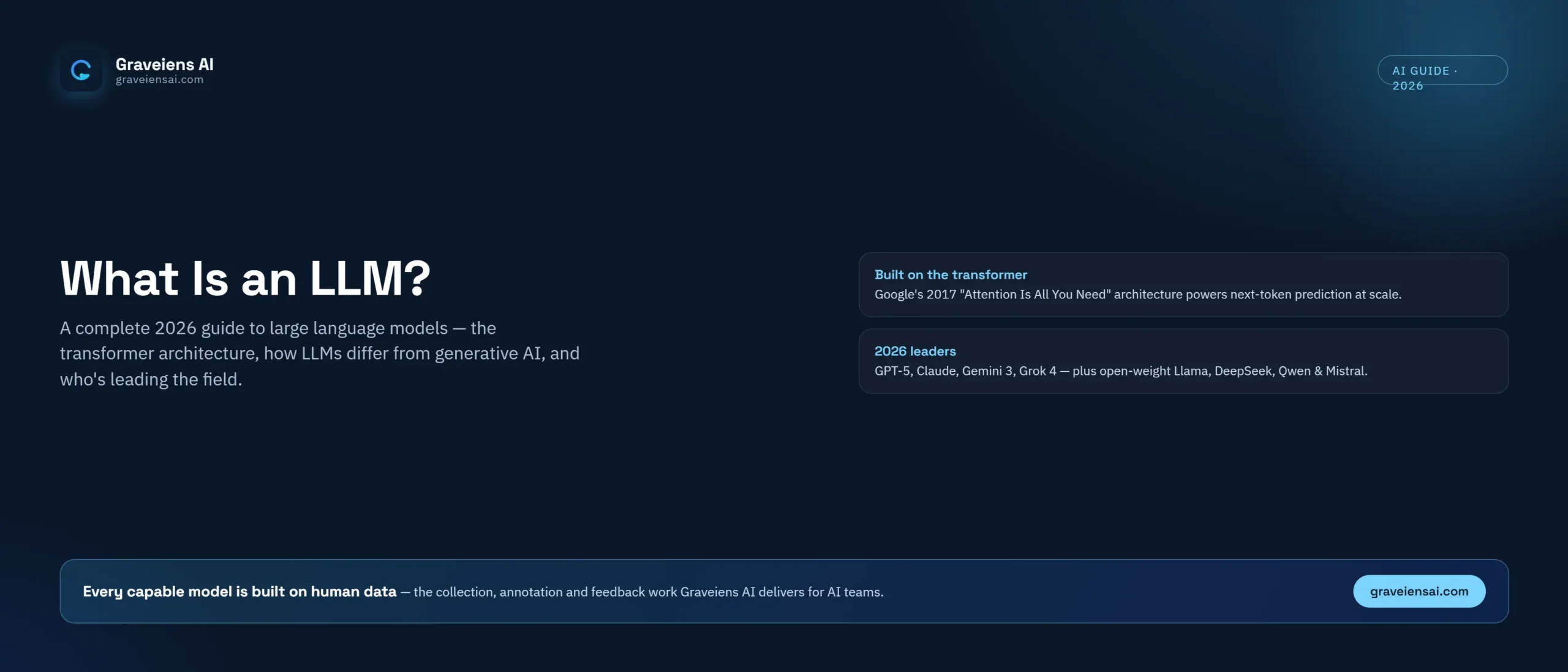
| 1.What is an LLM? A deep-learning system trained to predict the next token in a sequence using the transformer architecture. 2. LLM vs. Generative AI: LLMs are a specific subset of generative AI focused on text, whereas generative AI broadly covers audio, video, images, and code. 3.The Best LLMs: High-performing options include proprietary models like OpenAI (GPT‑5) and Anthropic (Claude), as well as open-weight models like Llama, DeepSeek, and Qwen. 4. Built on Human Data: Every capable model relies heavily on human data collection, annotation, and feedback to ensure accuracy and alignment. |
Who this article is for: founders, ML engineers, product managers and data leaders who want a clear, accurate definition of large language models plus a practical view of the best LLMs, LLM architecture and how LLMs differ from generative AI.
What is an LLM?
A large language model (LLM) is a type of artificial intelligence trained on enormous amounts of text so it can understand, summarize, translate and generate human language. At its core, an LLM does one deceptively simple thing: given a sequence of words, it predicts the most probable next unit of text. Repeat that prediction billions of times over trillions of words, and the model learns grammar, facts, reasoning patterns and style.
The word “large” is literal. Modern LLMs contain anywhere from a few billion to well over a trillion parameters the internal weights the model adjusts during training and are trained on datasets measured in trillions of tokens drawn from books, websites, code and licensed human data.
If you have used ChatGPT, Claude, Gemini or Microsoft Copilot, you have already used an LLM. These systems power chatbots, coding assistants, search summaries and enterprise conversational AI tools. The global LLM market reflects that adoption: analysts estimate it at roughly $10–13 billion in 2026, with double-digit annual growth forecast into the 2030s.
How LLMs work: from tokens to answers
Understanding what an LLM is becomes clearer once you see the four stages behind every response.
- Tokenization. Your input is broken into tokens words or word fragments.
- Embedding. Each token becomes a vector of numbers that captures meaning, so “king” and “queen” sit near each other mathematically.
- Attention & prediction. The model weighs how much each token relates to every other token, then predicts the next one.
- Decoding. The model repeats prediction token by token until it produces a complete answer.
The quality of this pipeline depends on the training data behind it. That is why teams invest in structured data collection and rigorous data annotation and labeling before a single training run begins the model can only learn from the signal it is given.
LLM architecture explained
The dominant LLM architecture is the transformer, first described by researchers at Google in the 2017 paper “Attention Is All You Need.” Nearly every leading model today GPT, Claude, Gemini, Llama is a transformer variant.
Self-attention
Self-attention lets the model look at an entire sequence at once and decide which words matter most to each other, capturing long-range context that older left-to-right networks missed.
Layers and parameters
A transformer stacks dozens or hundreds of identical layers. The parameters the tunable weights inside those layers are what the model “learns.” More parameters mean more capacity, though data quality now matters as much as raw size.
Mixture of Experts (MoE)
Many 2026 frontier models use a Mixture of Experts design, where only a fraction of the network activates per token keeping the model powerful while cutting the compute cost of each response.
| Pro tipArchitecture sets the ceiling on what a model can learn. Human feedback sets how well it actually behaves. The best teams treat LLM fine-tuning with RLHF and SFT as a first-class part of the architecture conversation, and validate behavior through LLM evaluation and red-teaming. |
LLM vs generative AI: what’s the difference?
Generative AI is any AI system that creates new content text, images, audio, video or code. An LLM is a specific kind of generative AI that specializes in language. Every LLM is generative AI, but not all generative AI is an LLM.
| Aspect | Large language model (LLM) | Generative AI (broader field) |
|---|---|---|
| Primary output | Text and language tasks | Text, images, audio, video, code |
| Core architecture | Transformer | Transformers, diffusion, GANs |
| Example systems | GPT‑5, Claude, Gemini, Llama | LLMs plus image & video generators |
| Typical use | Chat, summarization, translation | Content of any modality |
| Relationship | A subset of generative AI | The umbrella category |
The line is blurring: top models are now multimodal. Building them requires voice and speech data, audio transcription, and computer vision annotation feeding the same model. Our overview of generative AI and LLM services maps how these modalities come together.
The best LLMs in 2026
There is no single winner the leaderboard for the best LLMs shifts monthly, and the right model depends on your task, budget and latency needs. As of mid-2026 the frontier is led by a recognizable short list.
| Provider | Flagship family | Known strengths |
|---|---|---|
| OpenAI | GPT‑5 series | Structured reasoning, agentic tool use |
| Anthropic | Claude Opus / Sonnet | Coding depth, long-context reliability |
| Google DeepMind | Gemini 3 | Native multimodal, scientific reasoning |
| xAI | Grok 4 | Reasoning on hard exam-style benchmarks |
| Meta | Llama | Most-deployed open-weight model in enterprise |
Models are compared on benchmarks such as SWE-bench Verified, GPQA Diamond, MMLU and ARC-AGI. No model tops every chart, so many production systems route each request to whichever model best fits the task. That is where independent LLM evaluation earns its keep, especially in regulated fields like healthcare and banking and finance.
Best LLM for coding
Software development is the most popular professional use of LLMs. In 2026 the leaders are Anthropic’s Claude Opus-class models and OpenAI’s GPT‑5 coding variants, with fast Gemini tiers close behind and open-weight GLM and Qwen coding series rivaling them on SWE-bench.
What separates a strong coding model:
- Agentic ability planning multi-step edits across a whole repository, not just autocompleting a line.
- Long context holding an entire codebase in memory to reason about dependencies.
- Test-and-fix loops running code, reading the error, and correcting itself.
Coding models are made reliable through vast amounts of human-graded examples. This preference data is exactly what our RLHF and generative AI teams produce, backed by a specialized STEM and engineering workforce that can judge whether a model’s code is actually correct.
Best open source LLMs
Open models have closed most of the gap with proprietary systems. One distinction first: most “open-source” models are really open-weight you get the weights, but not always the training data or code, and the license may restrict use. The leading open families in 2026:
- Meta Llama the most widely deployed open-weight family in enterprise.
- DeepSeek strong reasoning and math, under a permissive MIT license.
- Alibaba Qwen competitive on reasoning and coding, much of it Apache 2.0.
- Zhipu GLM coding performance that rivals top proprietary models.
- Mistral strong multilingual models, now shipping under Apache 2.0.
- Google Gemma optimized for on-device and edge deployment.
An open base model still needs adaptation to your domain: task-specific LLM fine-tuning, multilingual language and localization, and content moderation data to keep outputs safe.
How LLMs are actually built: the human-data layer
An LLM’s architecture is public and its compute is buyable but its behavior is shaped by human data that is hard to source well. Three ingredients define a usable LLM:
- Pretraining data clean, diverse, well-sourced text and multimodal data, governed by data validation and natural language processing annotation.
- Supervised fine-tuning (SFT) human-written examples that teach the model how to respond to instructions.
- RLHF human raters ranking responses so the model learns what “good” looks like.
| Build a better model with Graveiens AIWe deliver this layer for AI teams: consent-backed data collection, multimodal annotation, transcription, RLHF preference data and expert evaluation run through a four-stage QA workflow and certified to ISO 9001:2017. See how our process works, read why AI teams choose Graveiens AI, or book a low-risk pilot and pay only for deliverables you approve. |
Frequently asked questions
Q. What does LLM stand for?
A. LLM stands for large language model — a deep-learning AI trained on massive text datasets to understand and generate human language by predicting the next token in a sequence.
Q. What is an LLM in simple terms?
A. An LLM is a very advanced autocomplete. It reads your text, predicts the most likely next words one at a time, and strings those predictions into coherent answers.
Q. Is ChatGPT an LLM?
A. Yes. ChatGPT is a chatbot interface powered by OpenAI’s GPT family of large language models. The LLM is the underlying model; ChatGPT is the product that lets you talk to it.
Q. What is the difference between an LLM and generative AI?
A. An LLM is a type of generative AI that specializes in language. Generative AI is the broader category that also creates images, audio and video. Every LLM is generative AI, but not all generative AI is an LLM.
Conclusion
So, what is an LLM? It is a large language model a transformer-based AI trained on massive human data to predict and generate language, and the engine behind today’s most useful AI products. Models are only as good as the human data behind them: the collection, annotation and feedback layer is what determines success.
Ready to build a better model?
| Ready to build a better model?Talk to the Graveiens AI team about a pilot — annotation, voice data, transcription or an RLHF run — and pay only for the deliverables you approve. graveiensai.com/contact-us |
Sources: Vaswani et al., “Attention Is All You Need” (2017); Artificial Analysis and SWE-bench Verified public leaderboards (2026); Mordor Intelligence and Straits Research LLM market forecasts (2026).

Jitendra Choubay is the CEO & Founder of Graveiens AI, leading a human-in-the-loop data services team that helps AI builders with data collection, annotation, consent-backed voice data, transcription and LLM fine-tuning. He writes on building better, ethically sourced AI training data.
Get the next Graveiens AI article
Expert notes on AI data, annotation, LLMs and eLearning — no spam, unsubscribe anytime.
Need AI Development? Data Annotation? eLearning?
Talk to Graveiens AI about data collection, annotation, voice data, RLHF/SFT, LLM evaluation and AI training data — invoiced only on approved work.
Contact Graveiens AI