Last updated: November 2026
Key takeaways
- No single public rate exists. Speech data collection cost per hour depends on ten drivers, led by language rarity, speech style, transcription depth and licensing rights.
- Define the hour first. A price per recorded hour and a price per accepted hour are not comparable until you write down acceptance criteria.
- Transcription can outweigh recording. In one 2025 study of Bambara, accurate transcription took about 30 hours of human labor per audio hour in the lab and 36 in the field.
- Off-the-shelf is cheaper up front, not always cheaper overall. Check commercial rights, channel fit and speaker metadata before you buy.
- Use the HOURS spec check (Hours, Ownership, Users, Recording, Standards) to get quotes you can compare line by line.
Ask three vendors for their speech data collection cost per hour and you may get three numbers that cannot be compared. One prices recorded hours, another prices accepted hours, and a third leaves out transcription or commercial rights.
This guide is for ASR, TTS and conversational AI teams in the US and EU who need to budget a custom voice dataset. You get the 10 cost drivers that move a quote and a clear definition of accepted hours. You also get an off-the-shelf vs custom comparison, licensing models and the HOURS spec checklist for comparing vendors.
Want to judge quality before you talk price? Request a free 30-minute speech sample set recorded and transcribed to your spec.
How much does speech data collection cost per hour?
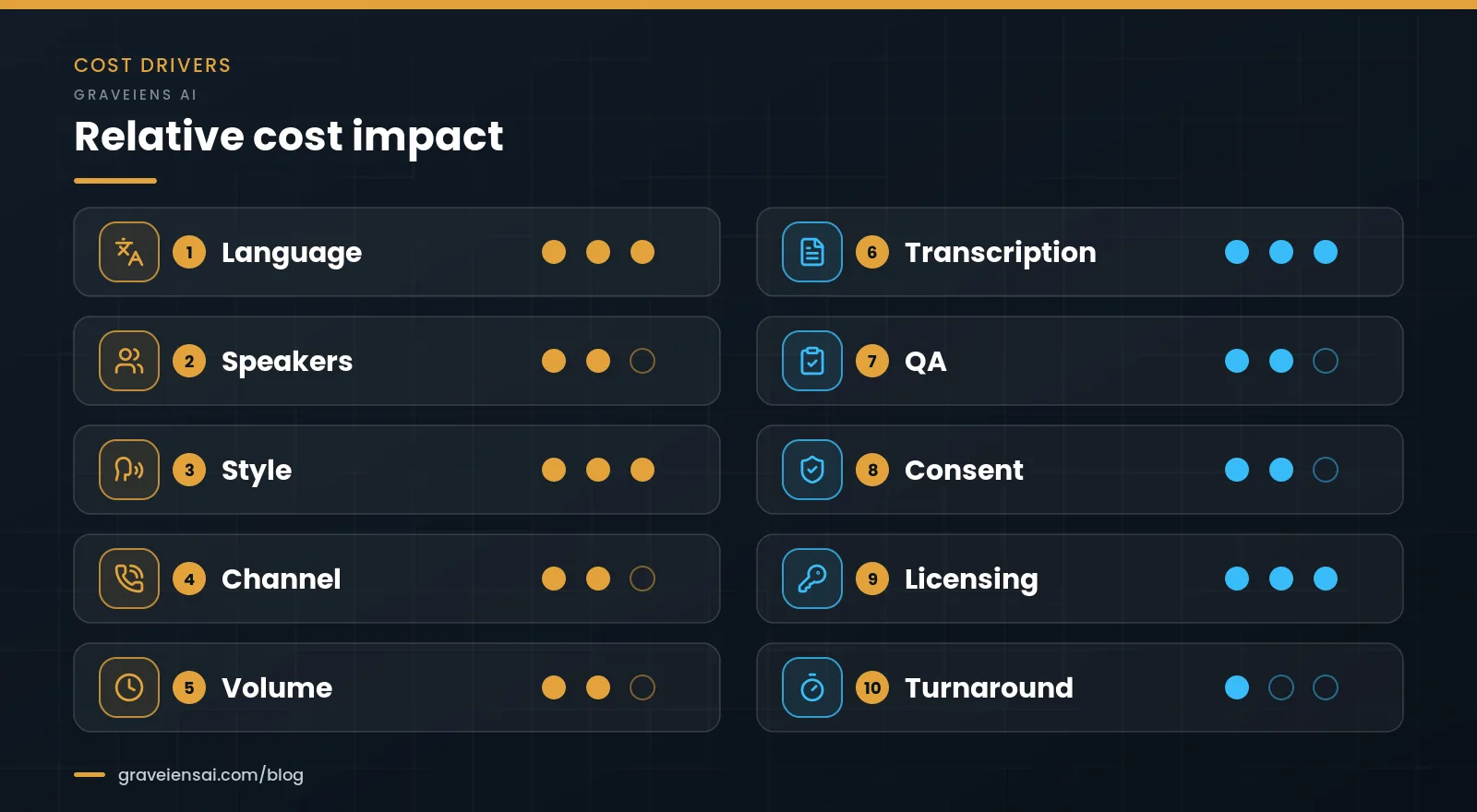
Speech data collection cost per hour has no single public rate. Ten drivers set it: language rarity, speakers and quotas, speech style, channel and environment, accepted-hour rules, transcription depth, QA depth, consent and metadata, licensing rights and turnaround. Common-language read speech sits at the low end, and exclusive conversational data in a rare accent at the high end.
Few neutral sources publish per-hour prices for custom collection. Most vendors ask for a spec before they quote, and that is fair. Two projects with the same hour count can need very different amounts of work.
What public, non-vendor sources do offer are reference points. As of November 2026, these are the most useful ones we could verify:
- Labeling at scale. The People’s Speech paper (NeurIPS 2021) says the team “initially estimated that hand-labeling 100,000 hours of speech would cost $5,000,000.” That works out to about $50 per hour, for labeling only. It is a 2021 planning estimate, not a market rate.
- Automation changes the math. The same team instead ran forced alignment on 52,500 hours of existing audio with transcripts. It took three days on Google Cloud at an estimated cost of $3,000. That only works when transcripts already exist.
- Human effort per hour. In a 2025 field study of Bambara transcription, the team corrected machine drafts of 53 hours of speech. That took about 30 hours of human labor per audio hour in lab conditions, and 36 in the field. Effort varies by language and literacy, but the ratio shows why transcription dominates many budgets.
- Licensed corpora. Under the Linguistic Data Consortium’s licensing terms, nonmember licensees, including for-profit nonmembers, cannot use LDC data for any commercial purpose. Commercial rights come through for-profit membership. Rights, not just hours, set the price.
In short: treat any single per-hour figure with caution. Price your own spec, driver by driver, and ask vendors to show their line items.
Why do speech data quotes vary so much?
Quotes vary because vendors price different units and bundle different work. One quote covers recorded hours with machine transcripts. Another covers accepted hours with verbatim transcripts, a second QA pass and exclusive rights. Until two quotes describe the same spec, the same acceptance rules and the same license, their per-hour numbers are not comparable.
Voice dataset pricing uses at least five units in the market. Knowing which one you are looking at is the first step in a fair comparison.
- Per recorded hour. All captured audio, including silence, retakes and files that may later fail checks.
- Per accepted hour. Only audio that passes your written acceptance criteria. The rate looks higher, but rejects are the vendor’s cost.
- Per speaker or per session. Common when many speakers each contribute a few minutes, such as accent coverage projects.
- Per utterance or prompt. Typical for wake words and short commands, where hours are a poor measure.
- Per audio minute transcribed. Used when you already have recordings and only need transcription or annotation.
Ask every vendor to split the quote into line items: recruitment and consent, recording, transcription, annotation, QA, licensing premium and project management. Line items make hidden gaps visible.
In short: normalize the unit before you compare the number.
What are the 10 cost drivers of speech data collection?
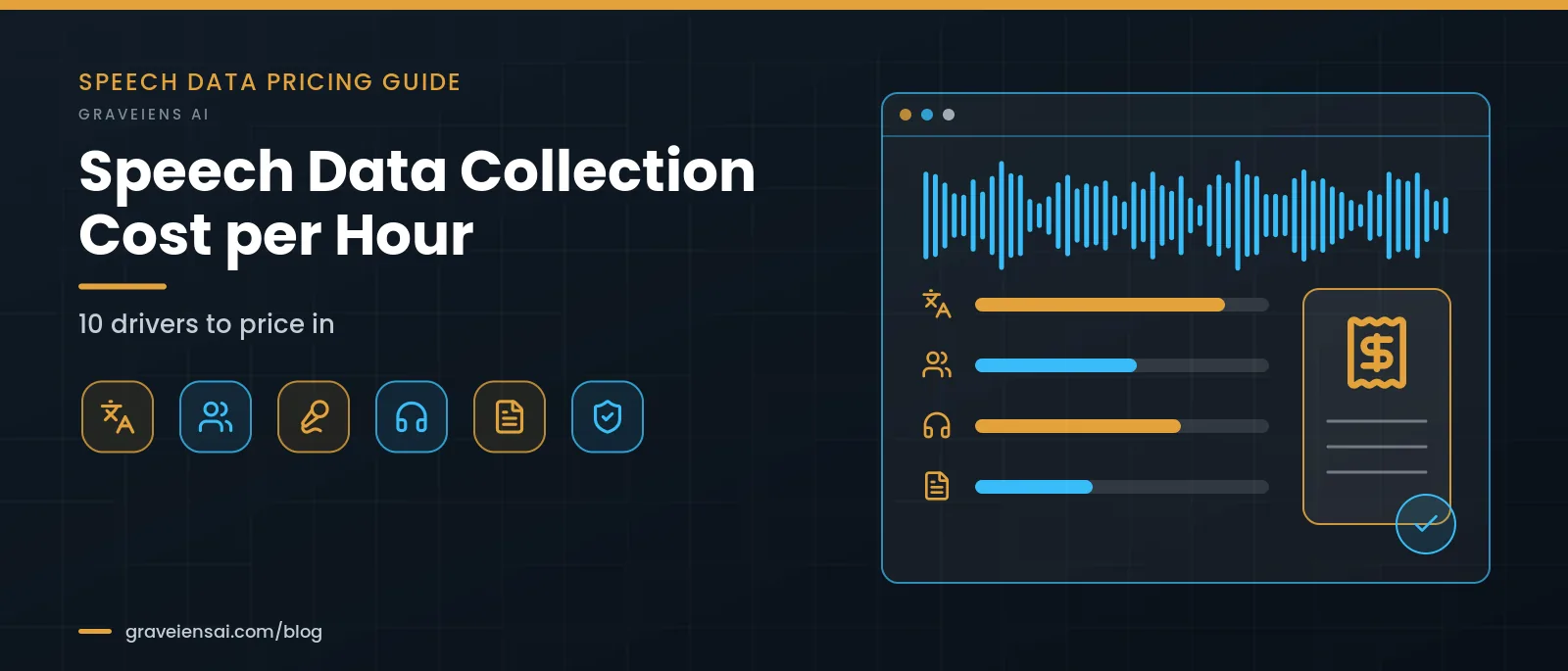
The ten drivers are language and accent rarity, speakers and demographic quotas, speech style, channel and recording environment, volume and accepted-hour rules, transcription depth, QA depth, consent and metadata, licensing rights and turnaround. Language, speech style, transcription and licensing usually swing a quote the most. Turnaround mainly matters when you need a rush delivery.
| Cost driver | Lower-effort end | Higher-effort end | Typical swing |
|---|---|---|---|
| 1. Language and accent rarity | Widely spoken language, general accent | Low-resource language or named regional accents | High |
| 2. Speakers and quotas | Fewer speakers, loose targets | Many unique speakers, hard age, gender and region quotas | Medium |
| 3. Speech style | Scripted read prompts | Spontaneous monologue or two-party conversation | High |
| 4. Channel and environment | Smartphone in a quiet room | Telephony pairs, studio capture, far-field or set noise conditions | Medium |
| 5. Volume and accepted-hour rules | Raw recorded hours, loose rules | Net speech hours under strict acceptance criteria | Medium |
| 6. Transcription depth | Orthographic text, no timestamps | Verbatim with tags, word timestamps and diarization | High |
| 7. QA depth | Sample-based audit | 100% second pass, double transcription, WER audits | Medium |
| 8. Consent, metadata and compliance | Single-purpose consent, basic metadata | Per-purpose consent, rich metadata, EU data handling | Medium |
| 9. Licensing and usage rights | Non-exclusive license | Exclusive rights or full ownership | High |
| 10. Turnaround | Flexible schedule | Rush delivery with parallel teams | Low |
1. Language and accent rarity
Recruiting is the main bottleneck, since speakers of a widely spoken language are easy to find. A low-resource language or a specific regional accent needs local recruiters, native transcribers and extra screening to confirm each speaker really has that accent.
Specify: language, locale, accent or dialect labels, and how speaker claims are verified. For India-specific planning, see our Indic speech data collection guide.
2. Speakers and demographic quotas
More unique speakers per hour means more recruiting, onboarding and consent records per hour. Hard quotas also slow the end of a project, because the last few cells, such as speakers over 60 in one region, take the longest to fill.
Specify: total speakers, a cap on minutes per speaker, quota cells, and which quotas are hard and which are best effort.
3. Speech style: scripted, spontaneous or conversational
Scripted speech is the fastest to record and to transcribe, because the prompt is a starting transcript. Spontaneous speech needs topic prompts and full transcription. Two-party conversation adds scheduling, a separate channel per speaker and turn-level transcription with overlaps.
If you are building a phone or app agent, read what voice agent training data needs before you choose the mix.
4. Channel and recording environment
Telephony audio is narrowband, usually sampled at 8 kHz. Wideband app audio is often 16 kHz, and TTS voices are usually recorded at 44.1 or 48 kHz in treated rooms. Each setup needs different devices, rooms and checks.
Real environments such as cars, kitchens or streets mean recording people where they are, then tagging each file. Controlled noise conditions and far-field microphone arrays add booking and equipment time. Never accept upsampled narrowband audio labeled as wideband.
5. Volume and the accepted-hour definition
Larger volumes spread fixed costs, such as guidelines, tooling and pilot work, over more hours. But the definition of an hour often moves the price more than the volume does. We cover this in the next section.
6. Transcription depth
An orthographic transcript records the words, while verbatim also captures fillers, false starts and cut-off words. Each extra layer, such as noise and overlap tags, segment or word timestamps, speaker diarization and language tags for code-switching, adds a pass and a guideline to follow. That is why transcription cost per hour of audio climbs fast.
Transcription appears here only as a cost driver. If you need it on its own, our human audio transcription services page lists the verbatim and time-aligned options.
7. QA depth and WER audits
Sample-based audits check a share of each batch. Evaluation sets often need 100% second-pass review or double transcription. A WER audit has a reviewer re-transcribe a sample, then measures the word error rate between the delivered transcript and that reference.
Specify: the audit sample size, the metric, the pass threshold per batch and what happens to batches that fail.
8. Consent, metadata and compliance
Per-purpose consent, a consent ID on every file and rich metadata (age band, gender, region, device, environment) all take time to capture and check. That work protects you later, when you need to prove coverage or honor a deletion request.
If any speakers are in the EU, the GDPR applies to their recordings. Per the European Commission, biometric data processed solely to identify a person is sensitive data with extra conditions. Our speaker consent form template covers the details. This is general information, not legal advice.
9. Licensing exclusivity and usage rights
A non-exclusive license is cheapest, because the vendor can license the same audio to others. Exclusive rights or full ownership remove that resale value, so the price rises. Rights for synthetic voice or voice cloning need separate speaker consent, which also affects cost.
10. Turnaround
Rush timelines mean parallel recruiting, more reviewers and tighter QA windows. Turnaround rarely changes the per-hour price as much as the drivers above, but it can force trade-offs in quota balance. Build pilot time into your plan.
In short: four drivers do most of the work. Pin down language, speech style, transcription depth and rights first, and the rest of the quote gets much easier to compare.
What is the difference between recorded and accepted hours?
Recorded hours count all captured audio, including silence, retakes and files that fail checks. Accepted hours count only audio that meets your written acceptance criteria, such as sample rate, noise level, speech content, transcript accuracy and complete metadata. Pricing per accepted hour moves the risk of rejects to the vendor. The rate looks higher, but it buys usable data.
It helps to separate four kinds of “hour” in every contract:
- Session hours. Time speakers spend in a recording session, including setup, instructions and breaks.
- Recorded hours. Total audio captured, including silence and retakes.
- Net speech hours. Audio left after trimming long silences and removing retakes.
- Accepted hours. Net speech that passes every acceptance check and is approved by you.
The gap between raw and usable hours is real, even outside custom collection. People’s Speech started with 52,500 hours of audio with transcripts. After forced alignment and filtering out mismatched transcripts, 31,400 hours were aligned, about 60% of the source.
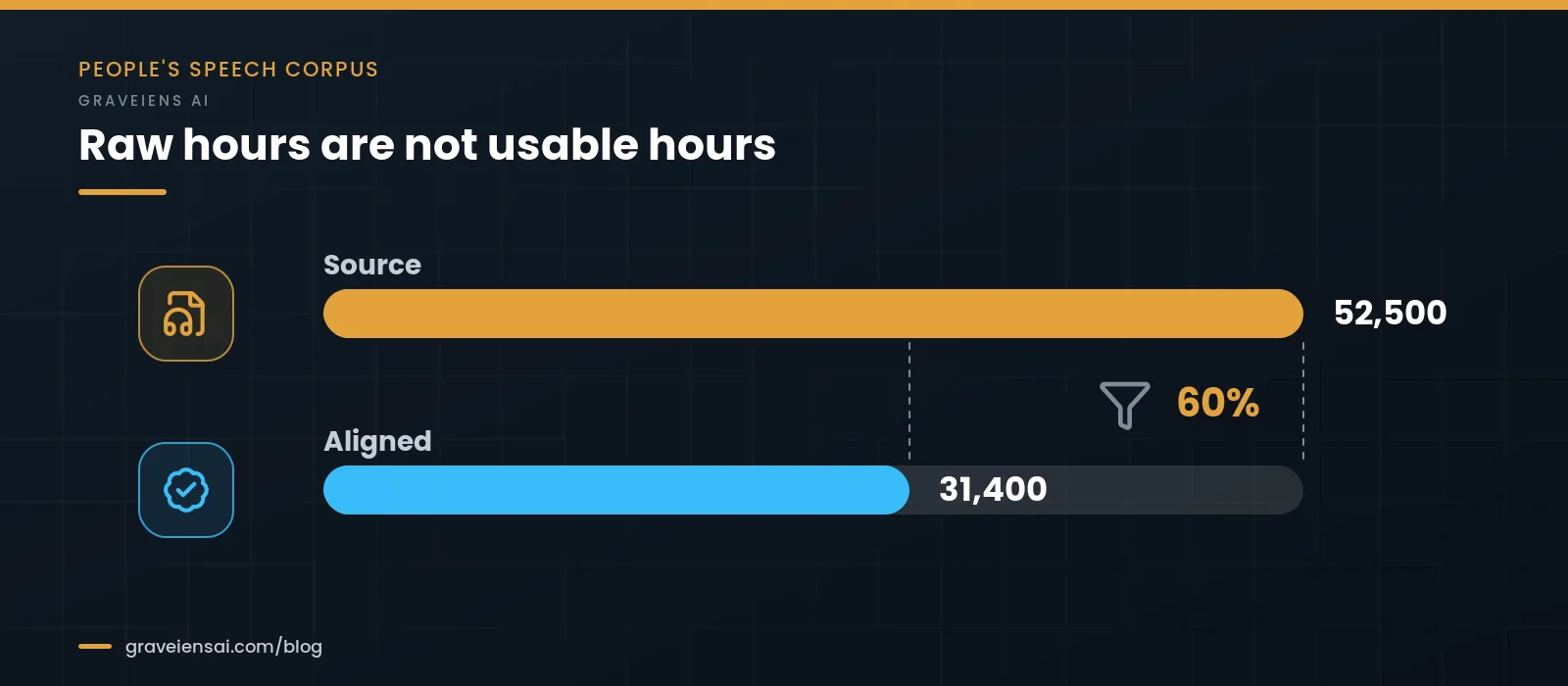
Your yield will differ, but the lesson holds. Write acceptance criteria before recording starts, so both sides price the same thing:
- Audio format: sample rate, bit depth, channel count, file type, no clipping.
- Speech content: minimum speech ratio and silence trimming rules.
- Environment: noise level or environment tag matches the spec.
- Transcript accuracy: maximum WER on an audited sample.
- Metadata: every required field filled, plus a valid consent ID.
- Quotas: speaker caps and quota cells respected per batch.
- Rework: rejection reasons, rework rules and deadlines.
In short: a cheap recorded hour can be an expensive accepted hour. Compare speech data collection cost per hour on accepted hours, not recorded ones.
How is a speech data quote built?
A reliable quote follows five steps: a written spec, a free sample against that spec, a small paid pilot, scaled batch delivery and approval of each batch. The pilot is where the per-hour price becomes evidence-based, because it measures real reject rates, transcription effort and how fast quota cells fill.
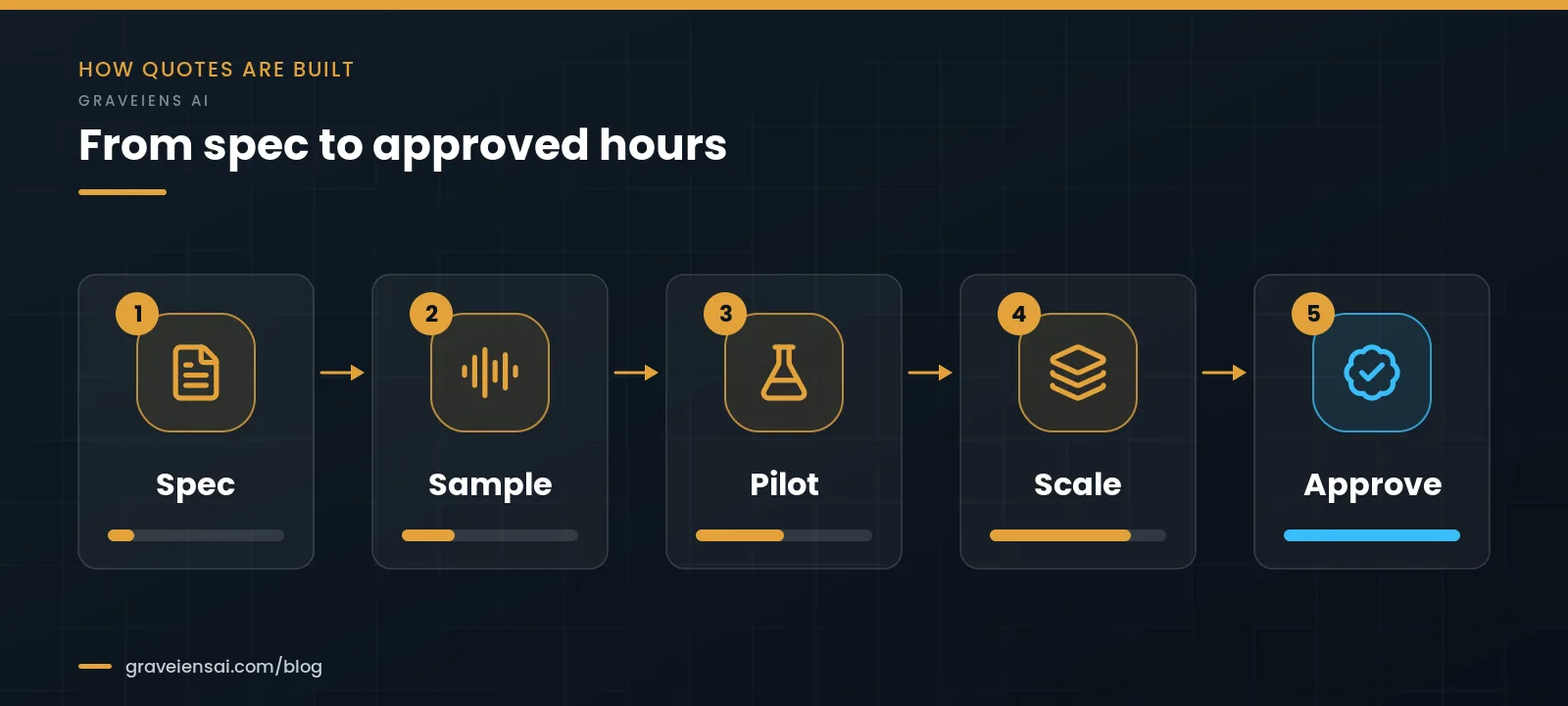
- Spec. Your team and the vendor’s project lead agree languages, speakers, style, audio format, transcription guideline, acceptance criteria and license. Output: a signed spec.
- Sample. The vendor records and transcribes a short sample to that spec. You check audio, transcripts and metadata against your own criteria.
- Pilot. A small paid batch runs end to end. You measure reject rate, rework time and quota fill, then confirm or adjust the price.
- Scale. Batches ship with quota reports and QA reports. Native-speaker reviewers audit each batch before delivery.
- Approve. You accept or reject each batch against the spec. In pay-on-approval models, only approved files are invoiced.
In short: do not sign a large order off a rate card. Let a pilot set the price.
Is off-the-shelf speech data cheaper than custom collection?
Off-the-shelf speech data is usually cheaper and faster up front, because recording costs are shared across buyers. Custom collection costs more per hour but matches your accents, channel, domain and rights. The cheaper option is the one that fits. A free corpus that does not match production audio, or forbids commercial use, can cost more in the end.
| Factor | Off-the-shelf or open data | Custom collection |
|---|---|---|
| Upfront cost | Low, sometimes free | Higher, priced to your spec |
| Time to first data | Fast, often immediate | Longer, after a sample and pilot |
| Channel and domain fit | Whatever the corpus captured | Matched to your product |
| Speaker metadata | Often limited | Fields you define |
| Commercial rights | Varies: open, research-only or licensed | Written into your contract |
| Exclusivity | None, others use the same data | Available at a premium |
Open data can be a strong start. People’s Speech offers about 30,000 hours of mostly English speech under CC-BY-SA, with a CC-BY subset, and its paper describes Mozilla Common Voice as CC0-licensed. Both suit pretraining and research, but check whether their accents, channels and domains match your users.
Licensing history matters too. The same paper recounts that Baidu collected 12,000 hours of read speech from 9,600 speakers through crowdsourcing. A legal review later found the speaker agreements did not permit public release or unrestricted commercial reuse, so the data was never released.
Most teams end up with a hybrid that uses open or licensed data for breadth and custom data for their own domain and channel. They also keep a custom held-out test set with speakers who never appear in training.
In short: buy breadth, collect fit, and always own your test set.
Which speech data licensing model fits your budget?
Pick the narrowest speech data licensing model that covers your real use. Open licenses cost nothing but carry attribution or share-alike terms. Research-only licenses are cheap but block products. Non-exclusive commercial licenses suit most teams. Exclusive licenses and full ownership cost the most, so reserve them for data that gives you a lasting edge.
| Licensing model | What you get | Cost effect |
|---|---|---|
| Open license (CC0, CC-BY, CC-BY-SA) | Free use under the license terms, such as attribution or share-alike | Lowest |
| Research-only license | Noncommercial research and education use | Low, but not usable in products |
| Non-exclusive commercial license | Use in products; the vendor may license the same data to others | Moderate |
| Time- or field-limited exclusive | No resale to others for a set period or field | Higher |
| Full ownership or assignment | You own the dataset outright | Highest |
Whatever the model, list the rights you need in writing:
- Training, fine-tuning and evaluation of your models.
- TTS or synthetic voice use, backed by separate speaker consent.
- Use by affiliates, contractors and cloud processors.
- Derivative datasets, such as augmented or filtered versions.
- Term, territory and what happens to data and models if the license ends.
This section is general information, not legal advice. Have counsel review any license before you sign.
The HOURS spec check: how to get comparable speech data quotes
We use a simple tool to turn the ten drivers into a spec any vendor can price: the HOURS spec check. Each letter covers two drivers, and if any letter is blank, the quote you get back is a guess.
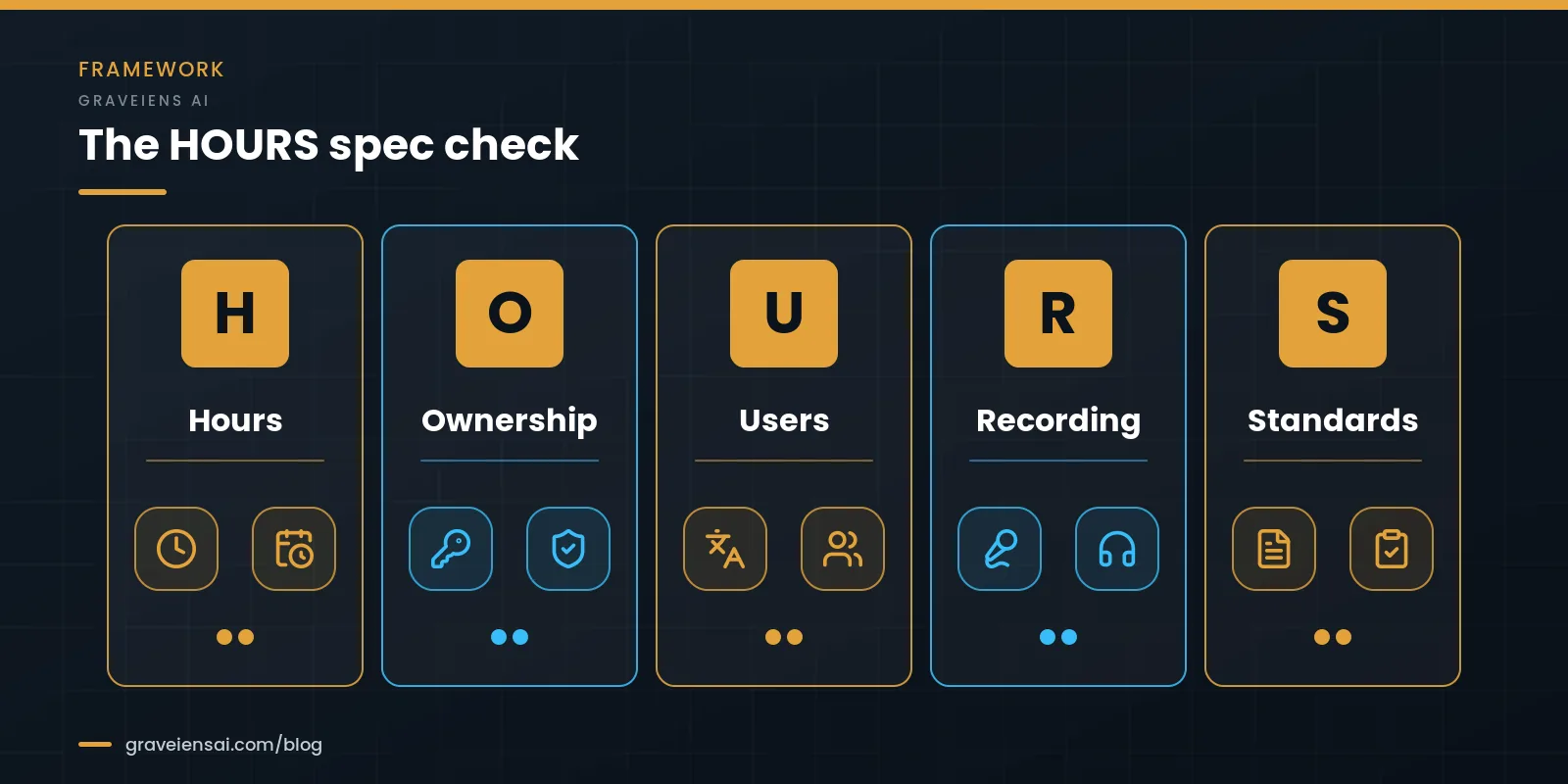
| Letter | Covers drivers | Questions to answer |
|---|---|---|
| H: Hours | Volume and accepted-hour rules; turnaround | How many accepted hours? What counts as accepted? When do batches ship? |
| O: Ownership | Licensing rights; consent and metadata | Exclusive or not? Which uses? Which consent purposes and metadata fields? |
| U: Users | Language and accent; speakers and quotas | Which languages and accents? How many speakers? Which quotas are hard? |
| R: Recording | Speech style; channel and environment | Scripted, spontaneous or conversational? Which sample rate, devices and settings? |
| S: Standards | Transcription depth; QA depth | Which transcription guideline and tags? Which QA metric and threshold? |
HOURS checklist: spec fields to fill in
Copy these fields into your request for quote. Example entries show the level of detail that gets a precise answer.
| Spec field | Example entry |
|---|---|
| Use case | ASR fine-tuning for a customer support voice agent |
| Languages and locales | US English; Italian (Italy) |
| Accents or dialects | US Southern, US Midwest; Northern and Southern Italian |
| Accepted hours | 200 accepted hours per language, net of silence |
| Speakers and caps | At least 500 speakers per language, 30 minutes maximum each |
| Quotas | Age bands 18–30, 31–50, 51+; gender within an agreed tolerance |
| Speech style mix | 20% scripted, 30% spontaneous, 50% two-party role-play |
| Channel and format | 8 kHz telephony pairs, one speaker per channel, 16-bit WAV |
| Environments | Quiet room, home with TV, car, street |
| Transcription | Verbatim, noise and overlap tags, segment timestamps, speaker turns |
| QA and acceptance | Audited sample per batch, WER threshold agreed after pilot |
| Metadata and consent | Speaker ID, age band, gender, region, device, environment, consent ID |
| License | Non-exclusive commercial license for training and evaluation |
| Timeline | Sample, pilot, then weekly batches |
Send your spec, get a scoped quote. Fill in the HOURS fields and send them to our voice data team. We will scope a pilot billed only on approved files. Request the HOURS checklist (mention “HOURS checklist” in your message and we’ll email the one-page PDF).
Common mistakes that inflate speech data costs
Most overruns in the cost of audio data collection come from decisions made before the first file is recorded. These are the ones we see most often:
- Comparing different hours. A recorded-hour quote and an accepted-hour quote look alike on paper but buy different amounts of usable audio.
- Writing acceptance rules at delivery. If criteria arrive late, rejected batches become disputes instead of rework.
- Recording the wrong channel. Studio audio for a phone product, or phone audio for a TTS voice, means paying twice.
- Over-transcribing training data. Bulk training audio may only need orthographic text. Save verbatim, tags and double review for the evaluation set.
- Loose quotas. Vague demographic targets skew toward the easiest speakers to recruit, and re-collecting the gaps costs more later.
- Buying research-only data for a product. A low price means little if the license forbids commercial use.
- Paying for exclusivity you do not need. Exclusive rights make sense for differentiating data, not for generic read speech.
- Skipping the pilot. Without a pilot, nobody knows the real reject rate, so both sides guess and pad the price.
In short: the cheapest hour is the one you only pay for once.
How Graveiens AI quotes speech data collection
Graveiens AI does not publish a rate card, because your spec sets your speech data collection cost per hour. We quote against your written spec, broken into line items you can compare with any other vendor.
- Free 30-minute speech sample set. Recorded and transcribed to your spec, so you can check quality before a pilot.
- Pilot billed only on approved files. You are invoiced only for deliverables you approve, at the pilot stage and after.
- Explicit-consent workflow. Participant onboarding, then recording management, then metadata tagging, then QA, with a consent record behind every file.
- Language coverage. 25+ languages, including Indian languages and European languages such as Italian.
- Quality system. Graveiens AI is ISO 9001 certified.
Scripted, spontaneous and conversational collection are all available through our consent-first voice and speech data services, and multi-modal programs run through our custom data collection programs. For anything outside a standard spec, we scope it with you.
We do not promise model accuracy gains, because those depend on your architecture and evaluation. What we commit to is data that matches the spec you sign off.
Frequently asked questions
What is a typical speech data collection cost per hour?
There is no reliable typical figure, because the spec drives the price. Public reference points exist: the People’s Speech team estimated hand-labeling 100,000 hours at $5 million in 2021, about $50 per hour for labeling alone. Treat such figures as context, and price your own spec with a sample and a pilot.
What is an accepted hour in speech data collection?
An accepted hour is an hour of net speech audio that passes every acceptance check in your spec. Checks cover audio format, noise level, transcript accuracy, metadata completeness and speaker caps. It excludes silence, retakes and rejected files. Pricing per accepted hour puts the cost of rejects on the vendor.
Is transcription included in speech data collection pricing?
Sometimes, and that is a common source of confusion. Some quotes cover recording only, some include machine drafts, and some include human verbatim transcription with timestamps and tags. Ask for transcription as a separate line item, with the guideline and QA threshold named, so you can compare quotes fairly.
Why does conversational speech data cost more than read speech?
Conversational data needs two speakers scheduled together, a separate channel for each, and scenarios that produce natural turn-taking. Transcription is harder too, with overlaps, fillers and speaker turns to mark. Read speech starts from a known script, so both recording and transcription take less effort per hour.
Does exclusive licensing increase the cost of speech data?
Yes. With a non-exclusive license, the vendor can license the same audio to other buyers, which spreads the cost. Exclusive rights or full ownership remove that option, so the price rises. Reserve exclusivity for data that gives you a lasting advantage, such as your own domain or a rare accent.
How can I lower speech data collection cost without hurting quality?
Define accepted hours and acceptance criteria up front, match the channel to your product, and transcribe bulk training audio at a lighter level than your evaluation set. Use open or licensed data for breadth, run a pilot before scaling, and only pay for exclusivity where it matters.
Is open speech data free to use commercially?
Not always. Licenses differ. CC0 and CC-BY generally allow commercial use, CC-BY-SA adds share-alike terms, and research-only licenses block commercial use. LDC, for example, limits nonmember licensees to noncommercial research. Read the license for each corpus and have counsel confirm your intended use.
Get a free 30-minute speech sample set
Tell us your language, accent, speech style and channel. We will record and transcribe a free 30-minute sample set to your spec, so you can check it against your own acceptance criteria. If you go ahead, the pilot is billed only on approved files.
Request your free speech sample set
Request the HOURS checklist (mention “HOURS checklist” in your message and we’ll email the one-page PDF).
Sources
- Galvez, D. et al. The People’s Speech: A Large-Scale Diverse English Speech Recognition Dataset for Commercial Usage. NeurIPS 2021 Datasets and Benchmarks Track, arXiv:2111.09344. https://arxiv.org/abs/2111.09344
- Diarra, Y., Coulibaly, N. S. and Leventhal, M. Cost Analysis of Human-corrected Transcription for Predominately Oral Languages. arXiv:2510.12781, October 2025. https://arxiv.org/abs/2510.12781
- Linguistic Data Consortium, University of Pennsylvania. Licensing. https://www.ldc.upenn.edu/data-management/using/licensing
- European Commission. What personal data is considered sensitive? https://commission.europa.eu/law/law-topic/data-protection/rules-business-and-organisations/legal-grounds-processing-data/sensitive-data/what-personal-data-considered-sensitive_en

Jitendra Choubay is the CEO & Founder of Graveiens AI, leading a human-in-the-loop data services team that helps AI builders with data collection, annotation, consent-backed voice data, transcription and LLM fine-tuning. He writes on building better, ethically sourced AI training data.
Get the next Graveiens AI article
Expert notes on AI data, annotation, LLMs and eLearning — no spam, unsubscribe anytime.
Need AI Development? Data Annotation? eLearning?
Talk to Graveiens AI about data collection, annotation, voice data, RLHF/SFT, LLM evaluation and AI training data — invoiced only on approved work.
Contact Graveiens AI