Data ingestion is the process of collecting data from its sources, such as apps, databases, devices, files and APIs, and moving it into a system where it can be stored, checked and used for analytics or AI. It is the first stage of any data pipeline, so every later report, dashboard or model inherits its gaps and errors.
This guide covers the data ingestion meaning, main types, the process, how to compare data ingestion tools, and a reusable scoring framework, with examples for India.
At a glance
| Question | Short answer |
|---|---|
| What is data ingestion? | Moving data from source systems into a target store such as a data lake or warehouse. |
| Why does it matter? | Every downstream report or AI model depends on what was ingested and how cleanly. |
| What are the main types? | Batch, micro-batch, streaming, change data capture (CDC) and event or API-driven ingestion. |
| Is it the same as ETL? | No. Ingestion moves data; ETL and ELT describe when and where it gets transformed. |
| What tools are used? | Open-source engines, cloud-managed services and connector platforms. |
| How do you choose an approach? | Score latency, data type, quality gates, compliance, cost and schema change risk. |
In this guide: meaning, why it matters, types, ingestion vs ETL, how it works, tools, the INTAKE Score, examples, mistakes, checklist, FAQ.
What is data ingestion? Meaning in plain terms
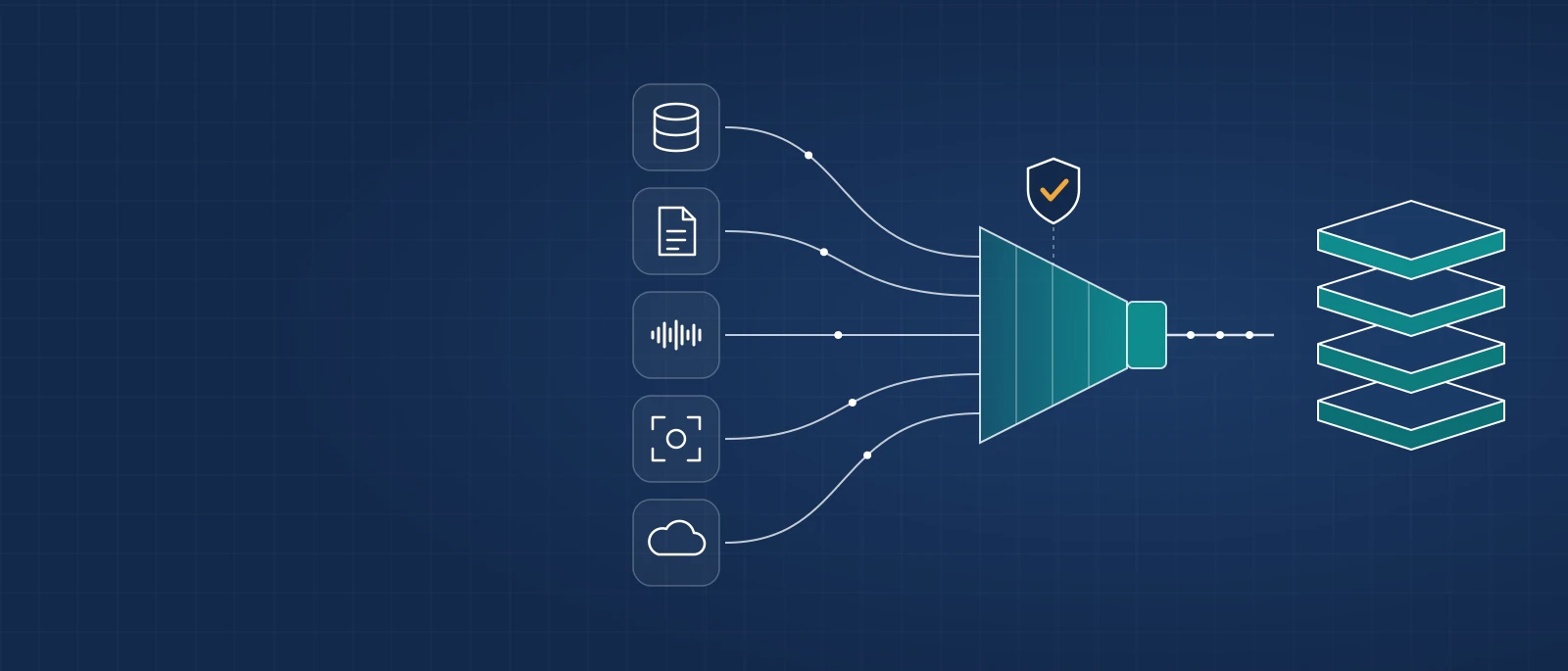
Data ingestion means getting data from where it is created to where it can be used. AWS defines it as collecting data from various sources and copying it to a target system for storage and analysis. The data ingestion meaning stays the same whether the source is a payments database, a CRM, IoT sensors or a folder of audio recordings.
In Fundamentals of Data Engineering (O’Reilly, 2022), Joe Reis and Matt Housley place ingestion between data generation in source systems and the storage, transformation and serving stages. Think of it as the intake desk: it decides what enters, how often and in what format.
Ingested data can be structured (database tables), semi-structured (JSON, logs, events) or unstructured (images, audio, video, PDFs, free text), which is most AI training material.
Why data ingestion matters
It matters because it sets the ceiling on data quality for everything that follows. Gartner research from 2020 estimated that poor data quality costs organisations at least USD 12.9 million a year on average. Duplicates, missing fields and silent format changes often enter at ingestion.
For AI teams the stakes are higher. If an ingestion job drops rare classes, mixes unconsented files with consented ones, or strips metadata such as speaker language or capture device, the damage surfaces later as bias or poor accuracy, when the cause is hard to trace. Even datasets from custom AI data collection need an ingestion layer that keeps consent records and metadata intact.
In India there is a compliance reason too. The Digital Personal Data Protection Rules, 2025 were notified on 14 November 2025 with a phased rollout of up to 18 months, according to the Press Information Bureau. Pipelines that ingest personal data should capture purpose, consent and retention details at entry.
Types of data ingestion
There are five common ingestion types. Most production systems combine two or more.
| Type | How it works | Best for | Trade-off |
|---|---|---|---|
| Batch | Loads data on a schedule, such as nightly | Reports, historical loads, training data refreshes | Only as fresh as the last run |
| Micro-batch | Loads small batches every few seconds or minutes | Near real-time dashboards at moderate cost | More jobs to monitor than batch |
| Streaming | Processes each event continuously as it arrives | Fraud checks, IoT, live personalisation | Higher compute cost and operational skill |
| Change data capture (CDC) | Reads inserts, updates and deletes from a database log | Syncing a warehouse with production databases | Needs log access and schema care |
| Event or API-driven | Pulls or receives data when an event or webhook fires | SaaS tools, partner data, file drops | Rate limits and API changes break jobs |
Batch is usually the cheapest place to start. Streaming makes sense only when a decision loses value within seconds. A hybrid, streaming the few feeds that need speed and batching the rest, is common.
Data ingestion vs ETL, ELT and data integration
The main difference is scope. Ingestion is about moving data into a destination. ETL (extract, transform, load) transforms data before loading it. ELT loads raw data first and transforms it inside the warehouse or lakehouse. Data integration is the wider discipline of combining data from many systems into one consistent view.
How data ingestion works: the process step by step
A reliable ingestion pipeline usually follows six steps:
- Identify sources. List every system, owner, format, volume and access method.
- Connect and extract. Use connectors, APIs, file transfer, CDC or event streams to pull data.
- Validate on arrival. Check schema, required fields, duplicates, file integrity and consent flags before data spreads.
- Attach metadata and lineage. Record source, timestamp, version and licence or consent status.
- Load to storage. Land data in a raw zone of a data lake, warehouse or object store.
- Monitor and alert. Track freshness, row or file counts, error rates and schema changes.
Step 3 is where many pipelines are weakest. Automated checks catch format problems, but not a transcript that mismatches its audio or a wrong image label. That is why AI teams often add an independent data validation and QA layer with gold-set audits and human review before data moves on to annotation and labelling.
Also read: What is training data? and how to choose an AI training data company.
Data ingestion tools: the main categories
Data ingestion tools fall into four practical categories. There is no single best option; the right one depends on your skills, sources and budget.
| Category | Examples | Best when | Watch out for |
|---|---|---|---|
| Open-source engines | Apache Kafka, Apache NiFi, Airbyte (open source) | You have engineers to run infrastructure | Hosting, upgrades and on-call load |
| Cloud-managed services | AWS Glue, Amazon Kinesis, Azure Data Factory, Google Cloud Dataflow | You are already committed to one cloud | Usage-based bills and lock-in |
| Managed connector platforms | Fivetran, Airbyte Cloud and similar ELT services | Many SaaS sources, small data team | Per-volume pricing as data grows |
| CDC tools | Debezium and CDC features in cloud services | Syncing operational databases | Log access and schema evolution |
Most data ingestion tools are built for tables, so unstructured AI data such as audio, video and documents also needs object storage, file-level checks and metadata capture. Pricing changes often; confirm current rates with vendors.
The INTAKE Score: an original framework for choosing an ingestion approach
Use the INTAKE Score to decide how to ingest each new source. Rate every factor from 1 (low) to 5 (high).
| Factor | What to evaluate | Score 1 to 5 |
|---|---|---|
| I: Interval | How fresh must the data be? 1 = weekly is fine, 5 = seconds matter | |
| N: Nature | Structure and modality. 1 = clean tables, 5 = mixed audio, video, documents | |
| T: Trust | Quality risk at the source. 1 = well-governed, 5 = noisy or crowd-sourced | |
| A: Accountability | Personal data, consent and audit needs. 1 = none, 5 = regulated | |
| K: Keep cost | Budget and people available to run it. 1 = ample, 5 = very tight | |
| E: Evolution | How often the source schema or format changes. 1 = rarely, 5 = constantly |
How to read it:
- Interval 4 or 5: consider streaming or CDC; otherwise start with batch.
- Nature, Trust or Accountability 4 or 5: add validation and human review, not just automated checks.
- Keep cost 4 or 5: prefer managed services over self-hosted engines.
- Evolution 4 or 5: add schema-change alerts from day one.
A short pilot, like the one in our scope, pilot and QA process, exposes real error rates before you scale.
Illustrative examples
These are illustrative scenarios, not client case studies.
Example 1: An Indian e‑commerce analytics team. Problem: orders were exported to spreadsheets daily and refunds went missing. INTAKE: I3, N1, T2, A3, K4, E2. Decision: managed CDC from the orders database into a cloud warehouse, nightly batch for marketing data. Expected outcome: order changes land within minutes, with personal fields tagged at entry for DPDP retention.
Example 2: A multilingual voice AI team. Problem: contributor audio sat in shared drives with no language tags. INTAKE: I1, N5, T4, A5, K3, E3. Decision: batch ingestion into object storage with checks for sample rate, duration and duplicates, a manifest holding consent ID, language and dialect, and a human spot check before speech data moves to transcription. Expected outcome: fewer unusable clips reach costly labelling.
The same applies to retrieval-augmented generation (RAG): documents ingested for large language models need versioning and access rules, or a chatbot will quote stale or restricted content. Teams building generative AI data pipelines should govern document ingestion too.
Also read: Data annotation outsourcing: the complete guide.
Common ingestion mistakes
| Mistake | Why it happens | Why it matters | How to prevent it |
|---|---|---|---|
| Choosing streaming by default | It sounds modern | Higher cost, no business gain | Stream only feeds scoring Interval 4 or 5 |
| Dropping metadata on arrival | Loaders keep only the payload | Lost consent or language context cannot be rebuilt | Require a metadata manifest per source |
| Ignoring drift after launch | Pipelines seem “done” | Models degrade quietly | Pair ingestion monitoring with continuous model evaluation |
Implementation checklist
- Write down the business or model decision the data supports.
- Inventory sources, owners, formats, volumes and access methods.
- Score each source with the INTAKE Score.
- Pick batch, micro-batch, streaming, CDC or a hybrid.
- Define validation rules, a metadata manifest and consent fields for personal data.
- Pilot on a small slice and measure error, duplicate and rejection rates.
- Set freshness, volume and schema-change alerts before scaling.
FAQ
What is data ingestion in simple words? It is moving data from where it is created, such as apps, databases, sensors or files, into one place where it can be stored and used. It is the first step of any data pipeline.
What is the data ingestion meaning in AI and machine learning? In AI, the data ingestion meaning extends to raw training material: bringing images, audio, video, text and labels into storage with the metadata needed to use them safely, such as source, consent status, language and version. Weak ingestion leads directly to biased or inaccurate models.
What are the two main types of data ingestion? Batch and streaming. Batch loads data on a schedule; streaming processes each event as it arrives. Micro-batch, CDC and event-driven ingestion are variations that balance freshness, cost and complexity.
Is data ingestion the same as ETL? No. Ingestion covers moving data into a destination. ETL is a specific pattern that extracts, transforms and then loads data. Ingestion can feed ETL or ELT, or simply land raw data with light validation.
Which data ingestion tools are most common? Popular data ingestion tools include Apache Kafka and Apache NiFi (open source), AWS Glue, Azure Data Factory and Google Cloud Dataflow (cloud-managed), and connector platforms such as Fivetran or Airbyte. The right one depends on sources, latency and team skills.
How much does data ingestion cost? There is no single price. Total cost = tool or cloud usage + storage + engineering time to build and maintain pipelines + review time for quality checks. Managed services cut engineering effort but bill by volume, so get current quotes.
Does India’s DPDP law affect ingestion pipelines? Yes, if you ingest personal data. The DPDP Rules, 2025 were notified in November 2025 with phased timelines. Capture consent, purpose and retention details at entry so access, correction and erasure requests can be met. Take legal advice for your case.
About the authors
Written by the Graveiens AI Team in Noida, India, which delivers data collection, annotation, validation and speech data for AI teams. The company grew out of an education-outsourcing business founded in 2017 and runs a four-stage QA workflow under ISO 9001:2017 [certificate details to confirm before publishing]. Reviewer credentials: [to be added]. Learn more about Graveiens AI.
Conclusion
So, what is data ingestion? It is the step that moves data from sources into storage where it can be trusted and used. Pick the type by how fresh the data must be, validate on arrival, keep metadata and consent records intact, and monitor for schema change. The INTAKE Score makes those calls repeatable for each new source.
If your AI data arrives messy, from contributors, vendors or legacy archives, Graveiens AI can validate, clean and label it with human QA and pay-on-approval delivery. Talk to the Graveiens AI team about a pilot.
Sources
- AWS: What is data ingestion?
- IBM Think: What is data ingestion?
- Databricks: What is data ingestion?
- O’Reilly: Fundamentals of Data Engineering by Joe Reis and Matt Housley (2022)
- Gartner: Data quality, why it matters and how to achieve it
- Press Information Bureau: DPDP Rules, 2025 notified
- Apache Kafka: Introduction

Jitendra Choubay is the CEO & Founder of Graveiens AI, leading a human-in-the-loop data services team that helps AI builders with data collection, annotation, consent-backed voice data, transcription and LLM fine-tuning. He writes on building better, ethically sourced AI training data.
Get the next Graveiens AI article
Expert notes on AI data, annotation, LLMs and eLearning — no spam, unsubscribe anytime.
Need AI Development? Data Annotation? eLearning?
Talk to Graveiens AI about data collection, annotation, voice data, RLHF/SFT, LLM evaluation and AI training data — invoiced only on approved work.
Contact Graveiens AI