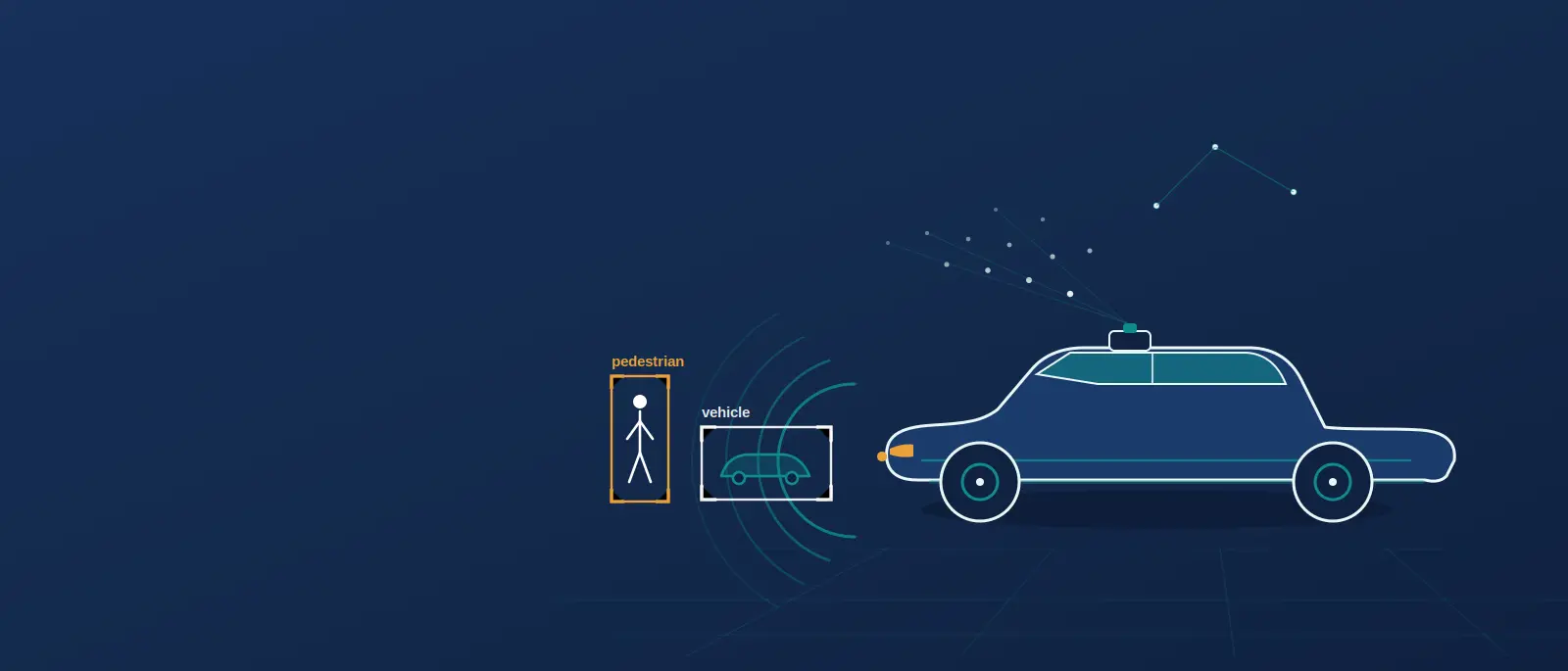
AI in self-driving cars is the stack of machine learning systems that let a vehicle sense its surroundings, predict what road users will do next, and control steering, braking, and acceleration without a human driver. In plain terms, artificial intelligence is the “brain” that turns raw sensor signals into safe driving decisions many times per second. This guide explains what that brain is made of, how do self driving cars work end to end, the six levels of driving automation, the sensor and software choices that separate the leaders from the rest, and the training data that quietly decides whether any of it is safe enough to trust.
You will get a plain-language definition, a comparison of the main technical approaches, an original readiness model you can reuse, a practical checklist, real safety numbers from primary sources, and answers to the questions people actually ask. Whether your interest is full autonomy or the automotive automation already shipping in today’s cars, the same principles apply.
At a glance
| Question | Direct answer |
|---|---|
| What is AI in self-driving cars? | The perception, prediction, planning, and control software (mostly deep learning) that replaces the human driver’s eyes, judgment, and hands. |
| How do self-driving cars work? | A four-stage loop: sense the world with sensors, perceive and classify objects, predict their motion, then plan and execute a driving path. |
| What are the levels? | SAE International’s J3016 standard defines six levels of driving automation, from Level 0 (no automation) to Level 5 (full automation anywhere). |
| Is it safe yet? | In its operating areas, Waymo reports 94% fewer serious-injury crashes than human drivers across 220.6 million rider-only miles (through March 2026). |
| What decides success? | Sensor choice and, above all, the quality and coverage of the labeled training data behind the perception system. |
| Who leads in 2026? | Waymo (US robotaxis), Baidu Apollo Go (China), and Tesla’s vision-first approach are the most cited programs; GM wound down its Cruise robotaxi effort in late 2024. |
Table of contents
- What is AI in self-driving cars?
- How do self-driving cars work?
- The six levels of driving automation
- The sensor suite: how an automated vehicle sees
- LiDAR-first vs vision-first: a nuanced comparison
- Automotive automation and the data behind it
- The Graveiens AV Data Readiness Matrix
- How to evaluate an autonomous driving data program
- A worked example: the occluded pedestrian
- What the safety data shows about AI in self-driving cars
- Frequently asked questions
- About the authors
- Conclusion
- Sources
What is AI in self-driving cars?
AI in self-driving cars refers to the family of machine learning models that perceive the environment, anticipate other road users, and decide how the vehicle should move, all in real time. It is not one algorithm but a pipeline of specialized systems working together.
A useful mental model is to think of the human tasks a driver performs and the AI component that replaces each one. Your eyes become cameras, radar, and LiDAR. Your visual understanding becomes a perception network that detects and classifies objects. Your anticipation of what other drivers might do becomes a prediction model. Your decision to slow, stop, or steer becomes a planning and control system. The role of artificial intelligence in self-driving cars is to run this loop reliably in conditions no engineer can fully script in advance, from a plastic bag blowing across a highway to a child stepping out between parked cars.
This matters because driving is an open-ended problem. Traditional rule-based software struggles with the long tail of rare events. Modern autonomous systems lean on deep learning trained on enormous volumes of real and simulated driving data, which is why the quality of that data, covered later in this guide, is widely regarded as one of the most important factors in whether a program succeeds. This shift from hand-written rules to learned behavior is what modern automotive automation really means, and it is the reason data has become the central battleground for automated vehicles.
How do self-driving cars work?
Self-driving cars work through a continuous four-stage loop: sensing, perception, prediction, and planning with control. Engineers often shorten this to “sense, think, act.” Understanding how do self driving cars work at this level is the fastest way to understand where AI adds value and where it can fail.
The loop runs many times each second and looks like this.
1. Sense. Cameras, radar, LiDAR, ultrasonic sensors, GPS, and inertial units capture a raw, overlapping picture of the world. NVIDIA describes this multi-sensor input as the foundation that lets the car “see” in conditions no single sensor handles alone.
2. Perceive. Neural networks turn those raw signals into a structured scene: this pixel cluster is a cyclist, that box is a bus, this region is drivable road. Techniques such as object detection and pixel-level semantic segmentation do the heavy lifting here.
3. Predict. The system forecasts where each detected agent is likely to move over the next few seconds. A pedestrian facing the curb behaves differently from one already stepping into the road.
4. Plan and act. A planning module chooses a safe, comfortable trajectory, and control systems translate it into steering, throttle, and braking commands.
The Waymo Driver Handbook frames perception as the stage where an automated vehicle builds a real-time understanding of everything around it, then continually updates that understanding as the scene changes. Every later decision is only as good as this perceived picture, which is why so much engineering effort, and so much labeled data, concentrates on the first two stages.
The six levels of driving automation
SAE International’s J3016 standard defines six levels of driving automation, numbered 0 to 5, describing how much of the driving task the system handles and when a human must be ready to take over. These levels are the shared language regulators, carmakers, and the press use, so it is worth knowing them precisely.
| Level | Name | Who drives | Example |
|---|---|---|---|
| 0 | No automation | Human, always | Basic warnings, emergency braking that only assists |
| 1 | Driver assistance | Human, with one aid | Adaptive cruise control or lane keeping, not both |
| 2 | Partial automation | Human supervises | Combined steering and speed assist; hands and eyes still required |
| 3 | Conditional automation | System, in set conditions | Car drives itself in defined situations but may ask the human to take over |
| 4 | High automation | System, within its domain | Robotaxi that needs no human inside its mapped service area |
| 5 | Full automation | System, everywhere | No steering wheel required, any road, any condition |
A key nuance the SAE guidance stresses: Levels 0 to 2 are driver support features, where a person is always driving even when their feet are off the pedals. Levels 3 to 5 are automated driving features, where the system is driving when engaged. Most cars you can buy today sit at Level 2. The robotaxis operating in several cities are Level 4, meaning a fully automated vehicle within a specific, mapped operating area rather than everywhere. No production vehicle has credibly reached Level 5.
The sensor suite: how an automated vehicle sees
An automated vehicle perceives the world by fusing several complementary sensors, because no single sensor is reliable in all conditions. This principle, called sensor fusion, is central to safe autonomy. The sensor layer is the eyes of the car, and getting it right is the first requirement for a dependable automated vehicle. The main sensors each have distinct strengths and blind spots.
| Sensor | Strength | Weakness | Typical role |
|---|---|---|---|
| Camera | Rich color and texture, reads signs and lights, low cost | Poor depth, struggles in glare, fog, and darkness | Classification, traffic lights, lane lines |
| Radar | Works in rain, fog, and dark; measures speed directly | Low resolution, coarse shape detail | Distance and closing speed, adaptive cruise |
| LiDAR | Precise 3D depth and shape, day or night | Higher cost, degraded in heavy precipitation | 3D mapping, object size and position |
| Ultrasonic | Accurate at very short range | Useless at distance | Parking, low-speed maneuvers |
Because each sensor covers another’s weakness, most Level 4 programs combine all of them and merge their outputs into one consistent 3D model of the scene. Building and labeling that fused, multi-sensor view is a specialized discipline, and it is where 3D point cloud and LiDAR annotation work becomes essential. For teams building perception at this level, the accuracy of fused sensor labels is a make-or-break input, which is why dedicated sensor fusion and LiDAR annotation is treated as core infrastructure rather than an afterthought. Our guide to semantic segmentation goes deeper on how pixel-level labeling supports this stage. (Also read.)
LiDAR-first vs vision-first: a nuanced comparison
There is no single “best” sensor strategy: LiDAR-first and vision-first approaches each win in different conditions, and many teams now blend them. Framing this as one side being simply correct misreads the engineering reality.
The LiDAR-first camp, which includes Waymo and most robotaxi operators, argues that precise 3D depth from LiDAR provides a safety margin that pure vision cannot yet match, especially for rare, high-consequence events. The vision-first camp, most associated with Tesla, argues that cameras plus powerful neural networks can learn depth and context the way humans do, at a fraction of the hardware cost, and that scale of data matters more than exotic sensors.
The honest assessment is that each approach has genuine trade-offs.
- LiDAR-first tends to win where absolute reliability in poor visibility and unusual objects matters most, and where per-vehicle cost is secondary to safety headroom. Robotaxis fit this profile.
- Vision-first tends to win where cost, scalability, and fleet-wide data collection matter most, and where the product can improve gradually under human supervision. Consumer driver-assistance fits this profile.
- Hybrid designs, increasingly common, use cameras for rich semantic understanding and radar or LiDAR for dependable depth, aiming to capture the best of both.
The practical takeaway is that the sensor debate is downstream of a deeper question: whichever sensors you choose, the models still have to be trained on data that represents the messy real world. That is the constant across every approach.
Automotive automation and the data behind it
Automotive automation succeeds or fails on training data, not just algorithms, because a perception model can only recognize what it has been taught to see. This is the part of the story that gets the least attention and deserves the most.
A modern automated vehicle can generate on the order of terabytes of sensor data per day of driving. Turning that raw stream into something a model can learn from requires disciplined data collection, precise data annotation, and rigorous validation. Each frame may need bounding boxes, lane markings, drivable-area masks, and 3D cuboids around vehicles and pedestrians, often across fused camera and LiDAR views. This labeling work is the foundation of the computer vision systems that let the car perceive its surroundings.
The hardest and most valuable data is the long tail: the rare, ambiguous, safety-critical moments that rarely appear in ordinary driving logs. A construction worker directing traffic by hand, an overturned couch on the freeway, a scooter running a red light at dusk. Programs that systematically mine, label, and simulate these edge cases build a durable advantage in ADAS and autonomous perception, because those are exactly the scenarios where a poorly trained model behaves unpredictably.
Human judgment stays in the loop throughout. Skilled annotators resolve the cases models find confusing, reviewers catch labeling errors before they poison a dataset, and domain experts define what “correct” even means for a novel scene. Our work on physical AI and robotics training data explores how this same human-in-the-loop discipline extends from vehicles to robots. (Also read.) When remote human operators need to assist a stuck vehicle, that fallback depends on its own carefully designed workflows, a topic we cover in our piece on teleoperation. (Also read.)
The Graveiens AV Data Readiness Matrix
Use this matrix to judge whether an autonomous driving data program is actually ready to support safe deployment, rather than merely producing labels. We built this model from repeated patterns in perception data work, because a program’s readiness is easy to overstate and hard to measure. It scores five pillars across three maturity stages. Find your honest position in each row.
| Data pillar | Nascent | Developing | Deployment-ready |
|---|---|---|---|
| Scenario coverage | Mostly clear-weather, common roads | Some weather and night data | Systematic edge-case and long-tail mining |
| Annotation precision | 2D boxes, inconsistent classes | Consistent 2D plus basic 3D | Fused 2D and 3D cuboids, tight tolerances, agreed taxonomy |
| Sensor fusion labels | Camera only | Camera plus one other sensor | Time-synced camera, LiDAR, radar labeled together |
| Quality assurance | Single-pass labeling | Spot-check review | Multi-stage QA with measured inter-annotator agreement |
| Feedback loop | No structured error mining | Occasional model-driven relabeling | Continuous active learning that targets model failures |
The rule of thumb: a program is only as strong as its weakest row. A team with beautiful 3D labels but no edge-case coverage will still be surprised on the road. Moving every pillar to “deployment-ready” is the real work of automotive automation, and it is rarely finished, because the long tail never fully ends. Programs that treat automotive automation as a data problem, not just a software problem, tend to age better.
How to evaluate an autonomous driving data program
To judge an AV data pipeline, test it against the failure modes that actually cause on-road incidents, not against its best-case demo. The reliability of an automated vehicle is decided far more by this pipeline than by any single model choice, and the same holds for lower-level automotive automation features. Use this checklist when you build or buy perception data.
1. Define the operational design domain first. Know exactly where and when the vehicle is meant to drive before you collect a single frame.
2. Audit scenario coverage. Ask what fraction of the dataset is night, rain, fog, glare, and unusual objects, not just clear-day highway.
3. Insist on a written label taxonomy. Ambiguity in class definitions is a leading source of silent errors.
4. Measure inter-annotator agreement. If two skilled annotators disagree often, the guidelines, not the people, need fixing.
5. Require multi-stage quality assurance. One reviewer catching another’s mistakes should be the norm, not the exception.
6. Check sensor synchronization. Fused labels are only useful if camera and LiDAR frames are time-aligned to the millisecond.
7. Close the loop with active learning. The pipeline should keep surfacing the exact frames where the current model fails.
8. Validate on held-out edge cases. Reserve rare, hard scenes the model has never seen to test whether it truly generalizes.
Run any program against these eight points and its real maturity, in the language of the readiness matrix above, becomes obvious quickly.
A worked example: the occluded pedestrian
Here is how better data changes an outcome: a pedestrian partly hidden behind a parked truck at dusk is the kind of edge case that separates a fragile model from a robust one.
Before. A perception model trained mostly on clear-day footage sees only the pedestrian’s legs below the truck. With no similar examples in its training set, it labels the region low-confidence “unknown” and the planner treats the space as drivable. The safety margin is thin.
After. The team mines thousands of partial-occlusion scenes, labels them with consistent 3D cuboids across fused camera and LiDAR, and adds matching simulated variations at different light levels. Retrained, the model now recognizes “partially occluded pedestrian, likely to emerge,” raises its confidence, and the planner slows and widens its gap before the person steps out.
Nothing about the algorithm changed in this example. The difference is entirely in the coverage and precision of the data, which is the recurring lesson of real autonomous driving work.
What the safety data shows about AI in self-driving cars
The best current evidence suggests mature Level 4 systems can be safer than human drivers within their operating areas, though the data is still geographically narrow. Attribution matters here, so these figures come from primary sources.
According to Waymo’s published safety impact data, across 220.6 million rider-only miles through March 2026 in its operating cities, its vehicles were involved in 94% fewer serious-injury-or-worse crashes and 82% fewer any-injury-reported crashes than the human benchmark for the same areas. Waymo also reports 93% fewer pedestrian-injury crashes and 84% fewer cyclist-injury crashes. These comparisons are drawn from police-reported crash records and are limited to the specific cities and conditions where Waymo currently drives.
For the human baseline, the figure often quoted is from the US National Highway Traffic Safety Administration’s National Motor Vehicle Crash Causation Survey, which found the critical reason for a crash was assigned to the driver in an estimated 94% of cases. NHTSA itself cautions that this “critical reason” is not the same as the cause of the crash, so the statistic supports the case for automation without proving that automation would prevent 94% of crashes. Responsible reporting keeps that distinction.
The market is betting heavily on this trajectory. Precedence Research estimates the autonomous vehicle market at USD 273.75 billion in 2025 and projects it could reach roughly USD 5.4 trillion by 2035 at about a 34.84% compound annual growth rate, though such long-range projections vary widely between research firms and should be read as directional. Deployment is uneven: Waymo has expanded to more US cities in 2026 and stated a goal of reaching one million paid rides per week, Baidu’s Apollo Go runs one of the largest robotaxi fleets in China, and General Motors wound down its Cruise robotaxi program in late 2024, a reminder that the path to scaled autonomy is neither smooth nor guaranteed.
Frequently asked questions
What is AI in self-driving cars in simple terms?
It is the software brain that replaces a human driver. AI in self-driving cars senses the road with cameras and other sensors, figures out what everything is and what it will do next, and then steers, accelerates, and brakes accordingly, without a person controlling the vehicle.
How do self-driving cars work step by step?
They run a repeating loop: sensors capture the scene, perception models identify objects, prediction models forecast movement, and a planner chooses and executes a safe path. This “sense, think, act” cycle repeats many times per second, and it is the simplest correct answer to how do self driving cars work.
Who invented self-driving car technology?
There is no single inventor. Early milestones include Carnegie Mellon and Mercedes-Benz research in the 1980s and 1990s and the DARPA Grand Challenges of the mid-2000s, which spurred much of the modern industry. Waymo grew out of Google’s self-driving project that began in 2009.
What are the levels of self-driving cars?
SAE International’s J3016 standard defines six levels, from Level 0 (no automation) to Level 5 (full automation everywhere). Most new cars offer Level 2 driver support; today’s robotaxis are Level 4, meaning full automation only within a defined area.
Is an automated vehicle safer than a human driver?
Within its limited operating areas, Waymo reports far fewer injury crashes than human drivers, including 94% fewer serious-injury crashes across 220.6 million rider-only miles. The evidence is encouraging but still geographically narrow, so broad claims should be made carefully.
Do self-driving cars use LiDAR or cameras?
It depends on the company. Most robotaxi operators fuse LiDAR, radar, and cameras for redundancy, while Tesla favors a vision-first approach built mainly on cameras. Each strategy has real trade-offs in cost, reliability, and scalability.
Why is training data so important for self-driving cars?
Because a perception model can only recognize what it has been taught to see. Broad, precise, well-validated training data, especially of rare edge cases, is widely regarded as one of the most decisive factors in whether AI in self-driving cars is safe.
What is the difference between ADAS and full automotive automation?
ADAS, or advanced driver-assistance systems, covers the Level 1 and Level 2 features such as adaptive cruise control and lane keeping, where a human is always responsible. Full automotive automation refers to Level 4 and Level 5, where the system drives itself and no human supervision is required inside its operating domain. Most cars today offer ADAS; a self-driving automated vehicle you can ride with no driver exists only as a Level 4 robotaxi in select cities.
Is full self-driving available to buy in 2026?
No production vehicle offers true Level 5 automation. Consumers can buy Level 2 driver assistance, and Level 4 robotaxis operate as a service in select cities rather than as a car you own and drive anywhere.
About the authors
This guide was produced by the Graveiens AI Editorial Team, which specializes in the data that powers perception systems for autonomous driving and robotics. Graveiens AI is a human-in-the-loop data services company delivering multilingual data collection, annotation, and validation across automotive, healthcare, finance, and geospatial domains, with quality processes aligned to recognized standards. Learn more on our about page.
Conclusion
The role of AI in self-driving cars is to do reliably what a good human driver does intuitively: see the road, anticipate other people, and act safely, thousands of times per trip. As this guide has shown, how do self driving cars work comes down to a sense-think-act loop, the SAE levels set expectations for what an automated vehicle can and cannot do, and the sensor debate is real but secondary to one deeper truth. Every approach to automotive automation rests on the quality, breadth, and precision of its training data.
That is where the hardest, most durable advantage is built, and it is exactly the work Graveiens AI does for perception teams: edge-case data collection, fused 2D and 3D annotation, and rigorous validation, with skilled humans in the loop at every stage. If you are building or scaling an autonomous driving program, talk to our team about a data pilot.
Sources
- Waymo, Safety Impact (rider-only miles and crash comparisons): https://waymo.com/safety/impact/
- SAE International, J3016 Levels of Driving Automation: https://www.sae.org/standards/content/j3016_202104/
- US NHTSA, Critical Reasons for Crashes (DOT HS 812 506): https://crashstats.nhtsa.dot.gov/Api/Public/ViewPublication/812506
- NVIDIA, How Does a Self-Driving Car See: https://blogs.nvidia.com/blog/how-does-a-self-driving-car-see/
- Waymo Driver Handbook, Perception: https://waymo.com/blog/2021/10/the-waymo-driver-handbook-perception/
- Precedence Research, Autonomous Vehicle Market: https://www.precedenceresearch.com/autonomous-vehicle-market

Jitendra Choubay is the CEO & Founder of Graveiens AI, leading a human-in-the-loop data services team that helps AI builders with data collection, annotation, consent-backed voice data, transcription and LLM fine-tuning. He writes on building better, ethically sourced AI training data.
Get the next Graveiens AI article
Expert notes on AI data, annotation, LLMs and eLearning — no spam, unsubscribe anytime.
Need AI Development? Data Annotation? eLearning?
Talk to Graveiens AI about data collection, annotation, voice data, RLHF/SFT, LLM evaluation and AI training data — invoiced only on approved work.
Contact Graveiens AI