Prompt engineering is the process of designing, testing, and refining the instructions given to AI models so they produce more accurate, relevant, and consistent results. A prompt is the input you give a large language model, and prompt engineering is the discipline of shaping that input, then measuring and improving it, so the model behaves reliably at scale.
Prompting works because large language models predict the most likely continuation of your text. Frame a request loosely and the model guesses loosely; frame it precisely, with the right context and format, and the output sharpens. For example, “write about our product” produces generic copy, while “write a 60-word product description for busy IT managers, emphasising security and uptime, in a confident tone” produces something usable. That gap is exactly what prompt engineering closes.
Prompt engineering at a glance
| Question | Short answer |
|---|---|
| What is prompt engineering? | Designing, testing, and refining AI instructions for accurate, repeatable results. |
| What does a prompt engineer do? | Builds and evaluates reusable prompts, tools, and context for production AI systems. |
| Why is it important? | It improves accuracy, cuts hallucinations, enforces format, and lowers cost. |
| Main techniques? | Zero-shot, few-shot, role, structured, reasoning, self-consistency, RAG, ReAct, chaining. |
| Still relevant in 2026? | Yes, as a baseline skill that now sits inside the broader field of context engineering. |
| Skills required? | LLM fundamentals, prompt design, an API or scripting language, RAG, and evaluation. |
What is prompt engineering?
To restate the core idea plainly: what is prompt engineering? It is the practice of engineering the input to an AI model, not just writing it once, but designing, testing, and refining it until the output is reliably good. A casual user writes a prompt and hopes; a prompt engineer designs a prompt, measures the result against a goal, and iterates until it performs.
This matters because large language models such as GPT‑5, Claude, and Gemini are highly sensitive to phrasing, context, examples, and format. Answering what is prompt engineering well means understanding that the model is not reading your mind; it is completing your text based on patterns learned from training data. It also sits within the wider field of generative AI. You do not need to be a programmer to begin, but the strongest practitioners treat prompting as an empirical, measurable process.
| Also read: New to the underlying technology? Our explainer on what an LLM is shows how large language models actually work before you start prompting them. |
How prompt engineering works
To see what is prompt engineering in practice, look under the hood: a model turns your prompt into tokens, then predicts the next token again and again until the response is complete. Two levers shape that process. The first is the prompt itself: the instruction, context, examples, and format. The second is decoding settings such as temperature, which controls randomness.
Because the model is probabilistic, the same prompt can give slightly different answers, and a small change in wording can produce a large change in output. Prompt engineering works by controlling the variables you can control, tightening the instruction, supplying the right context, showing examples, and constraining the format, so the model most likely output is also the correct one.
The anatomy of a prompt
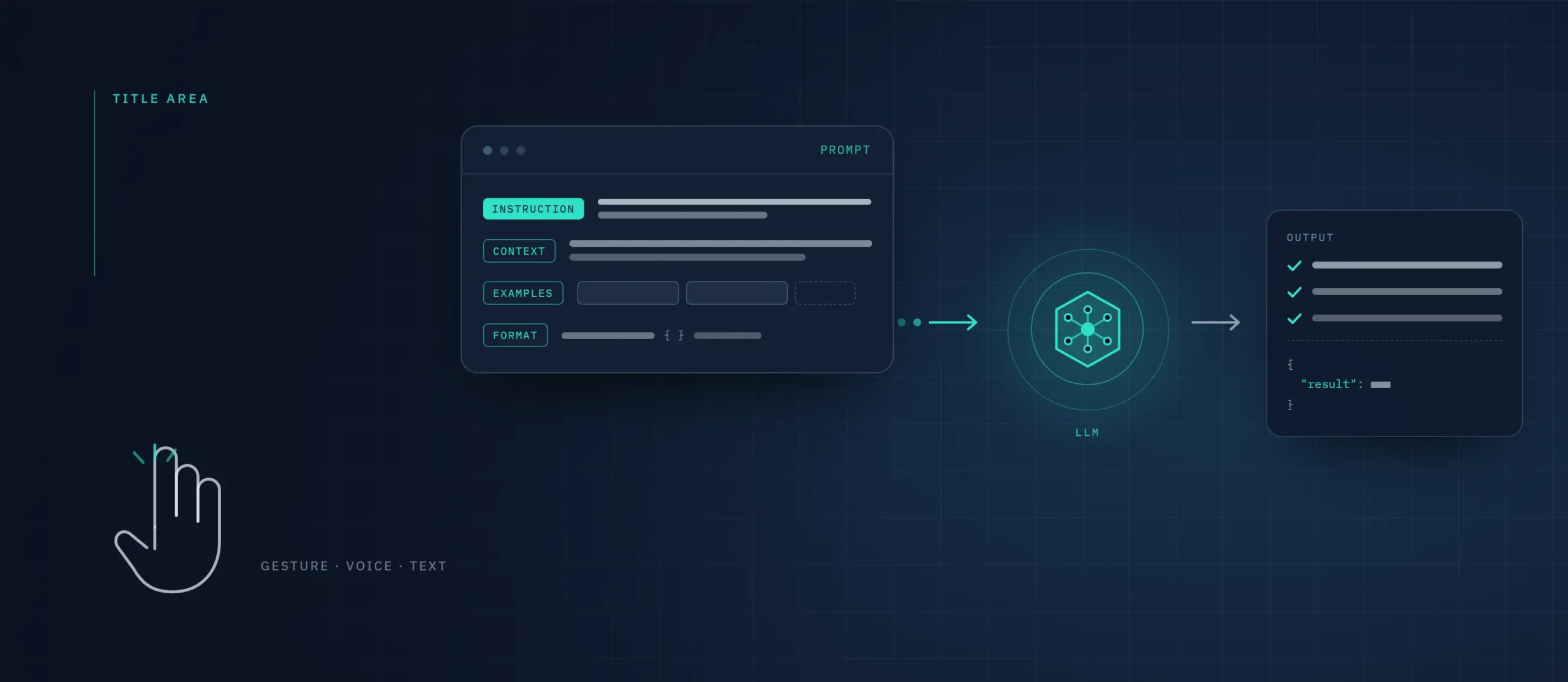
- Instruction: the task, stated clearly (“classify each review by topic”).
- Context: the background the model needs (the reviews, the categories, the audience).
- Examples: one or more samples of the output you want, to anchor format and tone.
- Format: the exact output structure (JSON, a table, a strict word limit).
A weak prompt supplies only the instruction. A strong prompt supplies all four and adds explicit constraints. This anatomy is the foundation beneath every technique and all the prompt engineering examples that follow.
Prompt engineering techniques (the full list)
These are the prompt engineering techniques worth knowing in 2026. Each entry gives what it is, when to use it, a quick example, and its main limitation.
| Technique | Best for |
|---|---|
| Zero-shot | Simple, common tasks |
| Few-shot | Enforcing format and style |
| Role prompting | Tone, expertise, perspective |
| Structured prompting | Clarity and parsing |
| Reasoning prompting | Complex, multi-step problems |
| Self-consistency | Hard problems, accuracy |
| Retrieval-augmented (RAG) | Fact-grounded, current answers |
| ReAct | Agents that use tools |
| Prompt chaining | Long, multi-stage workflows |
| Instruction hierarchy | Priority and safety |
| Output constraints | Machine-readable output |
| Evaluation and iteration | Everything, always |
1. Zero-shot prompting. Asking the model to do a task with no examples. Use it for simple, common tasks like translation. Example: “Translate this sentence into French.” Limitation: little control over format and style, so results vary on nuanced tasks.
2. Few-shot prompting. Including two to five examples of input and desired output before the real request. Use it whenever format, tone, or labelling consistency matters; two or three good examples usually suffice. Limitation: examples consume context and can bias the model toward their exact style.
3. Role prompting. Assigning the model a persona or expertise (“act as a senior security engineer”). Use it for a specific tone, depth, or perspective. Limitation: a role shapes style but does not add real knowledge, so it is not a substitute for grounding.
4. Structured prompting. Organising the prompt with clear sections and delimiters, such as labelled headings or triple backticks around input. Use it any time the prompt mixes instructions with data. This is close to a universal best practice.
5. Reasoning prompting. Guiding the model through complex problems by asking it to decompose the task and, where useful, produce a brief reasoning summary or verification step. A 2026 note: modern reasoning models already reason internally, so the goal is not to force “think step by step” on every prompt, but to guide decomposition and self-checking. Limitation: verbose reasoning costs tokens and is unnecessary for simple tasks.
6. Self-consistency. Generating several independent answers to the same hard question and taking the majority result. Use it for high-stakes problems where a single answer is unreliable. Limitation: it multiplies cost and latency.
7. Retrieval-augmented generation (RAG). Fetching relevant documents at query time and feeding them to the model as context. Use it whenever answers must be factual, current, or specific to your data. Limitation: the answer is only as good as the retrieval.
8. ReAct (reason and act). Interleaving reasoning with actions such as searching or calling tools, so the model gathers information before answering. Use it for agents that must use tools. Limitation: it needs a tool-execution framework and careful guardrails.
9. Prompt chaining. Splitting a big task into a sequence of smaller prompts, where each step feeds the next. Use it for long workflows like “extract, then classify, then summarise.” Limitation: more moving parts to design, test, and monitor.
10. Instruction hierarchy. Separating durable rules (the system instruction) from the specific user request, so priority and safety rules always win. Use it in any production app with fixed policies. Limitation: you must design the hierarchy deliberately.
11. Output constraints. Forcing a strict output shape, such as valid JSON with named fields or an exact length. Use it any time software will consume the output. Limitation: overly rigid constraints can cause truncation or distortion.
12. Evaluation and iteration. Testing prompts against real examples, scoring the results, and refining. This is what separates prompt engineering from prompt writing. Use it always, before shipping; it overlaps directly with formal LLM evaluation.
| Also read: Prompting is one side of machine intelligence. See how machines interpret images in our guides to semantic segmentation and object detection. |
A detailed prompt engineering example
Short prompts show the idea; detailed prompt engineering examples show the value. The task: turn a pile of free-text reviews into structured data an analyst can chart.
Weak prompt: “Analyse these reviews.” This produces an unstructured paragraph that no dashboard can use.
Engineered prompt: “Analyse the customer reviews below. For each review, categorise the main issue as one of: Product, Delivery, Pricing, Support, or Other. Also label sentiment as Positive, Neutral, or Negative. Return only valid JSON, one object per review, with fields: id, category, sentiment, and a summary under 12 words. Do not invent reviews. Reviews: [text].”
Sample output: [{“id”:1,“category”:“Delivery”,“sentiment”:“Negative”,“summary”:“Package arrived four days late”},{“id”:2,“category”:“Support”,“sentiment”:“Positive”,“summary”:“Agent resolved issue quickly”}]
The engineered version added a fixed category list, a second label, a strict JSON schema, a length limit, and a guardrail against hallucination. This is one of the clearest prompt engineering examples of how structure turns a vague request into production-ready output.
The Graveiens AI Prompt Quality Framework
Over many labelling and evaluation projects, we use a simple, repeatable framework to build prompts that hold up in production: Define, Context, Examples, Constraints, Output, Evaluate, Iterate.
- Define: the exact task and what a good answer looks like.
- Context: supply the background, data, and audience the model needs.
- Examples: show one to five samples of the desired output.
- Constraints: state the rules, limits, and things to avoid.
- Output: specify the precise format the answer must take.
- Evaluate: score the prompt against real, labelled examples.
- Iterate: change one variable at a time and re-measure.
The first five steps are prompt design; the last two are what make it engineering. This framework is model-agnostic and mirrors the disciplined review process our expert workforce uses on client data.
Prompt engineering vs prompt writing
| Prompt writing | Prompt engineering |
|---|---|
| Writing one-off instructions | Designing repeatable, reusable instructions |
| Focuses on wording | Focuses on measurable performance |
| Usually manual and ad hoc | Tested systematically against examples |
| Solves one task | Powers production workflows at scale |
| Little or no evaluation | Evaluation and iteration built in |
Prompt writing is a useful everyday skill. Prompt engineering is an engineering process: it treats the prompt as a component to be specified, tested, and improved. The difference is evaluation. If you are not measuring whether a change helped, you are writing prompts, not engineering them.
Prompt engineering vs context engineering vs AI system engineering
Prompt engineering designs the instruction. Context engineering designs everything the model sees around that instruction. AI system engineering designs the whole application in which the model runs. In a modern 2026 production system, behaviour is shaped by many parts at once:
- the prompt and system instructions,
- retrieved documents (RAG),
- tools the model can call,
- conversation history and memory,
- structured output schemas,
- evaluations and test sets, and guardrails for safety.
This does not make prompt engineering obsolete; it makes it the foundation of a larger stack. Much of that reliability still traces back to the quality of the model itself, which depends on RLHF and fine-tuning data.
Prompt enhancers and tools
A prompt enhancer is a tool that automatically rewrites a rough prompt into a stronger one, adding a role, context, examples, and an output format before the request reaches the model. Built-in “improve prompt” buttons, browser extensions, and meta-prompts are all forms of prompt enhancer. It is a fast on-ramp for beginners, but a draft tool, not a final answer: it cannot know context it was never given, and for high-stakes work the enhanced prompt should still be reviewed and evaluated.
Multimodal and gestural prompts
Prompts are no longer only text. Multimodal models accept images, audio, and video, so a photo or a spoken sentence can be a prompt. One emerging form is the gestural prompt, where a gesture such as pointing instructs a wearable or embodied AI system instead of typed text. Reading a gestural prompt reliably depends on training the model on real first-person footage, which is why consent-backed egocentric video data collection matters for multimodal prompt engineering. Multimodal prompts widen what counts as a prompt, but they still rest on high-quality computer vision data.
| Also read: Curious how machines recognise people and faces? Our guide to how facial recognition works explains the pixel-level pipeline behind visual AI. |
How to become a prompt engineer: skills and career
If you are wondering how to become a prompt engineer, focus on what employers actually screen for, not on memorising clever phrases. The high-value skills are:
- LLM fundamentals: tokens, context windows, temperature, and how models are trained.
- Prompt design: the techniques and framework above, applied to real tasks.
- An API or scripting language: usually Python, to run prompts programmatically.
- RAG: retrieving and grounding answers in your own data.
- Evaluation: building test sets and measuring prompt performance.
- Data analysis and model testing: reading results and diagnosing failures.
- AI safety and guardrails: keeping outputs reliable and appropriate.
- Domain knowledge: legal, healthcare, or code expertise that makes prompts precise.
A practical path is to learn how to become a prompt engineer by mastering the fundamentals, building a documented portfolio of tested prompt engineering examples, then specialising in a domain. The role increasingly blends prompting with software, data, and evaluation skills, so learning how to become a prompt engineer today really means learning to design and test AI behaviour. A grounding in natural language processing accelerates the journey.
Frequently asked questions
Q. What is prompt engineering in simple terms?
A. It is the process of designing, testing, and refining instructions for an AI model so it returns accurate and consistent output, then measuring and improving those instructions.
Q. What does a prompt engineer do?
A. A prompt engineer builds and evaluates reusable prompts, context, and tools for AI systems. The job is less about clever wording and more about designing instructions, testing them against real examples, and iterating.
Q. What are the main prompt engineering techniques?
A. Zero-shot, few-shot, role, structured, reasoning, self-consistency, RAG, ReAct, prompt chaining, instruction hierarchy, output constraints, and evaluation. Few-shot controls format, RAG grounds answers, and evaluation makes it engineering.
Q. Can you give a prompt engineering example?
A. A weak prompt says “analyse these reviews.” A strong one says “categorise each review as Product, Delivery, Pricing, Support, or Other, label sentiment, and return valid JSON with id, category, sentiment, and a summary under 12 words.”
Q. What skills do you need to become a prompt engineer?
A. LLM fundamentals, prompt design, an API or scripting language such as Python, RAG, evaluation, data analysis, AI-safety awareness, and domain knowledge in your field.
Q. Is prompt engineering still relevant in 2026?
A. Yes. It has evolved from a standalone job into a baseline skill that sits inside the broader disciplines of context engineering and AI system engineering.
Q. What is the difference between prompt engineering and prompt writing?
A. Prompt writing is crafting one-off instructions by hand. Prompt engineering designs reusable prompts and measures their performance against examples. The defining difference is systematic evaluation.
Conclusion
So, what is prompt engineering? It is the disciplined process of designing, testing, and refining AI instructions, using prompt engineering techniques from few-shot to RAG, learned through real prompt engineering examples, guided by a repeatable framework, and measured through evaluation. In 2026 it has grown into the foundation of context engineering and full AI system design. The deeper truth is that prompts sit on top of models, and models sit on top of data, so the most reliable path to great output still runs through great training data.
| Building or fine-tuning an AI model?Talk to the Graveiens AI team about the annotation, RLHF, and evaluation data behind models that respond well to every prompt. graveiensai.com/contact-us |
Sources: The Prompt Report (arXiv survey); Wei et al., Chain-of-Thought (arXiv); IBM, chain-of-thought prompting; OpenAI prompt engineering guide; Prompting Guide.

Jitendra Choubay is the CEO & Founder of Graveiens AI, leading a human-in-the-loop data services team that helps AI builders with data collection, annotation, consent-backed voice data, transcription and LLM fine-tuning. He writes on building better, ethically sourced AI training data.
Get the next Graveiens AI article
Expert notes on AI data, annotation, LLMs and eLearning — no spam, unsubscribe anytime.
Need AI Development? Data Annotation? eLearning?
Talk to Graveiens AI about data collection, annotation, voice data, RLHF/SFT, LLM evaluation and AI training data — invoiced only on approved work.
Contact Graveiens AI