Instruction tuning is a form of supervised fine-tuning that trains a pretrained language model on instruction-and-response examples so it learns to follow natural-language commands. It teaches the model how to respond to instructions, rather than simply predicting the next token from general web or text data.
In other words, instruction tuning is the step that turns a raw foundation model, which is a strong pattern predictor, into a helpful assistant that does what you ask. Base models like the pretrained versions of GPT, Llama, or Gemini understand language deeply but do not naturally follow instructions. Instruction tuning fixes that by training the model on many examples such as “Summarise this paragraph” paired with a good summary. After this step, the model generalises to new instructions it has never seen.
Instruction tuning at a glance
| Question | Short answer |
|---|---|
| What is instruction tuning? | A form of supervised fine-tuning on instruction-and-response pairs so a model follows commands. |
| Is it the same as supervised fine-tuning? | Instruction tuning is supervised fine-tuning (SFT) done with instruction-formatted data. |
| Why does it matter? | It turns a raw text predictor into a usable, instruction-following assistant. |
| Where does it sit? | Between pretraining and preference optimization such as RLHF. |
| What does it need? | A high-quality, diverse dataset of labelled instruction-response examples. |
What is instruction tuning?
To answer what is instruction tuning precisely: it is supervised training in which a pretrained language model is further trained on a curated set of tasks, each described in natural language, so it learns the general skill of instruction-following rather than a single narrow task. The training data is a collection of instruction-response pairs, often written as an instruction, an optional input, and a desired output.
The reason this works is generalisation. When a model sees many varied instructions during training, from summarizing to classifying to writing code, it does not just memorise those tasks; it learns the underlying behavior of reading an instruction and producing a suitable response. This is closely related to zero-shot and few-shot learning: a well instruction-tuned model can handle prompts it never saw in training.
Instruction tuning is a core service in the wider practice of LLM fine-tuning and modern generative AI. It is the bridge between a model that can predict text and a model that can be told what to do.
| Also read: If you are new to the underlying technology, our explainer on what an LLM is covers how large language models work before they are tuned. |
How instruction tuning works
At a mechanical level, instruction tuning is standard supervised fine-tuning applied to a specific kind of data. The workflow has four stages.
1. Start with a pretrained model that already understands language from large-scale pretraining.
2. Assemble an instruction dataset of examples, each pairing a natural-language instruction (and any input) with a high-quality target response.
3. Fine-tune the model on these pairs so its output matches the target responses. To save compute, teams often use parameter-efficient methods such as LoRA and other PEFT techniques instead of updating every weight.
4. Evaluate the tuned model on held-out instructions to confirm it generalises.
The quality of the instruction dataset is one of the most important factors determining how well the tuned model performs. The model learns to imitate the responses it is shown, so if the examples are accurate, diverse, and well written, the model becomes helpful. This is why disciplined data annotation and expert review sit at the heart of every successful instruction-tuning project.
An instruction tuning example
A single training example makes the idea concrete. Each example usually has three parts: an instruction, an optional input, and the ideal response the model should learn to produce.
Instruction: “Summarise the following customer complaint in one sentence.”
Input: “I ordered a laptop stand on the 3rd, paid for express delivery, and it still had not arrived by the 12th. Support did not reply to two emails, and I want a refund on the shipping at least.”
Ideal response: “The customer wants a shipping refund after a paid express order arrived nine days late with no support reply.”
During training, the model sees thousands or even millions of examples like this, across many task types, and learns the general behaviour of reading an instruction and returning the kind of answer the examples demonstrate. Every response in the dataset must be correct and consistently formatted. Producing these human demonstrations at scale, written and reviewed by skilled people, is exactly what our expert workforce does.
Instruction tuning vs supervised fine-tuning
Supervised fine-tuning (SFT) is the general method of training a model on labelled input-output pairs. Instruction tuning is supervised fine-tuning where those pairs are formatted as instructions across many different tasks. In everyday use, the two terms are often used interchangeably, and that is usually fine.
| Supervised fine-tuning (SFT) | Instruction tuning | |
|---|---|---|
| What it is | The method: training on labelled pairs | A purpose: SFT using instruction data |
| Data | Any labelled examples for a task | Diverse instruction-and-response pairs |
| Goal | Improve performance on target tasks | Teach general instruction-following |
| Scope | Can be one narrow task | Deliberately many tasks |
| Relationship | The broader category | A specific application of SFT |
Put simply, all instruction tuning is SFT, but not all SFT is instruction tuning. You use instruction tuning when you want the model to follow open-ended instructions in general. Because the mechanics are the same, teams that deliver supervised fine-tuning data can deliver instruction-tuning data with the same pipeline, which is how our LLM fine-tuning programmes are structured.
Instruction tuning vs fine-tuning vs prompt engineering
It helps to place instruction tuning alongside the other ways of shaping a model. Each one changes something different, at a different point in a model life.
| Method | When it happens | What changes | Main purpose |
|---|---|---|---|
| Pretraining | Before deployment | Model weights | Learn language and world patterns |
| Instruction tuning | Training (post-training) | Model weights | Teach the model to follow instructions |
| Fine-tuning | Training | Model weights | Adapt to specific tasks or domains |
| Prompt engineering | Inference (run time) | Prompt and context | Guide the output of a trained model |
| RLHF / preference optimization | Post-training | Behaviour and weights | Align responses with human preferences |
The key distinction is when each method acts. Instruction tuning and fine-tuning change the model weights during training, while prompt engineering changes only the input at run time. That is why the two are complementary: a well instruction-tuned model still benefits from good prompts. For the run-time side, see our guide to what prompt engineering is.
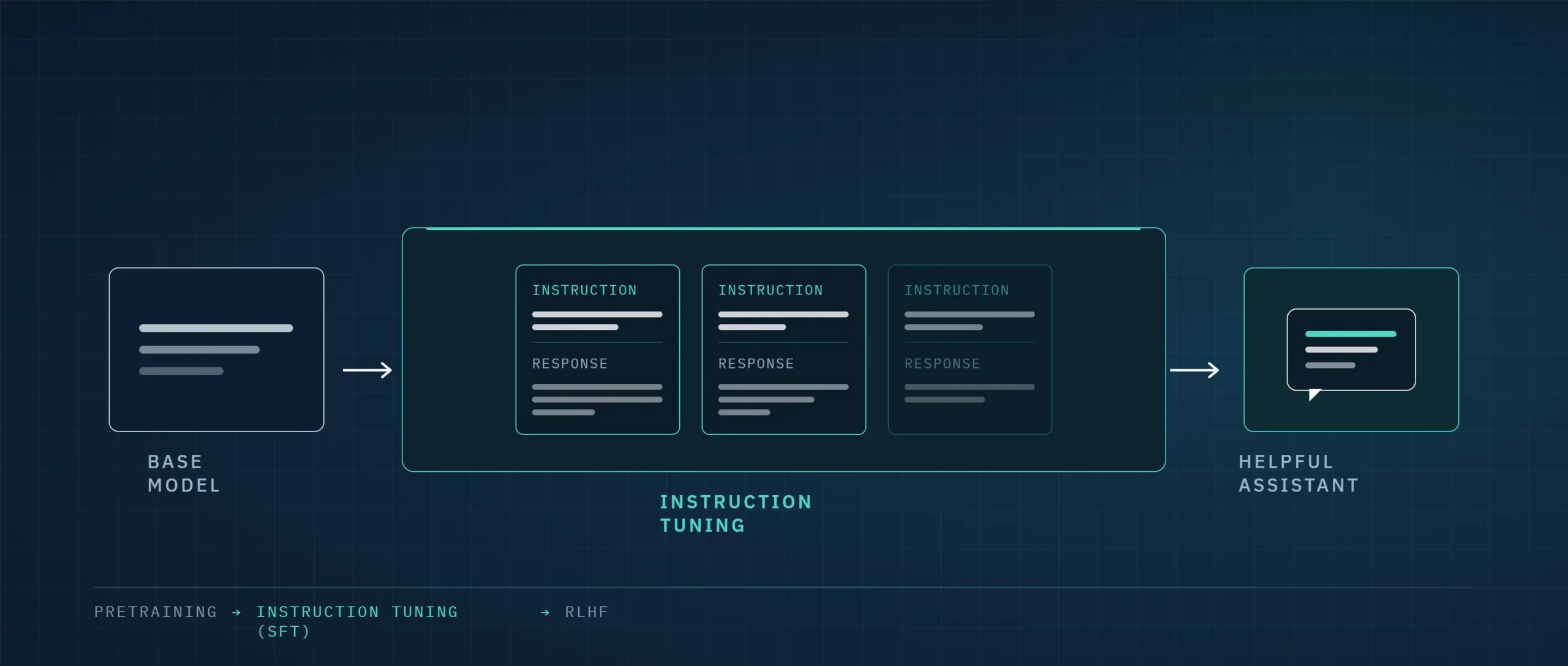
Where instruction tuning sits: pretraining, SFT, RLHF
1. Pretraining: the model learns language and world knowledge from a massive text corpus. It can predict text but does not reliably follow instructions.
2. Instruction tuning (SFT): the model is fine-tuned on instruction-response pairs and learns to follow commands. It is now genuinely useful.
3. RLHF and preference optimization: the model is refined using human preference data so its answers are more helpful, safe, and aligned with what people want.
An important point often missed: instruction tuning alone gets you surprisingly far. Many instruction-following models use supervised instruction tuning as an important post-training stage, with additional preference optimization or reinforcement-learning-based methods such as RLHF applied in some training pipelines. Landmark systems show the pattern: Google FLAN demonstrated that instruction tuning across many tasks sharply improves zero-shot generalisation, while OpenAI InstructGPT combined supervised instruction tuning with RLHF and became the direct ancestor of ChatGPT. Evaluating each stage requires structured LLM evaluation.
Why instruction tuning matters
- Usability: it turns a raw text predictor into an assistant that follows instructions.
- Generalisation: a model tuned on diverse tasks handles new, unseen instructions.
- Control: it lets teams shape tone, format, safety behaviour, and domain focus.
- Efficiency: far cheaper than pretraining from scratch, especially with PEFT methods like LoRA that tune only a small fraction of the weights.
- Customisation: organisations can instruction-tune an open model on their own tasks to build a private assistant.
For many teams, instruction tuning can be a cost-effective way to adapt a capable base model, particularly when combined with retrieval, evaluation, and appropriate preference-optimization methods. It is also a common foundation for domain assistants in healthcare, finance, and law, where precise instruction-following matters most.
Instruction tuning benefits and limitations
The benefits above are real, but a balanced view matters. Instruction tuning has clear limitations that every team should plan for:
- It does not automatically add new factual knowledge. Tuning teaches behaviour, not facts; new knowledge usually comes from pretraining or retrieval.
- Poor training data teaches undesirable behaviours. The model faithfully copies mistakes, biases, and bad formatting in its examples.
- Over-specialisation can reduce general ability. Tuning too narrowly can make a model worse at tasks outside the training set.
- More data is not automatically better. A smaller, cleaner, more diverse set often beats a large, noisy one.
- Evaluation is required. Without a held-out test set you cannot confirm that tuning actually helped.
- It does not eliminate hallucinations. The model can still produce confident, incorrect answers.
Understanding these limits is part of answering what is instruction tuning honestly, and it separates a realistic plan from an over-optimistic one, which is why disciplined evaluation is built into every serious project.
Instruction tuning datasets
Because the model imitates its training data, the dataset is the product. Instruction tuning depends on several kinds of data:
- Instruction-response datasets: the core (instruction, input, output) examples used for supervised fine-tuning.
- Human-written demonstrations: expert answers that show the model exactly how to respond.
- Domain-specific instruction data: examples in your field (clinical, legal, code) for specialised assistants.
- RLHF preference datasets: rankings of competing responses, used in the later alignment stage.
Instruction tuning is not limited to text, either. Multimodal models are instruction-tuned on image‑, audio‑, or video-and-response pairs, and first-person sources such as egocentric video data are increasingly used to teach models to follow instructions grounded in what a person sees and does.
It also helps to think about the types of instruction data by what each one teaches the model:
| Data type | Purpose |
|---|---|
| Single-turn instructions | Basic instruction following |
| Multi-turn conversations | Context retention and dialogue |
| Domain-specific instructions | Specialised knowledge and tasks |
| Reasoning examples | Structured, step-by-step problem solving |
| Safety examples | Appropriate refusal and safe behaviour |
| Preference pairs | Later preference optimisation (RLHF) |
A strong instruction-tuning dataset shares a few properties, in this order of priority:
1. Diversity: many task types, phrasings, and domains, so the model generalises.
2. Quality: accurate, well-written target responses, reviewed by qualified people.
3. Consistency: a clear format and labelling standard applied across every example.
4. Coverage: examples for the edge cases and behaviours you actually care about.
5. Safety: examples that teach the model to handle sensitive requests appropriately.
Assembling this requires careful data collection, skilled writers and annotators, a clear guideline, and a multi-stage quality-assurance and dataset-evaluation process. At Graveiens AI, we deliver consent-backed data, expert-written demonstrations, RLHF preference data, and rigorous evaluation, through a four-stage workflow certified to ISO 9001:2017. See how our process works or read why AI teams choose Graveiens AI.
Common challenges and best practices
- Overfitting to narrow data: too few task types means the model follows instructions only in those patterns. Fix it with deliberate diversity.
- Inconsistent labelling: mixed formats teach mixed signals. Fix it with a clear guideline and review, supported by strong NLP expertise.
- Quality over quantity: a smaller set of excellent, diverse examples usually beats a huge, noisy one.
- Weak evaluation: without a held-out test set, you cannot tell whether tuning helped. Always measure against unseen instructions.
The through-line is simple: the discipline of the dataset determines the quality of the model. Teams that treat instruction tuning as a data problem, not just a training run, get far better results.
Frequently asked questions
Q. What is instruction tuning in simple terms?
A. A form of supervised fine-tuning that trains a pretrained language model on examples of instructions paired with correct responses, so it learns to follow natural-language commands. It turns a raw text predictor into a helpful assistant.
Q. Is instruction tuning the same as supervised fine-tuning?
A. They are closely related and often used interchangeably. Supervised fine-tuning is the general method of training on labelled input-output pairs; instruction tuning is SFT done with instruction-formatted data across many tasks.
Q. What is the difference between instruction tuning and RLHF?
A. Instruction tuning teaches a model to follow instructions using demonstrations of correct responses. RLHF and other preference-optimization methods then refine the model using human preference data. Instruction tuning usually comes first.
Q. What is the difference between instruction tuning and fine-tuning?
A. Fine-tuning is any further training of a pretrained model. Instruction tuning is a specific kind of fine-tuning that uses instruction-formatted data across many tasks to teach general instruction-following, rather than adapting to one narrow task.
Q. What data do you need for instruction tuning?
A. A diverse, high-quality dataset of instruction-and-response pairs, written and reviewed by skilled people, with consistent formatting and coverage of the behaviours and edge cases you care about.
Q. Can I instruction-tune an open-source model?
A. Yes. Open models such as Llama can be instruction-tuned on your own dataset, often efficiently with LoRA or other PEFT methods. Quality depends almost entirely on the instruction data you provide.
Q. Does instruction tuning replace prompt engineering?
A. No. Instruction tuning changes the model at training time; prompt engineering shapes behaviour at run time. They are complementary, and well-tuned models still benefit from good prompts.
Conclusion
So, what is instruction tuning? It is a form of supervised fine-tuning that trains a pretrained model on instruction-and-response pairs so it learns to follow commands. It sits between pretraining and alignment methods like RLHF, and it is the moment a raw language model becomes a useful assistant.
Instruction tuning is one of the most important post-training techniques for turning a pretrained language model into an instruction-following system. By training on diverse, high-quality instruction-response data, teams can improve usability, consistency, and task performance without training a foundation model from scratch. The deeper lesson is consistent across all of AI: the model learns from its data, which is why the collection, writing, and review of high-quality instruction data is the real determinant of success.
| Building or fine-tuning an AI model?Talk to the Graveiens AI team about the instruction-tuning, supervised fine-tuning, and RLHF datasets behind models that follow instructions reliably. graveiensai.com/contact-us |
Sources: Nathan Lambert, RLHF Book (instruction fine-tuning); Wei et al., FLAN (arXiv); Ouyang et al., InstructGPT (arXiv); IBM, instruction tuning explained.

Jitendra Choubay is the CEO & Founder of Graveiens AI, leading a human-in-the-loop data services team that helps AI builders with data collection, annotation, consent-backed voice data, transcription and LLM fine-tuning. He writes on building better, ethically sourced AI training data.
Get the next Graveiens AI article
Expert notes on AI data, annotation, LLMs and eLearning — no spam, unsubscribe anytime.
Need AI Development? Data Annotation? eLearning?
Talk to Graveiens AI about data collection, annotation, voice data, RLHF/SFT, LLM evaluation and AI training data — invoiced only on approved work.
Contact Graveiens AI