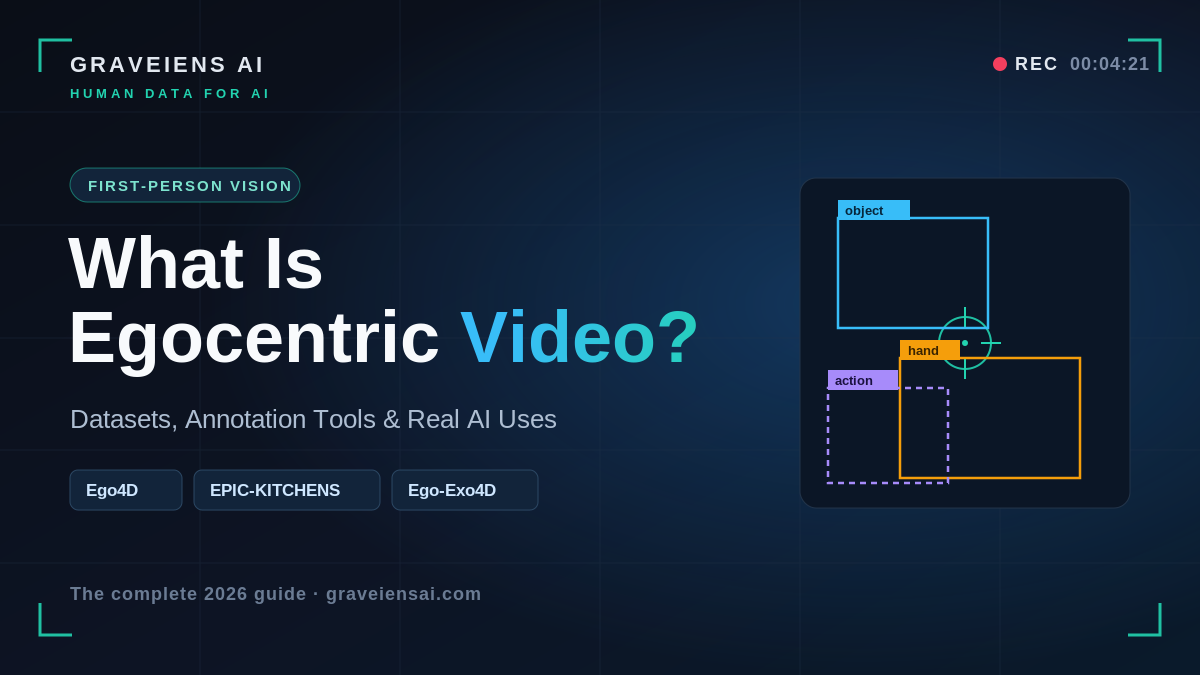
Quick answer: Egocentric video is firstperson footage captured by a wearable camera mounted on the head, chest or smart glasses, recording the world from the wearer’s own point of view. Because it captures real task demonstration videos, it has become core embodied AI training data for augmented reality, robotics, healthcare and assistive tech. The best egocentric video datasets today are Ego4D, EPICKITCHENS100 and EgoExo4D, and teams label this footage with tools such as CVAT, ELAN, VGG VIA and Encord, usually supported by an expert human int heloop workforce.
So, what is egocentric video, and why is it suddenly everywhere First personon AI has moved from a research curiosity to one of the most important frontiers in machine learning, and the reason is a wave of hardware and models that all see the world the way a person does. Consumer AR glasses from Meta, RayBan and others put a camera on millions of faces; humanoid and manipulation robots need to learn dexterous skills from human demonstrations; and visionlanguageaction (VLA) models, the fastgrowing class of systems that turn what a robot sees and is told into physical movement, are hungry for exactly this kind of data. None of these can be trained well on the fixed, thirdperson footage that dominated computer vision for a decade.
That shift is why egocentric video matters now. A robot that has to pick up a cup, a headset that has to guide you through a repair, or an assistant that has to understand your kitchen all need to learn from the first person perspective, complete with the hands, gaze and natural task sequencing that only a wearable camera captures. This guide explains what egocentric video is, why it matters, the datasets that define the field, the annotation tools practitioners rely on, the lessons we have learned labeling firstperson footage at scale, and how highquality egocentric datasets are actually collected and delivered.
What is egocentric video?
To answer what “egocentric video precisely: egocentric video (also called firstperson vision or FPV) is video recorded from the wearer’s point of view using a bodyworn camera, so the frame naturally approximates the person’s own field of view. Instead of watching a subject from the outside, the camera moves with the person, capturing their hands, the objects they manipulate and the task unfolding in front of them.
This is the opposite of the traditional setup in computer vision. Most classic training data is exocentric, meaning it is filmed by a fixed thirdperson camera watching a scene from a distance. Egocentric video flips the perspective: the camera is the eyes. Devices commonly used to capture it include GoPro action cameras, Meta and RayBan smart glasses, Microsoft HoloLens, and research rigs like Meta’s Project Aria glasses.
Because the footage tracks attention, motion and intent, it is uniquely valuable for teaching machines how people accomplish real tasks. The tradeoff is that firstperson footage is genuinely difficult to work with, which is why specialized video annotation services and structured data pipelines matter so much for this modality.
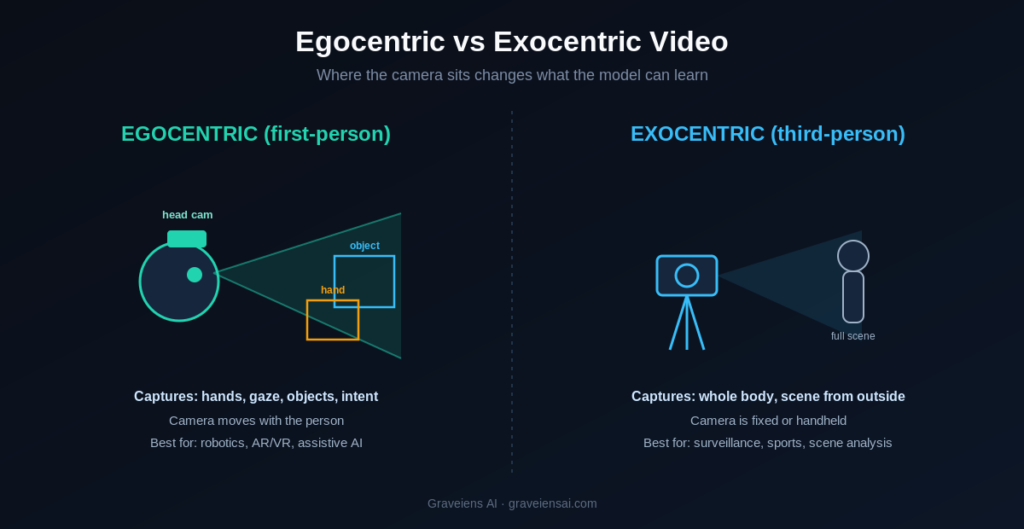
Egocentric vs exocentric video: the key difference
| Aspect | Egocentric (first-person) | Exocentric (third-person) |
| Camera position | Worn on head, chest or glasses | Fixed or handheld, watching from outside |
| What it captures | Hands, gaze, objects, intent | Full body and scene from a distance |
| Camera motion | Constant, tied to head and body movement | Usually stable |
| Best for | AR/VR, robotics, assistive AI, skill learning | Surveillance, sports broadcast, scene analysis |
| Annotation difficulty | High: motion blur, occlusion, action sequences | Moderate: often static, frame-by-frame |
How egocentric video is captured
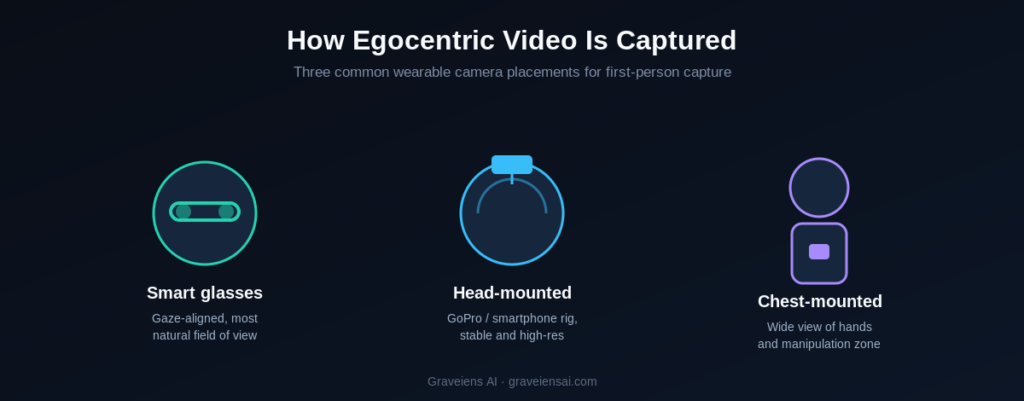
A practical part of what is egocentric video is simply how it is recorded. Egocentric footage is captured with a wearable camera placed where it best approximates the wearer’s view. The three common placements are smart glasses, which give the most gazealigned field of view; headmounted GoPro or smartphone rigs, which are stable and highresolution; and chest mounts, which give a wide view of the hands and the manipulation zone. The choice affects everything downstream, from how much of the hands are visible to how badly the footage shakes.
Why egocentric video matters for AI in 2026
Knowing what is egocentric video is only half the picture; the other half is why it matters. Egocentric video is the training signal behind a new generation of AI systems that operate in the physical world. Because it records genuine human behavior from the inside, it teaches models the sequence of actions, handobject interactions and context that thirdperson footage simply cannot show. Four use cases are driving most of the demand.Egocentric video is the training signal behind a new generation of AI systems that operate in the physical world. Because it records genuine human behavior from the inside, it teaches models the sequence of actions, hand-object interactions and context that third-person footage simply cannot show. Four use cases are driving most of the demand.
Augmented and virtual reality
AR and VR is the most visible use case. Smart glasses and headsets need to recognize objects, understand what the wearer is doing and offer timely help, all of which depend on first-person perception models. Teams building for this space often pair egocentric datasets with wider AR and VR data services to cover 3D, depth and scene understanding.
Robotics and embodied AI
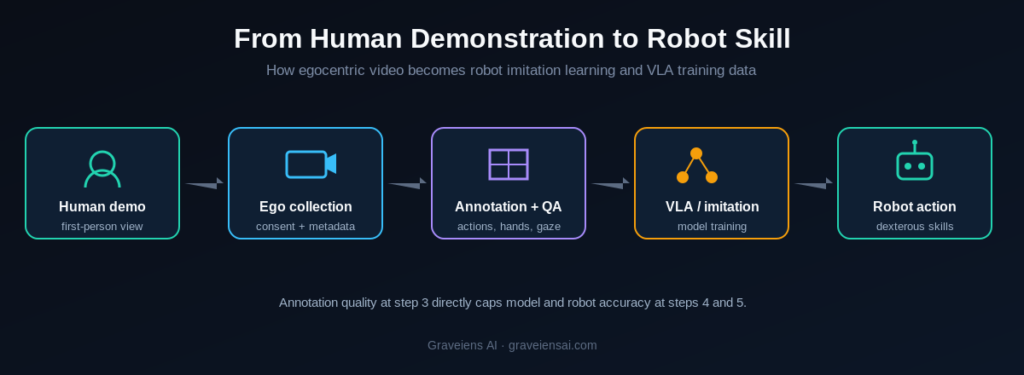
Robotics is where demand is growing fastest. Humanoid and manipulation robots learn dexterous skills far faster from robot imitation learning data, which is essentially task demonstration videos captured from a firstperson view where the perspective roughly matches what an endeffector camera sees. The same footage is now core embodied AI training data and a key source of VLA model training data for the visionlanguageaction systems that map what a robot sees and is told into physical action. Sourcing it at scale is its own discipline, which is why teams turn to managed egocentric video data collection paired with structured computer vision data labeling of grasps, contact points and action steps.
Healthcare and daily-living support
Healthcare and assistive technology form a third pillar. Firstperson footage underpins activities of daily living datasets used to monitor hand use during rehabilitation, support people with low vision, and build memory aids that recall where objects were last seen. The naturalistic, inhome nature of an activities of daily living dataset makes it far more representative than labstaged clips.
Automotive and driver monitoring
Automotive teams use incabin and driverfacing firstperson data for monitoring, distraction detection and safety, an area that overlaps with ADAS and autonomous programs and sensor fusion and LiDAR work.
Best egocentric video datasets
The best egocentric video datasets are Ego4D, EPICKITCHENS100 and EgoExo4D, complemented by newer sets like HDEPIC and specialist collections such as HoloAssist and EGTEA Gaze+. Rather than converging on a single dataset, the field has settled into a stack where each dataset contributes a different layer of firstperson understanding.
A big part of answering what is egocentric video in 2026 is knowing which datasets define it. Below is a practical comparison of the datasets most teams evaluate first.
| Dataset | Scale | What makes it useful | Origin |
| Ego4D | 3,670 hours, 923 camera wearers, 74 locations, 9 countries | Massive, diverse dailylife video with five benchmark tasks including episodic memory and handobject interaction | Meta AI and a global consortium |
| EPICKITCHENS100 | 100 hours, ~90,000 action segments, 45 kitchens | Densely annotated cooking activity with 97 verbs and 300 nouns; a gold standard for action recognition | University of Bristol and partners |
| EgoExo4D | 1,286 hours, 740 participants, 13 cities | Paired first- and thirdperson capture of skilled activities such as sports, music and repair, with gaze and 3D data | Meta AI and 15 universities |
| HDEPIC | Highly detailed kitchen subset (2025) | Finegrained, dense multimodal annotations for detailed kitchen understanding | EPICKITCHENS team |
| EGTEA Gaze+ / HoloAssist | Focused, taskspecific sets | Gaze tracking and interactive assistance scenarios | Academic and industry labs |
Ego4D
Ego4D is the largest and most influential egocentric dataset, with 3,670 hours of unscripted dailylife video collected by 923 unique participants across 74 locations in 9 countries. Portions include audio, eye gaze, 3D meshes, stereo and synchronized multicamera capture. Its five benchmark tasks, spanning episodic memory, hands and objects, audiovisual diarization, social interaction and forecasting, gave the research community a shared way to measure firstperson understanding.
EPICKITCHENS100
EPICKITCHENS100 is the most densely annotated egocentric action dataset, with 100 hours of headmounted GoPro footage recorded in 45 kitchens across several countries. It contains roughly 90,000 action segments and 20 million frames, labeled with 97 verb classes and 300 noun classes at 1080p and 50 fps. Its rich, temporally precise labels made it the benchmark of choice for action recognition and anticipation.
EgoExo4D
EgoExo4D is the goto dataset for skilled activity understanding, pairing simultaneously captured firstperson and thirdperson video of tasks like cooking, sports, dance, music and bike repair. It spans 1,286 hours from 740 participants across 13 cities, with multichannel audio, eye gaze, 3D point clouds, camera poses, IMU data and multiple paired language descriptions, making it ideal for research that links what a person sees to how an expert performs.
Egocentric video annotation tools
Once you understand what is egocentric video, the next practical question is which tools label it. The mostused egocentric video annotation tools are CVAT, ELAN, VGG VIA (the VGG Image Annotator), Encord, Label Studio, Supervisely and V7. The right choice depends on whether you need bounding boxes and object tracking, temporal action labels, gaze and handcontact annotation, or a managed platform for large teams.
Egocentric footage is harder to annotate than standard video, and the tooling has to account for that. Rapid camera motion, motion blur, partial occlusion of the wearer’s own hands, and the need to label actions and intent as an unfolding sequence all slow annotation down and make consistency across annotators difficult. A thirdperson clip can often be labeled frame by frame as a static scene, while a firstperson clip has to be read as a continuous action.
| Tool | Type | Best for | Notes |
| CVAT | Open source | Bounding boxes, polygons, skeletons, object tracking with interpolation | Widely used, built by Intel, strong for spatial labels |
| ELAN | Open source | Temporal and multitier annotation of actions and speech | Popular in academia for timealigned behavior labeling |
| VGG VIA | Open source, lightweight | Quick image and frame annotation with no install | Runs in the browser, good for small or pilot projects |
| Label Studio | Open source | Flexible multimodal labeling across video, audio and text | Configurable interfaces for custom ontologies |
| Encord | Commercial platform | Temporal annotation at scale with AIassisted tracking | Native video rendering and curation for large ego datasets |
| Supervisely / V7 | Commercial platforms | Team workflows, automation and QA at scale | Strong for production pipelines and review loops |
Tools handle the mechanics of labeling, but they do not solve the harder problem: consistent, accurate judgments on ambiguous firstperson frames. That is why most production programs combine a capable tool with a trained, wellmanaged annotation team and a structured review process. If you want a deeper primer, our full guide to data annotation and labeling breaks down each annotation type across modalities.
What we have learned labeling firstperson footage at scale
Most explanations of what is egocentric video stop at definitions. The harder, more useful knowledge comes from actually annotating firstperson video in production, where the failure modes are specific and repeatable. These are the patterns our annotation team runs into most often, and how we design around them.
Inconsistent actionboundary labeling is the number one quality problem
The single biggest quality issue we see in egocentric projects is inconsistent actionboundary labeling. Two skilled annotators will frequently disagree on the exact frame where an action such as “pick up the knife” begins and ends, because in firstperson footage the hand reaches, hesitates and adjusts before the true grasp. Left unmanaged, this disagreement injects temporal noise that directly hurts actionrecognition and forecasting models. We reduce it by defining boundary rules up front, for example anchoring the start of a manipulation action to first handobject contact, and then measuring interannotator agreement before footage ever reaches a client.
Selfocclusion and handobject overlap break naive labeling
In firstperson video the wearer’s own hands constantly occlude the objects they are using, and one hand hides the other during twohanded tasks. Annotators who treat each frame as an independent image will produce jumpy, contradictory labels across a sequence. The fix is to label the clip as a continuous action and carry object identity through the occluded frames, which requires interpolationaware tooling and reviewers who understand the task, not just the pixels.
Gaze and attention do not always match the crosshair
Where the camera points is not always where the person is attending. A cook may be looking at a pan while their hands work a cutting board just below the frame. When a project needs gaze or intent labels, we treat attention as a separate annotation layer rather than assuming it equals the center of the frame, which prevents a whole class of mislabeled intent.
Motion blur and dropped frames need a triage rule
Head motion produces frames that are simply unlabelable, and forcing annotators to guess on them lowers quality everywhere. We set an explicit rule for when a frame is skipped, interpolated or flagged, so blur is handled consistently instead of being each annotator’s private decision.
How annotation quality affects robot accuracy
These issues are not cosmetic. In imitation learning and VLA training, the model copies whatever the labels say the human did, so annotation error propagates straight into robot behavior. Loose action boundaries teach a robot to start a motion too early; inconsistent object identity teaches it to confuse similar tools; mislabeled contact points teach it to grasp in the wrong place. In practice, the ceiling on a manipulation model’s realworld accuracy is set at the labeling stage, long before training begins. That is the core reason we run a fourstage review rather than a single pass.
The real production challenges are logistics, not just labels
At scale, the hardest parts of an egocentric program are often operational. Distributing, tracking and retrieving headmounted rigs across many sites is a real logistics problem. Getting explicit, documented consent from participants and bystanders in live environments is a compliance problem that most vendors underestimate. And keeping annotators calibrated over long, repetitive firstperson sequences is a qualitymanagement problem. A dependable program treats all three as firstclass parts of the pipeline, which is exactly how our egocentric video data collection service is designed.
How egocentric video is collected and annotated at scale
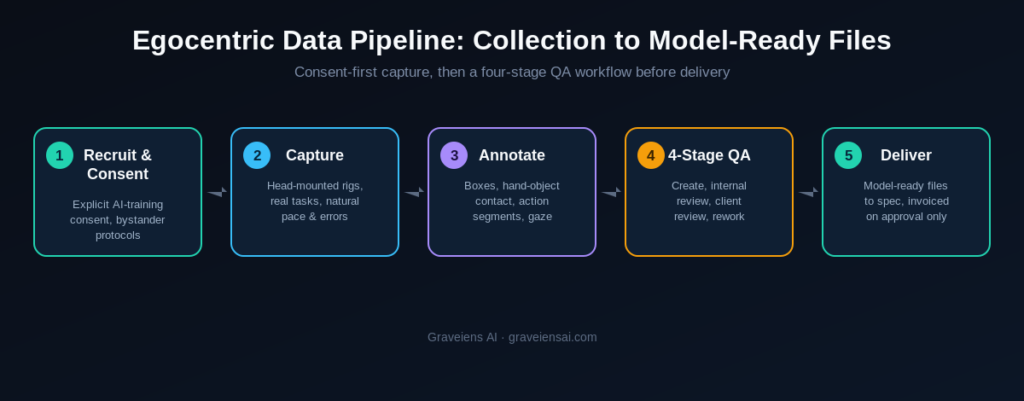
The last piece of what is egocentric video is how it actually gets made. Building a usable egocentric dataset is a pipeline, not a single step. It starts long before anyone puts on a camera and ends only after every label has passed review. Understanding the workflow helps you judge whether a dataset or a partner will actually meet your model’s needs.
Stage 1: Consentfirst wearable camera data collection
The first stage is scoped, consentfirst capture. Wearable camera data collection, usually through headmounted camera collection on smart glasses or a GoPro, records faces, homes, screens and bystanders, so provenance and consent are not optional. Wellrun programs define an ontology and capture specification up front, onboard participants with explicit consent, and tag every file with metadata so the dataset is traceable end to end. Teams that lack inhouse capture rely on managed egocentric video data collection services and broader data collection services to source participants, devices and environments to spec.
Stage 2: Annotation against a clear rubric
The second stage is annotation against a clear rubric. Annotators label the elements the model needs, such as objects and bounding boxes, handobject contact, action segments with start and end times, gaze, and naturallanguage narrations of what is happening. Because firstperson footage is ambiguous, edgecase guidelines and calibration are essential to keep different annotators consistent, especially on task demonstration videos where the exact moment an action begins matters. Programs that also need spoken narration aligned to the video bring in audio transcription at this stage.
Stage 3: Layered quality assurance
The third stage is layered quality assurance. Serious pipelines run every file through multiple review passes rather than a single labeling step. At Graveiens AI, work moves through a fourstage QA workflow of create, internal review, client review and rework, which you can see in detail on our process page. This is also where a vetted, specialized workforce of trained annotators and subject matter reviewers makes the difference between a dataset that looks finished and one that actually trains a reliable model.
Stage 4: Enrichment for multimodal models
Finally, first person understanding rarely lives on video alone. Many programs enrich egocentric datasets with human preference data and RLHF and human feedback, or with LLM evaluation when the goal is a multimodal assistant, or VLA model training data, that can reason about what the wearer is doing.
Graveiens AI by the numbers
Data quality claims are only as good as the operation behind them. These are the figures that describe our human data practice.
| Metric | Figure |
| Global clients served | 350+ |
| Inhouse experts & SMEs | 700+ |
| Data assets delivered | 2M+ |
| Languages supported | 25+ |
| Collection network | Pan India, metros to Tier‑3 |
| Real work environments covered | 10+ |
| Files traceable to signed consent | 100% |
| Quality workflow | Four stage QA (create, internal review, client review, rework) |
| Certification | ISO 9001:2017 |
| Pricing model | Invoiced only on approved deliverables |
On egocentric programs specifically, we track projectlevel quality metrics including interannotator agreement on action boundaries, postQA acceptance rate, perfile metadata completeness, and annotation throughput per reviewed hour. We report these against your acceptance criteria on every engagement, so quality is measured, not asserted.
Why teams trust Graveiens AI
Egocentric data is a high stakes, compliance sensitive modality, so it matters who produces it. Graveiens AI brings the experience, standards and trust signals that firstperson AI programs depend on.
- Experience across modalities: a human data practice spanning collection, annotation, transcription, RLHF, and evaluation, with 2M+ data assets delivered to 350+ clients.
- Subjectmatter expertise: a 700+ bench of trained annotators and STEM, medical, legal and finance SMEs, rooted in an education heritage that makes reviewers good at judgement calls, not just clicks.
- Certified quality process: an ISO 9001:2017certified, fourstage QA workflow applied to every file.
- Compliance by design: explicit participant and bystander consent, metadata tagging and a perfile audit trail, so 100% of footage is traceable to signed consent.
- Language and market reach: 25+ languages and a panIndia collection network covering metros to tier3 environments for real task and demographic diversity.
- Proven programs: representative work across voice AI, medical LLM evaluation and largescale computer vision annotation, summarized in our case studies.
Choosing a partner for egocentric video data
By this point, what is egocentric video should be clear, and the practical question becomes who should build your dataset. If you are building first person AI, the quality of your dataset will cap the quality of your model. When you evaluate a data partner for egocentric video, look for demonstrated experience with firstperson and multimodal footage, a documented quality process rather than a single labeling pass, explicit consent and compliance built into collection, and the flexibility to cover collection, annotation, transcription and evaluation under one accountable roof.
Graveiens AI is an ISO 9001:2017certified, humanintheloop data services company that runs managed egocentric video data collection across real work environments, plus pixel- and frameaccurate video annotation, multilingual transcription and expert model feedback, all invoiced only on the deliverables you approve. You can read more about our standards on the why choose us page.
Ready to build a firstperson dataset your model can trust? Book a lowrisk pilot and start with a sample batch before you commit budget.
Frequently asked questions
What is egocentric video in simple terms?
Egocentric video is footage filmed from a person’s own point of view using a wearable camera on the head, chest or smart glasses. It shows what the wearer sees and does, which is why it is used to train AI for augmented reality, robotics and assistive technology.
What is the difference between egocentric and exocentric video?
Egocentric video is captured from the wearer’s first-person perspective with a body-worn camera, while exocentric video is filmed from a third-person view by a fixed or external camera. Egocentric footage captures hands, gaze and intent; exocentric footage captures the full scene from the outside.
What are the best egocentric video datasets?
The most widely used egocentric video datasets are Ego4D, EPIC-KITCHENS-100 and Ego-Exo4D. Ego4D offers 3,670 hours of diverse daily-life video, EPIC-KITCHENS-100 provides densely annotated cooking activity, and Ego-Exo4D pairs first- and third-person capture of skilled tasks.
Which tools are used for egocentric video annotation?
Common egocentric video annotation tools include CVAT, ELAN, VGG VIA, Label Studio, Encord, Supervisely and V7. Open-source tools like CVAT and ELAN suit spatial and temporal labeling, while commercial platforms add AI-assisted tracking and large-team workflows
Which tools are used for egocentric video annotation?
Common egocentric video annotation tools include CVAT, ELAN, VGG VIA, Label Studio, Encord, Supervisely and V7. Open-source tools like CVAT and ELAN suit spatial and temporal labeling, while commercial platforms add AI-assisted tracking and large-team workflows.
How is egocentric video used in robot imitation learning?
In robot imitation learning, first-person task demonstration videos let a robot learn skills by watching how humans perform them. This egocentric footage serves as embodied AI training data and VLA model training data, teaching vision-language-action models to connect what they see and are told to physical actions.
Why is egocentric video harder to annotate than normal video?
First-person video has constant camera motion, motion blur and frequent occlusion of the wearer’s own hands, and it must be labeled as an unfolding action sequence rather than a static scene. The most common quality issue is inconsistent action-boundary labeling, which is why trained teams and multi-stage QA are essential.
What is an activities of daily living dataset?
An activities of daily living dataset captures everyday tasks such as cooking, cleaning and self-care, usually via head-mounted camera collection. It is used to train assistive and healthcare AI because it reflects natural, in-home behavior rather than staged laboratory clips.
Where can I get egocentric video annotation and data collection services?
Graveiens AI provides end-to-end egocentric video data collection and annotation services, including consent-backed wearable camera capture, frame-level annotation, transcription and expert evaluation, delivered by an ISO 9001:2017-certified, human-in-the-loop team across 25+ languages.

Jitendra Choubay is the CEO & Founder of Graveiens AI, leading a human-in-the-loop data services team that helps AI builders with data collection, annotation, consent-backed voice data, transcription and LLM fine-tuning. He writes on building better, ethically sourced AI training data.
Get the next Graveiens AI article
Expert notes on AI data, annotation, LLMs and eLearning — no spam, unsubscribe anytime.
Need AI Development? Data Annotation? eLearning?
Talk to Graveiens AI about data collection, annotation, voice data, RLHF/SFT, LLM evaluation and AI training data — invoiced only on approved work.
Contact Graveiens AI