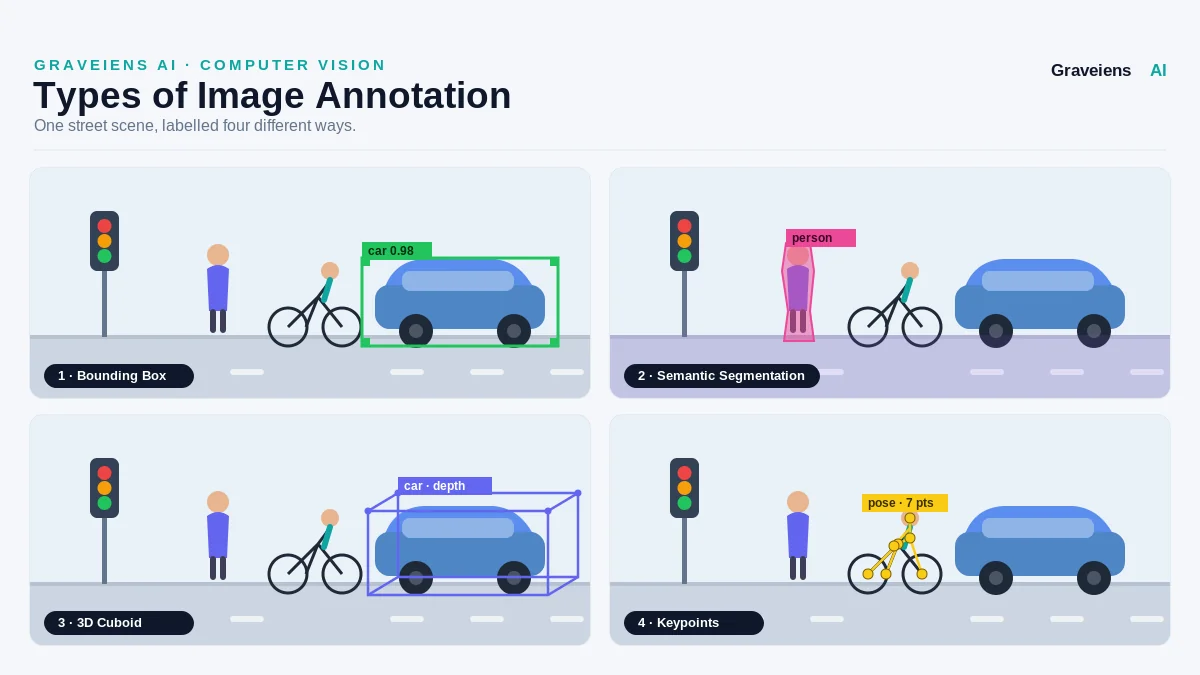
Quick answer: The main types of image annotation are bounding box annotation, polygon annotation, 3D cuboid annotation, semantic segmentation, instance segmentation, panoptic segmentation, keypoint (landmark) annotation, polyline annotation, and image classification. Each label visualizes data differently so a computer vision model learns to detect, outline, or understand objects at the level of accuracy your use case demands.
This guide is written for machine learning engineers, computer vision product owners, and data operations leads who need to choose the right labeling method before a training run, not a surface level definitions post.
Choosing between the many types of image annotation is one of the highest leverage decisions in any computer vision project. Get it right, and your model reaches production accuracy on schedule. Get it wrong and you pay twice: once for the labels and again to redo them. This guide breaks down every major annotation method, when to use it, the tradeoffs, and the real world use cases behind each so you can match the technique to the model instead of guessing.
At Graveiens AI, our annotation teams label millions of images a year through a four stage quality workflow, and the patterns below reflect what actually holds up in production. If you want the service view first, see our data annotation and labeling services for how these methods are delivered at scale.
Key takeaways
- Bounding box annotation is the fastest, most common form of object labeling and powers most object detection models.
- Semantic segmentation labels every pixel by class; instance segmentation separates individual objects; panoptic segmentation does both.
- 3D cuboid annotation adds depth for autonomous driving and robotics, while keypoint annotation captures pose and facial landmarks.
- Image classification tags a whole image with one or more labels and is the simplest annotation type to produce.
- The right choice depends on the task, budget, and the precision your model actually needs not on picking the most detailed method available.
Table of contents
- What is image annotation?
- Why the types of image annotation matter
- The main annotation types at a glance
- 1. Bounding box annotation
- 2. Polygon annotation
- 3. 3D cuboid annotation
- 4. Semantic segmentation
- 5. Instance segmentation
- 6. Panoptic segmentation
- 7. Keypoint and landmark annotation
- 8. Polyline and line annotation
- 9. Image classification
- How to choose the right annotation type
- Annotation formats: COCO, YOLO, Pascal VOC
- Best practices and quality assurance
- FAQs
What is image annotation?
Image annotation is the process of adding human verified labels to images so a machine learning model can learn to recognize objects, boundaries, and scenes. In practice it means drawing boxes, tracing outlines, marking points, or tagging pixels, then storing those labels in a structured format the model can read during training.
Every supervised computer vision system depends on it. Without accurate labels, even the best architecture has nothing meaningful to learn, which is why the various annotation methods exist in the first place: different models need visual information described in different ways. Object labelling for a retail shelf detection model looks nothing like pixellevel annotation for a self driving car, even though both start from a photograph.
Why the types of image annotation matter
Picking among these annotation methods is really a decision about the tradeoff between cost, speed, and precision. A bounding box takes a few seconds to draw; a detailed segmentation mask can take several minutes per object. Multiply that across a dataset of 100,000 images and the choice defines your entire budget and timeline.
The method you choose also caps your model’s ceiling. A detector trained only on rectangular object labelling can tell you where a tumshaped region is, but not its exact contour, so a healthcare team building diagnostic tooling almost always needs segmentation instead. Matching the annotation type to the outcome is the core skill, and it is where an experienced computer vision data partner earns its keep. The sections below give you the decision criteria for each method so the match is deliberate rather than accidental.
The main types of image annotation at a glance
Before the deep dive, here is how the most common annotation methods compare across effort and best fit tasks.
| Annotation type | What it labels | Precision | Typical use case |
| Bounding box | Rectangular region around an object | Low–medium | Object detection, counting |
| Polygon | Exact object outline | High | Irregular shapes, instance masks |
| 3D cuboid | Object with depth and orientation | High | Autonomous driving, robotics |
| Semantic segmentation | Every pixel by class | Very high | Scene understanding, medical |
| Instance segmentation | Each object separately at pixel level | Very high | Crowded scenes, counting |
| Panoptic segmentation | Classes + individual instances | Very high | Fullscene perception |
| Keypoint | Specific points on an object | High | Pose, facial landmarks |
| Polyline | Open connected lines | Medium | Lanes, roads, cracks |
| Image classification | The whole image | Low | Tagging, content sorting |
Understanding these differences is the foundation of good data collection and labeling planning, because the annotation type you choose should be decided before a single image is captured. Now let’s look at each method in detail.
1. Bounding box annotation
Bounding box annotation draws a rectangle around each target object, defined by its topleft and bottomright coordinates. It is the most widely used of all annotation methods because it is fast, cheap, and good enough for the majority of object detection tasks.
This form of object labelling powers models that count products on a shelf, spot pedestrians in a frame, or flag defects on a production line. A trained annotator can place dozens of boxes per minute, which makes bounding box object labelling the default starting point for most teams testing a new detection idea.
The limitation is precision: a rectangle always includes background pixels around anything that isn’t itself rectangular. For a car photographed at an angle or an animal midstride, a large share of the box is not the object. When that background noise hurts model performance, teams graduate to polygons or segmentation. Even so, straightforward object labelling with boxes remains the workhorse behind retail and ecommerce computer vision, where speed and volume matter more than pixelperfect outlines.
Best for: object detection, object counting, and rapid dataset bootstrapping.
2. Polygon annotation
Polygon annotation traces the exact outline of an object using a series of connected points, capturing irregular shapes far more precisely than a rectangle. Where a box wastes pixels on the background, a polygon hugs the true boundary of a building, a garment, or an animal.
That precision comes at a cost polygons take longer to draw and demand more skilled annotators, but they are indispensable when shape matters. Fashion catalogs, aerial imagery, and agricultural crop analysis all rely on polygon object labeling to isolate objects cleanly. Polygons are also the manual foundation for many instance segmentation datasets, since a closed polygon can be converted into a pixel mask.
For geospatial and satellite imagery projects, polygon annotation is often the only viable method, because rooftops, roads, and field boundaries almost never fit inside a clean rectangle.
Best for: irregular objects, overhead imagery, and precise object outlines.
3. 3D cuboid annotation
3D cuboid annotation extends the bounding box into three dimensions, capturing an object’s position, orientation, and volume rather than just its 2D location. Each cuboid encodes depth, so a model can reason about how far away a car is and which direction it faces not just that it appears in the frame.
This is essential for autonomous systems. Perception stacks for selfdriving vehicles use cuboids on both camera images and LiDAR point clouds to build a spatial map of the world. Robotics arms use them to grasp objects at the correct depth. Because cuboid work is often fused with sensor data, it pairs naturally with 3D point cloud and LiDAR annotation, where objects are labeled directly in a depthaccurate 3D space.
Among all annotation methods, cuboids demand the most spatial reasoning from annotators, which is why ADAS and autonomous driving programs typically rely on specialized, heavily QAreviewed teams rather than a general crowd.
Best for: autonomous driving, robotics, and any task needing depth and orientation.
4. Semantic segmentation
Semantic segmentation assigns a class label to every single pixel in an image, so a “road,” “sky,” “car,” or “tree” is understood at the pixel level rather than as a box. There are no separate object identities — all pixels of the same class share one label which makes it ideal for understanding the overall composition of a scene.
This is the most detailed way to teach a model what is present everywhere in a frame. Autonomous vehicles use it to know exactly where the drivable road surface ends. Medical imaging teams use it to outline organs and lesions with pixel accuracy, which is why healthcare AI data programs lean on segmentation far more than on boxes. Public benchmarks like Cityscapes provide dense pixellevel labeling across roughly 30 classes, giving teams a reference for how demanding this labeling can be.
The tradeoff is effort: semantic segmentation is among the slowest and most expensive annotation methods, often taking minutes per image. When budgets are tight, teams reserve it for the classes where pixel precision genuinely changes the model’s behavior.
Best for: scene understanding, medical imaging, and drivablearea detection.
5. Instance segmentation
Instance segmentation combines the pixel precision of semantic labeling with object identity: it labels every pixel and separates each object of the same class into a distinct instance. Ten people in a crowd become ten individually masked people, not one undivided “person” region.
This matters whenever counting or tracking individual objects is the goal. A warehouse robot needs to distinguish one box from the box behind it; a cellbiology model needs each cell counted separately. Instance segmentation gives models that perobject clarity while keeping pixellevel accuracy, at the cost of being one of the most laborintensive annotation methods available.
Because it blends two disciplines, instance segmentation projects benefit from a rigorous review loop the kind of independent data validation and quality review that catches merged or split masks before they poison a training set.
Best for: crowded scenes, perobject counting, and precise tracking.
6. Panoptic segmentation
Panoptic segmentation unifies semantic and instance segmentation into a single output: countable “things” (cars, people) get individual instance masks, while amorphous “stuff” (road, sky, grass) gets a single semantic label. The result is a complete, gapfree understanding of every pixel in the scene.
This is the most comprehensive of all annotation methods and the most demanding to produce, so it is usually reserved for highstakes perception systems full selfdriving stacks, advanced robotics, and research benchmarks where nothing in the frame can be left unlabeled. Teams that reach for panoptic segmentation almost always run it through a mature, documented annotation process to keep quality consistent across large volumes.
Best for: complete scene perception where both objects and background matter.
7. Keypoint and landmark annotation
Keypoint annotation, also called landmark annotation, marks specific points of interest on an object the corners of the eyes and mouth on a face, or the joints of a human body. Connecting those points reveals structure, pose, and movement.
It is the backbone of pose estimation, gesture recognition, and facial analysis. Fitness apps track body keypoints to check exercise form; AR filters map facial landmarks to place effects accurately, a common need in AR/VR and spatial computing datasets. Keypoint annotation is precise but sensitive: a landmark placed a few pixels off can meaningfully degrade a pose model, so consistency across annotators is critical.
Best for: pose estimation, facial landmark detection, and gesture recognition.
8. Polyline and line annotation
Polyline annotation draws open, connected line segments that follow a path rather than enclosing an area. Unlike a polygon, a polyline never closes, which makes it the natural fit for linear features.
Lane detection is the classic example: self driving and driver assistance systems trace lane markings, road edges, and rail tracks as polylines. Infrastructure inspection uses the same method to mark cracks in pavement or pipelines. Because lane geometry feeds directly into steering decisions, polyline work is a staple of automotive and in cabin data programs.
Best for: lanes, roads, rails, wiring, and crack or defect lines.
9. Image classification
Image classification is the simplest form of annotation: instead of locating anything, it assigns one or more labels to the entire image. A photo is tagged “cat,” a scan is tagged “pneumonia / normal,” or a product shot is tagged by category. There is no localization it answers what the image contains, not where.
Because image classification only requires a decision rather than a drawing, it is the fastest and cheapest annotation type to produce at scale. It powers content sorting, local-ization ital tilage, and the tagging layers behind search and recommendation. Many teams combine it with detection: a first model uses classification to filter relevant frames, then a detector localizes objects inside them.
Image classification also underpins content safety workflows, where images are labeled as safe or unsafe before they reach users, the same principle behind content moderation data services. Despite its simplicity, it still demands clear guidelines, since ambiguous labels are the most common cause of a noisy classification dataset.
Best for: whole image tagging, content sorting, triage, and recommendation.
How to choose the right annotation type
The right method follows from three questions: What does the model need to do? How much precision does that require? And what is your budget per image?
- Detect or count objects? Start with bounding box object labelling; move to polygons only if rectangles hurt accuracy.
- Understand every pixel of a scene? Use semantic segmentation, or instance/panoptic segmentation if you also need object identity.
- Reason about depth? Use 3D cuboids, usually fused with LiDAR.
- Track pose or structure? Use keypoint annotation.
- Follow linear features? Use polylines.
- Just label the whole image? Use image classification.
A practical tactic is to start simple and escalate. Many production pipelines bootstrap with bounding boxes, measure model performance, and upgrade only the classes that need finer annotation methods. This staged approach protects budget while still reaching the accuracy target. Sustained annotation at scale also depends on a reliable, vetted labeling team — the kind of specialized annotation workforce that keeps quality steady as volumes grow.
Annotation formats: COCO, YOLO, and Pascal VOC
Whichever annotation type you choose, the labels are stored in a standardized format so your training framework can read them. The three dominant formats are COCO (JSON, supports boxes, segmentation, and keypoints — the COCO dataset spans 80 object categories), YOLO (lightweight text files, one row per object, optimized for the YOLO detector family), and Pascal VOC (XML per image, a longstanding detection benchmark).
Getting the format right matters as much as the labels themselves. A perfect set of segmentation masks in the wrong schema will fail to load, so confirm the target format before annotation begins. These formats also make datasets portable across annotation and generative AI and model training workflows, which increasingly consume the same labeled visual data for multimodal training.
Best practices and quality assurance
The best annotation type still fails without disciplined quality control. Across thousands of production programs, the same practices separate model ready datasets from noisy ones.
- Write a precise annotation guide model Ready beled examples and edge cases before work starts ambiguity is the top source of label noise.
- Run a small pilot batch and measure interannotator agreement before scaling.
- Use a multistage review loop create, internal review, client review, and rework — rather than singlepass labeling.
- Track quality with metrics such as Intersection over Union (IoU) for boxes and masks; an IoU above 0.90 against a gold set is a common production bar.
- Version your dataset and guidelines so changes are auditable over time.
This is exactly the fourstage QA workflow Graveiens AI runs under its ISO 9001:2017 certification, and it is why teams choose us for highprecision programs where a single systematic labeling error can compromise an entire training run. For textheavy pipelines, the same rigor extends to our natural language processing annotation work.
Download: Use our free Image Annotation Type Selection Checklist task, required precision, budget per image, recommended annotation type, and output format to standardize the decision across your team. Request the checklist.
FAQS for Types of Image Annotation
-
What are the main types of image annotation?
The main types of image annotation are bounding box annotation, polygon annotation, 3D cuboid annotation, semantic segmentation, instance segmentation, panoptic segmentation, keypoint (landmark) annotation, polyline annotation, and image classification. Each labels images differently to train a specific kind of computer vision model.
-
What is the difference between object labeling and image classification?
Object labelling locates objects within an image, for example, drawing a box around each car so the model learns where things are. Image classification assigns a single label to the whole image and answers only what it contains, with no location information. Detection tasks need objectlabeling; sortingg or tagging tasks can use whole image tagging.
-
When should I use semantic segmentation instead of bounding boxes?
Use semantic segmentation when your model needs pixellevel understanding, such as identifying the exact drivable road surface or outlining an organ in a medical scan. Bounding boxes are faster and cheaper, but they include background pixels and cannot capture precise shape. If exact boundaries change your model’s decisions, it is worth the extra cost.
-
What is the difference between semantic and instance segmentation?
Semantic segmentation labels every pixel by class but treats all objects of one class as a single region. Instance segmentation also labels pixels but separates each object into its own instance, so ten cars become ten distinct masks. Choose instance segmentation when you need to count or track individual objects.
-
Which type of image annotation is the most accurate?
Panoptic segmentation is the most comprehensive, because it labels every pixel and separates individual objects, combining semantic and instance segmentation. It is also the most expensive and timeconsuming, so it is reserved for highstakes perception systems like autonomous driving where complete scene understanding is required.
-
How much does image annotation cost?
Cost depends almost entirely on the annotation type and complexity. A bounding box may take seconds, while a detailed segmentation mask can take several minutes per object — so segmentation can cost 10x or more than object labelling object soe image. Providers that invoice only for approved deliverables reduce the risk of paying for rework.
-
Which annotation type is best for autonomous vehicles?
Autonomous vehicles use several annotation methods together: 3D cuboids and semantic segmentation for perception, polylines for lane detection, and bounding boxes for fast object detection. These are usually fused with LiDAR pointcloud annotation to give the vehicle a depthaccurate 3D model of its surroundings.
Conclusion
There is no single best method — only the right one for your task. The types of image annotation range from fast, lowcost object labelling with bounding boxes to pixelperfect segmentation and full panoptic scene understanding, and the smart move is to match the technique to the precision your model actually needs, then escalate only where accuracy demands it. Start simple, measure, and upgrade deliberately.
If you’re planning a computer vision program and want an experienced partner to handle the labeling, Graveiens AI delivers every annotation type in this guide through an ISO 9001:2017 fourstage QA workflow — and invoices only for the work you approve. Book a lowrisk pilot with a sample batch on your own data.
Sources: Ultralytics — Data Collection and Annotation Guide, TELUS Digital — 5 Types of Image Annotation, Labelbox — Image Annotation Best Practices, COCO Dataset, Cityscapes Dataset.

Jitendra Choubay is the CEO & Founder of Graveiens AI, leading a human-in-the-loop data services team that helps AI builders with data collection, annotation, consent-backed voice data, transcription and LLM fine-tuning. He writes on building better, ethically sourced AI training data.
Get the next Graveiens AI article
Expert notes on AI data, annotation, LLMs and eLearning — no spam, unsubscribe anytime.
Need AI Development? Data Annotation? eLearning?
Talk to Graveiens AI about data collection, annotation, voice data, RLHF/SFT, LLM evaluation and AI training data — invoiced only on approved work.
Contact Graveiens AI