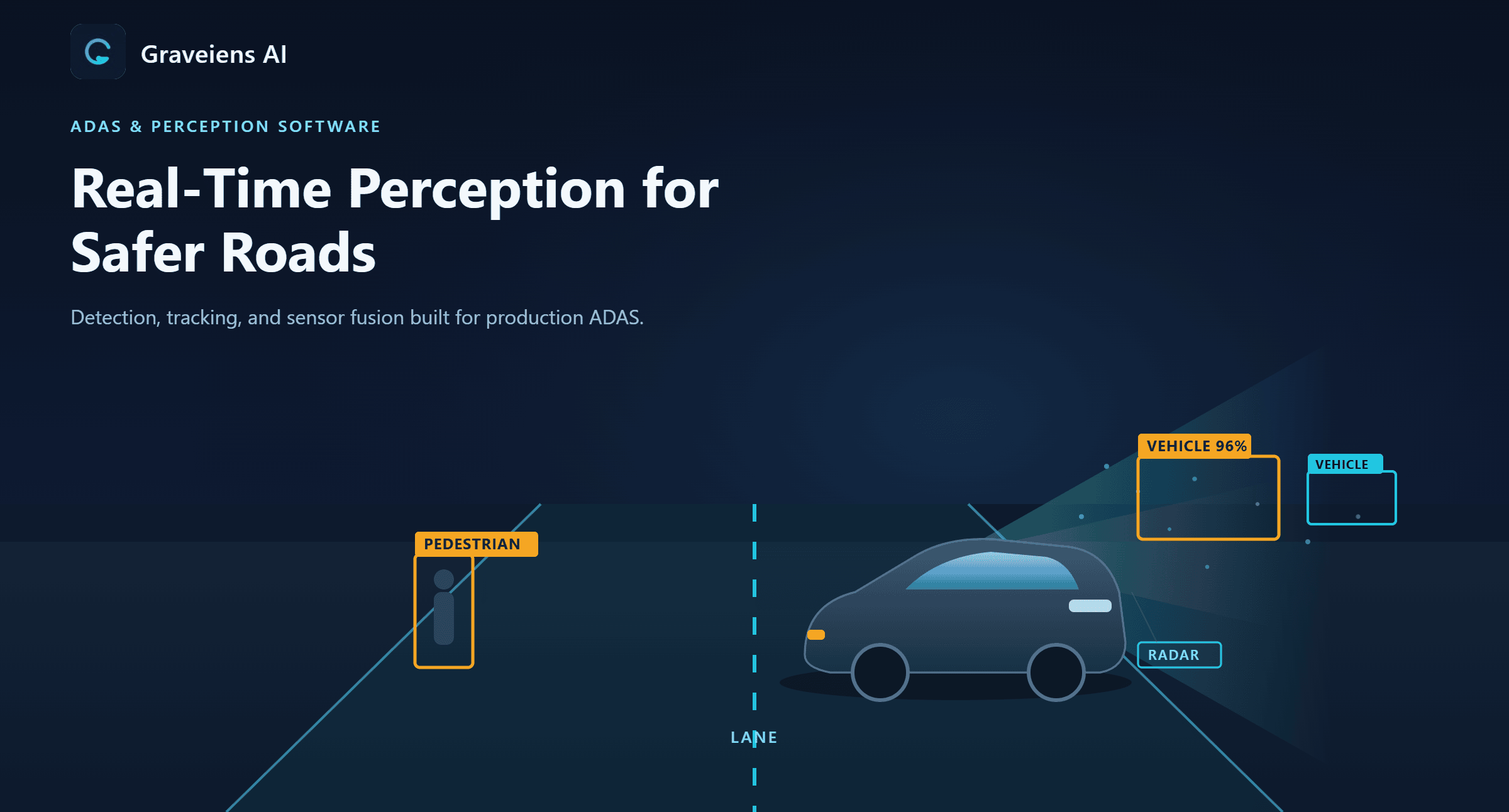
This guide is for automotive engineers, ADAS/AV product teams, fleet and safety managers, machine learning practitioners, and students who want a clear, technically accurate picture of ADAS software, the systems it runs on, and the training paths that lead into the field.
Quick answer: ADAS (Advanced Driver Assistance Systems) is a set of electronic safety technologies that use cameras, radar, LiDAR, and ultrasonic sensors interpreted by ADAS software to warn drivers, correct mistakes, and automate parts of the driving task. ADAS software is the perception, sensor fusion, decision, and control code that turns raw sensor signals into safety actions such as automatic emergency braking, lane keeping, and adaptive cruise control. The systems map to SAE J3016 automation Levels 0–2, and the global ADAS market is forecast to grow from roughly $37.5 billion in 2025 to about $90 billion by 2033, a CAGR near 11.8%. (Grand View Research)
Table of Contents
- What Is ADAS?
- What Is an ADAS System? Core Components
- What Is ADAS Software?
- The ADAS Software Pipeline: Perception to Control
- The 6 SAE Levels of Driving Automation
- Common ADAS Features Explained
- How ADAS Software Is Built, Trained & Validated
- ADAS Training Courses: Paths, Skills & Certifications
- ADAS Standards, Regulations & Safety Testing
- The Role of High Quality Training Data in ADAS
- Frequently Asked Questions
- Key Takeaways
What Is ADAS?
ADAS stands for Advanced Driver Assistance Systems — electronic systems in a vehicle that assist the driver with safety, awareness, and control. ADAS uses sensors to monitor the road, the vehicle, and the driver, then either alerts the driver or intervenes directly to prevent collisions and reduce human error.
Human error contributes to roughly 90% of road crashes, which is exactly the gap ADAS is designed to close. Instead of replacing the driver, most ADAS features act as a vigilant co pilot: they see hazards a fraction of a second sooner and react faster than a human can. That is why bodies like Euro NCAP now weight assisted driving performance so heavily in their safety ratings.
ADAS is not a single product. It is an umbrella term covering dozens of features from a simple parking sensor beep to camera and radar systems that steer, brake, and keep a car centered in its lane. The intelligence behind all of them is the ADAS software stack. Teams building perception models for these systems rely on ethically sourced ADAS and autonomous driving data to teach models what vehicles, pedestrians, and road features actually look like across real world conditions.
What Is an ADAS System? Core Components
An ADAS system is the combination of hardware and software that senses the environment, decides what matters, and acts. Every production ADAS system is built from four layers working together in real time.
1. Sensors (the eyes and ears). Cameras capture rich visual detail and color; radar measures distance and velocity in rain, fog, and darkness; LiDAR builds precise 3D depth maps; and ultrasonic sensors handle close range parking. Most modern systems combine several sensor types, a technique called sensor fusion. Building perception models for these inputs depends on accurate sensor fusion and LiDAR annotation that labels objects consistently across 2D and 3D data.
2. Compute (the brain). A dedicated System on Chip (SoC) or ADAS domain controller from suppliers such as NVIDIA, Qualcomm, Mobileye, or Texas Instruments runs the neural networks and control logic. These chips must process multiple high resolution streams within milliseconds while meeting automotive safety and power constraints.
3. Software (the decision maker). This is where raw signals become meaning. The computer vision and fusion models detect and classify objects, predict their motion, and plan a safe response covered in detail in the next section.
4. Actuators (the hands and feet). When the software decides to act, actuators execute it: applying the brakes, adjusting the throttle, or turning the steering. The loop from sensor to actuator often completes in under 100 milliseconds.
Together these layers form a closed loop: sense, understand, decide, act, and repeat — many times per second, every second the vehicle is moving.
What Is ADAS Software?
ADAS software is the code that turns sensor data into safe driving decisions. It is the perception, prediction, planning, and control logic that lets a vehicle interpret its surroundings and respond appropriately. Without this software, an ADAS sensor is just a camera or radar producing data nobody can use.
Modern ADAS software is dominated by machine learning, especially deep neural networks for perception. But it is more than models a production stack also includes deterministic control algorithms, a real time operating system (often a safety certified RTOS), middleware such as AUTOSAR Adaptive, calibration routines, and rigorous diagnostic and fail safe layers. The software must be verifiable, because a false negative can mean a missed pedestrian.
ADAS software typically spans four functional stages, and understanding them is the fastest way to understand the whole field.
The ADAS Software Pipeline: Perception to Control
The ADAS software pipeline is the sequence of processing stages that converts sensor input into a control action. Each stage feeds the next, and each depends on well labeled data to perform reliably.
| Stage | What the software does | Data it depends on |
|---|---|---|
| 1. Perception | Detects and classifies objects — vehicles, pedestrians, cyclists, lane lines, signs — from camera, radar, and LiDAR | Annotated images, video, and 3D point clouds |
| 2. Sensor fusion | Merges multiple sensor streams into one consistent model of the scene | Time synchronized, cross sensor labeled data |
| 3. Prediction & planning | Forecasts how other road users will move and plans a safe trajectory | Tracked object sequences and behavior data |
| 4. Control | Converts the plan into steering, braking, and throttle commands | Validated scenarios and edge case coverage |
Perception is the foundation. If the model mislabels a stopped truck or fails to see a pedestrian at dusk, every downstream stage inherits that error. This is why the quality of the underlying data annotation and labeling directly determines how safe an ADAS feature can be. Reliable perception starts with pixel accurate, frame consistent labels produced under a measured quality process, not a single pass crowd task.
The 6 SAE Levels of Driving Automation
The industry standard for classifying automation is SAE J3016, which defines six levels from 0 to 5. Most ADAS features live in Levels 0–2; anything Level 3 and above is considered automated driving rather than driver assistance. (SAE J3016)
| Level | Name | Who drives | Example |
|---|---|---|---|
| 0 | No automation | Human, full time | Blind spot warning, forward collision alert |
| 1 | Driver assistance | Human, with one assist | Adaptive cruise control or lane keeping |
| 2 | Partial automation | Human supervises | ACC and lane centering together |
| 3 | Conditional automation | System, in set conditions | Traffic jam pilot; driver takes over on request |
| 4 | High automation | System, in a defined domain | Robotaxi within a geofenced area |
| 5 | Full automation | System, everywhere | No steering wheel needed (not yet in production) |
A useful distinction: at Levels 0–2 the human is always responsible, even when the system is steering. At Level 3+, the system is responsible while engaged. Euro NCAP simplifies this for consumers into “assisted,” “automated,” and “autonomous” driving modes rather than numbered levels. (Euro NCAP overview via Hailo)
Common ADAS Features Explained
These are the features most drivers encounter, grouped by what they do.
Collision avoidance
- Automatic Emergency Braking (AEB) applies the brakes when a crash is imminent and the driver has not reacted.
- Forward Collision Warning (FCW) alerts before AEB engages.
- Pedestrian and cyclist detection extends AEB to vulnerable road users a task that hinges on diverse, well labeled automotive AI data covering many body poses, lighting conditions, and occlusions.
Lateral control
- Lane Departure Warning (LDW) alerts when the car drifts out of its lane.
- Lane Keeping Assist (LKA) and Lane Centering actively steer to stay centered.
Longitudinal control
- Adaptive Cruise Control (ACC) maintains a set speed and safe following distance.
- Traffic Jam Assist combines ACC and centering in slow traffic.
Awareness and monitoring
- Blind Spot Monitoring and Rear Cross Traffic Alert watch areas the driver cannot see.
- Driver Monitoring Systems (DMS) use an in cabin camera to detect drowsiness or distraction increasingly mandatory and central to Euro NCAP 2026 protocols. In cabin systems also draw on conversational AI and voice interfaces for hands free control.
Parking and low speed
- Automated Parking and 360° Surround View use ultrasonic sensors and cameras to maneuver in tight spaces.
Each feature is only as good as the perception model behind it, and each model is only as good as the data used to train and validate it.
How ADAS Software Is Built, Trained & Validated
Building production ADAS software is a disciplined, data intensive engineering cycle. Understanding this workflow explains why data quality sits at the center of the field.
Step 1 — Data collection. Teams gather millions of miles of real world sensor recordings across geographies, weather, and lighting. Rare but critical “edge cases” a child chasing a ball, a jackknifed truck, unusual road markings are the hardest and most valuable to capture. Structured road and in cabin data collection with consent and metadata built in makes this scalable and compliant.
Step 2 — Annotation. Raw data is labeled: bounding boxes and polygons on 2D images, semantic segmentation for drivable space, and 3D cuboids on LiDAR point clouds. Consistency across annotators is critical, which is why a vetted, trained annotation workforce outperforms an anonymous crowd on safety critical labels.
Step 3 — Model training. Engineers train deep neural networks on the labeled datasets, tuning architectures for the accuracy versus latency trade off that automotive compute demands.
Step 4 — Validation and QA. Every dataset and model output is checked. Independent data validation a second, expert review of labels and predictions catches errors before they reach the model, and structured processes like a four stage QA workflow keep accuracy high at scale. You can see how a measured pipeline works in Graveiens AI’s data process.
Step 5 — Simulation and road testing. Models are stress tested in simulation against synthetic edge cases, then validated on closed tracks and public roads before release. Realistic scenario generation increasingly uses generative AI to expand rare event coverage.
This loop never truly ends. Fleets keep collecting data, models keep improving, and the cycle repeats a core reason experienced data partners matter. Teams often review case studies to see how similar perception programs scaled.
ADAS Training Courses: Paths, Skills & Certifications
ADAS training courses teach the engineering, software, and testing skills needed to design, develop, calibrate, or validate advanced driver assistance systems. Demand is strong because the talent pool has not kept pace with the market’s double digit growth. Courses generally fall into four tracks.
1. Foundational / awareness courses. Short programs (a few hours to a few days) that explain ADAS features, SAE levels, and sensor basics. Ideal for product managers, technicians, insurance and fleet professionals, and newcomers. Often available free or low cost through OEM academies and platforms like Coursera, Udemy, and edX.
2. Engineering and software courses. In depth programs covering computer vision, sensor fusion, embedded systems, AUTOSAR, C++/Python, ROS, and functional safety (ISO 26262). These target working or aspiring ADAS software, perception, and systems engineers and range from university modules to specialized bootcamps.
3. Calibration and service courses. Hands on training on recalibrating cameras and radar after windshield replacement or collision repair a fast growing niche for automotive technicians and body shops, frequently certified by equipment makers (Bosch, Hunter, Autel) and industry bodies like I CAR.
4. Testing, validation, and data courses. Programs on scenario design, HIL/SIL testing, Euro NCAP protocols, and the data annotation and QA skills that feed perception models a track that has grown as data quality became the industry bottleneck.
Skills worth prioritizing: Python and C++, deep learning and computer vision, sensor fusion, LiDAR/point cloud processing, ROS/ROS 2, functional safety (ISO 26262), SOTIF (ISO 21448), and data annotation and validation methodology. A candidate who can both build a model and judge the quality of its training data is unusually valuable, because that judgment is what separates a demo from a deployable system.
Practical tip: If your goal is to enter ADAS through the fastest growing door, start with perception and data. Learn to annotate and audit driving datasets accurately, then layer on model training. Data quality fluency is in short supply and applies across every OEM and supplier.
ADAS Standards, Regulations & Safety Testing
ADAS software operates in one of the most heavily regulated software domains in the world. Key frameworks every practitioner should know:
- ISO 26262 (Functional Safety): governs how electrical/electronic systems avoid unreasonable risk from failures.
- ISO 21448 (SOTIF): the Safety Of The Intended Functionality standard, which addresses hazards from performance limitations for example, a perception model failing in glare even when nothing has “broken.”
- SAE J3016: the levels of automation taxonomy described above.
- Euro NCAP: the European consumer safety rating body. Its 2026 protocols raise the bar on driver monitoring, emergency response after a crash, and the real world effectiveness of assistance systems, explicitly discouraging over reliance on automation. (Euro NCAP 2026 via AB Dynamics)
- UN Regulations (e.g., UN R157, R152): type approval rules mandating features such as AEB in many markets.
Regulation is a growth engine, not just a constraint. Mandates for AEB, driver monitoring, and intelligent speed assistance are a primary reason the ADAS market is expanding at double digit rates. (MarketsandMarkets) Teams that build compliant, well documented data pipelines from the start ship faster and pass audits more smoothly one reason many choose an ISO 9001:2017 certified partner. See why teams choose Graveiens AI for how a compliance first model reduces program risk.
The Role of High Quality Training Data in ADAS
Every ADAS capability discussed above ultimately rests on data. A perception model cannot detect what it was never accurately shown. Three data qualities matter most:
Accuracy. A mislabeled object teaches the model the wrong lesson. Safety critical labels need pixel and frame level precision, verified through independent review.
Diversity. Models must generalize across countries, weather, times of day, road types, and rare events. Narrow datasets produce brittle systems that fail in the real world.
Compliance. In cabin and roadside data can capture faces and personal information, so consent, anonymization, and auditable provenance are non negotiable especially under tightening privacy law.
This is precisely where a specialized human in the loop data partner earns its place. Graveiens AI delivers consent backed collection, multi modal annotation, 3D/LiDAR labeling, and expert validation for ADAS and autonomous programs, invoiced only on approved deliverables. If you are building or scaling a perception model, you can book a low risk pilot and prove quality on your own data before committing budget.
Frequently Asked Questions about ADAS
-
Why is data annotation important for ADAS?
Data annotation defines what an ADAS perception model can recognize. If training data is mislabeled or lacks diversity, the model will miss hazards or misclassify objects, directly compromising safety. Accurate, consistent, and compliant annotation verified by expert review is therefore foundational to any reliable ADAS system.
-
Why is data annotation important for ADAS?
Data annotation defines what an ADAS perception model can recognize. If training data is mislabeled or lacks diversity, the model will miss hazards or misclassify objects, directly compromising safety. Accurate, consistent, and compliant annotation verified by expert review is therefore foundational to any reliable ADAS system.
-
What sensors do ADAS systems use?
ADAS systems typically use four sensor types: cameras (rich visual detail), radar (distance and speed in poor visibility), LiDAR (precise 3D depth), and ultrasonic sensors (short range parking). Most systems fuse several of these so their strengths cover each other’s weaknesses.
-
What is ADAS in simple terms?
ADAS (Advanced Driver Assistance Systems) is a group of vehicle safety technologies that use sensors and software to help drivers avoid accidents. It can warn you of hazards, keep you in your lane, brake automatically, and maintain a safe following distance — acting as an electronic co pilot rather than replacing the driver.
-
What is the difference between ADAS and autonomous driving?
ADAS assists a human driver who remains fully responsible (SAE Levels 0–2), while autonomous driving means the system handles the driving task itself (SAE Levels 3–5). In ADAS, you must stay engaged and ready to take over; in higher automation, the vehicle can drive without active human supervision in defined conditions.
-
What programming languages are used in ADAS software?
ADAS software is built mostly in C and C++ for real time, safety critical control, with Python widely used for machine learning model development and data pipelines. Engineers also use MATLAB/Simulink for modeling, ROS/ROS 2 for robotics middleware, and frameworks like TensorFlow and PyTorch for perception neural networks.
Key Takeaways
- ADAS is a family of sensor and software safety systems that assist, not replace the driver, spanning SAE Levels 0–2.
- ADAS software is the perception, fusion, prediction, and control code that turns sensor data into safe actions; perception quality sets the ceiling for safety.
- ADAS training courses span awareness, engineering, calibration, and testing/data tracks with perception and data skills among the most in demand.
- The field is governed by ISO 26262, ISO 21448 (SOTIF), SAE J3016, and Euro NCAP, and driven by a market growing at roughly 11.8% CAGR toward ~$90B by 2033.
- Everything depends on high quality, diverse, consent backed training data The layer where a specialized data partner adds the most value.
Building or scaling an ADAS perception model? Explore Graveiens AI’s ADAS and autonomous data services or book a pilot to validate quality on your own data first.
Sources: Grand View Research — ADAS Market · MarketsandMarkets — ADAS Market · SAE J3016 (UNECE PDF) · Euro NCAP 2026 — AB Dynamics · ADAS SAE to NCAP — Hailo

Jitendra Choubay is the CEO & Founder of Graveiens AI, leading a human-in-the-loop data services team that helps AI builders with data collection, annotation, consent-backed voice data, transcription and LLM fine-tuning. He writes on building better, ethically sourced AI training data.
Get the next Graveiens AI article
Expert notes on AI data, annotation, LLMs and eLearning — no spam, unsubscribe anytime.
Need AI Development? Data Annotation? eLearning?
Talk to Graveiens AI about data collection, annotation, voice data, RLHF/SFT, LLM evaluation and AI training data — invoiced only on approved work.
Contact Graveiens AI