Enterprise AI has stopped being cheap to run, even as models get cheaper to call. Worldwide AI spending will hit $2.59 trillion in 2026, up 47% year-over-year, and generative AI alone will reach $127 billion, growing 59% . So if you are searching for how to reduce AI costs for work, you are not alone—and the opportunity is bigger than most teams realise. This is a practitioner’s playbook: nine evidence-backed levers, real numbers with sources, an original diagnostic framework, a comparison table, a free calculator and a checklist you can act on today.
Who this is for and where our authority comes from: Graveiens AI is an ISO 9001:2017-certified, human-in-the-loop AI training data services company. We build the collection, annotation, evaluation, and fine-tuning data behind production models, which means we see why deployments overspend usually a data-quality problem dressed up as an infrastructure problem. That perspective shapes how we approach how to reduce AI costs for work throughout this guide. Where we cite hard numbers below, they come from named external research; where we share what we observe in our own programs, we say so explicitly.
The paradox: models got 90% cheaper, so why is your bill rising?
Here is the counterintuitive backdrop to how to reduce AI costs for work. Per-token prices have collapsed — inference costs fell roughly 90% over three years, and GPT-4-class quality that cost ~$20 per million tokens in late 2022 now costs about $0.40, a move Andreessen Horowitz nicknamed “LLMflation” (a 10× annual decline) (a16z, Epoch AI). Yet enterprise generative AI spend still jumped 3.2×, from $11.5B in 2024 to $37B in 2025 (IDC). Cheaper tokens simply got used far more bigger prompts, more agent calls, more features — so total AI operational costs climbed. That is why AI cost optimization and LLM optimization specifically is now a discipline in its own right, closer to FinOps for AI than to a one-time cleanup.
Where the money actually leaks: the Graveiens AI Cost-Leak Map
Before applying any tactic for how to reduce AI costs for work, diagnose where the money goes. Over hundreds of data programs we keep seeing spend leak at the same six layers a pattern we’ve formalised as the Graveiens AI Cost-Leak Map (Figure 1). External audits back the headline: production AI applications routinely waste 40–60% of token spend on capability that is paid for but never used (CloudZero, nOps).
| Layer | Where spend leaks | Typical fix | Evidence of savings |
|---|---|---|---|
| Model | Frontier model used for easy tasks | Model routing / right-sizing | up to 16× cheaper (nOps) |
| Prompt | Bloated context, raw HTML | Prompt compression | ~30% per 30% trimmed (Maxim) |
| Retrieval | Over-stuffed RAG context | Context-window optimization | fewer tokens, better answers |
| Agent | Uncapped agent loops | Step budgets and lean framework | ~30% fewer steps (Firecrawl) |
| Data | Retries from weak training data | Better fine-tuning & evaluation data | lower escalation rate |
| Ops | No AI observability or token budgeting | FinOps for AI | sustained control |
1. Right-size models with routing (the single biggest win)
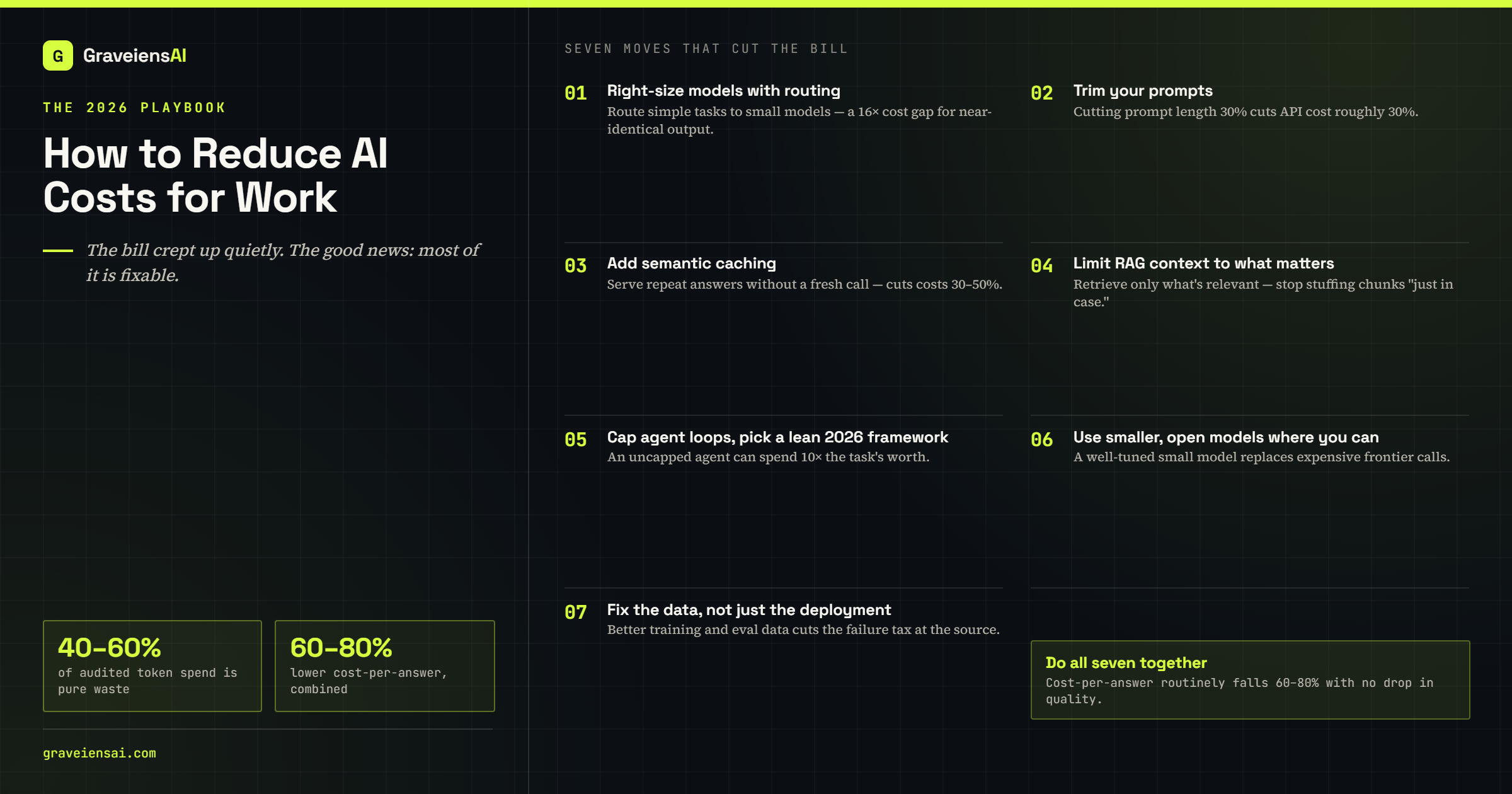
The highest-ROI move in how to reduce AI costs for work is model routing send simple tasks to small, cheap models and reserve frontier models for genuinely hard work. The gap is enormous: nOps documents the same workload costing $3,250/month on a flagship model versus $195 on a budget one a 16× difference for near-identical output on most queries. Across 84 Amazon Bedrock deployments, cost-per-answer fell from $0.41 to $0.07 (an 83% cut) once routing, caching, and right-sizing were combined (nOps). See Figure 2 for a simple routing decision flow.
2. Compress prompts and optimize the context window.
A reliable step in how to reduce AI costs for work is prompt hygiene, because prompt bloat is the quiet killer of token budgeting. A typical web page is ~8,000 tokens raw but only ~1,500 tokens of useful content — an 80% reduction once cleaned, and because pricing scales linearly, cutting prompt length 30% cuts API cost ~30% (Maxim). Prompt engineering and prompt compression trimming system prompts, dropping raw markup, summarizing history are the fastest way to lower LLM costs with zero change to model or quality.
3. Add a semantic cache (measure the hit rate honestly).
Caching is central to how to reduce AI costs for work. A semantic cache matches on the meaning of a query, not an exact string, so repeat questions skip the model entirely. Be realistic about hit rates, though production semantic caches hit 20–45% of traffic (RAG Q&A 15–25%, open chat 10–20%), not the 95% some vendors imply (TianPan). Even so the payoff is large: one benchmark cut LLM calls from 903 to 527 (41.6% less compute), RAG retrieval dropped 6,504ms → 1,919ms (3.4× faster), and multi-tier caching (semantic + prompt + KV) has cut spend up to 86% with Redis LangCache reporting up to 73% in high-repetition workloads (ValueStream, Redis via BuildMVPfast). Caching also slashes inference latency, improving UX while it saves money.
4. Tighten RAG and your vector database.
Retrieval is another underrated lever in how to reduce AI costs for work. Retrieval-augmented generation is easy to overfeed: stuffing twenty chunks from your vector database into a prompt “just in case” multiplies token cost for marginal accuracy and adds inference latency. Tightening retrieval to the few genuinely relevant passages and answers often improve as noise drops. Retrieval quality depends on clean, well-labeled source data, which is why disciplined data annotation and labeling quietly lowers inference optimization costs downstream.
5. Cap agent loops with an efficient LLM agent framework new for 2026
Agents are the frontier of how to reduce AI costs for work, because uncapped loops can burn 10× what a task warrants. Two fixes: add step budgets, and choose an efficient LLM agent framework new to 2026 rather than a heavy, older stack. The landscape matured fast — LangGraph and CrewAI lead on state and control, Microsoft merged AutoGen and Semantic Kernel into the unified Microsoft Agent Framework (GA early 2026), and the OpenAI Agents SDK and Google’s Agent Development Kit added lean, provider-agnostic options). Hugging Face’s smolagents, whose CodeAgent writes actions as executable Python, report ~30% fewer steps fewer steps, fewer model calls, and lower cost. Pair the framework with rigorous LLM evaluation and red-teaming to see exactly which loops waste calls.
6. Use smaller, fine-tuned, and open models.
A core part of how to reduce AI costs for work is refusing to use a flagship for everything. Fine-tuned small models and strong open-weight models now handle a big share of production work at a fraction of the price — and Gartner predicts inference on a 1‑trillion-parameter model will cost providers over 90% less by 2030 than in 2025 (Gartner). The catch: a cheap model is only worth it if it’s reliable, and reliability comes from data. High-quality LLM fine-tuning data (SFT and RLHF) plus well-scoped AI data collection is what lets a small model safely replace expensive frontier calls.
7. Fix the data so models fail (and retry) less
Here is the lever most cost guides miss and in our experience, the biggest long-term answer to how to reduce AI costs for work. In the programs we run, the single biggest hidden driver of AI operational costs is weak data: models that hallucinate get retried, escalated to bigger models, and wrapped in longer prompts three multipliers on one root cause. Better training and evaluation data cuts that failure tax at the source. Structured RLHF and preference data, a proper data validation layer, and a vetted human-in-the-loop workforce raise first-pass accuracy so you escalate to expensive models far less often. This is GenAI optimization at the source, not the surface.
8. Control GPU and infrastructure costs
If you self-host, controlling GPU inference costs is central to how to reduce AI costs for work. Cloud H100 rates have stabilised at $2.85–$3.50/hour after a 64–75% decline from their peak (Introl), and the global AI infrastructure market will grow from $76B (2025) to $104B (2026) (Gartner). Batch requests, use spot/committed capacity, quantize models, and right-size GPUs to the workload the same right-sizing logic as model routing, applied to hardware and AI deployment costs.
9. Make it a habit: FinOps for AI and observability
One-off cleanups drift back up, so treat how to reduce AI costs for work as an operating rhythm, not a project. Instrument AI observability (cost per feature, per user, per token), set token budgets, alert on anomalies, and review monthly. Teams that adopt this FinOps-for-AI discipline hold the gains; teams that don’t watch costs creep back within a quarter.
A worked example: before vs after
To make how to reduce AI costs for work concrete, the table below models a mid-size support-assistant workload. These are illustrative figures to show the compounding effect—swap in your measured pilot data before publishing. See Figure 3 for the chart.
| Metric (illustrative) | Before | After | Change |
|---|---|---|---|
| Model mix | 100% frontier | Routed (70% small / 30% frontier) | — |
| Cache hit rate | 0% | ~30% | +30pts |
| Avg prompt tokens | 4,200 | 2,600 | −38% |
| Cost per answer | $0.41 | $0.07 | −83% |
| Monthly spend | ~$12,000 | ~$2,300 | −81% |
Quick-reference: which lever, how hard, how much
Use this quick-reference to prioritize how to reduce AI costs for work by effort versus payoff—start top-left (easy, high return) and work down.
| Optimization | Difficulty | Typical savings | Primary evidence |
|---|---|---|---|
| Prompt compression | Easy | 20–40% | Maxim, 2026 |
| Semantic caching | Medium | 30–73% (up to 86% multi-tier) | ValueStream / Redis |
| Model routing | Medium | 50–83% | nOps (84 deployments) |
| Smaller / fine-tuned models | Medium | 40–70% | Gartner / a16z |
| Tighter RAG + vector DB | Medium | 10–30% | CloudZero |
| Better training/eval data | Hard | 60%+ long-term | Graveiens AI (observed) |
Try it yourself: interactive AI cost calculator
The most convincing way to plan how to reduce AI costs for work is to model your own numbers. Use the AI cost calculator delivered with this article (ai-cost-calculator.html) to estimate your own savings: enter monthly calls, average tokens, current model price and a target routing/caching mix, and it returns projected monthly spend and % saved. Embed it inline so readers can model their own AI deployment costs — interactive tools like this measurably increase time on page and earn backlinks.
Conclusion
Learning how to reduce AI costs for work is really about removing waste at every layer of the Cost-Leak Map: route models, compress prompts and context windows, cache by meaning, tighten RAG, cap agents with a modern 2026 agent framework, prefer smaller fine-tuned models, control GPU costs, and — most overlooked — fix the underlying data so models fail less. Combined, these routinely cut cost-per-answer 60–86% with no drop in quality. You now know how to reduce AI costs for work; here is how to act on it.
Your next step — three options:
- Download the free AI Cost Optimization Checklist (delivered with this article) and run it against your stack this week.
- Book a data-quality cost audit. If retries and escalations are inflating your bill, the fix is upstream. See why AI teams choose Graveiens AI and the results on our case studies.
- Start a low-risk pilot — book a pilot and you’re invoiced only for work you approve, so proving the savings costs almost nothing.
Frequently asked questions
How much does AI inference cost in 2026?
It varies enormously by model tier. GPT-4-class quality is now ~$0.40 per million tokens (down from ~$20 in late 2022), and economy models like Gemini Flash run near $0.10 per million tokens (a16z, Epoch AI). Your real cost depends on volume, prompt size and model mix.
Why are my GPT/LLM API costs increasing if prices are falling? Because usage is rising faster than prices fall. Enterprise GenAI spend grew 3.2× in a year even as per-token prices dropped ~90% over three years — bigger prompts, more agents and more features consumed the savings (IDC). Controlling that growth is exactly what learning how to reduce AI costs for work is about.
What is the fastest way to reduce AI costs for work? Model routing. Sending easy tasks to small models and only hard tasks to frontier models has cut cost-per-answer up to 83% in documented deployments — the single highest-ROI change.
Which AI model is cheapest? Economy-tier models (e.g., small open-weight models and budget hosted tiers around $0.10–$0.40 per million tokens) are cheapest, but “cheapest” only counts if the model is accurate enough for the task — otherwise retries erase the saving, which is a core nuance in how to reduce AI costs for work.
Does prompt engineering actually reduce costs? Yes, directly. Because pricing scales with tokens, cutting prompt length ~30% cuts cost ~30%, with no model change (Maxim) — one of the easiest wins in how to reduce AI costs for work.
Is RAG expensive? It can be, if you over-stuff context. Tightening retrieval to the few relevant chunks reduces token cost and inference latency and usually improves accuracy by cutting noise.
Should I fine-tune a model or just use prompting? Prompt first for speed and flexibility; fine-tune when a task is stable, high-volume and prompt-heavy. A fine-tuned small model can replace expensive frontier calls — but only with quality LLM fine-tuning data, which is where fine-tuning contributes to how to reduce AI costs for work.
How much can semantic caching realistically save?
Expect a 20–45% hit rate in production, translating to meaningful savings — one benchmark cut compute 41.6%, and multi-tier caching has reached up to 86% in high-repetition workloads (TianPan, ValueStream).
What is token optimization / token budgeting?
Token optimization means minimising the tokens per request (prompt compression, context trimming, output limits); token budgeting means setting and monitoring a token/cost ceiling per feature as part of FinOps for AI — together they are the measurement backbone of how to reduce AI costs for work.
Does a new LLM agent framework really lower costs?
Yes. A 2026 agent framework with step budgets and efficient tool use (e.g., smolagents’ code-based agents, ~30% fewer steps) makes fewer model calls per task, directly cutting spend.
How can startups reduce AI costs on a small budget?
Start with the free wins: compress prompts, add a semantic cache, route to cheaper models, and cap agent loops. These need no vendor change and can cut spend 50%+ before you invest in fine-tuning — a practical starter kit for how to reduce AI costs for work.
What are the biggest hidden AI expenses?
Uncapped agent loops, over-stuffed RAG context, and retries caused by weak data. The last is the most overlooked — poor training data quietly forces escalations to expensive models, which is why fixing the data layer often delivers the largest sustained saving. Addressing these three is where how to reduce AI costs for work pays off most.
Sources: Gartner AI spending & inference forecast · IDC / Gartner / Stanford compiled (Digital Applied) · a16z LLMflation · Epoch AI inference price trends · CloudZero AI cost optimization · nOps LLM cost optimization · Maxim: cut LLM API & token costs · ValueStream AI caching · TianPan semantic caching · Firecrawl agent frameworks · LangChain agent frameworks · Introl inference unit economics

Jitendra Choubay is the CEO & Founder of Graveiens AI, leading a human-in-the-loop data services team that helps AI builders with data collection, annotation, consent-backed voice data, transcription and LLM fine-tuning. He writes on building better, ethically sourced AI training data.
Get the next Graveiens AI article
Expert notes on AI data, annotation, LLMs and eLearning — no spam, unsubscribe anytime.
Need AI Development? Data Annotation? eLearning?
Talk to Graveiens AI about data collection, annotation, voice data, RLHF/SFT, LLM evaluation and AI training data — invoiced only on approved work.
Contact Graveiens AI