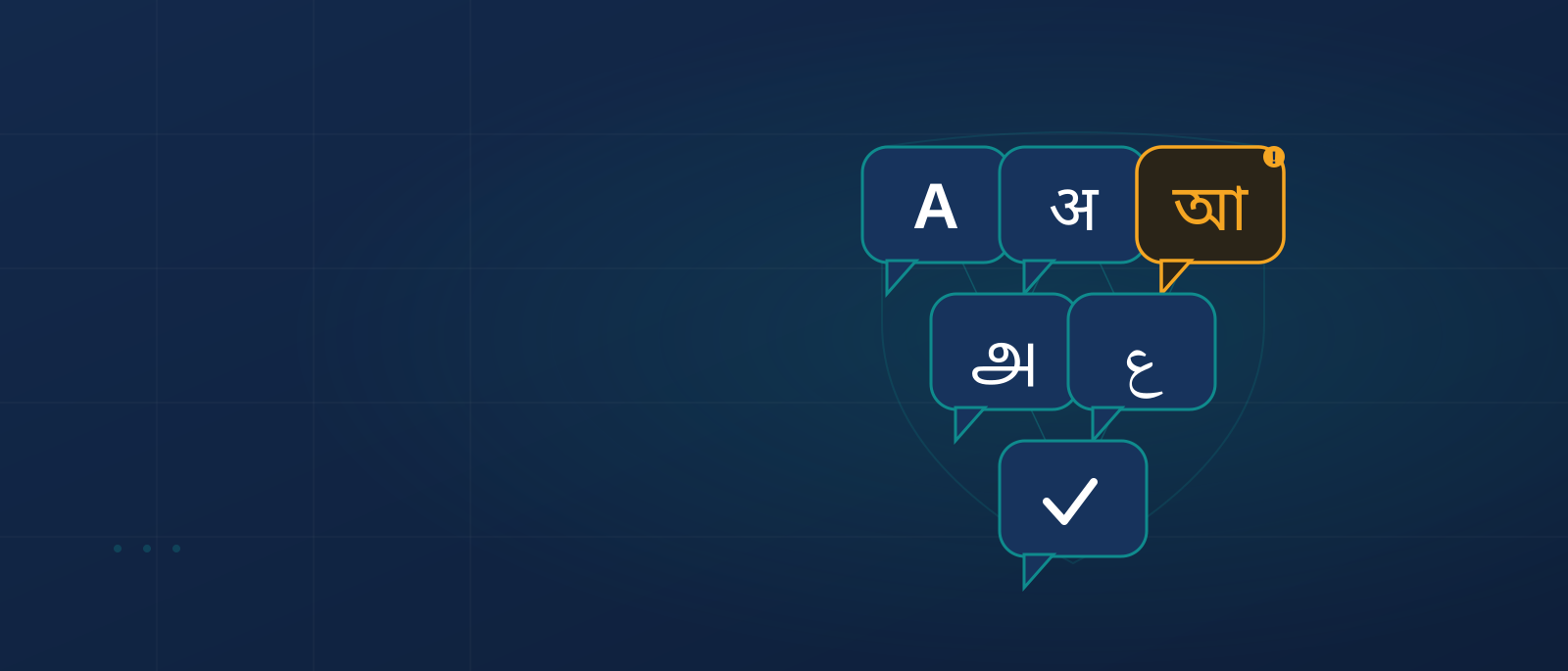
Multilingual LLM red teaming is the practice of adversarially testing a large language model for unsafe behavior in every language it serves, not only in English, using native speakers who write and grade original attack prompts in each target language. It exists because a safeguard that holds in English often collapses when the same request is rephrased in Hindi, Bengali, Tamil, Swahili, or Arabic. Peer-reviewed work presented at ICLR 2024 found that large language models were roughly three times more likely to produce harmful content in low-resource languages than in high-resource ones, and that translating an unsafe English prompt into a rarely tested language could push unsafe-output rates from single digits into the majority of responses. If your model ships in more than one language, English-only testing is not a measure of its safety. It is a measure of one language’s safety.
At a glance
| Question | Short answer |
|---|---|
| What is multilingual LLM red teaming? | Adversarial safety testing of an LLM across every language it serves, using native speakers who author and grade attack prompts in each language. |
| Why does it matter? | Safety training is concentrated in English, so models fail more often in other languages. Research shows low-resource languages face about 3x the harmful-output rate of English. |
| What does it test for? | Jailbreaks and adversarial attacks, multilingual toxicity and harmful-content evaluation, and multilingual bias and fairness testing, across single-turn and multi-turn conversations. |
| Why not machine-translate English probes? | Translation misses idioms, transliteration, and code-switching, the exact patterns real users and attackers use, so it under-reports true risk. |
| Who needs it? | AI lab safety teams, third-party evaluators and AI Safety Institutes, and enterprises deploying models in multilingual markets. |
| How is scope decided? | By prioritizing languages on exposure, harm severity, linguistic complexity, and safety-data scarcity, then testing across language tiers, attack classes, and turn depth. |
| Does it make a model safe? | No. It produces evidence of where a model fails. Fixing those failures through alignment and guardrails is a separate step. |
Table of contents
- What is multilingual LLM red teaming?
- Why English-only safety testing breaks in other languages
- The main types of multilingual safety testing
- How multilingual LLM red teaming works
- The Graveiens LENS Framework for language prioritization
- Approaches compared: which method wins when
- The multilingual safety testing maturity model
- What multilingual red teaming costs
- Common mistakes and how to avoid them
- A practical multilingual red-teaming checklist
- Worked examples
- How regulation is raising the bar
- Frequently asked questions
What is multilingual LLM red teaming?
Red teaming, in an AI context, is structured adversarial testing: skilled people deliberately attack a system with inputs designed to make it fail, then document exactly where and how it breaks. Applied to a large language model, red teaming means crafting prompts that try to bypass the model’s safety guardrails so that failures are found by a friendly team before they are found by users or bad actors.
Multilingual LLM red teaming extends that discipline across languages. Instead of assuming that an English safety result generalizes, native speakers write original adversarial and jailbreak prompts in each target language, submit them to the model, and grade the responses against a defined harm taxonomy. The output is not a pass or fail badge. It is a labeled dataset and a per-language findings report that shows which harms slip through in which languages, at what severity. That evidence then feeds evaluation dashboards and alignment training.
The distinction that matters most: multilingual red teaming is about coverage, not translation. A model can be genuinely safe in English and quietly unsafe in a dozen other languages at the same time, and only language-native testing reveals that gap.
Why English-only safety testing breaks in other languages
The core reason is data. Safety alignment, the fine-tuning that teaches a model to refuse harmful requests, is trained overwhelmingly on English examples. Languages with less text on the internet receive less safety training, so their guardrails are thinner. Johns Hopkins researchers put it plainly: the root issue is that there simply is not enough data available for less widely used languages during a model’s first training process, which leaves safety behavior underdeveloped exactly where it is hardest to audit.
The measured effects are large and consistent across independent studies:
- Low-resource languages carry far more risk. The ICLR 2024 study behind the MultiJail benchmark, built from 3,150 samples across nine languages, found low-resource languages produced unsafe content about three times as often as high-resource languages when users were not even trying to attack the model. When a malicious instruction was combined with a low-resource language, unsafe-output rates for one widely used model rose to roughly 80 percent, and an adaptive attack approached nearly 100 percent.
- Toxicity rises as language resources fall. PolygloToxicityPrompts, a benchmark of 425,000 naturally occurring prompts across 17 languages evaluated on 62 models, found that toxicity decreases as the availability of language resources increases, describing a persistent gap in multilingual toxicity mitigation even in highly capable models.
- Conversations and non-Latin scripts compound the problem. Amazon Science’s multi-turn, multilingual red-teaming work found models were on average 71 percent more vulnerable after a five-turn English conversation than after a single turn, and that non-English, non-Latin-script languages reached a 68 percent average attack success rate versus about 41 percent for English.
Both multilingual toxicity and harmful-content evaluation and multilingual bias and fairness testing show the same pattern: results degrade as language resources fall, so a model that looks clean in English can carry measurable toxicity and skewed treatment in other languages. Machine translation does not rescue an English probe set. Real attackers and real users mix scripts, transliterate, and code-switch mid-sentence, and those patterns are precisely what a literal translation flattens out. That is why serious programs pair language-native probe design with graded, rationale-rich LLM evaluation rather than treating a translated test as multilingual coverage.
Also read: What Is RLHF? for how graded human feedback turns red-team findings into alignment training data.
The main types of multilingual safety testing
Multilingual red teaming is an umbrella over several distinct testing types, most importantly jailbreak probing, multilingual toxicity and harmful-content evaluation, and multilingual bias and fairness testing. Strong programs run all of them, because each surfaces a different class of failure.
Jailbreak and adversarial probing
Direct attempts to make the model produce content it should refuse: roleplay and hypothetical framings, payload smuggling, instruction overrides, and prompt injection. In a multilingual setting, the same attack is authored fresh in each language so that language-specific evasions are caught.
Multilingual toxicity and harmful-content evaluation
Measuring how often the model generates hateful, obscene, or otherwise harmful text across languages, and how consistently it refuses. This is where per-language grading matters most, since a harm that is obvious in English can be scored inconsistently in another language without native reviewers. It connects directly to production content moderation, because the harms tested here are the harms a live system must catch.
Multilingual bias and fairness testing
Checking whether the model treats people and groups differently depending on the language of the prompt or the group named in it: stereotyping, unequal refusal behavior, or skewed sentiment. Bias that is masked in English can surface strongly in another language, so multilingual bias and fairness testing is a separate track rather than a byproduct of toxicity work.
Multi-turn and code-switching attacks
Escalating a conversation over several turns, or switching languages within a single exchange, to erode safeguards that hold on the first, English, single-turn prompt. Because vulnerability rises with conversation length, single-turn testing alone understates real risk.
How multilingual LLM red teaming works
A well-run engagement moves through a repeatable sequence:
- Scope and taxonomy. Agree on target languages, attack classes, harm categories, and the grading rubric before any probe is written, so results are comparable across languages.
- Native-speaker probe design. Vetted native speakers author original adversarial and jailbreak prompts in each language, capturing idiom, transliteration, and code-switching.
- Response collection. The model answers every probe, in both single-turn and multi-turn form, with metadata captured for traceability.
- Grading. Native-speaker reviewers score each response for severity against the taxonomy and write a short rationale, so a failure in one language means the same as a failure in another.
- Quality assurance. Labels pass a multi-stage review with consistency checks and gold-set audits before delivery.
- Reporting and handoff. The client receives a labeled dataset plus a per-language coverage and findings report, ready to drive alignment and guardrail work.
The Graveiens LENS Framework for language prioritization
No team can test every language at full depth on day one, so the first real decision in multilingual LLM red teaming is which languages to test first. Most teams default to “the biggest markets,” which quietly ignores where models are most likely to fail. The LENS Framework scores each candidate language or market on four dimensions, each from 1 (low) to 5 (high). Add the scores for a priority rating from 4 to 20; test the highest scores first.
| Dimension | What to evaluate | Score 1 to 5 |
|---|---|---|
| L: Language reach | How many users or how much revenue depend on this language in your product. | 1 = niche, 5 = core market |
| E: Exposure to harm | Severity if the model fails here: regulated domain, vulnerable users, safety-critical use. | 1 = low stakes, 5 = high stakes |
| N: Norms and linguistic complexity | How much code-switching, transliteration, dialect, and script mixing real users bring, all of which machine translation misses. | 1 = simple, 5 = highly mixed |
| S: Safety-data scarcity | How low-resource the language is, since thinner safety training means weaker guardrails. | 1 = high-resource, 5 = low-resource |
The framework is deliberately biased toward the languages the industry tends to skip. A high-traffic language with heavy code-switching and thin safety data, common across South Asian and African markets, will score higher than a large but well-resourced European language, which matches the research finding that risk concentrates in low-resource and mixed-script settings. LENS decides the order of work; a full coverage plan then tests each chosen language across language tier, attack class, and turn depth.
Approaches compared: which method wins when
There is no single best way to red team a multilingual model. The realistic question is which method to use for which purpose, and how to combine them.
| Approach | Best for | Strengths | Limitations | Cost profile |
|---|---|---|---|---|
| Automated scanners | Fast, repeatable regression checks | Cheap, high volume, runs on every build | English-centric, blind to cultural and code-switching attacks, shallow on novel harms | Low per run |
| Machine-translated human review | A rough first look at a new language | Faster than authoring from scratch | Misses idiom, transliteration, and code-switching, so it under-reports real risk | Low to moderate |
| English-only human red teaming | Products that truly ship in English only | Real human creativity and severity judgement | No visibility into non-English failure modes | Moderate |
| Multilingual native-speaker red teaming | Models shipping in multiple languages | Catches the safe-in-English, broken-elsewhere gap; labels are reusable for alignment | Needs a vetted native-speaker network and structured QA | Higher, highest signal |
Automated scanners are usually stronger for catching regressions cheaply on every release, and machine translation can be acceptable for a quick sniff test. Native-speaker testing is preferable whenever a real failure in another language would harm users or breach an obligation, which is most consumer and enterprise deployments. A hybrid approach tends to make sense: run scanners continuously, then commission native-speaker programs for the languages LENS ranks highest. The tradeoff is straightforward, cheaper methods cost less per run but leave the highest-risk failures undetected.
The multilingual safety testing maturity model
Teams rarely jump straight to full coverage. This maturity model helps you locate your current stage and plan the next one.
| Level | State | What it means |
|---|---|---|
| 0 | English-only | Safety is measured in English and assumed to hold elsewhere. |
| 1 | Translated probes | English tests are machine-translated; risk is under-reported. |
| 2 | Native probes, top languages | Original probes authored in the highest-priority languages, single-turn. |
| 3 | Multi-tier, multi-turn | Native probes across language tiers, including multi-turn and code-switching, with graded rationale. |
| 4 | Continuous and aligned | Per-language testing runs on a schedule and feeds alignment and guardrails as a closed loop. |
Most organizations shipping globally sit at Level 0 or 1 and believe they are further along. Moving to Level 2 for even three or four high-priority languages usually delivers the largest single jump in real safety assurance.
What multilingual red teaming costs
Pricing depends on scope, so the honest answer is that it is quoted per program rather than sold at a fixed rate. What you can estimate in advance is the shape of the cost. The main drivers combine like this:
Total cost is approximately: (number of probes) x (number of languages) x (per-probe authoring and grading effort) + program management + QA overhead.
The following figures are an illustrative model, not a quote, to show how scope moves the total. Suppose a program covers 6 languages, 500 native probes per language, each probe authored and graded once, plus multi-turn follow-ups on a subset. The probe count alone is 3,000, before multi-turn expansion and QA. Doubling the language count roughly doubles authoring and grading effort; adding multi-turn depth increases grading effort per probe rather than probe count. Because the highest-risk languages are often low-resource, native-speaker supply is the real constraint on both cost and timeline, which is another reason to prioritize with LENS rather than testing everything shallowly. For a scoped estimate on your own languages and harms, request a quote rather than relying on a generic figure.
Common mistakes and how to avoid them
- Treating machine-translated English probes as multilingual coverage. It happens because translation is fast and cheap. It matters because it systematically under-reports risk. Prevent it by authoring original probes in each language.
- Testing only single-turn prompts. Teams do this because single-turn is easy to automate. But vulnerability rises over a conversation, so single-turn results overstate safety. Add multi-turn probes to your scope.
- Ignoring low-resource languages. These are skipped because data and reviewers are scarce, yet they are where safety training is thinnest and jailbreaks succeed most. Prioritize them explicitly.
- Confusing red teaming with certification. Red teaming produces evidence of failure; it does not make a model safe by itself. Treat the findings as the input to alignment work, not the finish line.
- Capturing labels without rationale. A bare pass or fail is hard to reuse. Require severity plus a written reason so labels feed both evaluation and alignment training.
Also read: Content Moderation Services: Types, Costs and How to Choose, for how the harms you red team for map to live moderation.
A practical multilingual red-teaming checklist
- Define the harm taxonomy and grading rubric you will use across all languages.
- Prioritize languages with the LENS Framework and pick your first cohort.
- Set attack classes to cover: jailbreak, prompt injection, unsafe instruction, harmful content.
- Specify turn depth: run both single-turn and multi-turn, plus code-switching cases.
- Recruit and vet native-speaker probe writers and reviewers per language.
- Author original probes; do not translate an English set.
- Collect responses with metadata for traceability.
- Grade every response for severity with a written rationale.
- Run multi-stage QA with consistency checks and gold-set audits.
- Deliver a per-language findings report and route failures into alignment and guardrails.
- Re-test on a schedule and after every major model update.
Worked examples
The following are illustrative scenarios, not specific customer results.
Example 1: A consumer chatbot expanding into India. Before launch, safety was measured in English and passed. Problem: the product would serve Hindi, Bengali, and Tamil users who routinely mix English and local scripts. Decision: run native-speaker red teaming on those three languages, including transliterated and code-switched prompts. Implementation: original jailbreak and harmful-content probes per language, graded with rationale. Expected outcome: failure modes invisible in English are surfaced and fixed before launch, and the graded data seeds Indic-language alignment.
Example 2: An enterprise model with a compliance obligation. A model deployed across several European and Middle Eastern markets faces adversarial-testing expectations for higher-risk systems. Problem: an English-only evaluation will not satisfy a regulator asking about the languages actually served. Decision: commission a multilingual program covering the deployed languages across attack classes and turn depth, delivered as a defensible per-language coverage report. Expected outcome: documented evidence of where the model was tested and how it performed, ready for internal governance and external review.
How regulation is raising the bar
Adversarial testing is moving from best practice toward expectation. Under the EU AI Act, providers of general-purpose AI models with systemic risk are expected to perform adversarial testing, commonly understood as model evaluation and red teaming, to identify and mitigate systemic risks. The US NIST AI Risk Management Framework and its generative AI profile treat structured red teaming as a core practice, and the OWASP Top 10 for LLM Applications catalogs the vulnerability classes, such as prompt injection, that red teams probe. None of these frameworks says English is enough. For any provider serving multiple languages, defensible testing means testing in the languages the model actually serves, which is the premise of multilingual red teaming. Confirm the current text of any regulation before relying on it for a compliance decision, since these rules are still being implemented.
Frequently asked questions
What is multilingual LLM red teaming?
It is adversarial safety testing of a large language model across every language it serves, performed by native speakers who write original attack prompts and grade the model’s responses against a harm taxonomy. The goal is to find where safeguards fail outside English, then feed that evidence into evaluation and alignment.
How is red teaming different from LLM evaluation?
Red teaming is adversarial: testers actively try to make the model fail. Evaluation is broader and often measures general quality or capability. Red-team findings are a specialized, safety-focused input to a wider evaluation program, and the two work together.
Why do language models fail more in non-English languages?
Because safety alignment is trained mostly on English data. Lower-resource languages get less safety training, so their guardrails are weaker. Studies have measured roughly three times the harmful-output rate in low-resource languages compared with high-resource ones.
Can we just machine-translate our English red-team set?
It is better than nothing but not sufficient. Translation misses idioms, transliteration, and code-switching, the patterns real users and attackers actually use, so it under-reports true risk. Native-authored probes are needed for reliable coverage.
What harms does multilingual red teaming cover?
Typically jailbreaks and adversarial attacks, multilingual toxicity and harmful-content evaluation, multilingual bias and fairness testing, and prompt injection, tested across single-turn and multi-turn conversations and, where relevant, code-switching.
How much does it cost?
There is no fixed price; cost scales with the number of probes, the number of languages, grading depth, and QA. Because the highest-risk languages are often low-resource, native-speaker availability is the main constraint. Programs are scoped and quoted per engagement.
How do we choose which languages to test first?
Prioritize by exposure and risk, not just market size. The LENS Framework scores each language on reach, harm exposure, linguistic complexity, and safety-data scarcity, which tends to surface high-traffic, low-resource, code-switching languages that are otherwise skipped.
Does red teaming make a model safe?
No. It produces evidence of where the model fails. Making the model safer is a separate step, using the graded findings to drive alignment training and runtime guardrails, followed by re-testing.
Who should run multilingual red teaming?
AI lab safety teams shipping into non-English markets, third-party evaluators and AI Safety Institutes, and enterprises deploying models in multilingual regions. It requires a vetted native-speaker network and structured quality assurance, which is why many teams partner with a specialized generative AI data provider.
About the authors
This guide was written by the Graveiens AI editorial team, led by Jitendra Choubay, Founder and CEO of Graveiens AI. Graveiens AI is a human-in-the-loop AI data company that supplies consent-backed adversarial data and harm ratings for LLM safety programs, with native-speaker coverage across 25 or more languages including deep Indic support, backed by a four-stage quality assurance workflow and ISO 9001:2017 quality management. [Reviewer name, title, and relevant AI safety or NLP credentials to be confirmed by Om before publication.] Learn more about the team and methodology on the Graveiens AI site.
Conclusion
Multilingual LLM red teaming is how you find out whether a model is actually safe for the people who use it, rather than safe only for the people who tested it. The evidence is consistent across independent studies: safeguards that hold in English degrade sharply in lower-resource languages, get worse over multi-turn conversations, and are missed entirely by machine-translated tests. The path forward is practical. Prioritize languages with a clear framework such as LENS, run multilingual toxicity and harmful-content evaluation alongside multilingual bias and fairness testing, cover attack classes and turn depth with native speakers, grade with rationale, and route the findings into alignment and guardrails, then re-test. If you need native-speaker adversarial data and harm evaluation across the languages your model serves, Graveiens AI can scope a multilingual red-teaming pilot you can judge on your own model.
Sources
- Deng et al., “Multilingual Jailbreak Challenges in Large Language Models,” ICLR 2024. arxiv.org/html/2310.06474v3
- Jain et al., “PolygloToxicityPrompts: Multilingual Evaluation of Neural Toxic Degeneration in Large Language Models,” 2024. arxiv.org/html/2405.09373
- Singhania et al. (Amazon Science), “Multi-lingual Multi-turn Automated Red Teaming for LLMs,” 2025. arxiv.org/html/2504.03174v1
- Johns Hopkins University, “Jailbreaks Threaten Low-Resource Languages,” 2024. engineering.jhu.edu
- European Union, “EU Artificial Intelligence Act” (obligations for general-purpose AI models with systemic risk). artificialintelligenceact.eu
- NIST, “AI Risk Management Framework” and Generative AI Profile. nist.gov
- OWASP, “Top 10 for Large Language Model Applications.” genai.owasp.org

Jitendra Choubay is the CEO & Founder of Graveiens AI, leading a human-in-the-loop data services team that helps AI builders with data collection, annotation, consent-backed voice data, transcription and LLM fine-tuning. He writes on building better, ethically sourced AI training data.
Get the next Graveiens AI article
Expert notes on AI data, annotation, LLMs and eLearning — no spam, unsubscribe anytime.
Need AI Development? Data Annotation? eLearning?
Talk to Graveiens AI about data collection, annotation, voice data, RLHF/SFT, LLM evaluation and AI training data — invoiced only on approved work.
Contact Graveiens AI