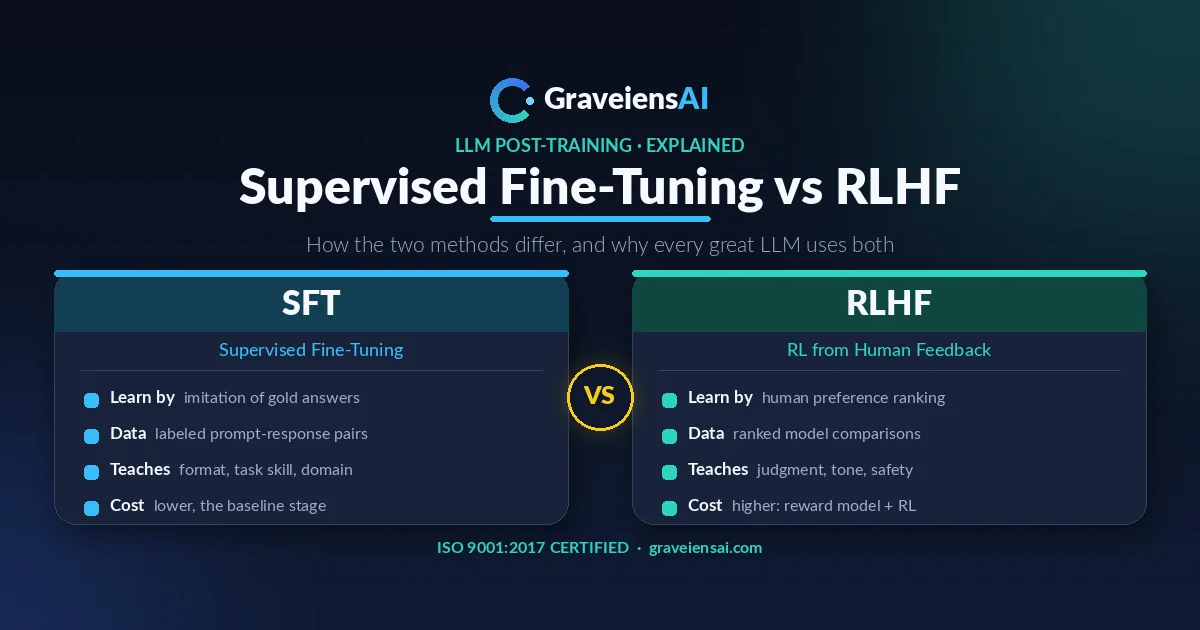
Supervised fine-tuning (SFT) teaches a language model to copy correct example answers from labeled prompt-response pairs, while RLHF (reinforcement learning from human feedback) teaches the same model to prefer better answers by learning from human preference rankings and a reward model. In the supervised fine tuning vs RLHF debate, they are not rivals. SFT builds the foundation and RLHF refines the behavior on top. Most production LLMs use both, in that order.
If you are trying to decide between supervised fine tuning vs RLHF for your own model, this guide is written for AI/ML engineers, product teams and data leads who need a clear, practical answer, not just theory. The supervised fine tuning vs RLHF question shows up in almost every LLM roadmap, so we break down what each method does, how the two compare, when to use which, and how the quality of your human data decides whether either one actually works.
Key takeaways
- SFT = imitation learning from curated, labeled demonstrations. It sets tone, format and task ability.
- RLHF = preference optimization using a reward model trained on human rankings. It aligns the model with what people actually prefer.
- Supervised fine tuning vs RLHF is a sequence, not a fight: pretraining, then SFT, then RLHF (or a lighter alternative like DPO).
- RLHF costs more. It needs preference data, a reward model and reinforcement learning, so it is roughly 3 to 10 times more expensive per iteration than SFT.
- Data quality decides the outcome. Both methods live or die on human-written demonstrations and well-judged preference labels.
Table of contents
- SFT meaning: what is SFT?
- What is RLHF?
- Supervised fine tuning vs RLHF at a glance
- How supervised fine-tuning works
- How RLHF works
- The 7 key differences
- When to use SFT vs RLHF
- Why modern LLMs use both
- Beyond RLHF: DPO, RLAIF and GRPO
- Data quality: the real deciding factor
- FAQs
SFT meaning: what is SFT?
SFT meaning: SFT stands for supervised fine-tuning, a training stage where a pretrained language model learns from labeled input-output pairs so it reproduces demonstrated behavior for a specific task, tone or domain. That is the short answer to what is SFT: it is supervised learning applied to an already-pretrained model.
So what is SFT doing in practice, and why does the SFT meaning matter before you weigh supervised fine tuning vs RLHF? A base model finishes pretraining knowing a lot about language but very little about how you want it to respond. During supervised fine-tuning, human experts write high-quality “ideal” answers to a set of prompts, and the model is trained with a standard next-token objective to match those answers. The SFT meaning most teams care about is simple: it turns a raw, general model into a helpful, instruction-following assistant.
If you remember one thing about the SFT meaning, make it this: SFT is imitation learning for language models. Typical uses of SFT include instruction tuning, domain adaptation (medical, legal, finance), style and format control, and teaching structured outputs like JSON. Because it only needs labeled demonstration data and conventional training, SFT is the fastest, cheapest and most predictable way to change model behavior, which is exactly why every serious pipeline starts here. Teams that need this foundation built correctly often lean on specialized LLM fine-tuning data services rather than scraping demonstrations together in-house.
The catch: supervised fine-tuning can only teach the model to imitate the answers it is shown. It cannot easily teach judgment between two decent answers, and it can drift into hallucination when a prompt falls outside the demonstration set. That limitation is the entire reason RLHF exists.
What is RLHF?
RLHF (reinforcement learning from human feedback) is a multi-stage alignment method that fine-tunes a language model using human preference judgments, so its outputs match what people actually prefer rather than just what a labeler wrote down. Where SFT asks “copy this answer,” RLHF asks “which of these answers is better, and why?”
RLHF became the technique behind ChatGPT, Claude and most leading assistants because it captures fuzzy, subjective qualities such as helpfulness, harmlessness, honesty and tone, which are almost impossible to specify with a single “correct” demonstration. Instead of one gold answer, human raters compare and rank multiple model responses, and that signal is distilled into a reward model that scores future outputs. High-quality RLHF and preference data is what makes this scoring reliable, and it is one of the hardest human-data problems to get right at scale.
The trade-off is complexity. RLHF adds two extra moving parts on top of supervised fine-tuning: a reward model and a reinforcement-learning loop. That means more compute, more data collection and more ways for training to go wrong. Understanding that added complexity is central to the supervised fine tuning vs RLHF decision.
Supervised fine tuning vs RLHF at a glance
Here is the side-by-side that most supervised fine tuning vs RLHF comparisons miss. It maps the two methods across the dimensions that actually affect your budget and results.
| Dimension | Supervised Fine-Tuning (SFT) | RLHF |
|---|---|---|
| Core idea | Imitate labeled example answers | Optimize toward human-preferred answers |
| Learning signal | Prompt-response pairs (demonstrations) | Preference rankings feed a reward model |
| Data type | Human-written “gold” answers | Human comparisons of model outputs |
| Training method | Standard supervised loss (next-token) | Reward modeling + RL (PPO, GRPO) |
| What it teaches | Format, task skill, domain knowledge | Judgment, nuance, safety, tone |
| Relative cost | Lower (baseline) | Higher (about 3–10x per iteration) |
| Main risk | Overfitting, hallucination outside data | Reward hacking, mode collapse, instability |
| Best for | Structured, domain-specific tasks | Open-ended, user-facing behavior |
| Pipeline role | First alignment stage | Refinement stage after SFT |
The honest summary of supervised fine-tuning versus RLHF: SFT gives you a capable model quickly; RLHF gives you a well-behaved model expensively. You almost always want the first before you attempt the second.
How supervised fine-tuning works
On the SFT side of supervised fine tuning vs RLHF, the process follows a clear, repeatable workflow. Getting each step right matters far more than the hyperparameters:
- Define the target behavior. Decide the tasks, tone, formats and edge cases the model must handle, and write the acceptance criteria before any data is created.
- Collect demonstration data. Subject-matter experts author high-quality prompt-response pairs, the “gold” answers. This is where accuracy is won or lost, and where an expert specialized workforce of STEM, medical, legal and finance reviewers earns its keep.
- Curate and QA the dataset. Remove duplicates, fix errors and balance the distribution so the model does not overfit to one answer style. Poor demonstrations quietly cap the ceiling of everything downstream, so this cleanup step deserves real time and expert eyes. Clean data validation at this stage prevents expensive retraining later.
- Fine-tune the base model. Train with a standard language-modeling objective, often using parameter-efficient methods like LoRA to cut cost.
- Evaluate and iterate. Test against held-out prompts, catch regressions, and refine the demonstration set.
The single biggest lever in SFT is not model size. It is the quality and diversity of the demonstrations. A few thousand carefully written examples routinely beat hundreds of thousands of noisy, scraped ones. That is why disciplined data annotation and labeling sits at the heart of every strong supervised fine-tuning program.
How RLHF works
RLHF is best understood as three stages that stack on top of a supervised-fine-tuned model:
Stage 1: SFT warm start. RLHF begins with a model that has already been through supervised fine-tuning. This is the clearest proof that supervised fine tuning vs RLHF is a sequence: RLHF literally starts where SFT ends.
Stage 2: Reward model training. Human raters are shown two or more model responses to the same prompt and rank them from best to worst. These comparisons train a separate reward model to predict human preference, effectively a learned scorer that can judge outputs the way people would. The reliability of this scorer depends entirely on consistent, well-calibrated preference labels, which is why rigorous LLM evaluation and rating rubrics matter so much.
Stage 3: Policy optimization. The language model (the “policy”) generates responses, the reward model scores them, and a reinforcement-learning algorithm such as PPO or GRPO nudges the model toward higher-reward behavior. A KL-divergence penalty keeps it from drifting too far from the original SFT model and “reward hacking” its way into gibberish.
Because RLHF depends on live generation, scoring and re-optimization, it is far more compute-intensive and unstable than supervised fine-tuning, but it is also the only stage that can reliably teach nuanced, human-aligned judgment. For conversational AI and other open-ended assistants, that judgment is the whole product.
The 7 key differences between SFT and RLHF
- Learning objective. SFT imitates a fixed target answer; RLHF optimizes a reward signal derived from human preferences.
- Data. SFT needs written demonstrations; RLHF needs comparative rankings of model outputs.
- What gets taught. SFT is great for skills and formats; RLHF is great for judgment, safety and tone.
- Cost and complexity. SFT is a single training run; RLHF adds a reward model plus an RL loop, multiplying cost and failure modes.
- Stability. SFT is predictable; RLHF can suffer reward hacking, instability and mode collapse without careful tuning.
- Ceiling. SFT is capped by the quality of its demonstrations; RLHF can, in principle, exceed any single human demonstration by combining many preferences.
- Pipeline position. SFT comes first and RLHF refines afterward, so you rarely do RLHF on a model that has not been supervised fine-tuned.
Keep these seven in mind and the supervised fine tuning vs RLHF choice stops feeling like a coin flip and starts feeling like a checklist.
When to use SFT vs RLHF
Framing the supervised fine tuning vs RLHF decision around your task type makes it far easier. Choose supervised fine-tuning when you have clear “right answers,” a structured or domain-specific task (classification, extraction, formatted generation), a limited budget, or you simply need a reliable baseline fast. For most enterprise NLP work, including much of applied natural language processing, well-executed SFT gets you 80% of the value at 20% of the cost.
Add RLHF when the task is open-ended and subjective, when tone, safety and helpfulness matter as much as correctness, or when users will push the model into territory your demonstrations never covered. Consumer-facing chat assistants, safety-critical support and brand-voice generation are classic RLHF territory.
A useful rule of thumb: if you can write the perfect answer, use SFT. If the best answer is “it depends, and humans know it when they see it,” you need RLHF (or a preference-based alternative). Teams unsure where their use case falls often start with a low-risk data pilot to test SFT quality before committing to a full RLHF program.
Why modern LLMs use both
The real answer to supervised fine tuning vs RLHF is “yes, both.” Nearly every frontier assistant is trained with the same recipe: pretraining for raw knowledge, supervised fine-tuning to make it follow instructions, then RLHF to align it with human preferences. Each stage fixes what the previous one cannot.
Supervised fine-tuning alone produces a model that is capable but sometimes tone-deaf, overconfident or unsafe at the edges. RLHF alone is impossible, because there is nothing sensible to optimize without an instruction-following starting point. Combine them and you get reliability and alignment. This staged approach is exactly why Graveiens AI structures its human-data pipelines around both SFT demonstrations and RLHF preference feedback, delivered through the same four-stage QA workflow our teams run on every program. You can see how that plays out on real engagements in our published case studies.
Beyond RLHF: DPO, RLAIF and GRPO
The preference-optimization landscape has moved fast, and any current supervised fine tuning vs RLHF discussion should mention the newer options that reduce RLHF’s cost and fragility:
- DPO (Direct Preference Optimization) skips the separate reward model and optimizes preference pairs directly against a reference policy. Fewer moving parts, lower compute and less room for reward hacking. It is increasingly the default “lightweight RLHF” for many teams.
- RLAIF (RL from AI Feedback) replaces some human rankings with AI-generated preferences to scale data collection, usually with a human-audited sample for calibration.
- GRPO (Group Relative Policy Optimization) is a more efficient RL algorithm popularized by recent reasoning models, reducing the overhead of classic PPO.
Two things stay constant no matter which method wins: every one of them still begins with a strong supervised-fine-tuned base, and every one of them still depends on high-quality human judgments somewhere in the loop. The algorithms change; the need for trustworthy human data does not.
Data quality: the real deciding factor
Here is the insight most supervised fine tuning vs RLHF articles bury: in the supervised fine tuning vs RLHF trade-off, the method matters less than the data feeding it. A mediocre algorithm on excellent human data beats a state-of-the-art algorithm on noisy labels almost every time.
Supervised fine-tuning is only as good as its demonstrations. If your “gold” answers are inconsistent, biased or written by non-experts, the model faithfully learns those flaws. RLHF is even more sensitive: if raters disagree on what “better” means, the reward model learns noise, and reinforcement learning will happily amplify that noise into confident, wrong behavior.
That is why serious teams invest in trained annotators, calibrated rating rubrics, inter-rater agreement checks and subject-matter experts for the hard prompts. Those are the same standards Graveiens AI applies across voice and speech data, annotation and preference feedback. Getting the data right is the difference between a model that impresses in a demo and one that holds up in production. If you want to see how a consent-first, ISO 9001:2017-certified process approaches this, the why choose us page walks through the quality controls, inter-rater checks and audit trails that keep both SFT and RLHF datasets trustworthy at scale.
Conclusion: SFT and RLHF are partners, not opponents
The supervised fine tuning vs RLHF question has a clear answer once you stop treating it as a competition. Supervised fine tuning vs RLHF is really a question of order and purpose, not either/or. Supervised fine-tuning builds a capable, instruction-following model from labeled demonstrations. RLHF refines that model’s judgment using human preferences and a reward model. Pretraining, SFT and RLHF form one pipeline, and the newer options (DPO, RLAIF, GRPO) are refinements of the same idea, not replacements for the foundation.
Whichever path you take, the deciding factor is the same: the quality of the human data behind it. Both supervised fine-tuning and RLHF collapse without accurate demonstrations and well-calibrated preference labels.
Ready to build models that actually behave? Graveiens AI delivers consent-backed, ISO 9001:2017-certified SFT demonstration data, RLHF preference feedback and expert LLM evaluation across 25+ languages, invoiced only on the work you approve. Book a low-risk pilot and see the difference expert human data makes.
FAQS for Fine-Tuning vs RLHF
What is the difference between supervised fine-tuning and RLHF ?
In the supervised fine tuning vs RLHF comparison, supervised fine-tuning trains a model to copy human-written example answers, while RLHF trains it to prefer better answers using human preference rankings and a reward model. SFT teaches skills and format; RLHF teaches judgment and alignment. Most production models use SFT first, then RLHF.
What does SFT stand for ?
SFT stands for supervised fine-tuning. So when someone asks what is SFT or wants the SFT meaning, it is the training stage where a pretrained language model learns from labeled prompt-response pairs so it reproduces demonstrated behavior for a specific task, tone or domain. It is the standard first step in aligning any large language model.
Is RLHF better than supervised fine-tuning ?
Neither is strictly better. They solve different problems. Supervised fine-tuning is cheaper, faster and ideal for structured tasks with clear right answers. RLHF is costlier but essential for open-ended, subjective behavior like helpfulness and safety. The best results come from using both in sequence.
Do you need SFT before RLHF?
Yes, in almost every case. RLHF starts from a supervised-fine-tuned model because reinforcement learning needs a competent, instruction-following policy to optimize. Skipping SFT leaves RLHF with nothing sensible to improve, which is why the standard pipeline is pretraining, then SFT, then RLHF.
How much more expensive is RLHF than SFT ?
RLHF is typically 3 to 10 times more expensive per iteration than supervised fine-tuning because it adds preference-data collection, reward-model training and a reinforcement-learning loop on top of the base fine-tune. Lightweight alternatives like DPO cut that cost by removing the separate reward model.
What is the meaning of SFT in machine learning ?
People asking what is SFT in a machine-learning context want the SFT meaning: supervised fine-tuning is adapting a pretrained model to a target task using labeled input-output examples and a standard supervised loss. It contrasts with unsupervised pretraining and with preference-based methods like RLHF and DPO.
Sources: Hugging Face: Fine-Tuning LLMs, SFT and Reward Modelling, Toloka: Direct Preference Optimization, Mercor: SFT vs RLHF.

Jitendra Choubay is the CEO & Founder of Graveiens AI, leading a human-in-the-loop data services team that helps AI builders with data collection, annotation, consent-backed voice data, transcription and LLM fine-tuning. He writes on building better, ethically sourced AI training data.
Get the next Graveiens AI article
Expert notes on AI data, annotation, LLMs and eLearning — no spam, unsubscribe anytime.
Need AI Development? Data Annotation? eLearning?
Talk to Graveiens AI about data collection, annotation, voice data, RLHF/SFT, LLM evaluation and AI training data — invoiced only on approved work.
Contact Graveiens AI