Data annotation outsourcing is the practice of hiring an external, specialized partner to label your raw data — images, text, audio, video, and sensor data — so it can train machine learning models. Instead of building an in-house labeling team, you delegate annotation to experts who supply trained annotators, tooling, and quality control at scale. Because roughly 80% of AI project time is spent preparing and labeling data (Cognilytica), outsourcing is how most teams ship models faster without diverting engineers into a labeling operation.
This guide explains what data annotation outsourcing is, when it makes sense, real data annotation examples by type, how image annotation outsourcing works, and exactly how to choose a partner that protects model quality.
What Is Data Annotation Outsourcing?
Data annotation is the process of adding labels to raw data so a machine learning model can learn from it — drawing a box around a car, marking the sentiment of a review, or transcribing a spoken sentence. Data annotation outsourcing means a third-party data annotation services provider performs that labeling for you, supplying the people, platforms, and processes required to turn unstructured data into accurate, model-ready training data.
A capable partner covers the full pipeline: sourcing or ingesting data, labeling it against your guidelines, running multi-stage quality validation, and delivering it in your required format (COCO JSON, Pascal VOC XML, YOLO, or a custom schema).
Why Companies Outsource Data Annotation
Labeling is deceptively hard to run internally. It needs domain-trained people, specialized tools, tight guidelines, and relentless QA — none of which is your core product. Teams outsource for five reasons:
- Speed to market. A managed team labels in parallel, compressing weeks of work into days.
- Cost control. You avoid hiring, training, tooling, and managing a full-time annotation team, converting fixed cost into scalable, per-project spend.
- Elastic scale. Volume in AI is spiky; an external annotation workforce flexes up for a data push and back down afterward.
- Specialized expertise. Medical imaging, LiDAR, and multilingual text each need trained specialists you rarely have on staff.
- Focus. Your engineers build models; your partner runs the labeling operation.
Key stat to quote: Cognilytica research found that data preparation and labeling consume about 80% of the time on a typical AI project — the single biggest reason annotation is outsourced.
Data Annotation Examples: The Main Types Explained
| Data type | Annotation example | Common use case |
|---|---|---|
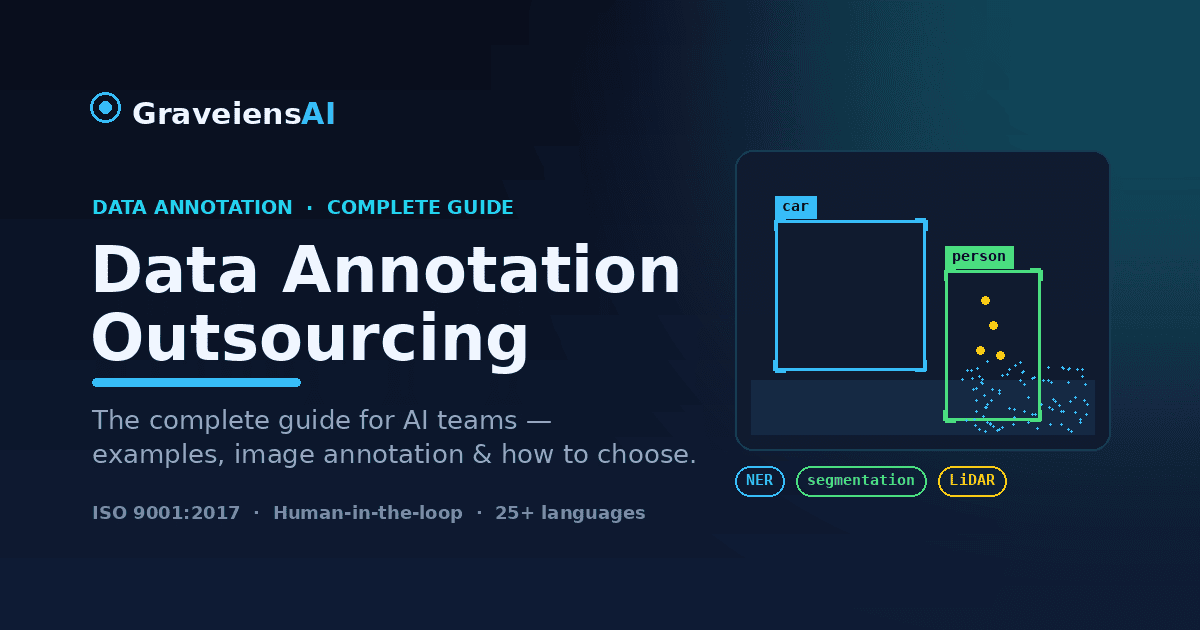
| Image | Bounding boxes around vehicles and pedestrians | Self-driving perception, retail shelf detection |
| Image | Semantic segmentation (pixel-level masks) | Medical imaging, satellite/geospatial mapping |
| Image | Polygon and keypoint annotation | Pose estimation, facial landmarks |
| 3D / sensor | Cuboids on LiDAR point clouds | Autonomous vehicles, robotics |
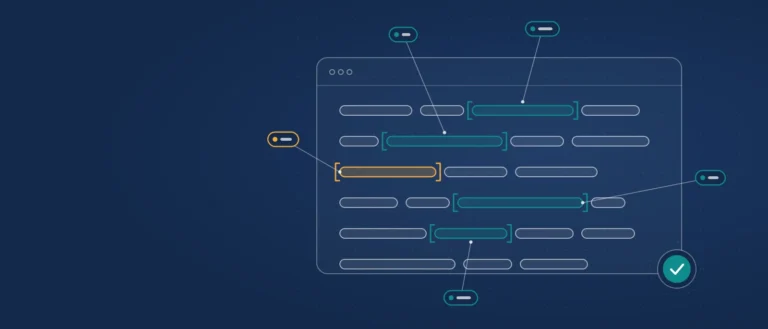
| Text | Named-entity recognition (tagging names, dates) | Search, chatbots, document AI |
| Text | Sentiment and intent labeling | Voice assistants, review analysis |
| Audio | Speech transcription and speaker tagging | Voice AI, call analytics |
| Video | Frame-by-frame object tracking | Sports analytics, surveillance, ADAS |
Image and Video Annotation
The largest category. It powers computer vision — from bounding boxes to pixel-perfect segmentation — and feeds driver-assistance systems built on ADAS and automotive perception stacks.
3D Point Cloud and Sensor Fusion
Autonomous systems combine cameras, radar, and LiDAR. Labeling this data — cuboids, tracking, and sensor fusion and LiDAR annotation — is a specialist discipline that is almost always outsourced.
Text and Language Annotation
NLP tasks such as entity tagging, classification, and multilingual labeling through language services train search, chatbots, and document-understanding models.
Audio and Conversational Data
Voice and speech labeling and transcription create the datasets behind conversational AI assistants.
LLM and Generative AI Data
Modern models also need human feedback: prompt-response labeling for LLM fine-tuning, model comparison for LLM evaluation, and preference data for generative AI alignment.
Image Annotation Outsourcing: A Closer Look
Image annotation outsourcing is hiring a specialized provider to label images for machine learning — drawing bounding boxes, creating segmentation masks, or marking keypoints — instead of doing it in-house. It is the most outsourced annotation category because image projects are high-volume, tool-heavy, and quality-sensitive.
A strong image annotation outsourcing engagement follows five steps:
- Define the task. Object classes, edge cases, and the exact output format (COCO JSON, Pascal VOC, YOLO).
- Write the guidelines. Clear rules and examples for how to handle occlusion, truncation, and ambiguity.
- Run a pilot. A small labeled batch to calibrate quality before scaling.
- Scale with QA. Full production with layered review and consensus checks.
- Deliver and iterate. Model-ready data, plus feedback loops to refine guidelines.
Because image labeling drives safety-critical systems, quality is non-negotiable — which is why mature providers run independent data validation on every batch rather than trusting a single pass.
In-House vs Outsourced Data Annotation
| Factor | In-house team | Data annotation outsourcing |
|---|---|---|
| Setup time | Weeks to months (hire, train, tool) | Days |
| Cost model | Fixed salaries and overhead | Variable, per-project |
| Scalability | Slow to flex | Elastic, on demand |
| Specialist skills | Limited to who you hire | Access to trained domain experts |
| Focus | Diverts engineers | Keeps your team on the model |
| Best for | Small, sensitive, continuous work | High-volume, spiky, or specialized work |
Many teams run a hybrid: a small internal team owns guidelines and edge cases, while an outsourcing partner handles volume. This keeps control where it matters and scale where it counts.
How to Choose a Data Annotation Outsourcing Partner
Not all providers are equal. Evaluate on:
- Quality systems, not quality claims. Ask how they measure accuracy — consensus scoring, gold-standard tasks, multi-tier review — and what their target and reported accuracy actually are.
- Domain expertise. A healthcare imaging project needs clinically trained annotators; a retail and e‑commerce catalog project does not. Match the vendor to your field.
- Security and compliance. Data handling, access controls, and privacy posture — essential for banking and finance and medical data.
- Workforce model. Is the annotation workforce trained, managed, and retained, or gig labor rotating through your project?
- Tooling and formats. Confirm they deliver in your exact schema and integrate with your ML pipeline.
- A transparent process. Reputable partners publish their annotation process and share case studies with real outcomes.
Data Annotation Pricing Models
Outsourcing is usually priced one of three ways:
- Per object / per label — you pay for each box, mask, or tag. Predictable for well-defined image work.
- Per hour — suited to complex, judgment-heavy, or research tasks.
- Managed project / dedicated team — a reserved team for ongoing pipelines, priced monthly.
The right model depends on volume and complexity. High-volume, well-specified image annotation outsourcing favors per-object pricing; evolving LLM and research work favors hourly or dedicated teams.
Challenges and How Good Partners Solve Them
Balanced content ranks better, so here is the honest picture:
- Quality drift. Guidelines get interpreted loosely at scale. Fix: gold-standard tasks, consensus review, and continuous auditing.
- Communication gaps. Remote teams can misread intent. Fix: a pilot batch, living guideline docs, and a dedicated project lead.
- Data security risk. Fix: NDAs, access controls, secure environments, and compliance certifications.
- Hidden edge cases. Real-world data is messy. Fix: an escalation path and feedback loops that refine rules as new cases appear.
The difference between a cheap vendor and a real partner is whether these are designed in from day one.
Frequently Asked Questions on data annotation
What is data annotation outsourcing?
Data annotation outsourcing is hiring an external specialist to label your raw data — images, text, audio, video, or sensor data — for machine learning. The partner supplies trained annotators, tools, and quality control, so your team can focus on building models instead of running a labeling operation.
What are some common data annotation examples?
Common data annotation examples include bounding boxes around objects in images, pixel-level semantic segmentation, cuboids on LiDAR point clouds, named-entity recognition in text, sentiment labeling, speech transcription, and frame-by-frame object tracking in video. Each trains a different type of AI model.
How much does data annotation outsourcing cost?
Pricing follows three models: per object or label (best for well-defined image work), per hour (for complex tasks), or a managed dedicated team (for ongoing pipelines). Cost depends on data type, annotation complexity, quality requirements, and volume, so most providers quote after a pilot.
Is image annotation outsourcing safe for sensitive data?
Yes, with the right partner. Look for NDAs, role-based access controls, secure labeling environments, and compliance with relevant standards. For medical or financial images, confirm the provider has domain-specific security practices before sharing data.
Should I build an in-house team or outsource annotation?
Outsource when volume is high, spiky, or specialized, and speed matters. Keep a small in-house team when work is continuous, highly sensitive, or tightly coupled to model development. Many teams use a hybrid: in-house owns guidelines, an outsourcing partner handles scale.
How do I ensure annotation quality when outsourcing?
Insist on measurable quality systems: gold-standard tasks, consensus scoring, multi-tier review, and reported accuracy targets. Start with a pilot batch, keep guidelines living and specific, and choose a partner that runs independent validation on every delivery.
Conclusion
Data annotation outsourcing lets AI teams move fast without turning into a labeling company. By delegating image, text, audio, and sensor labeling to a specialized partner — with real quality systems and domain expertise — you get model-ready data at scale while your engineers stay focused on models. If you are scoping a project, start with a pilot, insist on measurable quality, and match the partner to your domain.
Ready to see it in practice? Explore our data annotation services, learn why teams choose Graveiens AI, or talk to our team about a pilot for your dataset.

Jitendra Choubay is the CEO & Founder of Graveiens AI, leading a human-in-the-loop data services team that helps AI builders with data collection, annotation, consent-backed voice data, transcription and LLM fine-tuning. He writes on building better, ethically sourced AI training data.
Get the next Graveiens AI article
Expert notes on AI data, annotation, LLMs and eLearning — no spam, unsubscribe anytime.
Need AI Development? Data Annotation? eLearning?
Talk to Graveiens AI about data collection, annotation, voice data, RLHF/SFT, LLM evaluation and AI training data — invoiced only on approved work.
Contact Graveiens AI