What Is Artificial Intelligence?
Artificial intelligence (AI) is the branch of computer science that builds machines and software able to perform tasks that normally require human intelligence, such as understanding language, recognizing images, making decisions, and learning from experience. When people ask what artificial intelligence is, the simplest answer is that it is software that learns patterns from data instead of following fixed, hand-written rules, and gets better as it processes more examples.
In short: artificial intelligence is software that learns from data to make predictions, generate content, or take actions without being explicitly programmed for every situation. The quality of that artificial intelligence depends almost entirely on the quality of the data behind it.
How Does Artificial Intelligence Work?
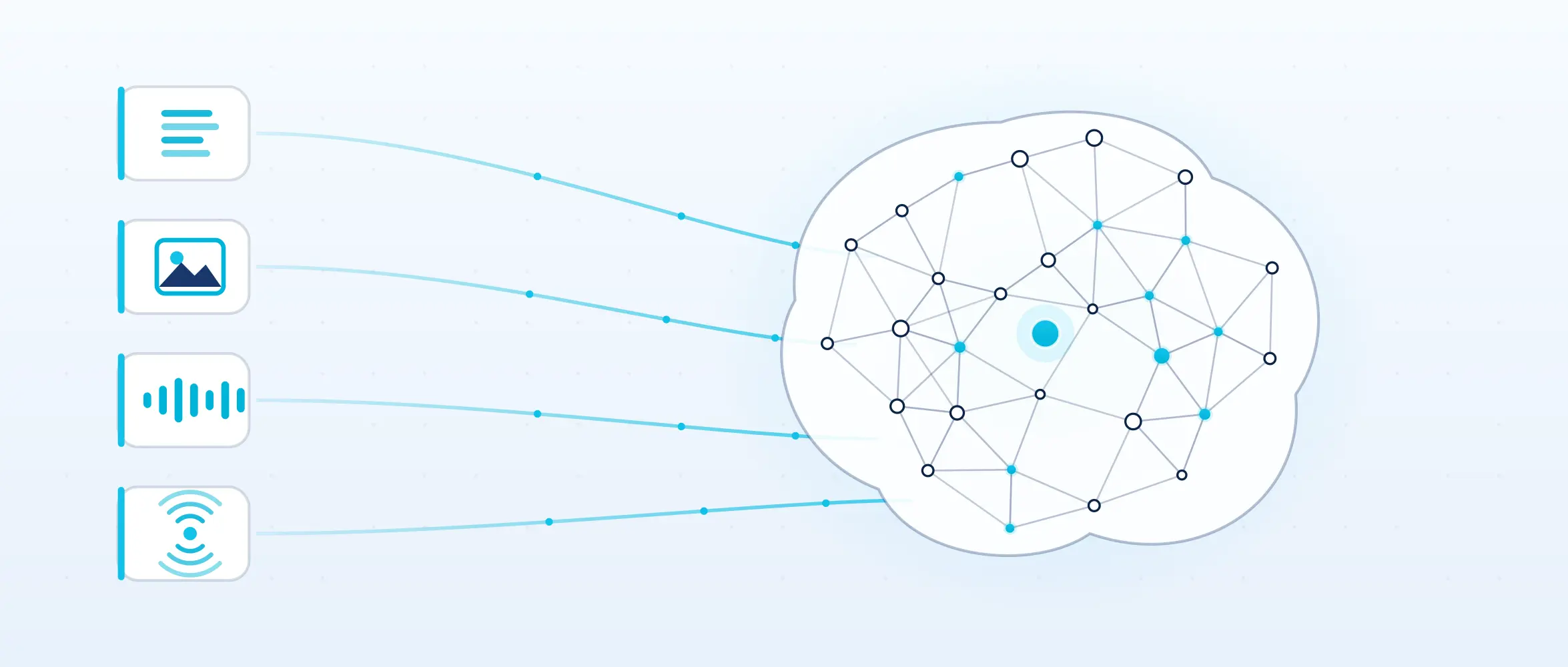
Every artificial intelligence system rests on three things: data, a model, and training. Data is the raw material, the text, images, audio, video, or sensor readings that describe the world. A model is a mathematical structure that searches for patterns in that data, and training is the process of showing the model many labelled examples so it can adjust itself until its predictions are accurate. In other words, an artificial intelligence model is only ever as capable as the examples it is trained on.
This is why data preparation matters more than most people expect. Before a model can learn, raw information has to be gathered through careful data collection and then made machine-readable through data annotation and labeling, where trained people mark objects, intent, sentiment, or boundaries so the model understands what it is looking at. Clean, well-labeled data is the difference between a model that performs in production and one that fails in front of real users.
What Are the Different Types of AI?
There are two common ways to answer the question of what are the different types of AI. The first way to group what are the different types of AI is by capability, and the second is by how the technology functions in practice. Knowing what are the different types of AI also makes it easier to choose the right data and approach for each project.
Types of AI by capability
Artificial Narrow AI (ANI) is built for a single task, such as spam filtering, product recommendations, or speech recognition, and almost every AI in use today is narrow AI. Artificial General AI (AGI) would match human reasoning across any task and does not yet exist. Artificial Super AI (ASI) describes a hypothetical system that surpasses human intelligence, which remains a research topic rather than a product. Understanding what are the different types of AI by capability helps teams set realistic expectations for any project.
Types of AI by function
By function, researchers describe four stages. Reactive machines respond only to the present input, limited-memory systems learn from recent data, theory-of-mind AI would understand emotions and intentions, and self-aware AI would have consciousness. Mapping what are the different types of AI by function shows how far today’s systems, which sit firmly in the first two stages, still are from science-fiction ideas of AI.
Core AI techniques you will hear about
Underneath these categories are the techniques that make artificial intelligence useful. Machine learning and deep learning let systems learn from data at scale. Natural language processing helps machines read and write human language, while computer vision lets them interpret images and video. Generative AI creates new text, images, and code and powers the conversational AI assistants that people now use every day. Together, these techniques cut across what are the different types of AI, turning abstract categories into working products.
How AI, Data Science, and Data Integration Fit Together
Artificial intelligence and data science are closely linked but not identical. Data science is the discipline of extracting insight from data using statistics, programming, and domain knowledge, and this AI data science overlap is where most modelling work happens. Artificial intelligence is what happens when those data science methods are used to build systems that predict, decide, or generate on their own. In practice, an AI data science workflow moves from raw data to cleaned datasets to trained models to monitored predictions.
The harder problem is often AI data integration, which means bringing together information from many sources so a model sees one consistent view of the world. A single project may combine audio transcription for speech models, consent-backed voice and speech data in multiple languages, and structured records from business systems. Strong AI data integration ensures each stream is cleaned, aligned, and checked through rigorous data validation before it can be trusted for training.
AI in Industrial Automation
One of the fastest-growing applications of artificial intelligence is AI in industrial automation, where factories use machine learning to run smarter, safer and more efficient operations. AI in industrial automation replaces fixed programming with systems that adapt to the real conditions they see on the production line. The most common uses of AI in industrial automation include:
- Predictive maintenance: models read sensor data to predict equipment failure before it happens, cutting unplanned downtime.
- Visual quality inspection: computer vision spots defects on the line faster and more consistently than manual checks.
- Robotics and guided vehicles: robots use perception to pick, place, and navigate safely around people.
- Process optimization: the system tunes temperature, speed, and energy use in real time to reduce waste.
Every one of these AI in industrial automation use cases depends on large amounts of labelled sensor and perception data. Depth-accurate 3D point cloud and LiDAR annotation teach machines to understand physical space, and the same perception skills that power AI in industrial automation carry over to ADAS and autonomous systems in vehicles. The pattern is consistent: better AI in industrial automation starts with better training data.
Why High-Quality Human Data Is the Foundation of Good AI
Across every type of artificial intelligence, one truth holds true: a model is only as good as the data it learns from. Large language models are aligned to human preferences through LLM fine-tuning with RLHF and SFT, and their outputs are measured through structured LLM evaluation by qualified reviewers. Without expert human judgement in the loop, even the most advanced model can drift, hallucinate, or misread context.
This is the work of Graveiens AI every day. Our specialized workforce of subject-matter experts, annotators, and voice artists produces model-ready data through a measured, four-stage QA process, and you are invoiced only for the deliverables you approve. If you are building or fine-tuning a model, you can book a low-risk pilot and see the quality on your own data before you commit to a full artificial intelligence program.
FAQs on What Is Artificial Intelligence
What is artificial intelligence in simple terms?
Artificial intelligence is software that learns from data to perform tasks that usually need human intelligence, such as understanding language, recognising images or making decisions. Modern AI improves as it processes more examples, instead of being programmed with fixed rules for every case.
What are the four main types of AI?
By function, the four types of AI are reactive machines, limited-memory systems, theory-of-mind AI and self-aware AI. By capability, AI is grouped as narrow AI, general AI and super AI. Nearly all AI in use today is narrow, limited-memory AI.
What is the difference between AI and machine learning?
AI is the broad goal of building intelligent systems. Machine learning is one method for achieving it, where models learn patterns from data rather than following hand-written rules. Deep learning is a further subset of machine learning that uses neural networks.
How is AI used in industrial automation?
In industrial automation, AI powers predictive maintenance, visual quality inspection, robotics and real-time process optimisation. These systems read sensor and camera data to make factories safer, reduce downtime and improve product quality.
How are AI and data science related?
Data science extracts insight from data using statistics and programming, while AI uses those methods to build systems that predict, decide or generate on their own. Most AI projects rely on a data science workflow to prepare and integrate data before training.
Why is data quality so important for AI?
AI models learn directly from their training data, so any errors, bias or gaps in that data show up in the model’s behaviour. High-quality collection, annotation an
What data do you need to build an AI model?
Most models need large, well-labelled datasets that match the task: images and video for vision, audio for speech, and text for language models. The data must be accurately annotated, consent-backed where required, and validated for quality before training begins.
Conclusion
Artificial intelligence has moved from research labs into everyday products, factories and services, but the intelligence still comes from data shaped by people. Understanding the different types of AI, how it connects to data science, and where it drives real value such as industrial automation makes it far easier to plan your own AI projects with confidence. And when you are ready to build, the fastest route to a reliable model is high-quality, human-in-the-loop training data.

Jitendra Choubay is the CEO & Founder of Graveiens AI, leading a human-in-the-loop data services team that helps AI builders with data collection, annotation, consent-backed voice data, transcription and LLM fine-tuning. He writes on building better, ethically sourced AI training data.
Get the next Graveiens AI article
Expert notes on AI data, annotation, LLMs and eLearning — no spam, unsubscribe anytime.
Need AI Development? Data Annotation? eLearning?
Talk to Graveiens AI about data collection, annotation, voice data, RLHF/SFT, LLM evaluation and AI training data — invoiced only on approved work.
Contact Graveiens AI