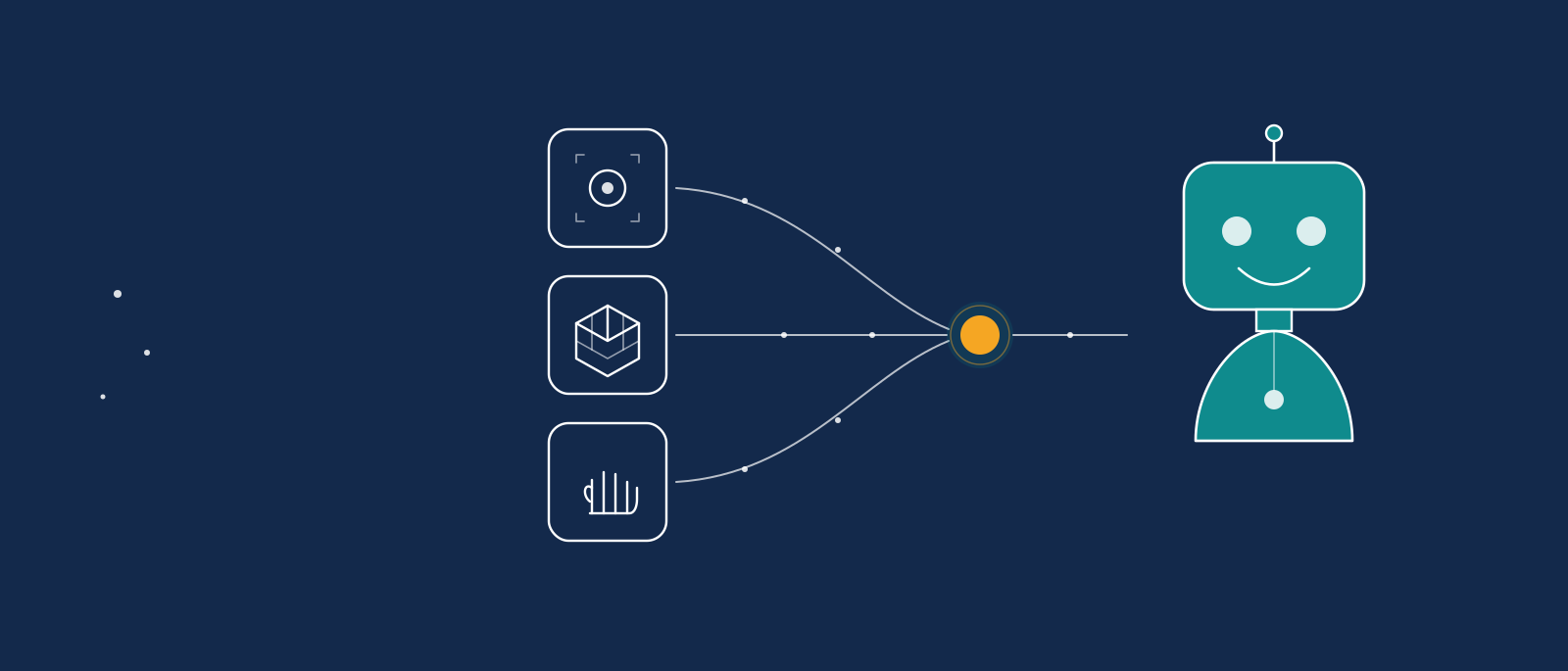
Robots learn by turning examples and experience into a policy, a mathematical model that maps what a robot senses to the action it should take next. They do not memorize fixed instructions the way older factory machines did. Instead, modern robots are trained on large amounts of data. That data can be collected from the real world, generated in a simulator, or demonstrated by people, for example through egocentric video data collection, where a person records a task from their own point of view. The robot improves as that data grows in size and quality.
In plain terms, learning gives a robot a habit for a task instead of a rulebook. This guide explains how robots learn in simple language, compares the main robot learning methods used today, and shows where each one fits. It is written for founders, product leads, and data teams at robotics and embodied AI companies who need to decide how to teach a robot a new skill and what data that will require. You will get a decision framework, a side by side comparison, worked examples, an implementation checklist, and answers to the questions people ask most.
Key takeaways
| Question | Short answer |
|---|---|
| How do robots learn? | They convert demonstrations, simulated trials, or real trial and error into a policy that maps sensor input to actions. |
| What are the main robot learning methods? | Classical programming, reinforcement learning, imitation learning, simulation and sim-to-real transfer, teleoperation, and learning from egocentric human video. |
| Which method is best? | It depends on task complexity, data availability, and the cost of failure. Most production systems blend several. |
| Why does data matter so much? | A policy is only as good as its training data, which is why AI data labeling and annotation and clean demonstrations drive results. |
| What is egocentric video used for? | First person footage teaches robots hand movements, gaze, and task order that third person cameras miss. |
| How long does training take? | Anywhere from days to many months, depending on task horizon, safety limits, and how much quality data exists. |
Table of contents
- What does it mean for a robot to learn?
- Why how robots learn matters now
- The main robot learning methods
- Robot learning methods compared
- How do robots learn, step by step
- The TEACH scorecard for choosing a method
- Real and illustrative examples
- What robot training costs, and where the money goes
- Common mistakes teams make
- Best practices for teaching a robot
- Frequently asked questions
- About GravEiens AI
- Conclusion
- Sources
What does it mean for a robot to learn?
For a robot, learning means improving its behavior on a task using data rather than hand written rules. NVIDIA defines robot learning as “a collection of algorithms and methodologies that help a robot learn new skills such as manipulation, locomotion, and classification in either a simulated or real world environment.”
The output of learning is a policy. Sensors such as cameras, force sensors, and joint encoders feed information in. A neural network processes that information. The policy then decides what the motors should do. When the robot practices, sees more demonstrations, or gets feedback on whether an action succeeded, the policy updates so the next attempt is a little better.
This is why the same underlying question, how do robots learn, produces different answers depending on the task. A robot arm that sorts parcels, a legged robot that walks over gravel, and a home assistant that folds laundry all learn a policy, but they are trained on very different data.
Why how robots learn matters now
Two shifts have made robot learning a practical business topic rather than a lab curiosity.
First, the field moved from narrow scripting to general models. Vision language action models, which take in images and instructions and output motor commands, let a single model handle many tasks instead of one program per task. That raises the value of broad, diverse training data.
Second, the bottleneck moved from algorithms to data. High quality demonstrations, well labeled scenes, and realistic simulation now decide who ships a working robot. This shift has turned robotics teaching from a scripting exercise into a data problem, and teams that once argued about model architecture now compete on how they collect and clean data. For most companies, deciding how to teach a robot is really a decision about what data to gather and how to label it.
The main robot learning methods
There is no single way robots learn. Six approaches dominate real systems, and most products combine them.
Classical programming. An engineer writes explicit rules and motion paths. This is precise and predictable, but it does not adapt when the environment changes. It still runs many industrial arms doing repeatable tasks.
Reinforcement learning. The robot learns by trial and error, guided by a reward that scores each action. Think of it as practice with a scorekeeper: good moves earn points, bad moves lose them, and over many attempts the robot keeps what scores well. Reinforcement learning can learn a task from scratch, but research reviews note it “requires extensive data and trials,” which makes raw real world trial and error slow and risky for physical arms.
Imitation learning. The robot copies expert demonstrations instead of starting blind. It is closer to learning by watching a teacher than to trial and error. Because it starts from good behavior, imitation learning is far more sample efficient, meaning it needs far fewer examples than pure reinforcement learning. Common variants include behavior cloning, inverse reinforcement learning, and generative adversarial imitation learning.
Simulation and sim-to-real transfer. The robot practices thousands of times in a physics simulator, then transfers the learned policy to a real machine. Simulation-based robot training is fast, safe, and cheap to scale, since many virtual robots can train at once and engineers can add noise and variation on demand. The challenge is the reality gap, the difference between simulated and real physics.
Teleoperation. A person remotely controls the robot to perform a task while the system records the sensor and action stream. Teleoperation produces clean, robot ready demonstrations in the exact body the robot will use, which makes it a favorite source of imitation learning data.
Learning from egocentric human video. The robot learns from first person footage of people doing tasks, captured with head mounted or glasses mounted cameras. This egocentric view naturally records hands, gaze, and the order of steps, and it scales far faster than robot demonstrations because ordinary people can record it.
Robot learning methods compared
No method wins everywhere. The right choice depends on task complexity, how much data you can get, and how costly a failed attempt is.
| Method | Best for | Strengths | Limitations | Data needed | When to choose |
|---|---|---|---|---|---|
| Classical programming | Fixed, repeatable tasks | Precise, predictable, no training data | Brittle when the scene changes | None, just engineering time | Structured factory tasks with little variation |
| Reinforcement learning | Locomotion, control, hard to script skills | Can learn from scratch, finds novel strategies | Sample hungry, unsafe to train raw on hardware | Reward signal plus many trials | Tasks easy to score but hard to demonstrate |
| Imitation learning | Manipulation and dexterous tasks | Sample efficient, learns human-like behavior | Only as good as the demonstrations | Clean expert demonstrations | You can show the task better than you can score it |
| Simulation and sim-to-real | Locomotion, early skill training | Fast, safe, cheap to scale, easy to vary | Reality gap needs domain randomization | 3D assets, physics setup, randomization | You need volume and safety before touching hardware |
| Teleoperation | Collecting manipulation data | Clean, robot-native demonstrations | Slow and costly per hour, needs operators | Human operated robot sessions | You need high fidelity demonstrations in the target embodiment |
| Egocentric human video | Scaling manipulation data | Scales fast, captures hands and gaze, low cost per hour | Human to robot gap, needs careful annotation | First person video plus labels | You need diverse demonstrations at scale beyond the lab |
For most teams, the practical answer is a blend. Pretrain broad behavior in simulation or on egocentric human video, then fine tune with a smaller set of high quality teleoperation demonstrations on the real robot.
How do robots learn, step by step
Under the hood, most modern robotics teaching follows the same loop, whatever the method.
- Collect data, whether demonstrations, simulated rollouts, or real trials.
- Clean and label the data through AI data labeling and annotation so actions, objects, and outcomes are marked correctly. This is the step where a raw video becomes a teachable example.
- Train a policy, a neural network that maps sensor input to actions.
- Evaluate the policy in simulation or on a small set of real tasks.
- Identify failures, then collect more data that targets those specific failures.
- Retrain and repeat until performance is stable.
- Deploy, monitor, and keep collecting edge cases for the next update.
The pattern that separates fast teams from slow ones is step 5. Learning speeds up when new data is aimed at the exact situations where the robot fails, not just more of the same easy examples.
The TEACH scorecard for choosing a method
Deciding how to teach a robot gets easier when you score the task first. The TEACH scorecard rates a task across five dimensions from 1 to 5, then points to the method that usually fits. It is a starting point for a decision, not a guarantee, and you can reuse it for any new skill.
| Letter | Dimension | Score 1 means | Score 5 means |
|---|---|---|---|
| T | Task dexterity | Simple, repeatable motion | Fine, contact-rich manipulation |
| E | Environment variability | Fixed, controlled scene | Open, unpredictable world |
| A | Availability of demonstrations | Easy to record many | Hard to demonstrate at all |
| C | Cost and risk of real trial and error | Cheap and safe to fail | Expensive or dangerous to fail |
| H | Horizon and deployment pressure | Short task, flexible timeline | Long task, tight timeline |
How to read your scores:
- Low T and low E, total under 10: classical programming is often enough.
- High C with a clear reward: lean on simulation-based robot training before touching hardware.
- High T with low A: use imitation learning, and source demonstrations from teleoperation or egocentric human video.
- High E across the board: prioritize data diversity, since no single clean dataset will cover an open world.
- High T and high E together: plan a blended pipeline, pretraining on scalable video and fine tuning on real demonstrations.
The scorecard turns a vague question, how do robots learn this task, into a short list of methods and, just as important, a clear data plan.
Real and illustrative examples
Ego4D, a large first person dataset (real). A consortium led by Meta AI and universities released Ego4D, more than 3,600 hours of first person video of everyday activities from hundreds of participants around the world. Datasets like this give robot learning models the broad, diverse human behavior that lab collected robot data cannot match on its own.
EgoMimic, human video that beats extra robot data (real). Researchers from Georgia Tech and Stanford built EgoMimic, a framework that scales manipulation using egocentric human demonstrations recorded with Project Aria glasses. They report that a policy trained on 2 hours of robot data plus 1 hour of human video outperformed one trained on 3 hours of robot data, and concluded that “scaling 1 hour of additional hand data is significantly more valuable than 1 hour of additional robot data.” This is a strong signal for why egocentric video is becoming standard.
Sim-to-real locomotion with Isaac Lab (real tool). Simulation frameworks such as NVIDIA Isaac Lab let engineers train legged and wheeled robots across thousands of randomized virtual environments, then transfer the policy to hardware. Domain randomization, varying friction, lighting, and mass, helps the policy survive the reality gap.
A warehouse pick and place startup (illustrative). Imagine a team teaching an arm to pick mixed parcels. Scoring the task on the TEACH scorecard gives high dexterity, high variability, and moderate demonstration availability. The illustrative plan: pretrain grasping in simulation, add a few hundred egocentric human video demonstrations of people sorting parcels, then fine tune with teleoperation on the real arm. The numbers here are hypothetical, used only to show how the framework guides a data plan.
What robot training costs, and where the money goes
Robot learning cost is mostly data cost, not compute cost. A useful way to estimate a data collection budget is to break it into parts rather than guess a single number.
Total data cost is roughly the sum of collection cost, which is hours or sessions times a per unit rate, plus annotation cost for labeling those hours, plus quality review cost, plus tooling and storage, plus program management. Real world collection and teleoperation cost more per hour because they need operators and hardware, while egocentric human video usually costs less per hour and scales faster.
Treat any single price you see as a starting point, not a market rate. Actual figures depend on task complexity, label density, language and location, and quality bar, so a real quote should come from a scoped pilot rather than a rule of thumb. GravEiens AI, for example, uses a pay-for-accepted-hours model, where footage that fails quality review is the vendor’s cost, which keeps the client’s spend tied to usable data.
Common mistakes teams make
Collecting volume before defining quality. Teams gather thousands of hours, then discover the demonstrations are inconsistent. It happens because collection feels like progress. It matters because a policy inherits every flaw in its data. Prevent it by writing a labeling rubric and a quality bar before collection starts.
Ignoring the human to robot gap. Human video is powerful, but hands are not grippers. Teams that skip alignment get policies that copy motions the robot cannot perform. Prevent it by pairing human data with some in-embodiment demonstrations and by planning for the gap during annotation.
Over trusting simulation. A policy that scores perfectly in a simulator can fail on real hardware because the physics differ. Prevent it with domain randomization and a small but honest set of real world evaluations before you trust any number.
Underspending on annotation. Cheap or rushed AI data labeling and annotation produces mislabeled actions and boundaries, which quietly cap model performance. Prevent it with layered review and clear acceptance criteria.
Best practices for teaching a robot
- Define the task and a measurable success criterion before collecting anything.
- Score the task with the TEACH scorecard to pick a method and a data plan.
- Start in simulation when failure on hardware is costly or unsafe.
- Use imitation learning from teleoperation or egocentric human video for dexterous tasks.
- Write a labeling rubric and quality bar, then hold every batch to it.
- Target new data at real failures, not just more easy examples.
- Keep a fixed evaluation set so you can tell whether the policy is truly improving.
- Plan for continuous collection, since deployment always reveals new edge cases.
Frequently asked questions
How do robots learn new tasks? Robots learn new tasks by training a policy on data. That data can be human demonstrations, simulated practice, or real trial and error. The policy maps what the robot senses to the action it takes, and it improves as the robot sees more high quality, well labeled examples of the task.
What is the difference between reinforcement learning and imitation learning? Reinforcement learning teaches a robot through trial and error using a reward that scores actions, so it can learn without a teacher but needs many trials. Imitation learning teaches a robot by copying expert demonstrations, which is far more sample efficient. Many systems combine both, imitating first and refining with reinforcement.
Can robots learn on their own? Robots can improve on their own within limits, mainly through reinforcement learning, where they practice and optimize against a reward. They still depend on humans to define the task, design the reward, provide demonstrations, and set safety limits. Fully autonomous open ended learning in the physical world remains a research problem.
Why is egocentric video used to train robots? Egocentric video, recorded from a person’s point of view, naturally captures hands, gaze, and the sequence of steps in a task, which third person cameras miss. It also scales quickly because ordinary people can record it in real settings. That combination makes it a fast, diverse source of demonstrations for imitation learning.
What is sim-to-real transfer? Sim-to-real transfer means training a robot policy in a physics simulator, then deploying it on real hardware. It is fast, safe, and cheap to scale. The main challenge is the reality gap, and engineers close it with domain randomization, varying physics and appearance in simulation so the policy generalizes to the real world.
How much data does it take to teach a robot a skill? It varies widely. A simple, low variability task might need a few hundred clean demonstrations, while a dexterous task in an open environment can need thousands of hours across simulation, human video, and real robot data. Quality and diversity of data usually matter more than raw volume.
Is teleoperation still needed if human video works? Yes, in most pipelines. Teleoperation produces clean demonstrations in the exact robot body, which reduces the human to robot gap and is ideal for fine tuning. Egocentric human video scales faster and adds diversity. Strong systems use both, video for breadth and teleoperation for precision.
How long does it take to train a robot? Training time ranges from days to many months. Simulation can generate large amounts of practice quickly, but collecting and labeling real demonstrations, closing the reality gap, and hardening the policy against edge cases take the most calendar time. Continuous collection after deployment extends the timeline indefinitely.
Does AI data labeling and annotation really change results? Yes. A policy inherits the quality of its labels. Inconsistent action boundaries, mislabeled objects, or missed steps quietly cap how well a robot can learn. Careful AI data labeling and annotation, with a rubric and layered review, is one of the highest leverage investments in a robot learning program.
About GravEiens AI
This article was produced by the GravEiens AI Editorial Team and reviewed by GravEiens AI Data Operations. GravEiens AI is an AI data services provider working across data collection, AI data labeling and annotation, voice and speech data, and model evaluation for robotics and embodied AI teams. The company operates a managed, consent-first pipeline and holds ISO 9001:2017 certification for its data operations. Learn more on the GravEiens AI about page or review the data operations process.
Conclusion
So, how do robots learn? They turn data into a policy, then improve that policy through demonstration, simulation, and feedback. The six robot learning methods, classical programming, reinforcement learning, imitation learning, simulation-based robot training, teleoperation, and egocentric human video, each win under different conditions, and most real products blend them. The practical decision is less about the model and more about the data, which is why a clear method choice and a strong data plan matter more than any single algorithm. Score your task with the TEACH scorecard, choose a method, and build the data pipeline it needs.
If your next step is teaching a robot from real human demonstrations, GravEiens AI runs managed, consent-first egocentric video data collection across diverse real world environments, with QA-reviewed, metadata-tagged footage and a pay-for-accepted-hours model. Book a pilot to scope a dataset for your task.
Also read:
- What is egocentric video? A complete guide
- Data collection services for AI and robotics
- Data annotation and labeling services
Sources
- NVIDIA, What Is Robot Learning? glossary definition and methods
- Xiao et al., Learning for a Robot: Deep Reinforcement Learning, Imitation Learning, Transfer Learning, PMC, on method differences and reinforcement learning sample cost
- Grauman et al., Ego4D: Around the World in 3,000 Hours of Egocentric Video, Ego4D consortium and dataset scale
- Kareer et al., EgoMimic: Scaling Imitation Learning via Egocentric Video, human video data efficiency and Project Aria
- NVIDIA, Isaac Lab, simulation framework for sim-to-real robot learning

Jitendra Choubay is the CEO & Founder of Graveiens AI, leading a human-in-the-loop data services team that helps AI builders with data collection, annotation, consent-backed voice data, transcription and LLM fine-tuning. He writes on building better, ethically sourced AI training data.
Get the next Graveiens AI article
Expert notes on AI data, annotation, LLMs and eLearning — no spam, unsubscribe anytime.
Need AI Development? Data Annotation? eLearning?
Talk to Graveiens AI about data collection, annotation, voice data, RLHF/SFT, LLM evaluation and AI training data — invoiced only on approved work.
Contact Graveiens AI